

10 Best Employer of Record in India: Reviewed in 2026

10 Best Indian Employer of Record Service Shortlist


The best Employer of Record (EOR) services in India help you hire and manage local talent smoothly—without needing to set up a legal entity or navigate complex employment regulations yourself.
India’s employment laws, tax requirements, and compliance rules can be difficult to navigate from abroad, especially if you’re unfamiliar with local practices. A reliable EOR partner assumes legal employer responsibility and handles payroll, contracts, social security contributions, and compliance on your behalf—making global expansion simpler and more secure.
Drawing on extensive research into global HR and staffing solutions, I’ve curated a list of top EOR providers for India. In this guide, you’ll find trusted services that streamline hiring, ensure compliance, and help you scale your workforce internationally with confidence.
Why Trust Our Software Recommendations
Our team has been testing and reviewing software since 2012. As HR experts ourselves, we know how difficult—and important—it is to choose the right software.
For this guide, we evaluated tools using hands-on testing and independent research, scoring tools using our selection criteria. We also draw on insights from industry thought leaders and practicing HR experts.
Our reviews reflect our human editorial judgment, not a sales pitch.
Expert reviewers:
Employer of Record in India Comparison Table
This comparison table summarizes pricing details for my top Employer of Record selections:
| Tool | Best For | Trial Info | Price | ||
|---|---|---|---|---|---|
| 1 | Best for employee onboarding | Free demo available | From $599/user/month | Website | |
| 2 | Best for compliant hiring under Indian labor law | Free demo available | From $599/user/month | Website | |
| 3 | Best for budget-conscious remote team expansion | Free demo available | From $199/user/month | Website | |
| 4 | Best for abiding by Indian labor laws | Free demo available | From $199/user/month | Website | |
| 5 | Best for quick employee onboarding | Free demo available | From $459/user/month (billed annually) | Website | |
| 6 | Best for indemnification-backed hiring | Free demo available | From $199/employee/month | Website | |
| 7 | Best India-based EOR with local expertise | Free demo available | From $99/employee/month | Website | |
| 8 | Best for secure and compliant employment | Free demo available | From $99/user/month | Website | |
| 9 | Best for an AI-based payroll engine | Free demo available | From $499/user/month | Website | |
| 10 | Best for 24/5 dedicated support | Free demo available | Pricing upon request | Website |


Reviews of the Best Employer of Record Services in India
To help you find the best EOR service for hiring Indian employees, I’ve described my top 10 selections in detail, including the specific services each provider offers and how HR teams can use them effectively. Additionally, I’ve listed 10 more EOR service providers for India if you’d like even more options to consider.

G-P
Best for employee onboarding
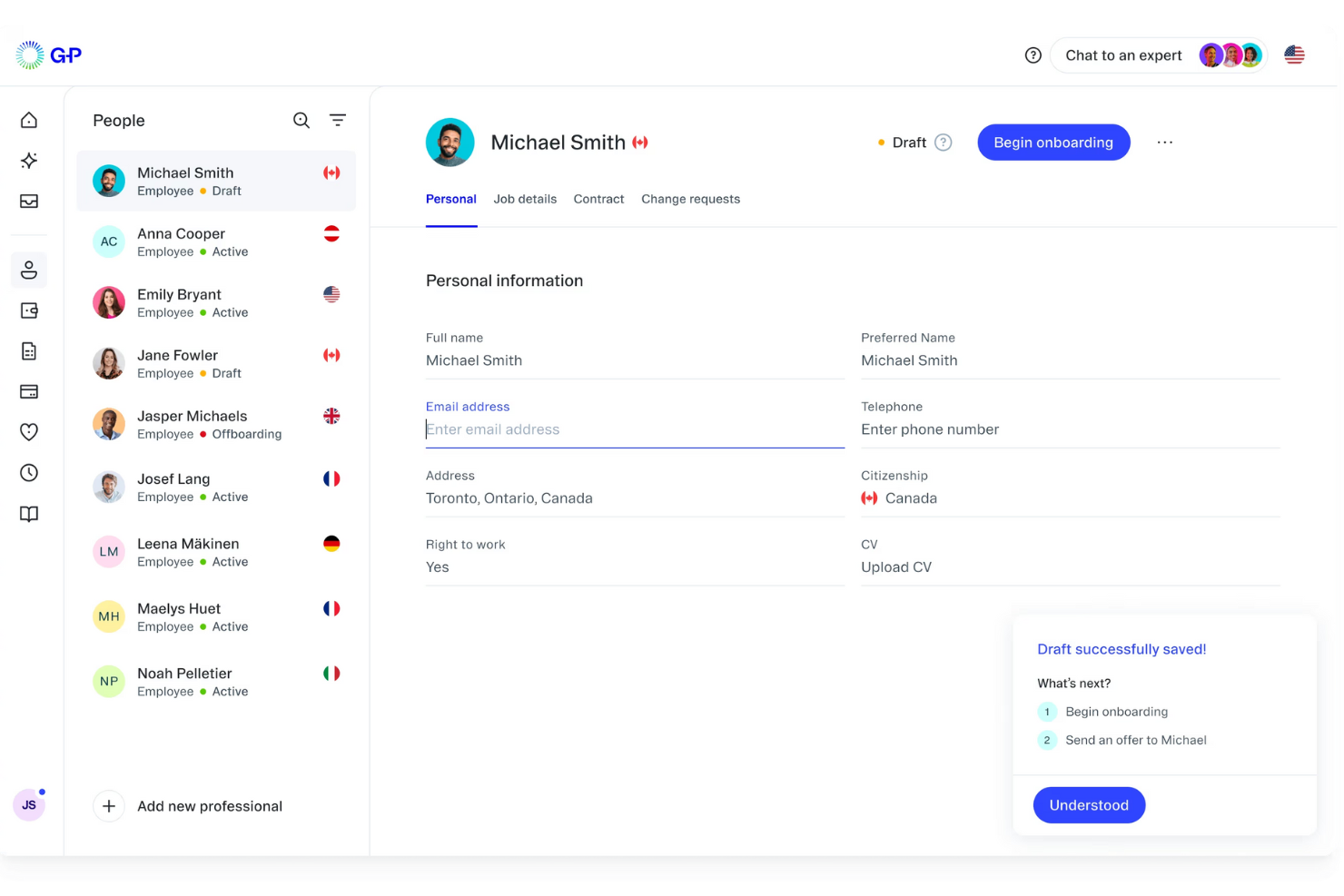
G-P is a global employment platform that covers EOR, contractor management, and multi-country payroll across 180+ countries, with AI-powered compliance guidance built directly into the platform through G-P Gia.
Who Is G-P Best For?
G-P is a strong fit for mid-market and enterprise companies that need to hire across multiple countries simultaneously, including India.
Why I Picked G-P
I've included G-P in my top picks because it owns its legal entities directly in every country it operates in, including India, which means there's no third-party partner handling your compliance on the ground. What I like most is G-P Gia, an AI compliance assistant built on 100,000+ vetted legal articles that can draft India-specific employment contracts and offer letters in minutes. I also rely on Globalpedia for instant, country-level guidance on India's labor laws without filing a support request.
G-P Key Features
- Multi-currency global payroll: Process payroll in 50+ currencies via digital wallet, ACH, bank transfer, wire transfer, or credit/debit card, with G-P assuming full legal responsibility for accuracy.
- Time-off management: Review, approve, or reject time-off requests from India-based employees and export time management reports directly from the platform.
- Expense management: Review, approve, or reject expense reports submitted by global team members and generate reports from within the platform.
- Employee Assistance Program (EAP): Provide India-based employees with dedicated support resources designed to reduce absenteeism and support overall well-being.
G-P Integrations
G-P offers native integrations with ADP TotalSource, ADP Workforce Now, Paylocity, BambooHR, Personio, TriNet, UKG Pro, UKG Ready, Workday, SAP SuccessFactors, HiBob, Microsoft Entra ID, Google Workspace, and Okta/Auth0. An API is available for custom integrations.
Pros and Cons
Pros:
- Dedicated account managers for ongoing support
- AI compliance advisor covers 50+ countries
- Owns legal entities in India directly
Cons:
- Support ticket responses can be delayed
- Benefits packages limit India-specific customization

Best for compliant hiring under Indian labor law
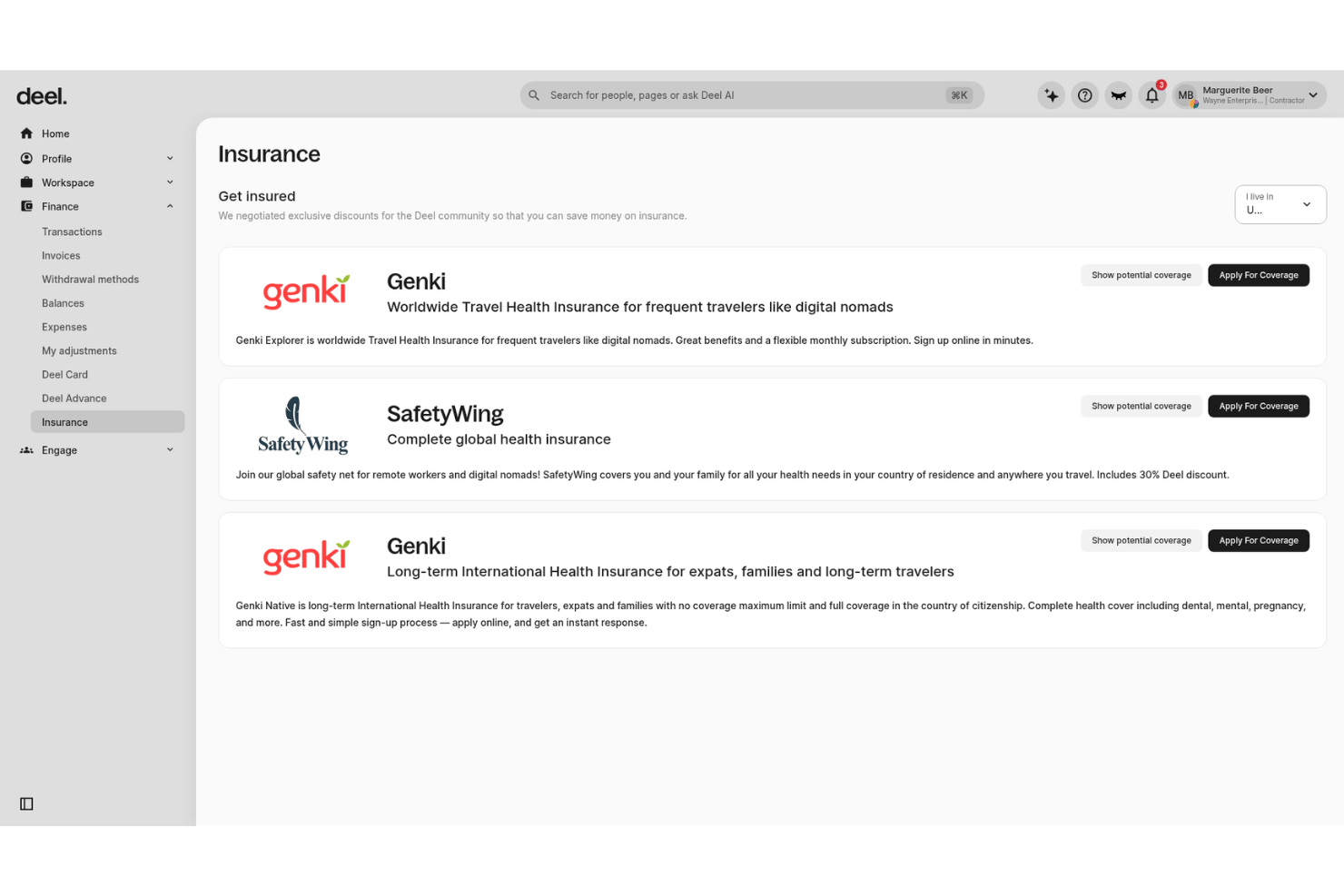
Deel Hire is a global hiring platform that covers EOR, contractor management, PEO, talent sourcing, an ATS, and onboarding—all in one connected system.
Who Is Deel Hire Best For?
Deel Hire is a strong fit for scaling companies that need to hire full-time employees across multiple countries without setting up legal entities.
Why I Picked Deel Hire
I've included Deel Hire in my top picks because the automation it brings to compliance and payroll is genuinely hard to find at this scale. When you're hiring in India, Deel automatically applies local contracts, classification rules, and data protection requirements at every stage—so nothing falls through the cracks. I also like that the EOR sits inside a single system with the ATS, onboarding, and payroll, which means a new hire in India can go from offer to fully onboarded in under two days without any manual handoffs between tools.
Deel Hire Key Features
- Global worker onboarding: Manage paperwork, contracts, tasks, account access, and equipment setup for new hires in one flow.
- Built-in background screening: Automate new hire background checks and add human-led verifications before a hire's start date.
- Applicant tracking system (ATS): Review applications, manage interviews, and move candidates through a single pipeline without switching tools.
- Multi-currency contractor payments: Create compliant contracts and pay contractors in 120+ currencies, including Crypto.
Deel Hire Integrations
Deel offers integrations through its App Store across HR, accounting, and recruiting categories, including Workday, BambooHR, Hibob, Personio, SAP SuccessFactors, UKG, QuickBooks Online, Xero, NetSuite, and Greenhouse. It also connects with Lever, Workable, and Ashby for applicant tracking and provides an API for custom integrations.
Pros and Cons
Pros:
- Covers 150+ countries from one dashboard
- Contractor-to-EOR conversion in one platform
- Owns its own legal entity in India
Cons:
- Support can feel transactional at scale
- Feature depth varies across some countries

Best for budget-conscious remote team expansion
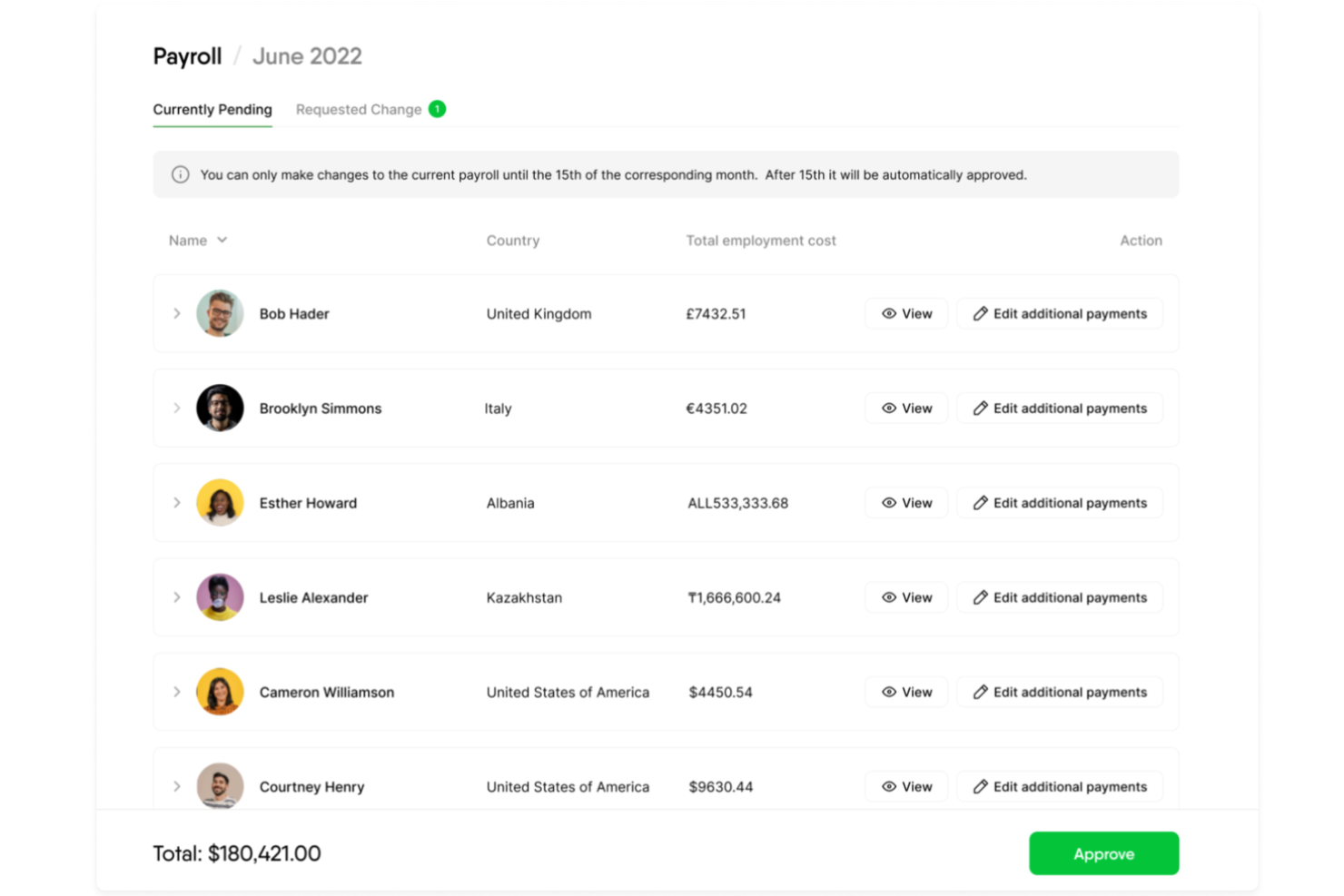
RemoFirst is an EOR platform that covers full-time international hiring, contractor management, global payroll, visa and work permit support, health insurance, background checks, and equipment delivery across 185+ countries.
Who Is RemoFirst Best For?
RemoFirst is a strong fit for early-stage and mid-size startups that need a cost-accessible EOR to hire their first employees in India and other emerging markets.
Why I Picked RemoFirst
I picked RemoFirst as one of the best because its all-in-one platform genuinely covers the full employee lifecycle in India from a single dashboard. When I hire in India, payroll, taxes, pension contributions, and social contributions are all calculated and filed automatically, with no manual intervention. I also like that visa and work permit support is built directly into the platform, so if a hire needs relocation or sponsorship, I don't have to pull in a separate vendor. The dedicated account manager model means there's one person who knows my team's setup, not a rotating support queue.
RemoFirst Key Features
- Compliant offboarding management: Handle terminations in India with built-in guidance on notice periods, severance calculations, and required documentation.
- Aggregated global payroll payments: Consolidate your entire international team's payroll into a single payment instead of processing individual transactions per country.
- Localized employment contract generation: Automatically generate India-specific employment contracts that align with local labor laws during the hiring flow.
- Contractor-to-employee conversion: Convert existing India-based contractors to full-time employees, including payroll enrollment and localized contract creation.
RemoFirst Integrations
RemoFirst offers a small set of native integrations, including BambooHR, ADP Workforce Now, and GoCardless. An API is available for custom integrations, and RemoFirst has an active developer and tech partner program for building additional connections.
Pros and Cons
Pros:
- Includes visa and work permit support
- Flat-rate pricing across all countries
- Onboarding in India starts within days
Cons:
- Reporting and analytics are limited
- Relies on local partners, not owned entities

Best for abiding by Indian labor laws
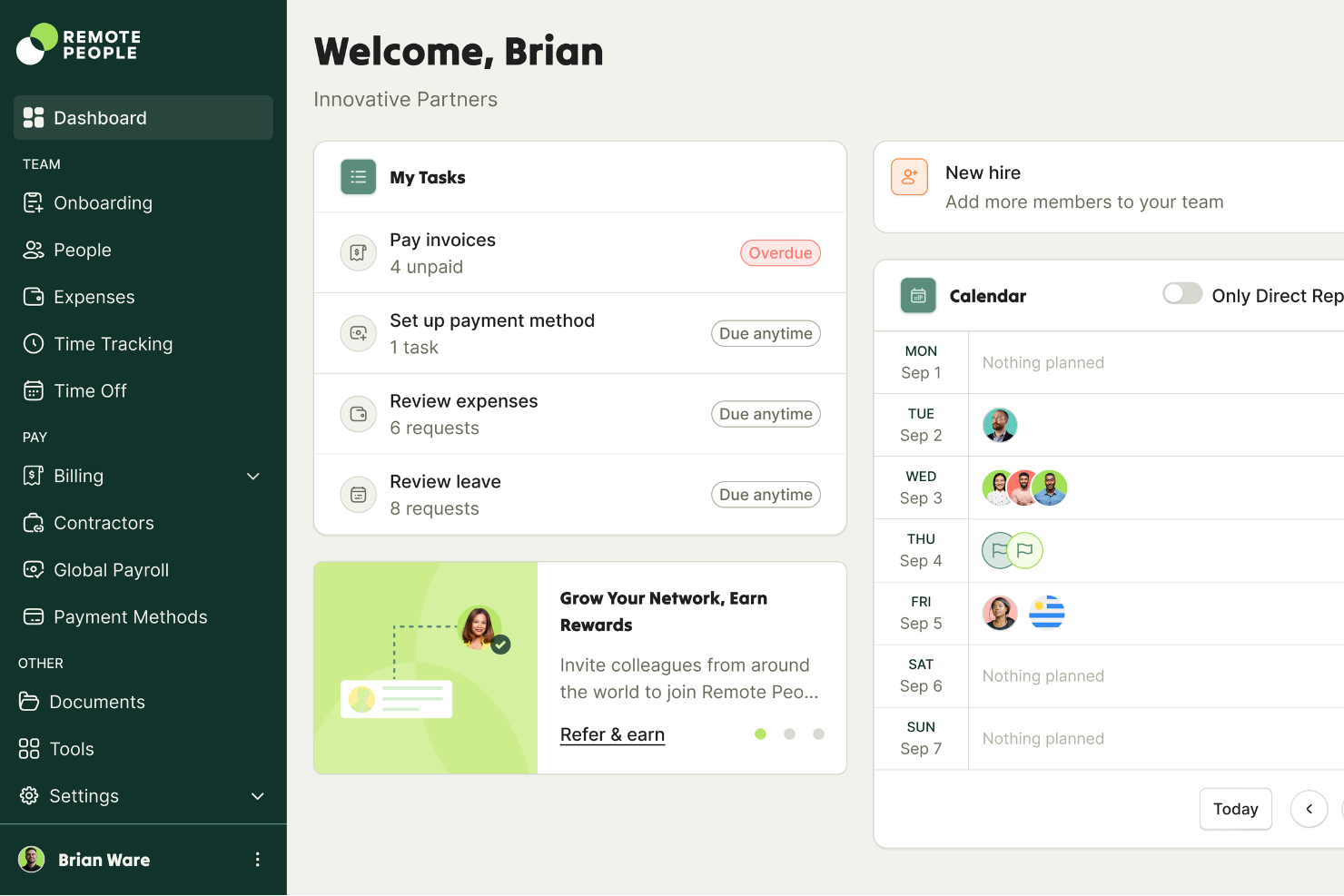
RemotePeople is an EOR platform that combines full-time international employment, built-in recruitment, contractor management, and global payroll across 150+ countries through owned entities.
Who Is RemotePeople Best For?
RemotePeople is a strong fit for mid-size to enterprise companies that need to hire across multiple regions simultaneously, without managing separate vendors for recruitment and employment compliance.
Why I Picked RemotePeople
I've included RemotePeople in my top picks because its built-in recruitment function is genuinely unusual for an EOR platform. Most EOR providers only take over once you've already found your hire. With RemotePeople, in-house recruiters source and screen candidates in India in roughly 72 hours, then hand them directly to the EOR onboarding flow. I like that the entire path from job brief to first day on payroll runs through one platform, with no handoff to a separate recruitment vendor.
RemotePeople Key Features
- Contractor classification and compliance: Automatically classifies contractor engagements and generates watertight agreements to reduce misclassification risk in India.
- Multi-currency contractor payments: Pays contractors in 120+ currencies within 48 hours of onboarding.
- Dedicated account manager: Assigns a named account manager to your account rather than routing requests through a general support queue.
- India-specific benefits enrollment: Enrolls new hires in locally compliant benefits packages on day one of onboarding.
RemotePeople Integrations
RemotePeople offers 70+ native integrations with major HRIS, HCM, payroll, and SSO platforms, including BambooHR, Workday, SAP SuccessFactors, Personio, HiBob, Rippling, Gusto, Okta, and Microsoft Entra ID, plus Paylocity, Factorial, Lattice, and UKG Pro. An open API is also available for custom integrations.
Pros and Cons
Pros:
- Includes visa and work permit support
- Flat-rate pricing across all countries
- Onboarding in India starts within days
Cons:
- Reporting and analytics are limited
- Relies on local partners, not owned entities

Best for quick employee onboarding
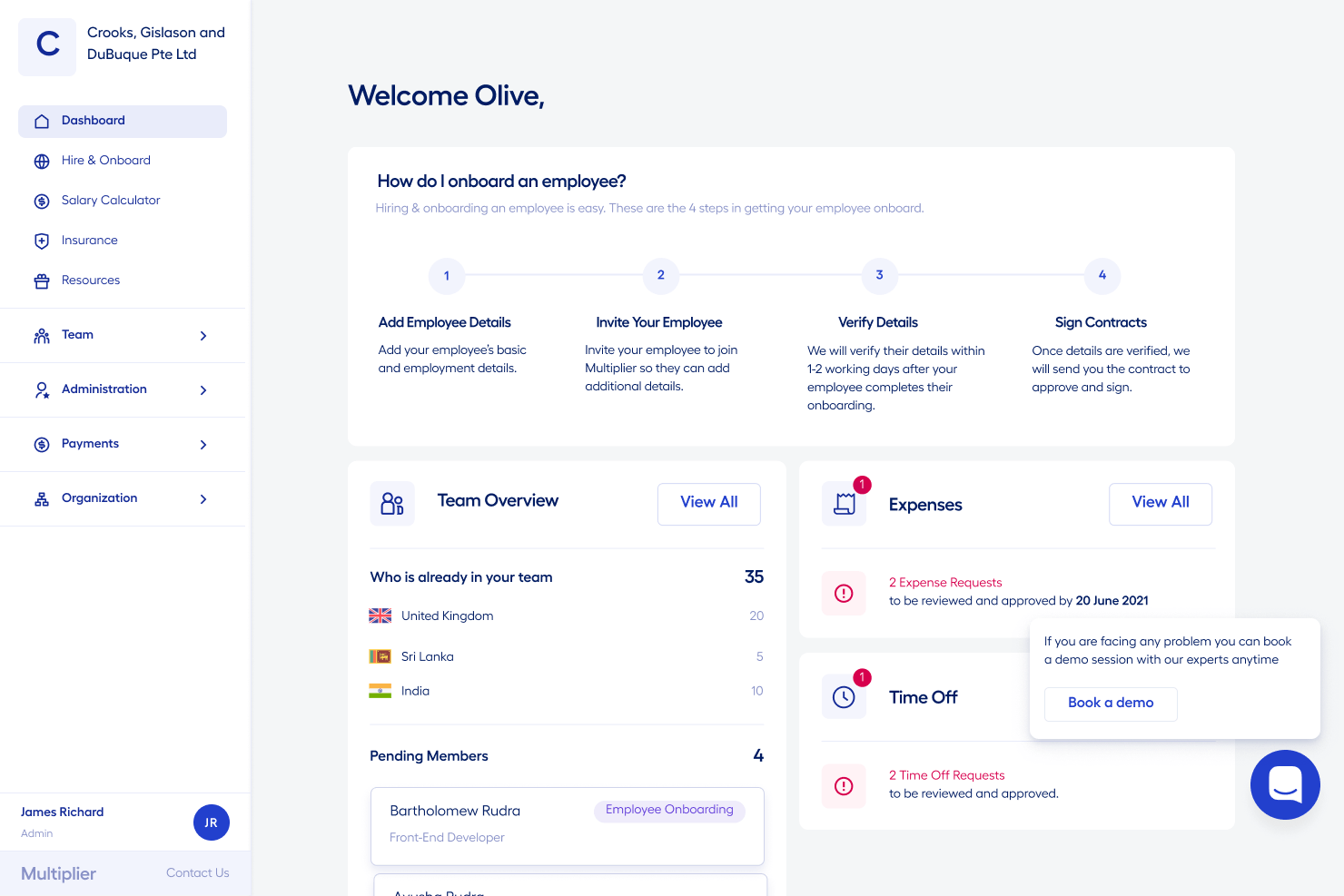
Multiplier is an employer of record platform that lets you hire workers in India through its own locally registered entity, handling employment contracts, INR payroll, statutory filings, and benefits administration without requiring you to set up a local company.
Who Is Multiplier Best For?
Multiplier is a strong fit for talent acquisition teams and global mobility leaders who need to get employees hired and working in India within days, not weeks.
Why I Picked Multiplier
I've included Multiplier in my top picks because it operates through its own registered Indian entity, Multiplier Technologies India Private Limited, which means your new hires are legally employed without you needing a local company. What I find most impressive is the onboarding speed: contracts are ready in minutes and employees can be up and running in 48–72 hours. Bulk onboarding and same-day account setup make this especially practical when you're bringing on multiple India-based hires at once.
Multiplier Key Features
- Statutory benefits administration: Multiplier calculates and files EPF, ESI, gratuity, and professional tax contributions on behalf of your Indian employees.
- HRIS integrations: Connect Multiplier to Workday, BambooHR, HiBob, SAP SuccessFactors, ADP Workforce Now, and more via native integrations or API.
- Supplemental insurance add-ons: Employees can be enrolled in health, life, and travel insurance coverage from day one, with no underwriting required.
- Bulk onboarding tools: Generate and send contracts to multiple India-based hires at once using built-in bulk onboarding and digital contract workflows.
Multiplier Integrations
Multiplier supports 15+ integrations, including Workday, BambooHR, HiBob, ADP Workforce Now, SAP SuccessFactors, Personio, Zoho People, Oracle HCM, and UKG. Its Core plan includes API access for custom integrations.
Pros and Cons
Pros:
- Handles PF, ESI, gratuity, and TDS
- Employs workers through its Indian entity
- Onboards Indian employees within 48–72 hours
Cons:
- Reviews cite payroll errors and slow support
- Conflicting India-specific statutory figures undermine confidence

Best for indemnification-backed hiring
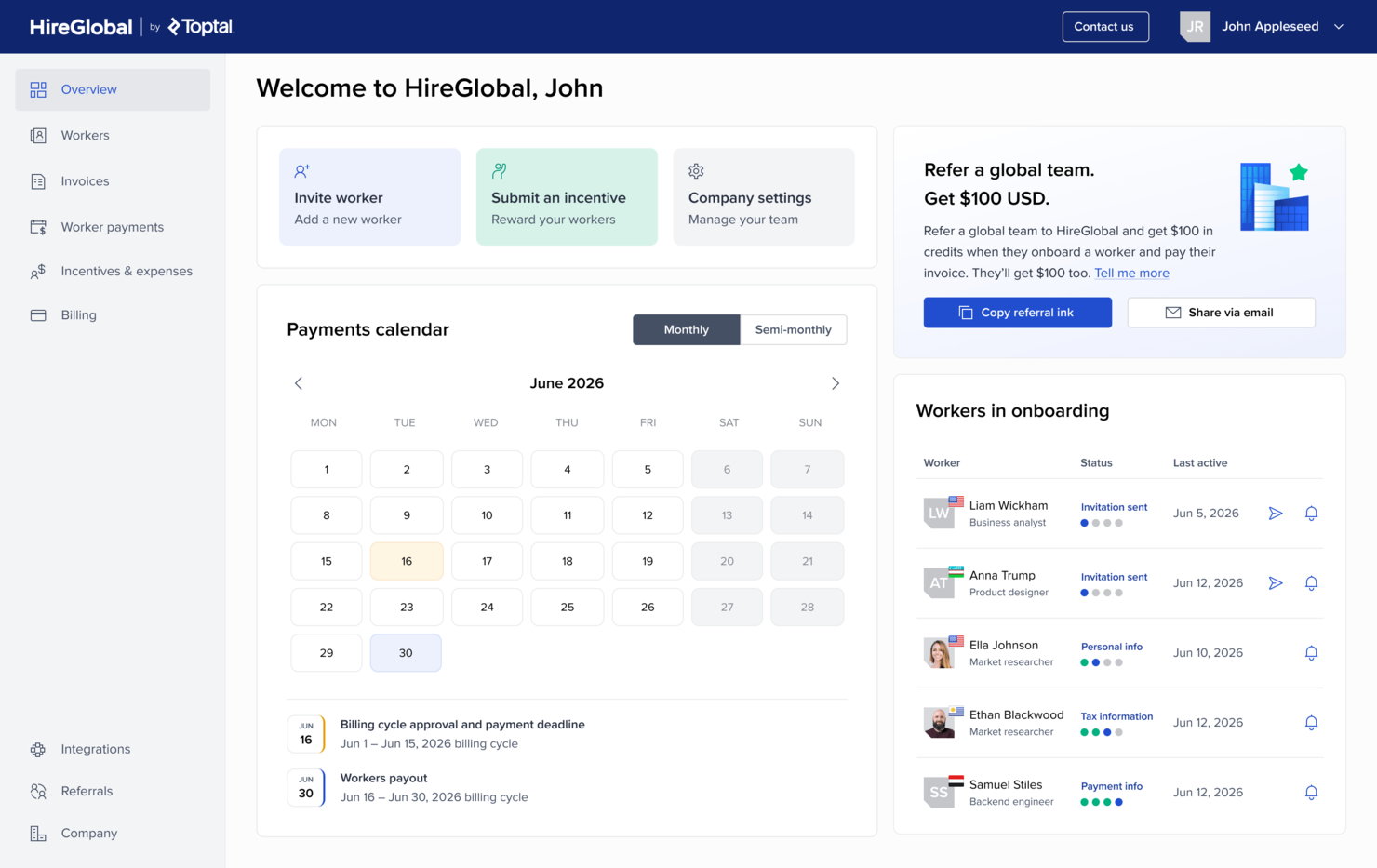
HireGlobal is a global EOR and payroll platform built on Toptal's infrastructure that lets you onboard, manage, and pay workers across 180+ countries using multiple hiring models—contractor management, agent of record, virtual EOR, and full EOR.
Who Is HireGlobal Best For?
HireGlobal is a good fit for globally distributed companies that need flexible hiring structures to compliantly engage workers across multiple countries, including India.
Why I Picked HireGlobal
HireGlobal combines Employer of Record (EOR) services with access to Toptal's network of professionals across technology, design, finance, and other industries. It supports hiring workers in India across various roles and helps businesses choose the appropriate engagement model. The platform also includes worker verification and onboarding processes before employment begins.
HireGlobal Key Features
- Multiple hiring models: Choose between contractor management, Agent of Record, Virtual EOR, or full EOR based on your workforce needs.
- $1 million worker indemnification: Each worker is covered by HireGlobal's indemnification policy, reducing legal exposure on India-specific employment claims.
- Multi-currency global payments: Pay Indian workers in local currency while managing consolidated invoicing across 50+ currencies.
- Dedicated legal network: A team of 40+ lawyers supports compliance across countries, including India's EPF, ESI, and TDS requirements.
HireGlobal Integrations
HireGlobal integrates natively with TopTracker, Toptal's time-tracking tool, for an end-to-end workflow that covers time tracking, invoice approval, and payments. Native integrations beyond TopTracker are not clearly documented, and Zapier and API support are not publicly listed.
Pros and Cons
Pros:
- Supports multiple hiring models
- 40+ legal experts support compliance
- $1M indemnification per worker included
Cons:
- Relies on local partner networks in some countries
- Newer EOR with limited user reviews

Wisemonk
Best India-based EOR with local expertise
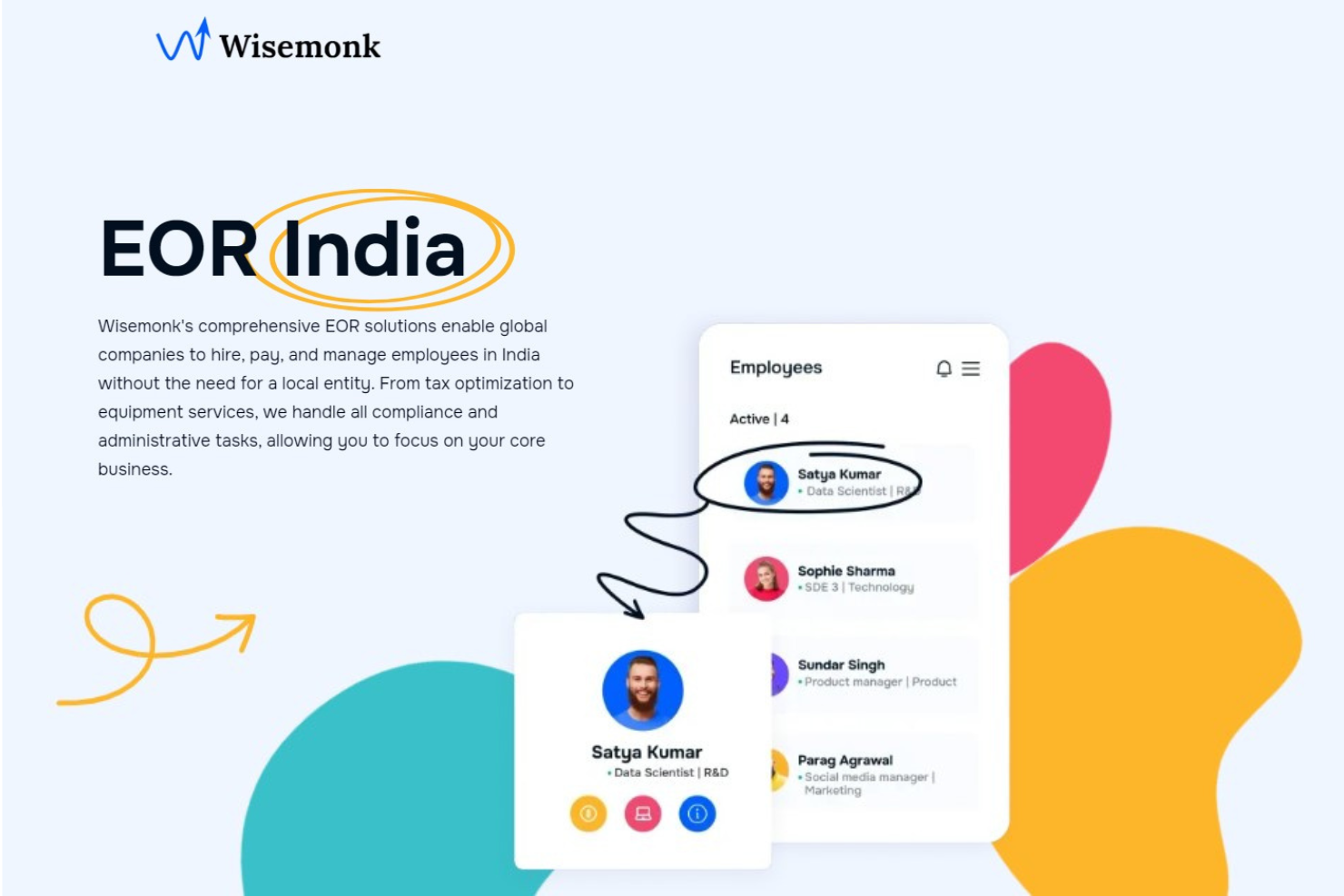
Wisemonk is an India-only employer of record platform that handles legal employment, statutory compliance, INR payroll, benefits administration, and contractor-to-employee conversion for companies hiring in India without a local entity.
Who Is Wisemonk Best For?
Wisemonk is a strong fit for global companies hiring their first employees in India, particularly teams of 1–50 that need local compliance expertise without setting up their own entity.
Why I Picked Wisemonk
Wisemonk earns its spot on my shortlist because it's built exclusively for India, which means its compliance coverage goes deeper than any global EOR I've seen. I particularly like that it owns its Indian entity outright and handles PF, ESI, TDS, gratuity, and professional tax filings in-house across all 28 states, rather than routing work through a local partner. It also restructures each employee's CTC using HRA, NPS, and flexible allowances to increase take-home pay by 5–8%, which is a meaningful differentiator when attracting talent in competitive Indian markets.
Wisemonk Key Features
- Contractor-to-employee conversion: A four-step process that moves contractors to full employment, including IP reassignment and statutory enrollment, in an average of 3–4 days.
- Background verification: Built-in ID, education, employment, and criminal checks that complete in roughly 3–5 days, included with the EOR service.
- Employee self-service portal: A web-based portal where employees can access payslips, tax documents, leave balances, and benefits information without contacting HR.
- Subsidiary migration support: Guided transition from EOR to a client-owned Indian entity, typically recommended at around 25–30 hires.
Wisemonk Integrations
Native integrations are not clearly documented. Clutch reviewers report workflows through Slack and Google Sheets, while HRIS integration is available in the Enterprise plan; no public API documentation is available.
Pros and Cons
Pros:
- Dedicated local HR business partner
- Fast contractor-to-employee conversions
- India-specific statutory compliance expertise
Cons:
- Supports India-only employment operations
- Offboarding can become lengthy and complex

Best for secure and compliant employment
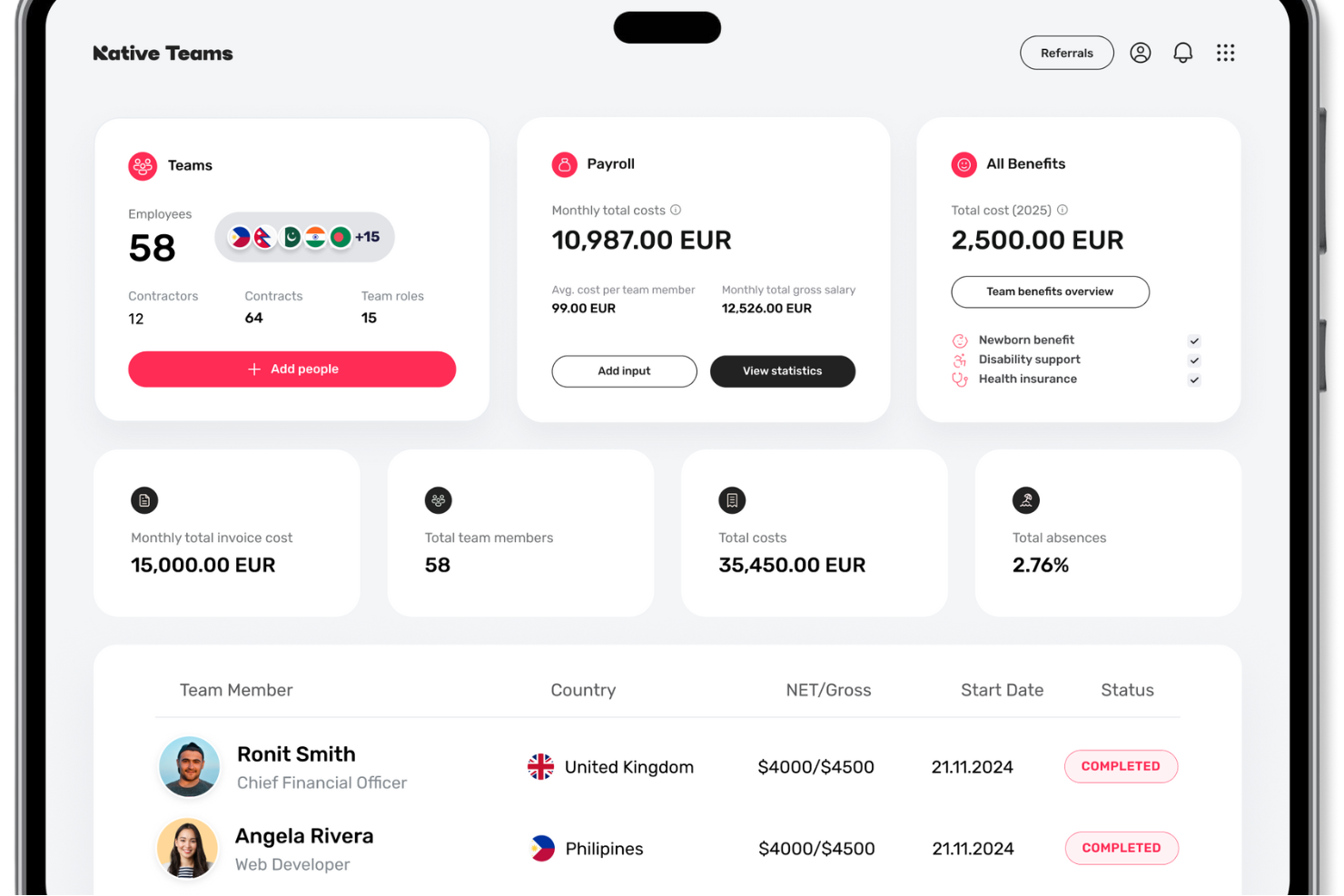
Native Teams is a global employer of record platform that handles legal employment, payroll, statutory compliance, and benefits administration across 95+ countries, including India.
Who Is Native Teams Best For?
Native Teams is a good fit for finance and HR teams that need to hire in India without a local entity and want statutory compliance handled end to end.
Why I Picked Native Teams
I've included Native Teams in my top picks because its India compliance coverage is genuinely detailed, tracking EPF, ESIC, gratuity, statutory bonus, and all four Labour Codes that took effect in late 2025. I like that it handles statutory filings, TDS withholding, and INR payroll under one employer-of-record structure, so there's no scrambling across separate vendors when a new hire's first pay cycle hits. Country-specific contracts valid under the IT Act 2000 add another layer of legal grounding that matters when you're onboarding in India without a local entity.
Native Teams Key Features
- Multi-currency payroll processing: Run INR payroll alongside other currencies, with bulk payment tools and direct debit funding built into the platform.
- Employee self-service app: Employees access contracts, payroll documents, leave balances, and payment options through iOS and Android mobile apps.
- Expense card and tracking: Employer of record plans include expense cards and built-in expense tracking for India-based team members.
- Onboarding and offboarding management: Native Teams handles documentation, contracts, and separation workflows, including final settlement timelines under India's Labour Codes.
Native Teams Integrations
Native Teams doesn't have any clearly documented native integrations. It mentions partnership integrations and a marketplace, but no confirmed HRIS, ATS, ERP, accounting connector, or public API.
Pros and Cons
Pros:
- Offers mobile leave and payroll access
- Supports INR payroll and local benefits
- Covers EPF, ESIC, gratuity, and Labour Codes
Cons:
- Indian entity ownership needs verification
- Payment delays appear in user reviews

Best for an AI-based payroll engine
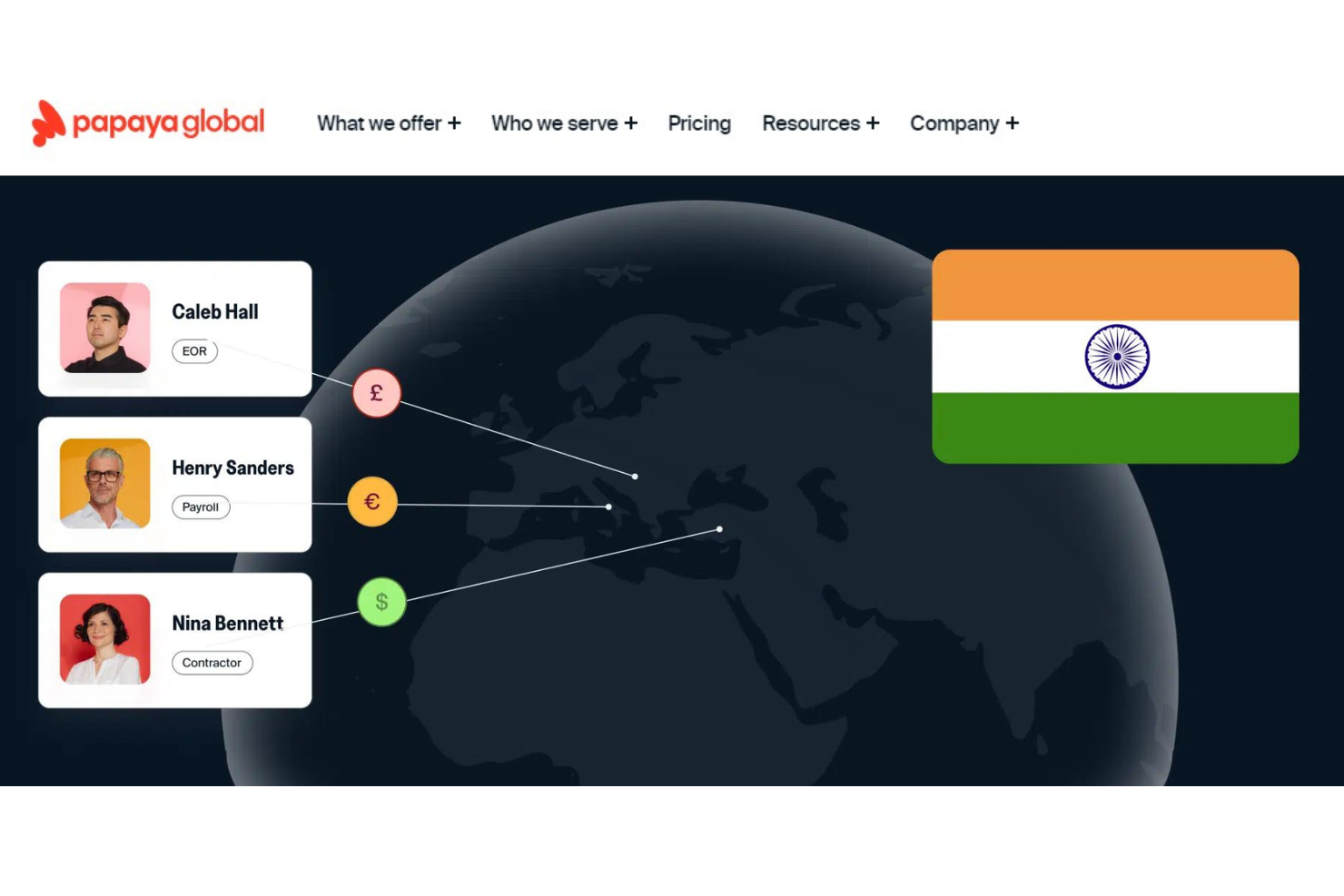
Papaya Global is a global payroll and EOR platform that handles employment, payroll, compliance, and cross-border payments for employees, contractors, and EOR workers across 160+ countries from a single system.
Who Is Papaya Global Best For?
It's a strong fit for multinational companies that need to hire in India as part of a broader, multi-country workforce strategy managed from one platform.
Why I Picked Papaya Global
Papaya Global earns its spot on my shortlist because it's the only EOR I know of that contractually guarantees termination liability, covering legal, financial, and operational risk when you let someone go in India. I also like that it runs payroll, compliance, and cross-border payments through a single flow, so your India payroll isn't handed off to a separate banking process. On top of that, its AI-backed expense validation checks receipts at submission and routes approved reimbursements directly into payroll.
Papaya Global Key Features
- Automated journal entries: Payroll data converts automatically into structured journal entries aligned to your general ledger and reporting requirements.
- Worker classification engine: Manage employees, contractors, and EOR workers under a single governance model with built-in classification controls.
- Real-time workforce cost reporting: Track workforce costs, liabilities, and employment status across countries without manual reconciliation.
- Continuous compliance monitoring: Local labor laws, contracts, and termination requirements are enforced automatically across every country you hire in.
Papaya Global Integrations
Papaya Global offers connectors with SAP SuccessFactors, Oracle HCM, Workday HCM, BambooHR, HiBob, Personio, UKG, Namely, PrismHR, and NetSuite, spanning HRIS, ERP, expense management, and journal entry categories. It also integrates with SAP Fieldglass and Beeline for vendor management, Expensify for expense data, and provides an API for custom integrations.
Pros and Cons
Pros:
- Built-in BI and payroll cost reporting
- Bulk onboarding supports up to 1,000 employees
- Proprietary payment rails with guaranteed land dates
Cons:
- Invoice line items can be hard to reconcile
- EOR relies on third-party in-country partners

TopSource
Best for 24/5 dedicated support
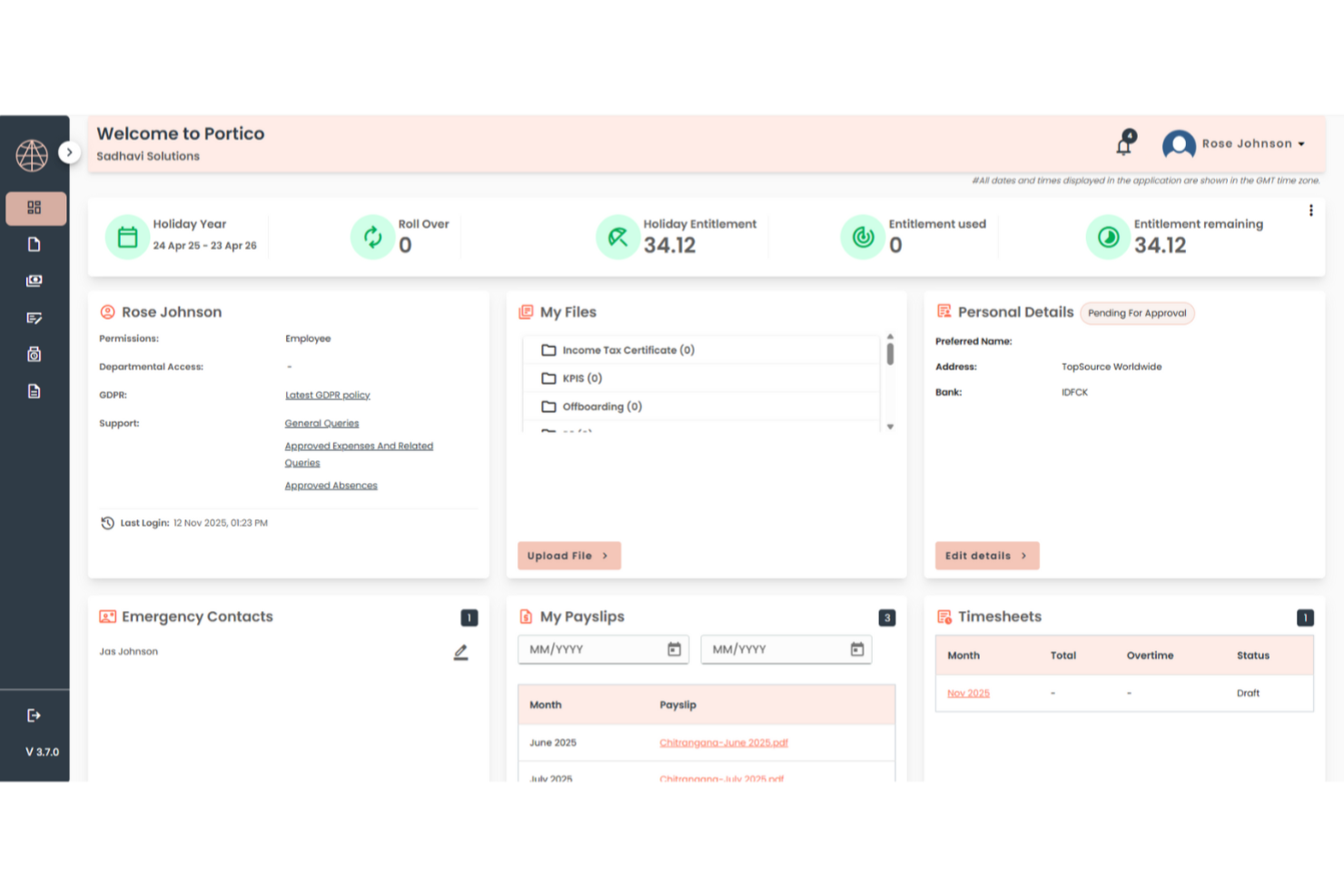
TopSource is a global EOR service that pairs a self-owned legal entity model with dedicated in-country HR specialists to handle employment, payroll, benefits, and compliance across 180 countries.
Who Is TopSource Best For?
It's a strong fit for mid-sized companies hiring across multiple regions in India who want a dedicated local HR specialist, not just a self-serve platform.
Why I Picked TopSource
I've included TopSource in my top picks because its owned-entity model means your Indian employees are hired directly under TopSource's legal entity, not through a third-party partner. I like that each client gets a dedicated in-country HR specialist for India, so when a payroll query or compliance question comes up, you're calling someone who knows Indian labor law firsthand. TopSource also lets you customize employment contracts term by term, including notice periods, probation, and IP clauses, all within local legal boundaries.
TopSource Key Features
- Bespoke benefits configuration: Build a custom benefits package for Indian employees, choosing from health insurance, pension plans, wellness perks, and paid leave options with guidance from in-country specialists.
- 24/5 phone support: Reach TopSource's in-country India experts by phone during your business hours for payroll, compliance, or onboarding questions.
- Quarterly talent strategy audits: TopSource reviews your global talent setup every quarter to flag compliance gaps and identify ways to optimize your India hiring strategy.
- Salary and benefits benchmarking: Access TopSource's India-specific hiring market data and salary benchmarks to set competitive compensation for new hires.
TopSource Integrations
TopSource offers integrations with HRIS platforms, including Workday, SAP SuccessFactors, UKG, BambooHR, HiBob, Personio, and Keka, as well as ATS tools like Greenhouse, Lever, Workable, SmartRecruiters, Ashby, Teamtailor, and JazzHR. A custom API is available for connecting to additional HR, finance, and workforce systems.
Pros and Cons
Pros:
- EOR-to-entity transition support included
- Named account manager for every client
- Deep India payroll roots since 2007
Cons:
- Portico platform lacks modern self-serve tools
- Onboarding takes 7-15 business days
Other Indian Employer of Record Services
Here are some other EOR service providers in India that didn’t make it into my top 10 shortlist, but are still worth considering:
- Oyster HR
For EOR-related educational resources for clients
- Payoneer Workforce Management
For onboarding and paying talent in India
- Remote
For India-specific employee benefits tiers
- Mercans
For supporting payments in cryptocurrency
- Borderless AI
For platform-led expansion into India
- Asanify
For flat-fee INR payroll with transparent FX
- Justworks
For global payroll management
- ANSR
For its talent network
- Remunance
For hiring in India without a local entity
- GoGlobal
For people-led India hiring at scale


Selection Criteria for Employer of Record India
Uncovering the best EOR services for this list required a deep understanding of how these services can alleviate common challenges, such as legally hiring employees abroad, managing international payments, ensuring compliance with local labor laws, providing competitive benefits, and facilitating smooth onboarding.
Here are the specific criteria I used to carefully compare the service offerings for each provider in this list:
Core Employer of Record Services (25% of total score): To be considered for inclusion in this list, each EOR provider had to offer the following basic services first:
- The corporate structure to legally and compliantly hire employees in multiple countries without a local entity
- The ability to manage worldwide payroll and taxes in compliance with local regulations
- Assistance with offering competitive and locally compliant benefits packages
- Assistance with navigating Indian visa and work permit processes for expatriate employees
- Robust procedures to ensure data privacy and security that comply with international standards, including GDPR and other requirements
Additional Standout Services (25% of total score): To help me narrow in on the best EOR services out of the numerous options available, I also took note of any unique or less common services, including:
- Advanced technology platforms that streamlined payroll and HR processes while still offering ease of use
- Specialized experience in hiring employees within specific new countries or key industries
- Services that enhance remote work compliance and global mobility needs
- Specialized customer support for complex immigration cases
- Assistance with international IT requirements, including managing computer equipment, software licenses, and other asset-tracking requirements
- A focus on eco-friendly and sustainable employment practices
Industry Experience (10% of total score): To evaluate the industry experience of each EOR service provider, I considered the following:
- How many years their business has operated in the EOR space
- Any industry recognitions or certifications the provider may hold in international HR and payroll
- Their depth of knowledge in local labor laws across multiple jurisdictions
- Their expertise in new markets, including how many different countries they offer local expertise in
- Evidence of a strong track record managing global expansion processes
- The combined experience and credentials of their team members, if available
Customer Onboarding (10% of total score): To get a sense of each provider's customer onboarding process, I considered the following factors:
- The availability of comprehensive onboarding materials, such as fact sheets, guides, FAQ repositories, or other training resources
- Support for integrating the EOR provider's software with existing HR systems
- Direct access to onboarding specialists, customer support, or a dedicated account manager during the setup phase
Customer Support (10% of total score): Since the EOR provider will act as your remote workers' legal employer, it's important to ensure you'll receive timely communications and top-level support. To evaluate the level of customer support each company offered, I considered the following:
- The availability of a multilingual support team that covers different time zones
- Multiple support channels, including phone, email, and live chat
- Evidence of responsiveness and effectiveness in resolving issues, as inferred from customer reviews
- The existence of dedicated account managers to provide assistance as needed
Value for Price (10% of total score): To gauge the overall value of each service, I considered the following factors:
- Transparent pricing models without hidden fees
- Comparative analysis of service offerings versus cost
- Flexibility in service packages to suit different business sizes and needs
Keep in mind that EOR services are complicated, and because of that the price tag can sometimes be high. However, the prices for their services still offer a good ROI considering the complexity of the premium-grade services you're gaining.
Customer Reviews (10% of total score): Evaluating customer reviews is the final element of my selection process, which helps me understand how happy real users are with a service. To determine this, I considered the following factors:
- Consistently high ratings across various consumer review platforms
- Specific feedback on the ease of use of the EOR services
- Testimonials highlighting exceptional customer support and problem resolution
Using this assessment framework helped me identify the employer of record services that go beyond basic requirements to offer additional value through unique services, deep industry experience, smooth onboarding, effective support, and overall value for price.
How to Choose an Employer of Record in India
The right EOR service can simplify your expansion into India—but only if it fits your specific needs. Before comparing providers, start by mapping out your challenges and goals.
Here are five questions to guide your decision:
- What problem are you solving?
Whether you're struggling with compliance, paying employees in INR, offering local benefits, or hiring in specific Indian regions, identify the core challenges you want the EOR to handle. - Who benefits from the EOR service?
Identify who in your team will manage the relationship and how it will ease their workload. - What's your budget?
Estimate how many employees you plan to hire in the UAE. Since most EORs charge a monthly fee per employee, this will help you estimate your costs. - What outcomes matter most?
Do you want to source talent in a specific state or city to access new customers? Are you testing the waters before considering opening a legal entity? Define your success metrics up front to avoid wasting time on mismatched options. - Will it work with your HR systems?
Make sure the EOR’s platform integrates with your current HR tools and won’t create data silos or extra admin work.
Just because a provider is well-known doesn’t mean it’s right for you. Focus on fit, not flash.

Key Employer of Record Services And Features
Here are the core features any great employer of record in India, keep an eye out for the following key features:
- Global payroll management: An EOR ensures employees in India are paid accurately and on time in Indian rupees (INR). This includes salary calculations, statutory deductions, reimbursements, and allowances. Consistent, compliant payroll helps maintain employee satisfaction and financial stability across global operations.
- Tax compliance and withholding: The EOR manages all required employee income tax withholdings under India’s Income Tax Act, as well as employer contributions such as Provident Fund (PF), Employees’ State Insurance (ESI), and Professional Tax. This prevents compliance issues and ensures timely, accurate tax submissions.
- Local labor law compliance: India’s labor laws span federal and state regulations, covering working hours, leave entitlements, wages, contract terms, and termination rules. EOR providers offer deep, country-specific knowledge to keep you compliant and reduce risks of disputes, penalties, or accidental violations.
- International talent acquisition & background checks: Many EOR providers assist with sourcing talent in India and conducting background checks to verify education, employment history, and credentials. They also prepare India-specific employment contracts that meet local legal requirements.
- Visa and work permit sponsorship: For foreign employees relocating to India, the EOR helps secure the correct employment visas and work permits. They guide employers and employees through government processes to ensure full legal compliance.
- Onboarding and offboarding: EORs manage compliant onboarding workflows and handle terminations according to Indian labor law — including notice periods, final settlements, and statutory payouts. This creates smoother transitions for both employees and employers.
- Benefits administration: EOR providers offer competitive benefits tailored to India’s market, such as private health insurance, life insurance, transportation allowances, and statutory benefits like PF and ESI. These benefits support employee wellbeing and help attract and retain top talent.
- HR support and consultation: EOR specialists provide ongoing HR guidance on India-specific employment practices, grievance handling, workplace policies, documentation, and dispute avoidance — helping maintain strong employee relations and protect your employer brand.
- Risk management and insurance: Because the EOR becomes the legal employer in India, they manage employment-related risks, workers’ compensation requirements, and insurance coverage like professional indemnity and public liability, reducing liability for your business.
- Multi-language support: EOR services often include localized documentation and support in multiple languages. This ensures smooth communication with India’s diverse workforce and helps prevent misunderstandings related to contracts, policies, and compliance requirements.
Common Employer Of Record India AI Features
Many EOR providers serving India are incorporating AI capabilities to improve compliance, accuracy, and efficiency, for example:
- Automated payroll anomaly detection: AI scans Indian payroll data for errors such as incorrect PF calculations, ESI deductions, or tax slab mismatches — identifying issues before payroll is finalized.
- Automated document verification: AI validates PAN cards, Aadhaar IDs, educational records, employment history, and visa documents, speeding up onboarding and reducing compliance risks.
- Smart compliance monitoring: AI tracks updates to India’s frequently evolving labor laws — including state-level shop and establishment rules, PF/ESI changes, and tax reforms — and notifies employers of impacts or required adjustments.
- Predictive workforce analytics: AI analyzes salary trends, attrition risks, hiring patterns, and skill availability in the Indian market to support smarter talent planning and compensation decisions.
- AI-powered employee support: Chatbots answer employee questions about payroll, leave balances, benefits, tax forms, and onboarding in real time — supporting employees in English or regional languages like Hindi, Tamil, or Kannada.
- Automated contract generation: AI creates compliant India-specific employment agreements using role details, seniority, location, and statutory requirements — reducing legal workload.
- AI-enabled background checks: Some systems use AI to speed up verification processes, cross-reference candidate data, and flag inconsistencies early.
- Identity and fraud risk detection: AI identifies unusual activity, such as duplicate employee records, incorrect bank details, or potentially fraudulent documentation.and more time to concentrate on your core business objectives.
Benefits
Expanding globally doesn’t have to mean getting tangled in legal red tape. An EOR lets you hire abroad without setting up a local entity—taking on compliance, payroll, and HR logistics so you can scale with confidence.
Here’s what you gain when partnering with an EOR:
- Quick Market Entry: For organizations aiming to test new markets or hire talent in new countries where they have no legal presence, an EOR offers a swift and efficient solution to initiate operations, saving time and resources.
- Simplified Global Payroll: Using an EOR service simplifies the complex process of managing international payroll, including tax deductions, withholdings, and currency conversions for your employees worldwide.
- Global Compliance & Risk Mitigation: By managing compliance, an EOR service provides expertise in navigating the intricacies of employment laws, tax regulations, and insurance requirements in multiple jurisdictions, helping businesses safeguard their operations against compliance-related risks.
- Enhanced Benefits Negotiation: By leveraging their extensive networks and purchasing power, EORs can negotiate better international insurance rates and secure competitive benefit packages on your behalf, enhancing your ability to attract and retain top talent worldwide.
- Improved Cost Effectiveness: Using an EOR service is a cost-effective way for businesses to enter new markets, compared to the significant costs of establishing a new foreign entity. The latter option involves significant upfront legal fees, plus other costs related to office infrastructure, staffing, and local benefits and insurance coverage.
Understanding the benefits of an EOR service is crucial for strategic planning and operational efficiency. As businesses look towards international markets for growth opportunities, partnering with an EOR provider offers a streamlined, cost-effective, and compliant pathway to global expansion.
Costs and Pricing
Typically, the cost of an EOR service follows a fee per-employee, per-month pricing model, which can vary widely depending on a range of factors. This model allows for scalability and predictability in budgeting for international expansion efforts.
In general, EOR services in India cost between $150 to $499/employee/month.
Key factors that can influence the pricing of an employer of record service include:
- Geographic Location: Costs can vary significantly based on the country or countries you're hiring in. This is due to local economic conditions, labor laws, and the complexity of compliance requirements.
- Employee Seniority and Role Complexity: The level and nature of the roles being filled can also impact the monthly cost. Senior positions or roles requiring special qualifications may increase the price due to higher benefits and compensation management costs.
- Number of Employees: The total number of employees being managed can also impact the cost. In some cases, higher volumes may lead to volume discounts, making per-employee costs more economical.
- Custom Requirements: Any specific needs beyond the standard service offering may also contribute to the monthly cost. This may include customized solutions for recruitment, specialized employee onboarding, or unique compliance requirements, all of which can affect pricing.
Some EORs also operate under different pricing models, including a percentage of employee salary model, a fixed pricing model, and custom pricing models.

What is an Employer of Record in India?
An Employer of Record (EOR) in India is a third-party service that legally hires employees on your behalf—handling onboarding, running Indian payroll, taxes, compliance, and benefits—while you manage their day-to-day work. It’s a fast, low-risk way to build a team in India without setting up a local entity or navigating complex labor laws on your own.
Why Use an Employer of Record Service in India?
India is a "compliance-dense" market where administrative errors can trigger aggressive audits from the Employees' Provident Fund Organization (EPFO).
- Navigating the 2026 Labor Codes: The new codes introduced "Fixed-Term Employment" and changed gratuity eligibility. An EOR ensures your contracts are compliant with these new standards from day one.
- Complex Payroll Structuring: Indian payroll isn't just a single number; it's a mix of Basic, HRA (House Rent Allowance), Special Allowances, and LTA (Leave Travel Allowance). EORs optimize these components for tax efficiency while staying within the 2026 "50% rule."
- State-Level Complexity: India is a federal union. Hiring in Karnataka (Bangalore) involves different Professional Tax and Labor Welfare Fund rules than hiring in Maharashtra (Mumbai). An EOR manages these regional variations for you.
EOR vs Legal Entity
If you're weighing the pros and cons of using an EOR in India versus setting up your own legal entity, the decision often comes down to speed, cost, and risk.
While incorporating a local entity gives you full control, it also comes with complex compliance requirements and ongoing administrative burdens. An EOR, on the other hand, offers a faster, lower-risk way to get started.
Here’s a quick side-by-side comparison to help clarify the differences:
| Factor | Employer of Record (EOR) | Setting Up a Legal Entity |
|---|---|---|
| Setup Time | Days to weeks | 3–6 months or more |
| Cost to Set Up | Low (monthly fee per employee) | High (legal, accounting, and registration costs) |
| Compliance Responsibility | Handled by EOR | Fully on your company |
| Local Expertise Required | Minimal | High (you’ll need local legal and HR knowledge) |
| Employee Contracts | Issued and managed by EOR | Must be created and managed by your HR/legal team |
| Scalability | Easily scalable as you grow | Slower, with more red tape |
| Control Over HR Policies | Standardized via EOR | Full control and customization |
| Best For | Fast entry, testing new markets, small teams | Long-term investment, large or permanent teams |
Using an EOR is often the smarter route for companies testing new markets or needing to hire quickly. If you're building a large, permanent presence in India, setting up a local entity might make sense, but for most growing teams, an EOR offers a far simpler path to expansion.
EOR vs. Permanent Establishment in India
India has some of the world's most aggressive Permanent Establishment (PE) and Significant Economic Presence (SEP) rules. In 2026, the threshold for SEP is earning more than INR 2 crore from Indian customers or having 300,000+ local users.
How EORs Protect From Permanent Establishment Risk
- Legal Buffer: The EOR is the "Employer on Record" in all government databases (EPFO, ESIC). This prevents your foreign headquarters from appearing as a de facto branch.
- Tax Neutrality: The EOR remits the 22%–25% Corporate Tax (as part of their domestic operations) and all withholding taxes (TDS) locally.
- Revenue Separation: By using an EOR, the relationship is classified as "Human Resource Services" rather than "Direct Foreign Operation," helping to keep your global profits out of the reach of the Indian Income Tax Department.
Hiring in India: Important Details
Here are some key details to note if this is your first time hiring staff located in India. Your EOR provider will manage these compliance details on your behalf. However, proactively informing yourself of these details is always recommended before you invest your resources into sourcing staff based in India.
In India:
- Termination of employment in India is governed by the Industrial Disputes Act of 1947. This requires employers to give a 30 to 90-day notice period to employees who are not in a supervisory, administrative, or managerial role. Once terminated, employees are granted a severance package that includes 15 days of pay for each year of service.Market Details for Hiring in India
- Employment lawsare determined by a combination of Central and State laws.
- Central laws regulate aspects such as minimum wages, employee benefits (e.g., provident fund, gratuity, bonus), retrenchment, layoffs, and hiring of contract labor.
- State laws supplement Central laws and address specific regional issues, including professional taxes, laws for shops and establishments, labor laws for agriculture, and specific labor welfare funds.
- India has two main worker classification types: workers and non-workers.
- Workers Category: Includes employees performing non-supervisory work (manual, skilled, technical, clerical) for hire or reward.
- Non-Workers Category: Includes employees performing managerial, administrative, and supervisory duties. They are governed by State-specific S&E Laws and employment contracts.
- Within these two categories, you can hire full-time, part-time, seasonal, and temporary, as well as contractors and apprentices.
- Employment taxes and payroll deductions include the Provident Fund (PF), Employees State Insurance (ESI), professional tax (varies by state), and an Income Tax.
- Standard working hours range between 40 to 48 hours per week, with between 8 to 9 hours per day. Employees are entitled to one day off per week, usually Sunday.
- Paid vacation varies by industry, but typically ranges between 12 to 15 days per year for full-time workers.
- National holidays: There are 3 national holidays in India, Republic Day (January 26), Independence Day (August 15), and Gandhi Jayanti (October 2). On these dates, employers must provide a holiday to all employees.
- Maternity leave is a mandatory Indian employee benefit for female employees. The maximum entitlement is 26 weeks of paid maternity leave. Paternity leave policies are not mandated but may be offered at the discretion of the employer.
- Paid sick leave varies by industry, state laws, and company policies. Most states offer a minimum of 10 paid sick days per year for full-time workers.
- Probationary periods are not required in India but are still a common practice. While some states don’t have local laws covering probationary periods, most employment arrangements include a probationary period of 3 to 6 months.
Market Details for Hiring in India
- Capital City: New Dehli
- Currency: Indian Rupee (INR)
- Payroll Frequency: Monthly
- Official Language: Hindi and English
- Approx. Population: 1.42 Billion
- Public Holidays: varies by region
Hiring in India in 2026 is a massive opportunity to access one of the world’s most dynamic talent pools, but it requires navigating a landmark regulatory shift. As of April 2026, the four new Labor Codes (Wages, Social Security, Industrial Relations, and Occupational Safety) are fully operational, replacing 29 legacy laws with a modernized, albeit complex, framework.
An Employer of Record (EOR) is the standard "fast-track" for global companies looking to hire in Bangalore, Mumbai, or Delhi without spending 6+ months navigating the Registrar of Companies (ROC).
Why Use an Employer of Record Service in India
India is a "compliance-dense" market where administrative errors can trigger aggressive audits from the Employees' Provident Fund Organization (EPFO).
- Navigating the 2026 Labor Codes: The new codes introduced "Fixed-Term Employment" and changed gratuity eligibility. An EOR ensures your contracts are compliant with these new standards from day one.
- Complex Payroll Structuring: Indian payroll isn't just a single number; it's a mix of Basic, HRA (House Rent Allowance), Special Allowances, and LTA (Leave Travel Allowance). EORs optimize these components for tax efficiency while staying within the 2026 "50% rule."
- State-Level Complexity: India is a federal union. Hiring in Karnataka (Bangalore) involves different Professional Tax and Labor Welfare Fund rules than hiring in Maharashtra (Mumbai). An EOR manages these regional variations seamlessly.
Tax Overview for Employers in India (2026)
Employer-side costs in India are primarily driven by the Employees' Provident Fund (EPF).
Statutory Employer Contributions (2026)
| Contribution Branch | Rate (%) | Notes |
| Provident Fund (EPF) | 12.0% | 12% of "Wages" (Basic + DA). |
| ESI (Health Insurance) | 3.25% | Only for employees earning < INR 21,000/mo. |
| Gratuity Accrual | ~4.81% | Statutory requirement (15 days' pay per year). |
| Bonus Act | 8.33% | Mandatory for certain wage brackets. |
| Professional Tax | Fixed | Varies by state (approx. INR 200/mo). |
| Total Statutory Load | ~17% – 20% | Calculated on the "Wages" portion of the CTC. |
Total Cost of Employment in India
In India, compensation is almost always discussed as CTC (Cost to Company). However, the EOR bill will be the CTC + Management Fee.
Fully Loaded Cost Illustration (INR 200,000 Gross Monthly Salary)
Assuming a Senior Software Engineer in Bangalore in 2026 (~$2,400 USD):
| Item | Monthly Amount (INR) | Monthly Amount (USD Approx.) |
| Gross Monthly Salary | ₹200,000 | ~$2,400 |
| Employer EPF Contribution (12% of Wages) | ₹12,000 | ~$145 |
| Statutory Gratuity Accrual (~4.8%) | ₹9,600 | ~$115 |
| Labor Welfare Fund / Misc. Levies | ₹500 | ~$6 |
| EOR Management Fee (Typical) | ₹25,000 | ~$300 |
| TOTAL MONTHLY COST | ₹247,100 INR | ~$2,966 USD |
Note: The 50% Basic Rule: Because the 2026 codes mandate that "Basic Pay" must be 50% of the salary, your EPF cost (which is 12% of Basic) is higher than in previous years when companies used a 20–30% Basic Pay structure.
Why Hire Employees in India?
When looking to hire internationally, India stands out for several compelling reasons. India has a large English-speaking population and a talent marketplace that is particularly deep in industries like IT, manufacturing, engineering, pharmaceuticals, and BPO (business process outsourcing), for services like customer support, telemarketing, and back-office operations.
The cost-effectiveness of hiring Indian talent can offer companies substantial workforce savings without compromising on quality. Plus, the country’s time zone provides a strategic advantage for companies looking to ensure continuous productivity or offer customer services around the clock to a global customer base.
FAQs
If you’ve got specific questions about the requirements to hire Indian employees or how EOR services work, these answers to frequently asked questions are a good place to start:
How does an EOR handle IP transfer upon termination?
In India, an Employer of Record (EOR) typically establishes intellectual property (IP) ownership in the employment agreement before work begins. Because IP ownership can depend on the type of work created and the wording of the contract, EORs ensure that employee-created work is clearly assigned to the employer or client company. Upon termination, the EOR helps confirm the assignment, complete any necessary documentation, and coordinate the return of company property and work-related materials.
What are the minimum wage requirements in India?
In India, the minimum wage is governed by the Code on Wages Act of 2019. The minimum wage varies per region and type of worker, including unskilled, semi-skilled, skilled, etc. Staying on top of changes to minimum wages is just one of the benefits of working with an EOR.
Do EOR providers offer other types of global HR services?
Yes, most of the time they do. Many service providers in this space also offer professional employer organization services (also known as PEO services), as well as cross-border payroll services.
PEO services are a way of outsourcing human resources to support international teams. PEO companies can help you with international compliance issues, benefits administration, workers’ compensation, and other HR administrative tasks.
What are some of the consequences of non-compliance?
Hiring internationally without following local labor laws can expose your company to serious consequences. These may include government fines, legal action, revoked business licenses, and increased scrutiny, plus the reputational damage that comes with being seen as a non-compliant employer.
Because labor laws vary by country, it’s easy to miss something, and ignorance isn’t a valid legal defense. That’s why many companies rely on EOR services to stay compliant and reduce their exposure to legal and financial risks when hiring abroad.
Are there any risks to using an Employer of Record service?
While EOR services offer a low-risk path to international hiring, they’re not entirely risk-free. As with any business partnership, it’s important to choose your provider carefully.
Here are some risks to watch for:
-
Financial surprises: Hidden service fees, mandatory benefit costs, or currency fluctuations can impact your budget if not clearly outlined upfront.
-
Data security concerns: You’re trusting your EOR with sensitive employee data, so ensure they follow strict security standards like ISO 27001 and have clear incident response protocols.
-
Loss of control: Because the EOR is the legal employer, you may have less say in some workforce processes, which can affect how aligned employees feel with your company.
-
Brand exposure: Poor practices or employee experiences managed by your EOR can reflect poorly on your brand—even if you weren’t directly involved.
To minimize these risks, vet providers thoroughly, clarify cost structures, and assess their security, communication, and compliance track records before committing.
This content is provided for general informational purposes only and does not constitute legal, tax, or other professional advice. It may not be complete, accurate, or current, and laws and practices may change without notice and vary by jurisdiction. You should not act on this information without obtaining advice from qualified legal or tax counsel in the relevant jurisdiction regarding your specific circumstances.