

10 Best Employer of Record in Hong Kong in 2026

10 Best Employer of Record Hong Kong Shortlist


When hiring in Hong Kong, understanding local labor laws, tax obligations, and pension schemes is essential to staying compliant and avoiding fines.
I recommend using an Employer of Record (EOR) to sidestep the lengthy process of incorporating a local entity and registering with the Companies Registry, Inland Revenue Department, and the MPF Schemes Authority.
Instead, an EOR in Hong Kong will handle employment contracts, tax filings, and labor compliance, allowing you to focus on building your remote team. This approach helps you stay in line with the regulations enforced by the Labour Department of Hong Kong without the operational burden.
But which EOR provider is the best fit to help you access top talent in Hong Kong? In this article, I’ve rounded up my top recommendations and highlighted each provider’s unique strengths, to help you decide which EOR provider in Hong Kong works best for your business needs.
Why Trust Our Software Recommendations
Our team has been testing and reviewing software since 2012. As HR experts ourselves, we know how difficult—and important—it is to choose the right software.
For this guide, we evaluated tools using hands-on testing and independent research, scoring tools using our selection criteria. We also draw on insights from industry thought leaders and practicing HR experts.
Our reviews reflect our human editorial judgment, not a sales pitch.
Expert reviewers:
Employer of Record in Hong Kong Comparison Table
This comparison table summarizes pricing details for my top Employer of Record selections:
| Tool | Best For | Trial Info | Price | ||
|---|---|---|---|---|---|
| 1 | Best for hiring in Hong Kong without an entity | Free demo available | From $599/employee/month | Website | |
| 2 | Best for cost-effective global HR solutions | Free demo available | From $199/employee/month | Website | |
| 3 | Best for global payroll compliance | Free demo available | From $199/employee/month | Website | |
| 4 | Best for compliance with Hong Kong laws | Free demo available | From $459/employee/month (billed annually) | Website | |
| 5 | Best for 24/5 dedicated support | Not available | Pricing upon request | Website | |
| 6 | Best for hiring via a wholly-owned HK entity | Free demo available | From $599/employee/month | Website | |
| 7 | Best for mixed contractor and employee hiring | Free demo available | From $199/employee/month | Website | |
| 8 | Best for APAC-rooted Hong Kong EOR expertise | Not available | From $300/employee/month | Website | |
| 9 | Best for APAC-focused market entry hiring | Free demo available | From $488/user/month | Website | |
| 10 | Best for multi-country hiring from one platform | Free demo available | From $399/employee/month | Website |

Reviews of the Best Employer of Record Services in Hong Kong
Below are my detailed summaries of the best EOR service providers in Hong Kong that made it onto my shortlist. My reviews offer a look at each provider’s key services, unique specialties, and pros & cons to help you find the best one for your needs.

Best for hiring in Hong Kong without an entity

Deel Hire is an employer of record platform that lets you legally hire, onboard, and pay employees in 150+ countries, with built-in payroll processing, tax filing, benefits administration, and compliance management.
Who Is Deel Hire Best For?
Deel Hire is a strong fit for growing companies that need to hire international talent quickly without setting up legal entities in every country.
Why I Picked Deel Hire
Deel Hire is one of my top picks because it lets you hire full-time employees in Hong Kong without needing a local legal entity. I especially like the Remote Worker Verification feature, which confirms identity and ensures contracts meet local employment laws before day one. Deel also handles Hong Kong-specific payroll, tax filings, and benefits enrollment in one platform, so there's no juggling separate tools or vendors.
Deel Hire Key Services
- Localized contract generation: Automatically creates employment contracts that meet Hong Kong's specific labor law requirements.
- Background checks: Run identity and background verification on new hires directly within the platform before onboarding begins.
- Work visa and immigration support: Manages visa applications and immigration documentation for international hires without requiring a law firm.
- IP protection clauses: Includes intellectual property protection in every employment contract, ensuring your IP is automatically assigned back to your company.
Deel Hire Integrations
Deel offers integrations with BambooHR, Xero, QuickBooks, NetSuite, Slack, Expensify, and Sage Intacct. It's available on Zapier and has an API for custom integrations.
Pros and Cons
Pros:
- Localized employee benefits
- Automated payroll processing
- Quick onboarding process
Cons:
- May not suit very small businesses
- Limited customization options

Best for cost-effective global HR solutions

RemoFirst is an employer of record platform that handles payroll, compliance, and HR administration across 180+ countries, with added services for contractor management, visa and work permit support, and global health insurance.
Who Is RemoFirst Best For?
RemoFirst is a strong fit for startups and early-stage companies that need to hire internationally without the overhead costs of larger EOR providers.
Why I Picked RemoFirst
RemoFirst earns its spot as one of the best on my shortlist because its monthly flat rate makes it one of the most affordable EOR options on the market. I like that this price includes contractor management at no additional cost, which matters when your Hong Kong team is a mix of full-time hires and project-based workers. RemoFirst also aggregates your entire global team's payroll into a single monthly invoice, so you're not managing separate payments across currencies.
RemoFirst Key Services
- Background checks: Run pre-employment background checks on Hong Kong hires directly within the platform before finalizing onboarding.
- Visa and work permit support: Apply for and manage visas and work permits across 110+ countries, including Hong Kong, through RemoFirst.
- RemoHealth: Enroll international employees in global health insurance plans, with coverage options available across regions.
- Workforce management: Store employment contracts, manage HR records, and track time off for your entire global team in one place.
RemoFirst Integrations
Integrations include BambooHR, ADP Workforce Now, and GoCardless.
Pros and Cons
Pros:
- Risk management emphasis
- Contractor onboarding support
- Global payroll management
Cons:
- Limited local presence
- May not suit large enterprises

Best for global payroll compliance
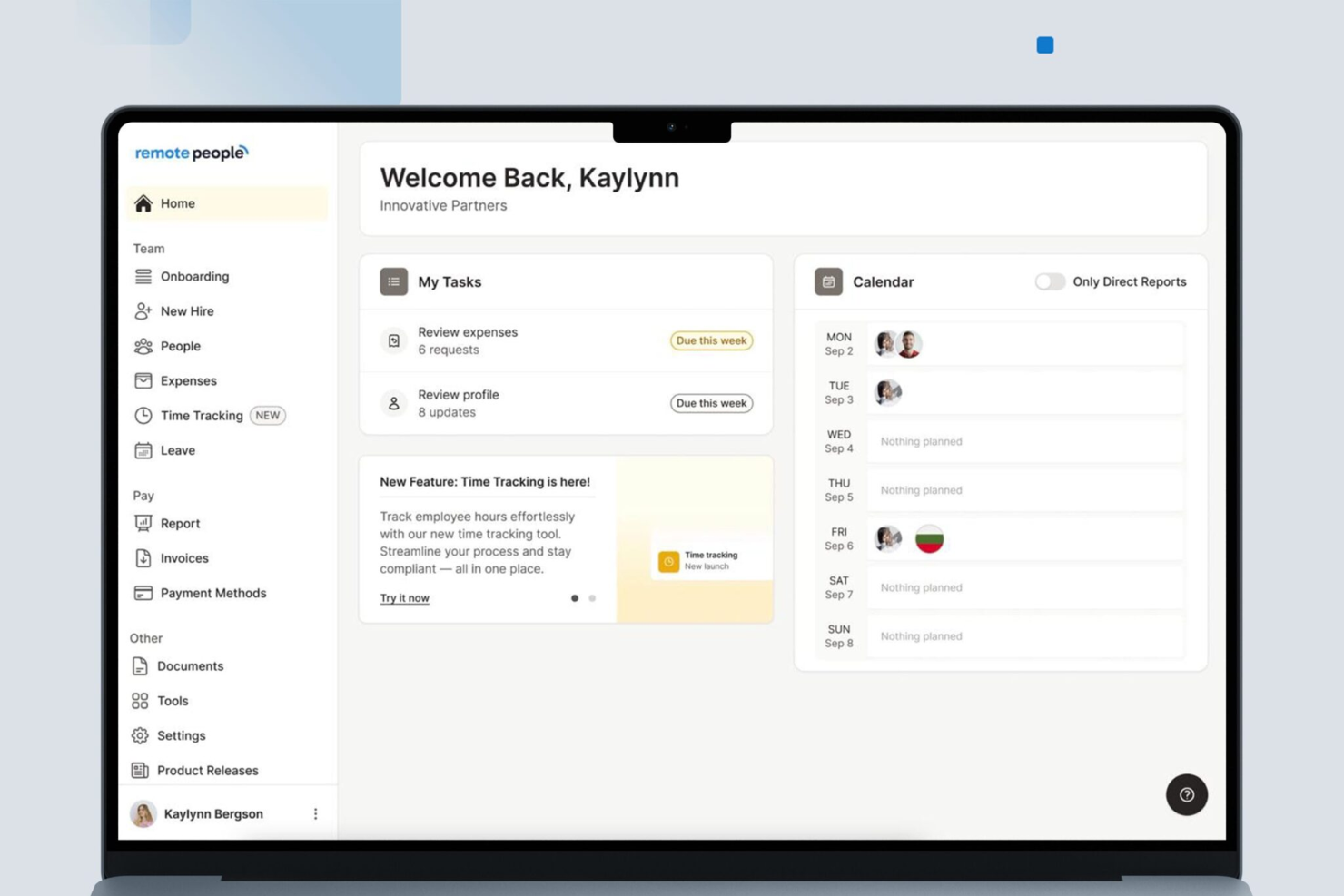
RemotePeople is an employer of record platform covering 150+ countries, with owned local entities that handle payroll, tax withholding, statutory benefits, and employment compliance across multiple jurisdictions from a single dashboard.
Who Is RemotePeople Best For?
RemotePeople is a good fit for mid-size companies hiring across multiple countries at once, where managing payroll compliance in each jurisdiction would otherwise require multiple local providers.
Why I Picked RemotePeople
I picked RemotePeople as one of the best because its compliance engine is genuinely built for multi-country hiring at scale. It monitors labor codes, tax authority updates, and social security rules across 150+ countries, then automatically pushes changes to your contracts, payslips, and benefits before they take effect. I also like the full audit trail this generates, which makes payroll-compliance reviews straightforward when hiring across jurisdictions that include Hong Kong.
RemotePeople Key Services
- Expense management: Submit, approve, and reimburse employee expenses in one workflow, with country-specific tax treatment applied automatically.
- Time and leave management: Track hours, approve PTO, and manage statutory leave entitlements by jurisdiction, including Hong Kong's mandatory leave requirements.
- Equity management: Offer compliant stock options and RSUs to international employees, with local tax filings handled per country.
- Equipment provisioning: Source, ship, and recover laptops and peripherals worldwide, with returns and disposal included.
RemotePeople Integrations
Integrations are not publicly listed.
Pros and Cons
Pros:
- Candidate placement guarantee
- Dedicated client support contact
- Wide recruitment network
Cons:
- No publicly listed integrations
- Some services available only in certain regions

Best for compliance with Hong Kong laws

Multiplier is a global EOR platform that handles employment contracts, multi-country payroll, benefits administration, and local labor law compliance across 150+ countries, including Hong Kong.
Who Is Multiplier Best For?
Multiplier is a strong fit for mid-sized companies hiring across multiple countries simultaneously, including Hong Kong as part of a broader global expansion.
Why I Picked Multiplier
Multiplier earns its spot on my shortlist because its compliance engine is built specifically to handle the Employment Ordinance, MPF contributions, and IRD salaries tax withholding without manual intervention. I like that it generates locally compliant Hong Kong employment contracts in under five minutes, with customizable terms for working hours, remuneration, and termination conditions. Multiplier also backs that automation with 100+ in-house legal and tax experts, so you're not relying on third-party advisors when a compliance question comes up.
Multiplier Key Services
- Multi-currency payroll: Run payroll across 120+ currencies from a single dashboard, with on-time payments to Hong Kong employees.
- Benefits and insurance administration: Enroll Hong Kong employees in local health, wellness, and ESOP benefit packages directly through the platform.
- Expense and leave management: Review, approve, and track employee expenses and leave requests without leaving the platform.
- 24/5 local HR and legal support: Access in-house HR and legal experts directly, with no third-party handoffs or delays.
Multiplier Integrations
Integrations include HiBob, BambooHR, Workday, Deel, and more.
Pros and Cons
Pros:
- 24/7 customer support
- Helps businesses meet local tax and labor requirements
- Supports payroll across over 150 countries
Cons:
- Limited self-service resources and troubleshooting guides
- Some users may find the interface initially difficult to navigate

Best for 24/5 dedicated support

TopSource is a global employer of record platform covering 180+ countries, with country-specific payroll, locally compliant employment contracts, benefits administration, and dedicated account management built into its service model.
Who Is TopSource Best For?
Small to mid-sized companies hiring internationally across multiple regions will get the most from TopSource, particularly those who want a dedicated account manager rather than a ticket queue.
Why I Picked TopSource
I've included TopSource in my top picks because its 24/5 dedicated phone support is genuinely different from what most EOR platforms offer. When a Hong Kong compliance question comes up, you're not filing a support ticket or waiting on a chatbot. You get a direct line to a country specialist who knows local payroll and employment law. I also like that every account includes a named client success manager who meets with your team quarterly and proactively flags optimization opportunities.
TopSource Key Services
- Customizable employment contracts: Build locally compliant employment contracts for Hong Kong hires, with terms tailored to your organization's needs.
- Bespoke benefits administration: Configure benefits packages specific to each country rather than applying a one-size-fits-all approach.
- Hands-on employee onboarding: TopSource manages the full onboarding process for new hires, including documentation and local compliance steps.
- Global employment dashboard: Manage all international employees from a single dashboard, with a dedicated API available for custom integrations.
TopSource Integrations
TopSource offers integrations with Workday, SAP SuccessFactors, UKG, BambooHR, HiBob, Personio, Keka, Greenhouse, Lever, Workable, and JazzHR.
Pros and Cons
Pros:
- Service includes direct access to local experts
- Strategic HR guidance available for expansion planning
- Wide country coverage with 180+ supported markets
Cons:
- No integrations with popular HRIS platforms
- Limited reporting or automation features compared to tech-driven platforms

Best for hiring via a wholly-owned HK entity
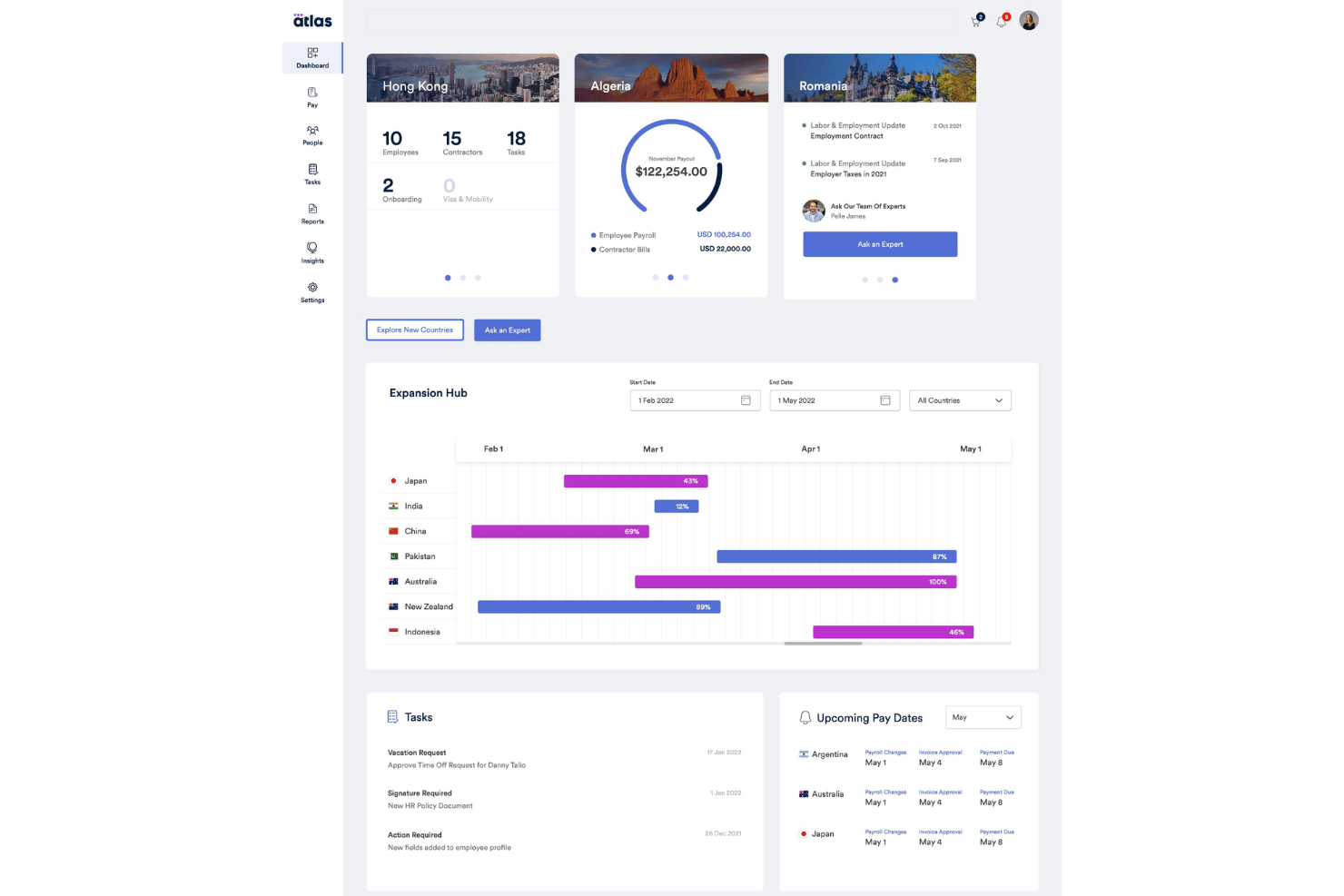
Atlas HXM is a direct employer of record platform that hires and manages employees in Hong Kong and 160+ countries through its own wholly-owned legal entities, covering local payroll in HKD, MPF administration, statutory benefits, work visa sponsorship, and employment contract generation.
Who Is Atlas HXM Best For?
Atlas HXM is a strong fit for global expansion leaders and HR teams that need a transparent, entity-owning EOR partner to hire in Hong Kong without relying on a third-party employer.
Why I Picked Atlas HXM
Atlas HXM earns its spot on my shortlist because it owns and operates its Hong Kong entity directly, which means your employment contracts, MPF contributions, and payroll run through Atlas itself rather than a local third party. I find that distinction meaningful: when the 10th-of-month payroll deadline hits or the minimum wage updates (HKD 43.10 from May 2026), you're dealing with one accountable employer of record, not a partner chain. I also like that visa sponsorship for Hong Kong Employment Visas is built into the platform as a managed add-on, covering eligibility assessment through renewal.
Atlas HXM Key Features
- MPF administration: Atlas HXM calculates and manages both employer and employee MPF contributions, applying statutory caps and exemption thresholds automatically each pay cycle.
- Visa sponsorship add-on: A managed immigration service covers Hong Kong Employment Visa applications and renewals end-to-end, from eligibility assessment through consular support.
- Employee self-service portal: Employees access payslips, tax documents, leave requests, and benefits changes through a web portal and iOS/Android app.
- HRIS integrations: Native connections to Workday, BambooHR, Sage, and other platforms sync employee records and headcount changes without manual data entry.
Atlas HXM Integrations
Atlas HXM integrates with Workday, BambooHR, Sage, Ashby, Paycor, UKG, and Dayforce, plus single sign-on through Okta, Microsoft, and Google Workspace.
Pros and Cons
Pros:
- Responsive account management receives reviewer praise
- Local MPF and payroll administration
- Direct Hong Kong entity ownership
Cons:
- Portal issues may affect pay accuracy
- Payroll deadlines can limit flexibility

With direct entity presence across Asia Pacific, Skuad is an EOR platform that manages Hong Kong employment contracts, payroll, statutory benefits, and contractor engagements from one dashboard.
Who Is Skuad Best For?
Skuad works well for HR and people operations teams at growth-stage tech companies expanding into Hong Kong from Southeast Asia or other APAC markets.
Why I Picked Skuad
Skuad earns its spot on my shortlist because it's one of the few EOR platforms built with startup DNA—founded in Singapore and clearly designed with APAC-first hiring in mind. I like that it combines EOR and AOR in one dashboard, so you can hire a full-time engineer in Hong Kong and onboard a contractor simultaneously without switching tools or paying for separate platforms. It also includes built-in contractor misclassification checks, which matters a lot in Hong Kong given the territory's strict "418 rule" around worker classification. Skuad's AI-driven compliance automation handles regulatory documentation automatically, which is genuinely useful when your people ops team is still small.
Skuad Key Services
- MPF compliance management: Skuad handles Mandatory Provident Fund enrollment and contribution calculations for Hong Kong employees automatically.
- Multi-currency payroll: Run payroll in HKD and 70+ other currencies from a single platform without switching between systems.
- Visa and work permit support: Skuad manages work permit applications and global mobility documentation directly within the platform.
- Statutory leave tracking: Track and enforce Hong Kong statutory entitlements, including annual leave and paid sick days, from within the employee dashboard.
Skuad Integrations
Skuad offers 70+ integrations across HR, accounting, and time tracking categories, including BambooHR, ADP Run, ADP Workforce Now, Gusto, HiBob, Deel, Employment Hero, Darwinbox, FreshBooks, and Harvest. API-based integrations are available by contacting the Skuad team for custom workflows.
Pros and Cons
Pros:
- Suitable for international expansion
- Quick onboarding process
- Tailored solutions for startups
Cons:
- Requires commitment for lower pricing
- Limited to certain industries

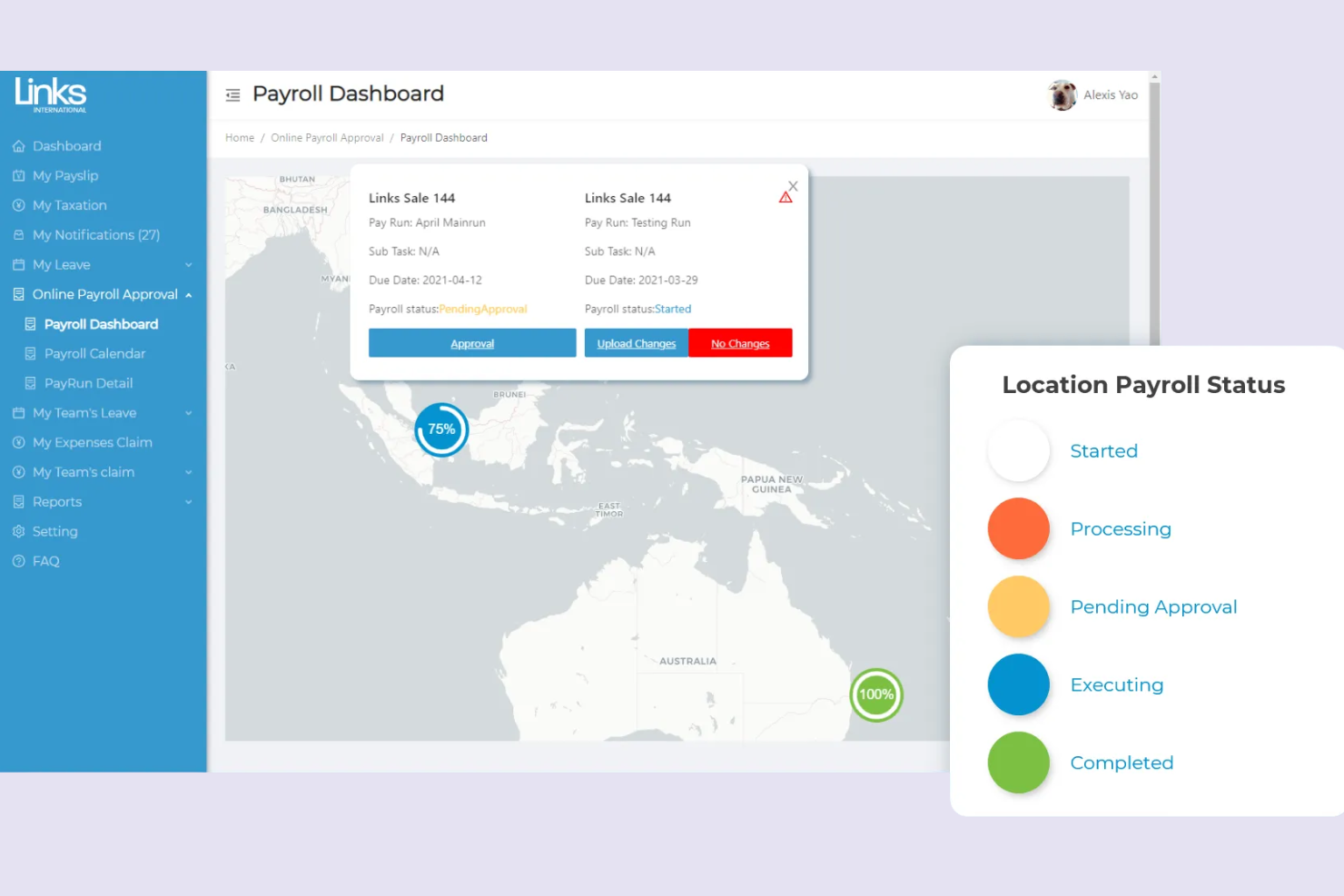
Links International is an APAC-focused employer of record that hires staff through its own Hong Kong entity, managing local payroll, MPF enrollment, IRD tax reporting, visa applications, and Employment Ordinance compliance.
Who Is Links International Best For?
Links International is a strong fit for mid-size to large organizations expanding across APAC that need a Hong Kong EOR backed by in-country entities, deep regional compliance expertise, and integrations with enterprise HR systems like Workday and SAP SuccessFactors.
Why I Picked Links International
Links International earns its spot on my shortlist because it operates through its own Hong Kong entity, which means your workers are employed directly by Links rather than through a third-party partner. I particularly like that it covers the full Employment Ordinance lifecycle, including MPF enrollment, IRD tax reporting, and termination paperwork like IR56F and IR56G forms. When your team needs a dependent visa for a relocated hire's family, Links handles that too, covering spousal and under-18 dependant applications alongside the primary work permit.
Links International Key Features
- Links One payroll platform: A self-service hub where employees can view payslips, submit leave requests, and access tax documents via desktop, mobile app, or Microsoft Teams.
- HR system integrations: A built-in integration hub connects payroll and benefits data with Workday, SAP SuccessFactors, BambooHR, Oracle HCM Cloud, and major ERP and BI tools.
- EOR cost calculator: A free online tool that estimates Hong Kong employment costs, including salary, employer MPF contributions, taxes, and statutory benefits.
- Quarterly labor law updates: Links publishes regular compliance updates covering Hong Kong Employment Ordinance changes, keeping your HR team current on regulatory shifts.
Links International Integrations
Links International offers integrations with Workday, SAP SuccessFactors, BambooHR, Oracle HCM Cloud, and Microsoft Teams. Its Integration Hub also connects payroll, leave, and benefits data with ERP, accounting, and reporting tools.
Pros and Cons
Pros:
- Supports dependant visas and termination compliance
- Onboards employees in under 48 hours
- Employs workers through its own Hong Kong entity
Cons:
- Contract language and legal review remain unclear
- More suited to mid-size and large employers


AYP Group is an APAC-focused employer of record that lets you hire, onboard, and pay employees in Hong Kong through its own locally incorporated entity, covering payroll, MPF, tax filings, visa sponsorship, and bilingual employment contracts.
Who Is AYP Group Best For?
AYP Group is a strong fit for companies expanding across multiple APAC markets who want a single regional partner to handle Hong Kong hiring and compliance.
Why I Picked AYP Group
I've included AYP Group in my top picks because it's built specifically for APAC hiring, which matters when Hong Kong is your entry point into a broader regional strategy. Its directly owned Hong Kong entity means you're not routed through a partner network, and its compliance coverage is current: it already reflects the 2025 MPF offset abolition and the 2026 "4-6-8" continuous contract rule. I also like that it sponsors multiple visa types, including the Top Talent Pass Scheme and QMAS, making it practical for hiring foreign nationals fast.
AYP Group Key Features
- Zero-penalty compliance guarantee: AYP covers any penalties resulting from its own compliance errors, so the financial risk stays with them, not you.
- IR56 tax filing management: AYP handles IR56E registration, annual IR56B filings, and IR56F/IR56G on employee departure, including final payment holds pending IRD clearance.
- Multi-visa sponsorship: AYP sponsors General Employment Policy, Top Talent Pass Scheme, QMAS, and ASMTP visas directly through the Immigration Department's online system.
- Role-based payroll platform access: AYP Global Pay lets you assign HR or Finance roles to different team members for approvals, reporting, and dispute tracking.
AYP Group Integrations
Native integrations are not clearly documented. AYP Global Pay can be used alongside other global HR or payroll platforms, but specific vendors, marketplace connections, and API availability aren't published.
Pros and Cons
Pros:
- Multiple visa pathways support foreign-national hiring
- Current guidance covers changing statutory requirements
- Hong Kong entity supports faster local hiring
Cons:
- Independent customer reviews remain very limited
- Hong Kong hiring speed claims vary

Pebl
Best for multi-country hiring from one platform
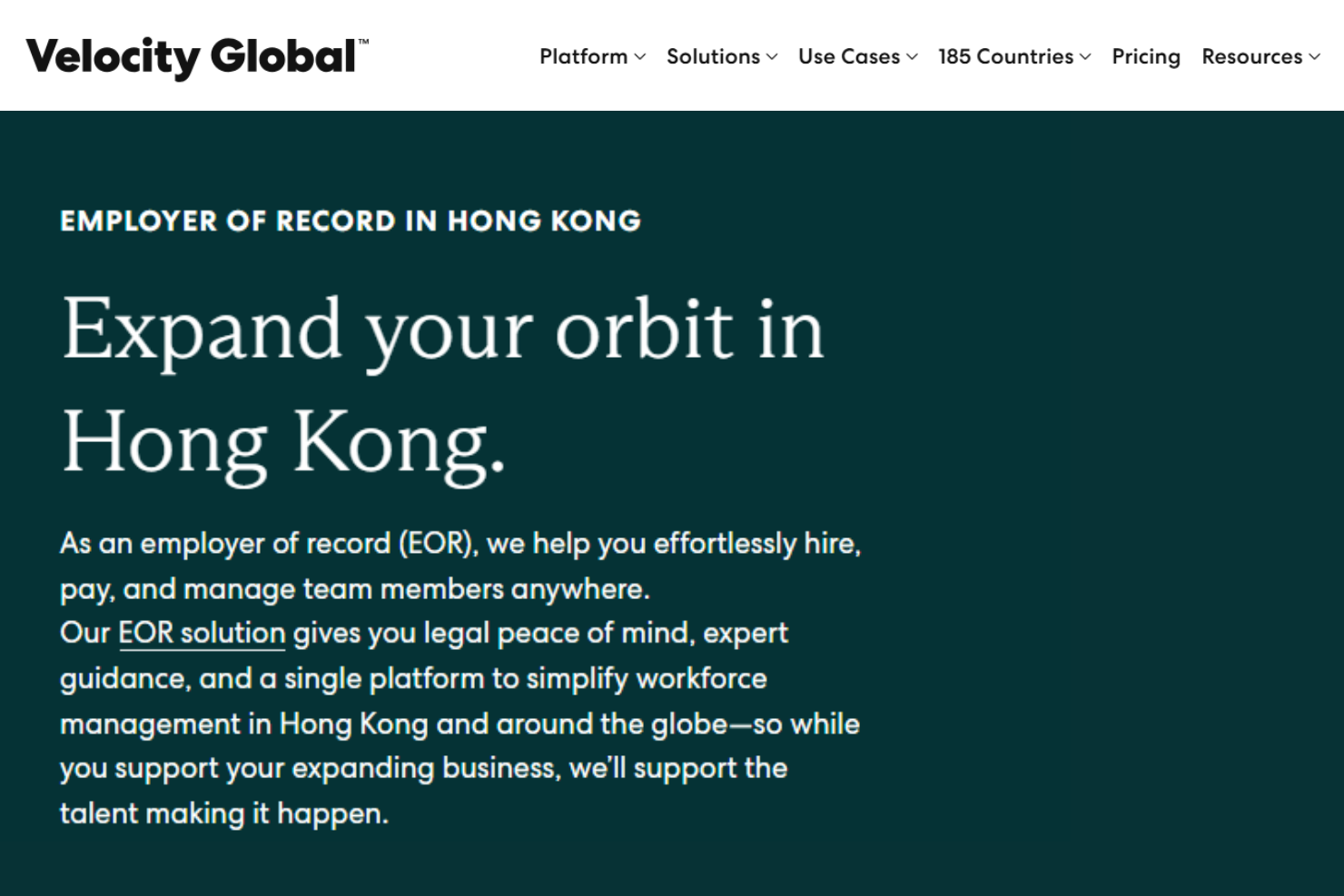
Pebl is an employer of record platform that covers hiring, onboarding, payroll, MPF administration, benefits, compliance, and offboarding across 185+ countries from a single platform.
Who Is Pebl Best For?
Pebl is a strong fit for HR and finance teams managing hires across multiple countries from a single platform.
Why I Picked Pebl
I've included Pebl in my top picks because it's one of the few EOR platforms I've seen that genuinely consolidates multi-country hiring into a single workflow, which matters when you're managing hires in Hong Kong alongside other markets. Its platform covers MPF administration, monthly HKD payroll, and statutory compliance from one place, so your team isn't stitching together separate tools per country. Pebl also holds a published Hong Kong Employment Agency Licence and is backed by Baker McKenzie for compliance guidance, giving you a credible foundation for local hiring.
Pebl Key Features
- Baker McKenzie compliance vetting: Pebl's employment contracts and compliance guidance are reviewed and vetted by Baker McKenzie, a global law firm.
- Alfie AI assistant: Pebl's built-in AI assistant answers HR and compliance questions in 50+ languages, available directly within the platform.
- Employee Cost Calculator: A self-serve tool that estimates employer costs for up to five roles by country and salary before you commit to a quote.
- 250+ platform integrations: Pebl connects with leading HRIS, ATS, and finance tools—including Workday, BambooHR, Greenhouse, and NetSuite—via native integrations and open API.
Pebl Integrations
Pebl offers 250+ integrations, including Workday, Oracle HCM Cloud, BambooHR, Greenhouse, NetSuite, and SAP Concur. Its open API supports custom integrations.
Pros and Cons
Pros:
- Baker McKenzie-vetted compliance guidance supports hiring
- MPF contributions and account closure handled
- Hong Kong Employment Agency Licence publicly listed
Cons:
- Conflicting notice and minimum-wage figures appear
- Hong Kong visa guidance remains outdated
Other Employer of Record Services in Hong Kong
Here are some additional EOR providers in Hong Kong that didn’t make it onto my shortlist but are still worth considering:
- G-P
For global reach
- Native Teams
For direct hiring in Hong Kong
- Papaya Global
For enterprise HRIS-connected HK payroll
- Remote
For enterprise-grade data security standards
- Playroll
For flat-rate HK market entry testing
- Gloroots
For flat-rate Hong Kong market testing
- Rivermate
For multilingual support


Market Details for Hiring in Hong Kong
- Capital City: Hong Kong (Hong Kong is a Special Administrative Region and its own capital)
- Currency: Hong Kong Dollar (HKD)
- Payroll Frequency: Monthly (most common)
- Official Language: Chinese (Cantonese) and English
- Estimated Current Population: Approximately 7.4 million
- Number of Public Holidays: 17 statutory/public holidays
Why Hire Employees in Hong Kong?
Hong Kong stands out as a premier destination for companies aiming to hire international talent because of its strategic position as a global financial hub, coupled with a free-market economy and low taxation, creates an environment conducive to business expansion.
The city's proximity to Mainland China and integration with the Greater Bay Area offer unparalleled access to a vast market and cross-border collaboration opportunities. Furthermore, government initiatives like the Quality Migrant Admission Scheme and the Top Talent Pass Scheme demonstrate a commitment to attracting skilled professionals worldwide.
Hong Kong offers a deep talent pool in key business sectors like financial services, technology, and logistics, and its international connectivity and multilingual workforce proficient in English and Chinese further adds to its appeal.
Selection Criteria for Hong Kong Employer of Record
When selecting the best EOR services for this list, I considered common business needs and pain points that these providers address, like navigating local labor laws and managing global payroll complexities.
I also used the following framework to keep my evaluations structured and fair:
Core Services (25% of total score): To be considered for inclusion in this list, each provider had to offer these basic services:
- Local and global payroll management
- Compliance with local laws
- Employee benefits administration
- Visa and immigration support
- HR management support
Additional Standout Services (25% of total score): To help further narrow down the competition, I also looked for unique or especially valuable services, such as:
- Local market insights
- Multilingual support
- Tailored compliance advice
- Data security features
- Remote team management
Industry Experience (10% of total score): To get a sense of the industry experience of each provider, I considered the following:
- Years in operation
- Number of clients served
- Range of industries covered
- Presence in multiple countries
- Expertise in local regulations
Onboarding (10% of total score): To evaluate the onboarding experience for each provider, I considered the following:
- Speed of setup
- Clarity of process
- Support during onboarding
- User-friendly platform
- Flexibility in customization
Customer Support (10% of total score): To assess the level of customer support each provider offers, I considered the following:
- Availability of support channels
- Response time to inquiries
- Quality of support staff
- Availability of local support
- Customer feedback on service
Value for Price (10% of total score): To evaluate the pricing and potential ROI of working with each provider, I considered the following:
- Transparency of pricing
- Competitive pricing
- Included services for the price
- Flexibility of pricing plans
- ROI potential
Customer Reviews (10% of total score): To get a sense of the overall satisfaction of existing customers, I considered the following when reading customer reviews:
- Overall satisfaction ratings
- Comments on service quality
- Feedback on problem resolution
- Testimonials on value for money
- Recommendations from other clients
How to Choose a Hong Kong Employer of Record
It’s easy to get bogged down in long lists of services and complex pricing structures. To help you prioritize the things that matter most for your business, keep the following factors in mind:
| Factor | What to Consider |
| Business Objectives | Ensure the provider aligns with your long-term goals. If you're planning to expand into new markets, check if they support those regions and industries. |
| Service Scope and SLAs | Review the range of services offered and the terms of their Service Level Agreements (SLAs). Make sure they cover all your HR needs, from payroll to compliance. |
| Support Availability | Check if they offer 24/7 support and have local representatives or dedicated account managers. Quick support can be crucial during onboarding and compliance changes. |
| Costs and Pricing Structure | Understand the pricing model and what’s included. Push for transparent pricing to avoid hidden fees and assess if it fits your budget. |
| Communication and Reporting | Evaluate their communication practices and reporting capabilities. Regular updates and clear reporting can help you manage your workforce effectively. |
| Compliance Expertise | Ensure they have strong knowledge of Hong Kong labor laws. This is vital for avoiding legal issues and ensuring smooth operations. |
| Technology Platform | Consider if their technology is user-friendly and integrates with your current systems. A good platform can simplify employee management. |
| Reputation and Reviews | Look for reviews and testimonials from other clients. Positive feedback on service quality and reliability is a good indicator of a trustworthy provider. |
What is an Employer of Record in Hong Kong?
An Employer of Record in Hong Kong is a service that lets companies hire workers in Hong Kong without setting up a local entity. The parent company still controls the employee’s day-to-day work, but the EOR handles everything related to legal employment.
This includes drafting compliant employment contracts, running monthly payroll and tax deductions, managing local employee benefits, handling mandatory pension contributions, and ensuring labor law compliance.
Startups, HR teams, and global companies use EOR services in Hong Kong when they want to hire local talent fast but don’t want to deal with company registration or legal paperwork. Instead, by partnering with an EOR service, the parent company can hire talent quickly and gain peace of mind that all the challenging aspects of global HR will be handled correctly, without mistakes or delays.
Why Use an Employer of Record Service in Hong Kong?
Using an employer of record (EOR) in Hong Kong allows you to hire employees without setting up a local entity or managing payroll, MPF contributions, tax filings, and employment compliance yourself. To hire directly, employers must comply with the Employment Ordinance, Inland Revenue Department (IRD) requirements, and Mandatory Provident Fund (MPF) obligations.
Hong Kong is known for its business-friendly environment, but employers still need to manage statutory leave, MPF contributions, employment contracts, payroll reporting, and visa sponsorship requirements for foreign hires. An EOR helps you stay compliant while reducing administrative overhead and allowing you to hire quickly.
Deciding Between an EOR and a Legal Entity in Hong Kong
When deciding between an EOR and setting up a legal entity in Hong Kong, the main consideration is speed versus long-term operational control.
Setting up a Hong Kong company is generally efficient, but employers still need to manage tax registration, payroll setup, MPF enrollment, employment compliance, and ongoing reporting obligations. An EOR allows you to hire employees immediately without building local HR and payroll infrastructure.
| Feature | Employer of Record (EOR) | Legal Entity (Hong Kong) |
| Setup Time | Fast (days to ~2 weeks) | Moderate (typically a few weeks, including payroll setup) |
| Operational Readiness | Immediate hiring | Delayed until registrations and payroll setup are complete |
| Compliance Responsibility | Shared; EOR handles payroll and employment compliance | Fully on your company |
| Payroll and MPF Setup | Managed by EOR | Must be handled directly or via local providers |
| Administrative Burden | Low | Moderate; ongoing payroll and reporting obligations |
| Flexibility | High | Lower; better for permanent operations |
| Cost Structure | Service fee per employee | Setup + ongoing accounting and payroll costs |
| Best For | Market entry, remote hiring | Long-term local operations |
EOR vs Permanent Establishment in Hong Kong
When hiring in Hong Kong, one key consideration is whether your activities create a Permanent Establishment (PE), which could subject your company to Hong Kong profits tax obligations.
A PE may arise if your company maintains a fixed place of business in Hong Kong or conducts business through employees or agents who habitually conclude contracts on behalf of your company. If a PE exists, locally sourced profits attributable to that presence may become taxable in Hong Kong.
PE risk increases if you:
- Hire employees directly in Hong Kong
- Maintain office space or infrastructure
- Allow employees to negotiate or conclude contracts on behalf of your company
How EORs Protect From Permanent Establishment Risk
An EOR helps reduce PE risk by creating legal and operational separation between your company and your workforce in Hong Kong.
- Legal employer structure. The EOR is the official employer, not your company
- No local entity required. You avoid establishing a direct local business presence
- Payroll and statutory compliance handled locally. MPF, payroll, and tax administration are managed under the EOR’s setup
- Service-based relationship. Your agreement with the EOR is structured as a B2B service contract
- Reduced authority risk. Employees are less likely to be viewed as representatives who can legally bind your company
While an EOR reduces PE risk, the employee’s actual business activities in Hong Kong still matter for tax purposes.
Hiring in Hong Kong: Important Details
- Employment laws in Hong Kong are set by the Labour Department, which administers the Employment Ordinance (Cap. 57), the main legislation governing employment conditions.
- You can hire employees full-time, part-time, or temporary, or make contractor arrangements. The Employment Ordinance does not differentiate between these categories; all employees are entitled to statutory rights and protections. However, statutory protections apply to employees only; independent contractors may be exempt depending on classification.
- Hong Kong has mandatory payroll deductions, including the Mandatory Provident Fund (MPF) contributions. Both employers and employees are required to contribute to the MPF scheme.
- Chinese and English are the official languages in Hong Kong. English is widely used by the government and legal, professional, and business sectors.
- The standard working week in Hong Kong typically consists of 48 hours spread over six days, with eight hours per day. However, no statutory standard exists; actual hours can vary by industry and employer.
- Overtime is allowed under the Employment Ordinance. While the law does not mandate overtime pay, the employer is legally obligated to pay it if an employment contract specifies overtime compensation.
- In Hong Kong, employees are typically paid monthly, usually on the last working day of the month.
- While there is no statutory requirement for a 13th or 14th-month payment, it is customary for employers to provide a 13th-month salary, often referred to as an end-of-year payment or double pay, especially before the Chinese Lunar New Year.
- Paid vacation in Hong Kong starts at seven days of annual leave after 12 months of continuous employment. Based on the length of service, this entitlement increases progressively to a maximum of 14 days.
- National public holidays in Hong Kong include:
- The first day of January: January 1 (1 day)
- Lunar New Year’s Day: Variable date (1 day)
- The second day of Lunar New Year: Variable date (1 day)
- The third day of Lunar New Year: Variable date (1 day)
- Ching Ming Festival: April 4 (1 day)
- Good Friday: Variable date (1 day)
- The day following Good Friday: Variable date (1 day)
- Easter Monday: Variable date (1 day)
- Labour Day: May 1 (1 day)
- The Birthday of the Buddha: Variable date (1 day)
- Tuen Ng Festival: Variable date (1 day)
- Hong Kong Special Administrative Region Establishment Day: July 1 (1 day)
- National Day: October 1 (1 day)
- The day following the Chinese Mid-Autumn Festival: Variable date (1 day)
- Chung Yeung Festival: Variable date (1 day)
- Christmas Day: December 25 (1 day)
- The first weekday after Christmas Day: December 26 (1 day)
- Hong Kong offers parental leave.
- Female employees are entitled to 14 weeks of maternity leave, with pay at four-fifths of their average daily wages, funded by the employer.
- Male employees are entitled to five days of paternity leave and are compensated at four-fifths of their average daily wages, provided they have been employed under a continuous contract for not less than 40 weeks immediately before the day of paternity leave.
- Paid sick leave in Hong Kong is accumulated at the rate of two days per month during the first 12 months of employment and four days per month thereafter, up to a maximum of 120 days.
- Sickness allowance is paid at four-fifths of the average daily wages, provided the sick leave taken is not less than four consecutive days and is supported by an appropriate medical certificate.
- The probationary period in Hong Kong typically ranges from 1 to 3 months, though it can extend up to six months. During the first month of probation, either party may terminate the employment without notice. After the first month, at least seven days' notice is required unless otherwise specified in the contract.
- The termination terms in Hong Kong are mandated by the Employment Ordinance. The required notice period is at least seven days if not specified in the contract. If the contract specifies a notice period, it cannot be less than seven days. In the absence of a specified period, the default notice period is one month.
- Severance pay is offered in Hong Kong to employees who have been employed under a continuous contract for at least 24 months and are dismissed due to redundancy. The payment is calculated as two-thirds of the employee's monthly wages or two-thirds of HK$22,500 (whichever is less) for each year of service.
- Additional points to consider:
- Employers are required to provide employees with a written employment contract outlining the terms of employment.
- Employees are entitled to at least one rest day every seven days.
- Employers must maintain accurate records of employees' wages and employment history.
Tax Overview for Employers in Hong Kong
Hong Kong has a relatively straightforward employer tax system compared to many other jurisdictions.
- There is no employer payroll tax in the traditional sense. Employers are not generally required to withhold broad payroll taxes like many Western jurisdictions.
- MPF contributions are mandatory.
- Employers generally contribute 5% of relevant income (subject to contribution caps)
- Employees also contribute 5%
- Salaries tax is employee-based. Employers report employee compensation to the Inland Revenue Department (IRD), while employees are generally responsible for their own tax liabilities.
- Employer reporting obligations apply.
- Employers must file annual Employer’s Returns and report employee compensation to IRD
- Payroll recordkeeping is mandatory. Employers must maintain payroll and employment records for statutory periods.
- Strict compliance applies for MPF and immigration matters. Penalties can apply for late contributions or non-compliance.
Key Employer of Record Services
When selecting an EOR provider in Hong Kong, keep an eye out for the following key services:
- Payroll management: Handles salary payments and deductions, ensuring timely and accurate compensation for your team.
- Compliance with local laws: Ensures your business adheres to Hong Kong’s labor regulations, minimizing legal risks.
- Employee benefits administration: Manages benefits packages, helping attract and retain top talent.
- Visa and immigration support: Assists with obtaining work visas and simplifying the hiring process if you need to relocate foreign employees.
- HR management: Provides support for day-to-day HR tasks, allowing your team to focus on core business activities.
- Data security: Protects sensitive employee information, ensuring compliance with data protection regulations.
- Multilingual support: Offer services in multiple languages, catering to diverse workforces and enhancing communication.
- Local market insights: Provides valuable knowledge about the Hong Kong market, aiding in strategic decision-making.
- Onboarding services: Streamlines the process of integrating new hires, reducing time to productivity.
- Entity setup assistance: Helps establish a local presence, facilitating market entry and expansion efforts.
Benefits of Using an Employer of Record
Partnering with an EOR service in Hong Kong offers several benefits for your team and your business. Here are a few you can look forward to:
- Quick Market Entry: For organizations interested in testing new markets or hiring talent in new countries where they have no legal presence, an EOR offers a swift and efficient solution to gain market entry, saving time and resources.
- Simplified Global Payroll: Using an EOR service simplifies the complex process of managing international payroll, including tax deductions, withholdings, and currency conversions for your employees worldwide.
- Global Compliance & Risk Mitigation: By managing compliance, an EOR service provides expertise in navigating the intricacies of employment laws, tax regulations, insurance requirements in multiple jurisdictions, and Hong Kong work visas, helping businesses safeguard their operations against compliance-related risks.
- Enhanced Benefits Negotiation: By leveraging their extensive networks and purchasing power, EORs can negotiate better international insurance rates and secure competitive benefits in Hong Kong on your behalf, enhancing your ability to attract and retain top talent worldwide.
- Improved Cost Effectiveness: Using an EOR service is a cost-effective way for businesses to enter new markets, compared to the significant costs of establishing a new foreign entity. The latter option involves significant upfront legal fees, plus other costs related to office infrastructure, staffing, and local benefits and insurance coverage.
Understanding the benefits of an EOR service is crucial for strategic planning and operational efficiency. If you’re looking towards international markets for growth opportunities, partnering with an EOR provider offers a streamlined, cost-effective, and compliant pathway to global expansion.
Costs & Pricing Structures of Employer of Record Hong Kong
Typically, Hong Kong EOR providers follow a per-employee, per-month pricing model. This model gives businesses predictable hiring costs when expanding internationally.
In general, EOR services in Hong Kong cost between $199 and $1,500 per employee per month.
Alternatively, some EOR providers in Hong Kong charge a percentage of the employee’s salary, ranging between 6% to 15%.
Key factors that can influence the pricing of an EOR service include:
- Level of customization: The more tailored the services are to your specific needs, the higher the potential cost. This may include customized solutions for recruitment, specialized employee onboarding, or unique compliance requirements, all of which can affect pricing.
- Industry regulations: Compliance with specific industry standards can add to the overall expense, especially if safety is a concern. In general, the more complex the industry standards are, you’ll see a bigger impact on the price.
- Number of employees: Managing more employees generally increases the cost due to additional administrative work. However, in some cases, higher volumes may trigger volume discounts, making per-employee costs lower if you hire more employees.
- Employee role complexity: The level and nature of the roles being filled can also impact the monthly cost. Senior positions or roles requiring special qualifications may increase the price due to higher benefits and compensation management costs.
- Level of support: EOR providers that offer enhanced support services like 24/7 assistance or dedicated account managers may result in higher fees due to their increased staffing requirements to offer these services.
Some EORs use hybrid or custom pricing models based on unique hiring setups. Understanding the service structure and asking for a breakdown can help you find a provider that fits your team and budget.
Employer of Record Hong Kong: FAQs
Here are some answers to common questions about EOR providers in Hong Kong:
How Does an EOR Handle IP Transfer Upon Termination in Hong Kong?
In Hong Kong, intellectual property (IP) created by employees in the course of employment generally belongs to the employer under Hong Kong copyright and intellectual property laws. When using an EOR, however, the EOR is the legal employer, so IP rights would initially vest with them unless contractual arrangements state otherwise.
To ensure your company retains ownership, EOR providers include IP assignment clauses in both the employment agreement and the service agreement. These agreements create a clear transfer path from the employee to the EOR, and then from the EOR to your company. The provisions remain enforceable after termination, ensuring all work created during employment continues to belong to your business, alongside confidentiality and post-termination protections where permitted under Hong Kong law.
How does an Employer of Record handle payroll in Hong Kong?
An Employer of Record manages payroll by ensuring your team gets paid accurately and on time according to Hong Kong laws. They handle salary calculations, deductions, and tax withholdings. This service relieves you of the administrative burden and helps you comply with local payroll regulations.
Can an Employer of Record help with visa and immigration processes?
Yes, an EOR can assist with obtaining work visas and managing immigration processes for your international hires. They have the expertise to navigate the local legal requirements, ensuring that your team members can work legally in Hong Kong. This support simplifies the hiring of foreign talent.
What compliance support does an Employer of Record provide?
An EOR ensures that your business complies with Hong Kong labor laws and regulations. They keep track of any changes in the law and adjust your practices accordingly. This helps you avoid legal issues and ensures that your employment practices are up to date.
How does an EOR manage employee benefits?
An EOR administers employee benefits programs, ensuring your team receives the appropriate perks and protections. They handle everything from health insurance to retirement plans, tailoring benefits to meet local standards. This management style helps you attract and retain employees effectively.
What level of control do I retain over my employees?
While the EOR handles HR and administrative tasks, you maintain control over your team’s day-to-day management and operations. You make work assignments and performance management decisions while the provider manages compliance and payroll. This allows you to focus on your core business.
How do I choose the right Employer of Record for my business?
Choosing the right Employer of Record involves evaluating their service offerings, industry experience, and reputation. Consider their pricing structure and the level of support they provide. Choosing a provider that aligns with your business goals and can meet your needs is important.
This content is provided for general informational purposes only and does not constitute legal, tax, or other professional advice. It may not be complete, accurate, or current, and laws and practices may change without notice and vary by jurisdiction. You should not act on this information without obtaining advice from qualified legal or tax counsel in the relevant jurisdiction regarding your specific circumstances.