

10 Best Employer of Record in Indonesia: Reviewed in 2026

10 Best Employer of Record Services in Indonesia Shortlist


Struggling to hire employees in Indonesia? Instead of navigating complex Indonesian labor laws, tax regulations, and employment standards, and registering a legal entity with the Ministry of Investment (BKPM) and the Ministry of Law and Human Rights, there is a better way! Instead, you can use an Employer of Record (EOR) in Indonesia to outsource your legal responsibilities and simplify this process immensely.
An Indonesian EOR will manage the complexities of local employment regulations, including tax registration and mandatory social security contributions, allowing you to concentrate on growing your business. This way, you'll avoid potential legal consequences and stay in compliance with the Ministry of Manpower’s labor regulations.
However, determining the best Indonesian EOR service for your needs can take time and research. Luckily for you, I’ve already done all the legwork! In this article, I’ll walk you through my top recommendations for the best Employer of Record services for hiring in Indonesia to help you find the best fit for your needs.
Why Trust Our Software Recommendations
Our team has been testing and reviewing software since 2012. As HR experts ourselves, we know how difficult—and important—it is to choose the right software.
For this guide, we evaluated tools using hands-on testing and independent research, scoring tools using our selection criteria. We also draw on insights from industry thought leaders and practicing HR experts.
Our reviews reflect our human editorial judgment, not a sales pitch.
Expert reviewers:
Employer of Record in Indonesia Comparison Table
This comparison table summarizes pricing details for my top Indonesian EOR selections.
| Tool | Best For | Trial Info | Price | ||
|---|---|---|---|---|---|
| 1 | Best for navigating labor regulations | Free demo available | From $599/employee/month | Website | |
| 2 | Best for vetted talent sourcing | Free demo available | From $199/user/month | Website | |
| 3 | Best for compliance support | Free demo available | From $199/user/month | Website | |
| 4 | Best for rapid onboarding | Free demo available | From $599/employee/month | Website | |
| 5 | Best for indemnification-backed hiring | Free demo available | From $199/employee/month | Website | |
| 6 | Best for APAC payroll with IDR and ESOP support | Free demo available | From $459/user/month (billed annually) | Website | |
| 7 | Best for direct hiring in Indonesia | Free demo available | From $99/employee/month | Website | |
| 8 | Best for extended weekday support | Free demo available | Pricing upon request | Website | |
| 9 | Best for owned-entity hiring across 160+ markets | Free demo available | From $599/user/month | Website | |
| 10 | Best for month-to-month Indonesia hiring | Not available | Pricing upon request | Website |


Best Employer of Record Indonesia Reviews
Below are my detailed summaries of the best Employer of Record providers in Indonesia that made it onto my shortlist. My reviews offer a look at each provider’s key services, unique specialties, and pros & cons to help you find the best one for your needs.

Best for navigating labor regulations
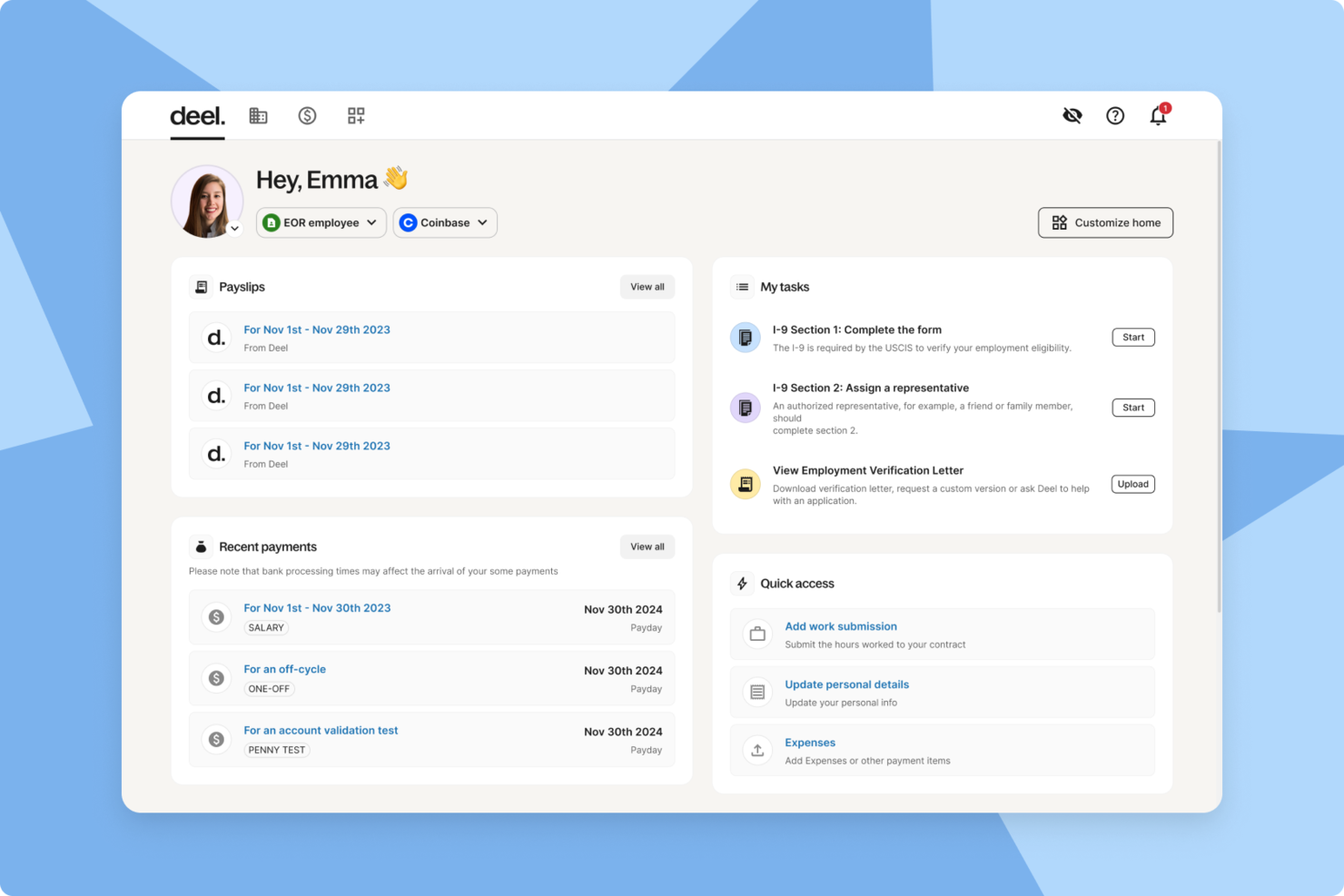
Deel Hire is a global EOR platform that handles employment contracts, payroll, tax compliance, and statutory benefits for full-time employees in Indonesia and 150+ other countries.
Who Is Deel Hire Best For?
Deel Hire is a strong fit for mid-size to enterprise companies that need to manage both full-time employees and contractors across multiple countries from a single platform.
Why I Picked Deel Hire
Deel Hire earns its spot on my shortlist because it has built Indonesian statutory benefits directly into the platform. I can add BPJS and optional private healthcare through Allianz, KBRU, or Unisure from the same dashboard I use for contracts and payroll. I also like that Deel's 250+ in-house legal and compliance experts handle Indonesian tax calculations, including the country's nuanced overtime tiers, which range from 150% to 400% of the hourly rate depending on the day and hours worked.
Deel Hire Key Services
- Automated contract generation: Generate locally compliant Indonesian employment contracts in minutes, with terms that reflect current labor law requirements.
- Time off management: Track and manage Indonesian statutory leave entitlements, including annual leave and public holidays, from within the platform.
- Expense management: Employees can submit expense claims directly through Deel, with multi-currency reimbursement support built in.
- Background checks: Run pre-employment background checks on Indonesian candidates directly through the platform before finalizing a hire.
Deel Hire Integrations
Deel offers a large app store with integrations across HR, accounting, and recruiting categories, including BambooHR, Greenhouse, Ashby, Workday, NetSuite, QuickBooks, Xero, Slack, Hibob, and Okta. It's available on Zapier and has an API for custom integrations with HRIS, finance, and ERP systems.
Pros and Cons
Pros:
- Built-in Indonesian statutory benefits like BPJS
- Handles contractor-to-employee conversion easily
- Compliance Hub monitors local regulatory changes
Cons:
- AI chat support can delay complex issue resolution
- Custom benefits setup requires support team help

Best for vetted talent sourcing
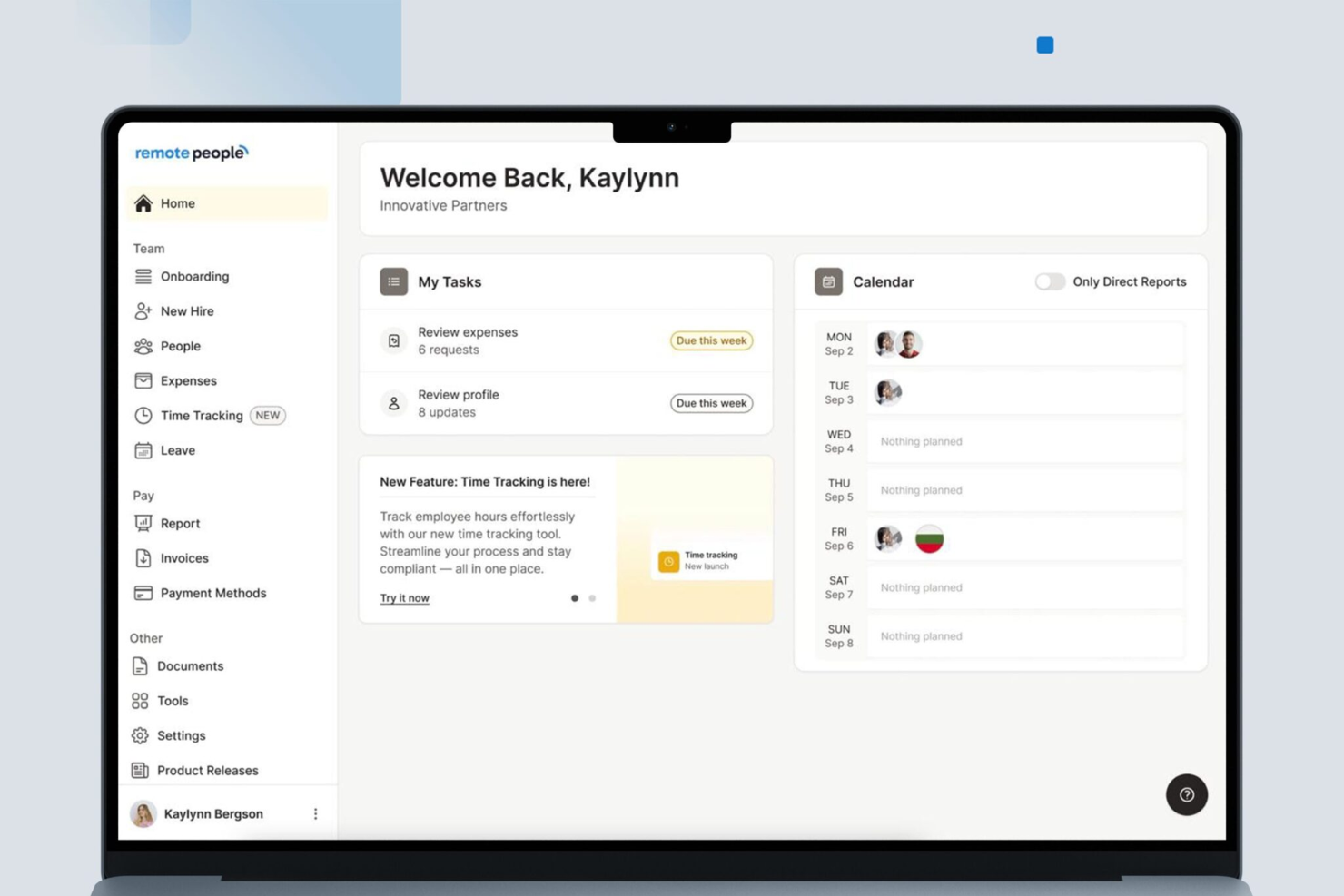
RemotePeople is an employer of record platform focused on Indonesia and the broader Asian market, handling BPJS registration, payroll, tax withholding, and employment compliance without requiring you to set up a local entity.
Who Is RemotePeople Best For?
RemotePeople is a strong fit for companies looking to hire in Indonesia and Southeast Asia without navigating local labor law on their own.
Why I Picked RemotePeople
RemotePeople earns its spot on my shortlist because of how deeply it's built around Indonesian and Southeast Asian compliance specifically. I love that it handles BPJS Kesehatan and BPJS Ketenagakerjaan registrations directly, including the tiered contribution calculations that trip up most foreign employers. It also manages THR religious holiday bonuses and PPh 21 tax withholding using the TER method, which became mandatory in 2024. For teams expanding across ASEAN, I think the regional coverage is genuinely useful.
RemotePeople Key Services
- Employment contract drafting: RemotePeople prepares both permanent (PKWTT) and fixed-term (PKWT) contracts in Bahasa Indonesia, which are legally required for enforceability.
- Work permit and KITAS processing: RemotePeople manages the full RPTKA approval and KITAS application for foreign hires, including the USD 100 monthly compensation fund.
- Severance calculation support: RemotePeople handles severance calculations under GR 35/2021, including service appreciation pay and the applicable termination multiplier.
- Payslip generation: RemotePeople produces detailed monthly payslips showing gross salary, BPJS deductions, PPh 21 withholding, and net pay.
RemotePeople Integrations
RemotePeople offers direct integrations with BambooHR, Rippling, HiBob, and Workday, and has a standard API for custom integrations. For less common HRIS combinations, it also connects through middleware like Zapier.
Pros and Cons
Pros:
- Dedicated account manager for every client
- Covers BPJS and THR compliance directly
- Includes in-house recruitment alongside EOR
Cons:
- Limited automation for leave approvals
- Time tracking lacks project-level detail

Best for compliance support

RemoFirst is a global EOR platform that covers payroll processing, employment contracts, benefits administration, and onboarding for full-time hires in Indonesia and 180+ other countries.
Who Is RemoFirst Best For?
RemoFirst is a natural fit for startups and scale-ups that need to hire across multiple countries at once, not just Indonesia.
Why I Picked RemoFirst
I've included RemoFirst in my top picks because it covers the full employment lifecycle in Indonesia within a single platform, from contract generation and onboarding to monthly payroll and BPJS contributions. I especially like that payroll invoices can be aggregated across multiple countries into one payment, which is genuinely useful if Indonesia is just one of several markets you're hiring in. The platform also handles fixed-term PKWT contracts directly, including the five-year conversion rules that catch many foreign employers off guard.
RemoFirst Key Services
- Background checks: Run pre-employment background checks on Indonesian candidates directly through the platform before finalizing a hire.
- Visa and work permit support: RemoFirst handles visa and work permit applications for foreign nationals being placed in Indonesia, covering 110+ countries in total.
- THR bonus administration: RemoFirst calculates and processes the mandatory Tunjangan Hari Raya religious holiday bonus, including pro-rated amounts for employees with under 12 months of service.
- Contractor onboarding: Onboard and pay independent contractors in Indonesia separately from full-time employees, with built-in misclassification risk management.
RemoFirst Integrations
RemoFirst offers a small set of native integrations, including BambooHR, ADP Workforce Now, and GoCardless. An API is available for custom integrations, though it may involve additional setup costs.
Pros and Cons
Pros:
- Aggregates multi-country payroll into one invoice
- Onboards new hires within one to three days
- Visa assistance available
Cons:
- Limited reporting and workflow automation options
- Relies on local partners, not owned entities

G-P
Best for rapid onboarding

G-P offers Employer of Record services, focusing on global hiring, payroll, and compliance solutions for businesses expanding internationally. Their main client base includes companies seeking rapid market entry without setting up local entities.
Why I picked G-P: G-P excels in rapid onboarding, enabling your team to hire employees quickly in new markets. Their platform manages local compliance and payroll, ensuring your team can focus on growth without regulatory headaches. With their services, you can efficiently expand your global workforce.
Standout Services: G-P offers automated compliance tracking, keeping your business updated with the latest regulatory changes in each market. They also provide international payroll management, simplifying salary disbursement across different currencies and regions.
Target industries: Technology, finance, healthcare, manufacturing, and retail.
Specialties: Rapid onboarding, global hiring, payroll management, compliance tracking, and market entry.
Pros and Cons
Pros:
- Strong global presence
- Efficient payroll management
- Fast market entry
Cons:
- Focused on larger enterprises
- Pricing details are not transparent

Best for indemnification-backed hiring
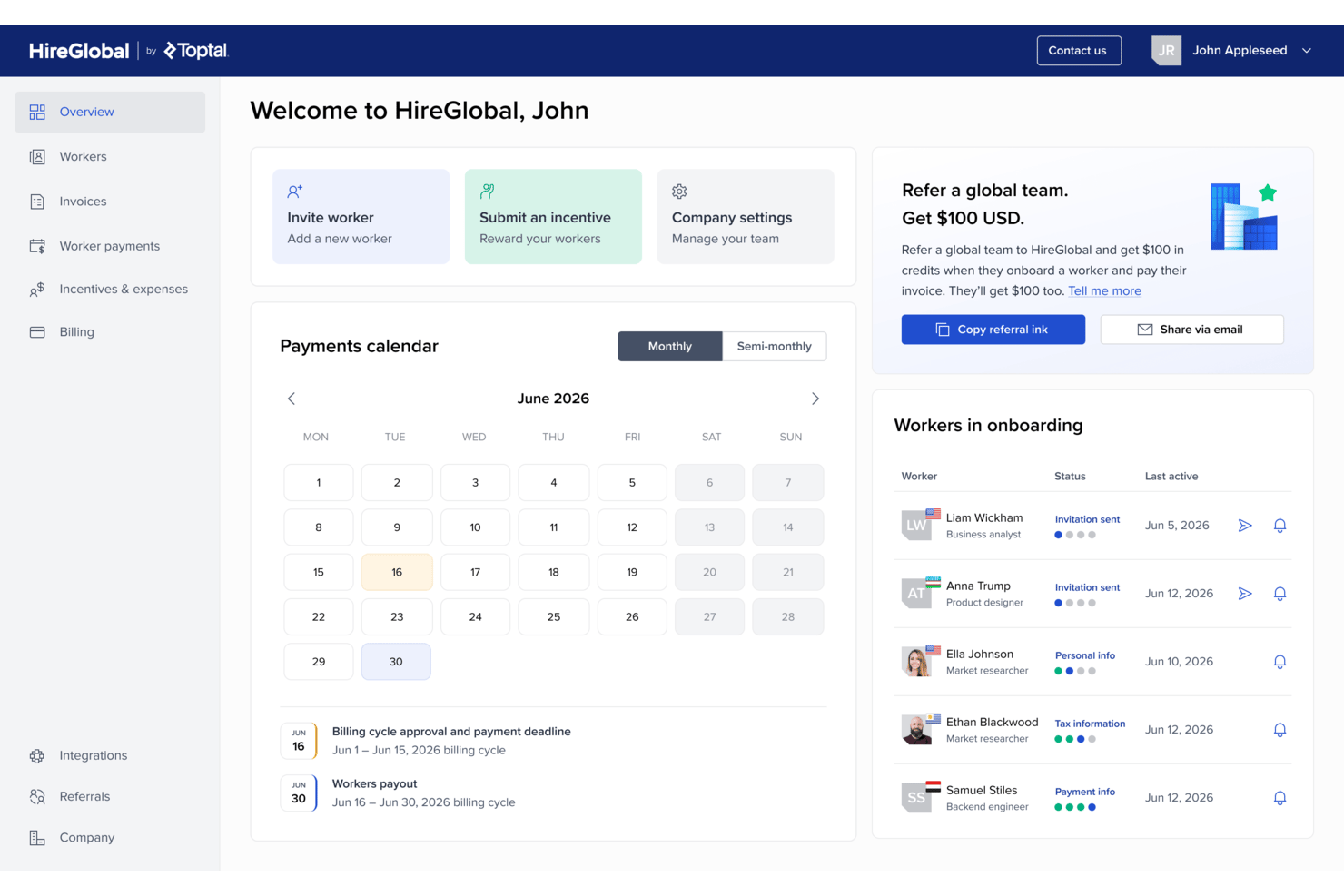
HireGlobal is Toptal's global workforce platform that offers employer of record, virtual EOR, agent of record, and contractor management services across 100+ countries from a single consolidated HRIS.
Who Is HireGlobal Best For?
HireGlobal suits companies that want to hire international contractors or remote workers with built-in misclassification protection across multiple engagement models.
Why I Picked HireGlobal
I've included HireGlobal in my top picks because its $1M per-worker indemnification on Virtual EOR engagements is a genuinely rare feature, giving you a financial backstop against misclassification claims when hiring across borders. It also combines contractor, AOR, V-EOR, and full EOR models on one platform, so you can shift a worker's engagement type without switching vendors. Backed by Toptal's payments infrastructure, it processes payroll across 50+ currencies with consolidated invoicing.
HireGlobal Key Features
- Multi-model engagement: Switch a worker between contractor, AOR, V-EOR, and full EOR arrangements without changing platforms or vendors.
- Consolidated invoicing: Receive a single invoice covering all workers, engagement types, salaries, and payments across 50+ currencies.
- Built-in background checks: Run identity verification, global watchlist screening, employment history checks, and criminal record checks directly within the platform.
- Local payroll support: Manage payroll for teams in countries where you already have an entity, alongside workers hired through EOR arrangements.
HireGlobal Integrations
HireGlobal integrates with TopTracker for time tracking and worker payments. Other listed integrations, including Slack, Jira, Workday, BambooHR, Rippling, Gusto, Claude, and ChatGPT, are under development and not confirmed as live.
Pros and Cons
Pros:
- Users report responsive support and reliable payouts
- Multiple engagement models support workforce changes
- $1M V-EOR indemnification protects against misclassification
Cons:
- Third-party entities may limit local oversight
- Indonesia-specific compliance capabilities remain undocumented

Best for APAC payroll with IDR and ESOP support
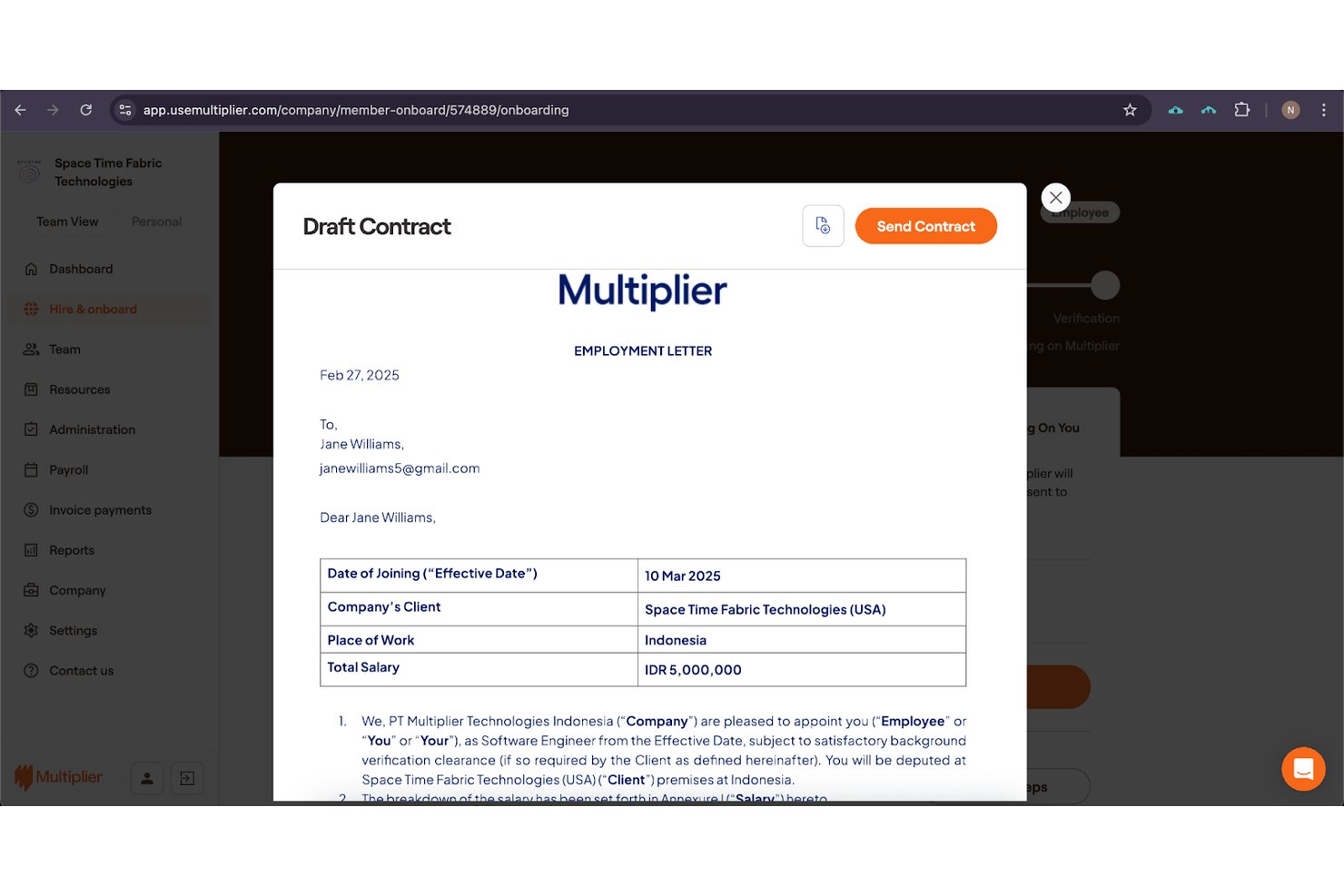
Multiplier is a Singapore-headquartered employer of record platform that manages IDR payroll, BPJS administration, THR automation, ESOP support, and Omnibus Law-compliant contracts for teams hiring in Indonesia without a local entity.
Who Is Multiplier Best For?
Multiplier is a strong fit for APAC-focused teams that need to hire in Indonesia quickly and want equity compensation built into their EOR setup from day one.
Why I Picked Multiplier
Multiplier earns its spot on my shortlist because of how well it handles the APAC payroll complexity that trips up most EOR platforms in Indonesia. I'm particularly impressed by its built-in ESOP administration, which lets you grant equity to Indonesian hires without spinning up a separate provider. Pair that with automated PPh 21 withholding using the 2024 TER method and full BPJS remittance, and you've got end-to-end statutory compliance handled in one place.
Multiplier Key Features
- Employee Cost Calculator: Estimates total hiring costs for Indonesian employees, including BPJS contributions, THR, and PPh 21, before you make an offer.
- Contractor-to-employee conversion: Built-in worker classification tooling lets you convert Indonesian contractors to full employees without switching platforms.
- Multi-currency billing: Clients can be billed in USD, SGD, AUD, EUR, or GBP while Indonesian employees receive payroll in IDR.
- Dedicated customer success manager: Each account gets a named CSM with 24/5 human support for compliance and payroll questions.
Multiplier Integrations
Multiplier offers a marketplace integration with BambooHR, plus integrations with Microsoft 365 and Power Automate. API Gateway and Anypoint support custom HR and payroll data connections, while Multiplier claims compatibility with 100+ HR and payroll systems.
Pros and Cons
Pros:
- Instant employment contracts in dual languages
- Built-in ESOP management for Indonesian hires
- Automates PPh 21 payroll and BPJS remittance
Cons:
- Limited native integrations with leading HR platforms
- Entity ownership transparency for Indonesia unclear

Best for direct hiring in Indonesia

Native Teams is an EOR and work payments platform that combines legal employment in Indonesia with built-in global payroll, tax compliance, and a multi-currency digital wallet.
Who Is Native Teams Best For?
Native Teams is a strong fit for small to mid-size businesses that pay distributed or remote teams across multiple currencies and need Indonesian EOR compliance built into the same platform.
Why I Picked Native Teams
I've included Native Teams in my top picks because of its built-in multi-currency digital wallet, which sets it apart from most Indonesian EOR providers. I can pay Indonesian employees in their local currency while managing contractor payments and expenses from the same account. The platform also handles PPh 21 income tax withholding and BPJS enrollment in a single dashboard, so there's no jumping between tools for payroll compliance and benefits registration.
Native Teams Key Services
- Localized employment contracts: Generate Indonesian employment contracts in Bahasa Indonesia, with bilingual options available directly through the platform.
- HR document management: Access and manage all HR documents, payslips, and employee records from a single dashboard with one-click retrieval.
- Absence management: Track, approve, and manage employee time off in line with Indonesian statutory leave entitlements.
- Work permit and visa support: Native Teams coordinates IMTA work permits and KITAS visa processing for foreign employees hired in Indonesia.
Native Teams Integrations
Native integrations are not clearly documented. Native Teams lists an API among its features, which may support custom integrations.
Pros and Cons
Pros:
- Mixes EOR and contractor payments in one platform
- Multi-currency wallet and payment cards included
- Flat-rate pricing with no country markups
Cons:
- Some wallet payouts delayed around bank holidays
- Reporting lacks custom filters and deeper analytics

Best for extended weekday support

TopSource is an EOR platform covering employment, payroll, tax compliance, and HR administration across 180+ countries, with dedicated in-country expertise for markets like Indonesia.
Who Is TopSource Best For?
TopSource is a good fit for small to mid-size companies entering the Indonesian market for the first time and needing a hands-on account manager to guide them through local compliance without setting up a legal entity.
Why I Picked TopSource
I've included TopSource in my top picks because its named account manager model genuinely changes how Indonesia onboarding feels for a first-time market entrant. Rather than submitting tickets and waiting, you get a dedicated contact who knows Indonesian labor law and walks you through PKWT contract structuring and BPJS enrollment. I also like that TopSource's built-in employee cost calculator lets you model total employer costs in Indonesian Rupiah before you commit to a hire.
TopSource Key Services
- Salary benchmarking: Compare compensation data across Indonesian roles and regions to set competitive pay before making a hire.
- HR platform dashboard: Access headcount visibility, employee records, and reporting through a centralized online portal.
- Contractor and employee engagement: Onboard both full-time employees and contractors in Indonesia under a single EOR arrangement.
- Optional benefits upgrades: Add supplemental health and benefits coverage on top of statutory Indonesian requirements at the employee level.
TopSource Integrations
TopSource offers HRIS integrations with Workday, SAP SuccessFactors, and Keka, plus ATS integrations with Greenhouse, Lever, and more. An API is available for custom integrations, with dedicated integration specialists to help map data fields and configure workflows.
Pros and Cons
Pros:
- Advisory services beyond standard EOR scope
- Dedicated named account manager per client
- Strong compliance expertise
Cons:
- No publicly available pricing for budgeting
- Onboarding slower than tech-first EOR competitors

Best for owned-entity hiring across 160+ markets
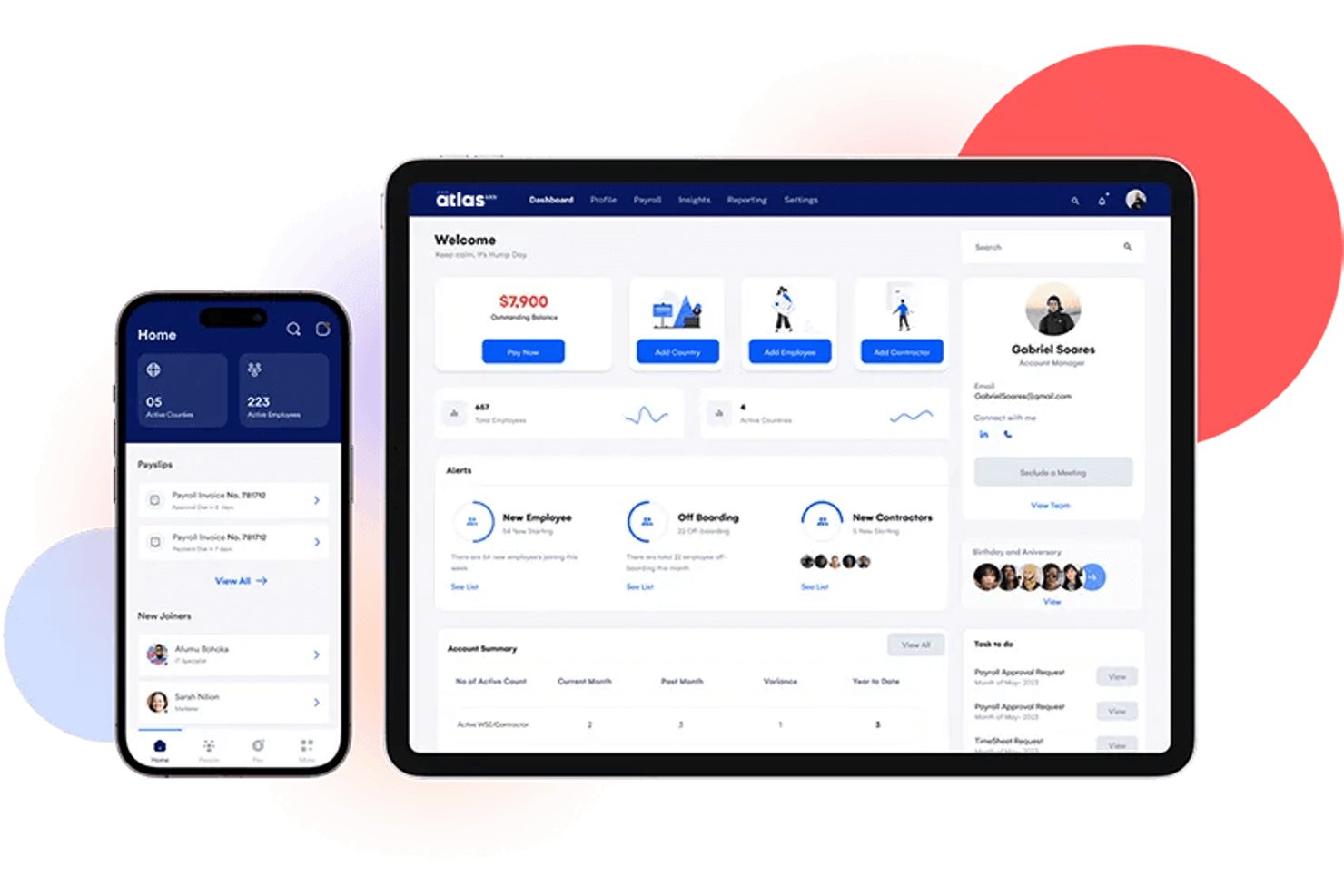
Atlas HXM is a global employer of record platform that hires workers on your behalf in 160+ countries, managing local payroll, statutory benefits, tax withholding, contract localization, and expat work permits through its own directly owned legal entities.
Who Is Atlas HXM Best For?
Atlas HXM is a strong fit for global expansion teams and HR leaders who need to hire in multiple markets simultaneously without setting up local entities.
Why I Picked Atlas HXM
Atlas HXM earns its spot on my shortlist because it owns its legal entities in every market it operates in, including Indonesia, which means you're never routed through a third-party partner when something goes wrong. I particularly like that it handles the full expat hiring chain in Indonesia: the RPTKA (expatriate placement plan), IMTA work permit, and VITAS work visa are all managed in-house. It also administers BPJS contributions and THR alongside IDR payroll, so your Indonesian hires are covered from day one without you piecing together separate vendors.
Atlas HXM Key Features
- IDR payroll processing: Atlas runs payroll in Indonesian rupiah on local cycles, with tax withholding, monthly remittance, and annual employee tax statements.
- Localized contract generation: Onboarding automatically produces Indonesian-language employment contracts covering salary, benefits, working hours, leave, and notice periods.
- Employee self-service app: Employees access payslips, tax documents, leave balances, timesheets, and expenses through a web and mobile app on iOS and Android.
- HRIS integrations: Atlas connects with Workday, BambooHR, Sage, Paycor, UKG, and Dayforce to sync payroll with your existing HR and accounting systems.
Atlas HXM Integrations
Atlas HXM lists seven integrations relevant to global HR teams: Workday, BambooHR, Sage, Ashby, Paycor, UKG, and Dayforce.
Pros and Cons
Pros:
- Dedicated account managers receive positive reviews
- Handles RPTKA, IMTA, and VITAS sponsorship
- Owns Indonesia entity without third-party partners
Cons:
- Indonesia guidance contains conflicting BPJS figures
- Payroll deadlines can delay employee payments

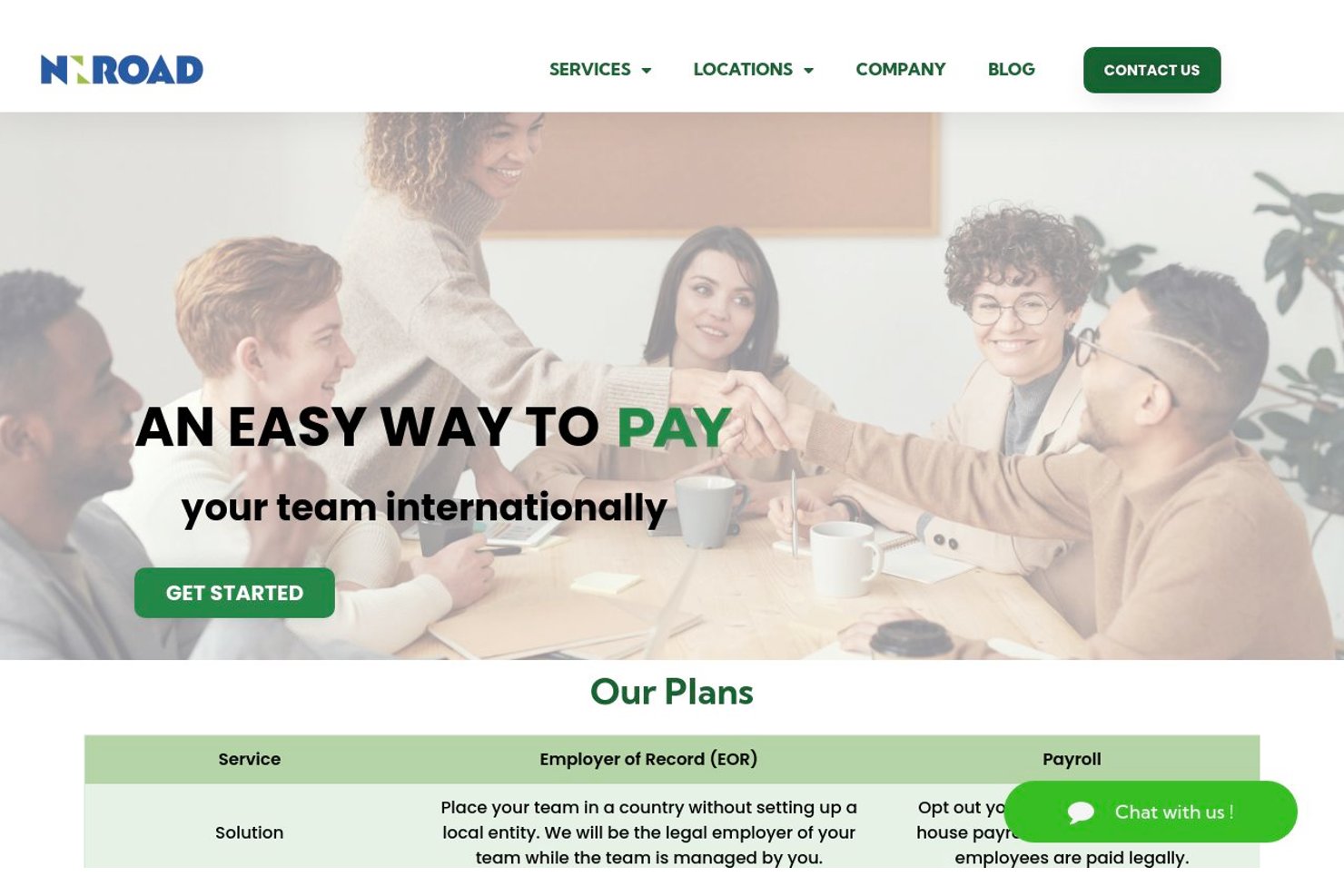
NNRoad is an employer of record service covering Indonesia that handles local employment contracts, IDR payroll processing, BPJS benefits administration, PPh 21 tax withholding, and statutory compliance across the full employment lifecycle.
Who Is NNRoad Best For?
NNRoad is a strong fit for startups and small businesses that need flexible, month-to-month Indonesia hiring without committing to long-term contracts or minimum headcounts.
Why I Picked NNRoad
I've included NNRoad in my top picks because its month-to-month contract terms with no headcount minimums make it one of the more flexible options for Indonesia hiring. I like that it openly screens roles against the 2026 outsourcing rules before you commit, so you know upfront whether your position qualifies. Its detailed PKWT and PKWTT contract localization, including Bahasa Indonesia compliance and statutory compensation terms, means employment agreements are built correctly from day one.
NNRoad Key Features
- PPh 21 TER withholding with December true-up: NNRoad withholds income tax monthly using effective rate categories, then reconciles to the progressive annual rate in December per Minister of Finance Regulation No. 168/2022.
- Expat visa and work permit sponsorship: A dedicated foreign-hire service covers RPTKA work permits, KITAS/ITAS stay permits, dependent coordination, and permit renewals for international employees in Indonesia.
- Indonesia labor cost calculator: A free tool estimates gross-to-net pay, BPJS contributions, PPh 21, and total employer cost in both USD and IDR before you commit to a hire.
- Contractor-to-employee conversion: NNRoad supports converting existing contractors to EOR employees, including full records transfer if you later move staff to your own Indonesian entity.
NNRoad Integrations
NNRoad doesn't have any native integrations. Its client portal and report-based accounting files support operational workflows.
Pros and Cons
Pros:
- Responsive support earns client praise
- Flexible month-to-month hiring terms
- Detailed local compliance guidance
Cons:
- Local entity ownership remains unclear
- Role eligibility limits professional hiring
Other EOR Services in Indonesia
Here are some additional EOR service providers in Indonesia that didn’t make it onto my shortlist but are still worth considering:
- Acclime
For in-house expat work permit filing
- AYP Group
For APAC-specialist local entity hiring
- Papaya Global
For termination liability coverage in Indonesia
- Rivermate
For customizable Indonesian employment contracts
- Pebl
For global talent acquisition
- Payoneer Workforce Management
For hiring in Indonesia via multi-currency payroll
- GoGlobal
For M&A and spinoff workforce transitions
- InCorp Indonesia
For Indonesia entity setup and EOR in one


Selection Criteria for Employer of Record Indonesia
To uncover the best EOR providers in Indonesia to include in this list, I considered common business needs and pain points that these providers address. This included ensuring compliance with local employment laws and managing payroll efficiently.
I also used the following framework to keep my evaluations structured and fair:
Core Services (25% of total score): To be considered for inclusion in this list, each provider had to offer these basic services:
- Managing payroll and taxes
- Handling employee benefits
- Ensuring legal compliance
- Providing HR support
- Assisting with onboarding and offboarding
Additional Standout Services (25% of total score): To help further narrow down the competition, I also looked for unique or especially valuable services, such as:
- Offering immigration and visa support
- Providing localized benefits packages
- Delivering data security and privacy solutions
- Supporting multiple currencies and languages
- Offering global mobility solutions
Industry Experience (10% of total score): To get a sense of the industry experience of each provider, I considered the following:
- Years of operation in the industry
- Number of countries served
- Range of industries supported
- Expertise in local employment laws
- Track record with multinational companies
Onboarding (10% of total score): To evaluate the onboarding experience for each provider, I considered the following:
- Speed of employee onboarding
- Clarity of onboarding process
- Availability of onboarding resources
- Support provided during onboarding
- Flexibility of onboarding solutions
Customer Support (10% of total score): To assess the level of customer support each provider offers, I considered the following:
- Availability of support channels
- Response time to inquiries
- Quality of customer service
- Availability of dedicated account managers
- Support in local languages
Value for Price (10% of total score): To evaluate the pricing and potential ROI of working with each provider, I considered the following:
- Transparency of pricing structure
- Competitiveness of pricing
- Range of services included in price
- Flexibility of pricing plans
- Potential cost savings for clients
Customer Reviews (10% of total score): To get a sense of the overall satisfaction of existing customers, I considered the following when reading customer reviews:
- Overall satisfaction ratings
- Feedback on service quality
- Comments on customer support
- Reports of any recurring issues
- Testimonials on value for money
Using this assessment framework helped me identify the EOR service providers that go beyond basic requirements to offer additional value through unique services, deep industry experience, smooth onboarding, effective support, and overall value for price.
Market Details for Hiring in Indonesia
- Capital City: Jakarta
- Payroll Frequency: Monthly (standard for most industries)
- Official Language: Indonesian (Bahasa Indonesia)
- Currency: Indonesian Rupiah (IDR)
- Approx. Population: 285.3 million
- Public Holidays: 16 national public holidays (excluding additional collective leave days known as "Cuti Bersama")
Why Hire Employees in Indonesia?
Indonesia stands out as an appealing hiring destination because of its growing, youthful workforce and affordable labor costs relative to Western economies. Urban centers like Jakarta, Surabaya, and Bandung offer a strong base of English-speaking professionals ready to support global business operations.
The country features a deep talent marketplace across industries such as technology, manufacturing, e-commerce, logistics, and customer support. It is particularly known for strong capabilities in software engineering, digital marketing, and operations related to natural resources and fintech.
Indonesia’s massive population, increasing number of skilled graduates, and supportive government policies around digital innovation make it an attractive market for international companies seeking to build agile, competitive teams. With its strategic location in Southeast Asia, Indonesia offers easy access to broader APAC operations.
How to Choose an Employer of Record in Indonesia
It’s easy to get bogged down in long lists of services and complex pricing structures. To help you prioritize the things that matter most for your business, keep the following factors in mind:
| Factor | What to Consider |
|---|---|
| Business Objectives | Align the provider's services with your goals. For instance, if you're expanding quickly, ensure they can scale with your team and support rapid hiring. |
| Service Scope and SLAs | Check the included services and service level agreements (SLAs). Ensure they cover payroll, compliance, and employee management at a minimum. |
| Support Availability | Look for 24/7 support options and dedicated account managers. Your team needs quick responses, especially during onboarding or compliance issues. |
| Costs and Pricing Structure | Understand all costs involved, including hidden fees. Compare pricing models to ensure they fit your budget and offer good value for money. |
| Communication and Reporting | Ensure they offer clear communication channels and regular reporting. Your team should receive updates on compliance changes and payroll processing. |
| Compliance Expertise | Verify their knowledge of local laws and regulations. This is crucial to avoid legal issues and ensure your operations run smoothly. |
| Technology Integration | Check if their platform integrates with your existing HR systems. This can save time and prevent data entry errors. |
| Reputation | Research and request copies of customer reviews and testimonials. A provider with a strong reputation is more likely to deliver reliable and consistent service. |
What is an Employer of Record in Indonesia?
An Employer of Record (EOR) in Indonesia is a third-party organization that legally employs workers on behalf of another company. The EOR manages essential employment tasks such as payroll processing, tax withholding, and benefits administration, ensuring compliance with Indonesian labor laws. This arrangement allows the client company to oversee the employees' daily activities and responsibilities without establishing a local legal entity.
Businesses typically use EOR services to expedite Indonesian market entry, reduce the complexities associated with local employment regulations, and manage human resource functions efficiently. This approach is particularly beneficial for companies that want to hire local top talent without setting up a physical presence in the country.
Why Use an Employer of Record Service in Indonesia?
Indonesia is one of those markets that gets more interesting the deeper you look. It has a massive workforce, a fast-growing digital economy, and a strong talent pool across tech, operations, support, and manufacturing roles. For companies expanding into Southeast Asia, it’s often one of the first markets that comes up for a reason.
From a hiring perspective, Indonesia gives companies scale. You are hiring from one of the largest labor markets in the region, with growing startup and remote-work ecosystems in cities like Jakarta and Bandung. Labor costs are also generally lower than in many Western markets, which makes scaling teams more realistic from a budget standpoint.
The challenge is compliance. Indonesia has detailed labor laws, mandatory social security programs, religious holiday bonuses (THR), and strict rules around contracts and termination. It’s manageable once set up correctly, but not something most companies want to navigate alone. An employer of record handles payroll, contracts, and local compliance so you can hire in Indonesia without setting up a local entity first.
Deciding Between an EOR and a Legal Entity in Indonesia
Hiring in Indonesia usually comes down to one key decision: start quickly with an EOR, or invest in setting up a local entity for long-term operations.
An employer of record is often the faster and simpler route, especially for companies testing the market or building a smaller team. Setting up a legal entity gives you more control, but it also means dealing with local registration, payroll setup, licensing, and ongoing compliance requirements. Here are the key differences between using an Employer of Record and setting up a legal entity in Indonesia:
| Features | Employer of Record (EOR) | Legal Entity Setup in Indonesia |
|---|---|---|
Setup time | Hiring can begin in a few days once onboarding is complete. | Entity setup can take several weeks, including registration and bank account setup. |
| Upfront Cost | No entity setup costs; pricing is typically per employee. | Higher initial costs for registration, legal support, and administration. |
| Ongoing Costs | Predictable monthly fee per employee. | Lower per-employee cost at scale, but ongoing admin and compliance expenses. |
| Compliance & liability | EOR manages payroll, taxes, and employment compliance. | Full responsibility for compliance, tax filings, and legal risk. |
| Payroll & tax management | Fully managed, including filings and statutory contributions. | Requires internal resources or local providers to manage payroll. |
| Flexibility | Easier to enter or exit the market. | Entity closure can be time-consuming and costly. |
| Control & customization | Limited control over contracts and benefits structures. | Full control over employment terms, policies, and benefits. |
| Best use case | Short-term hiring, market testing, or small teams. | Long-term expansion with a larger, established presence. |
EOR vs Permanent Establishment in Indonesia
Permanent establishment risk is one of those things companies often overlook when expanding into Indonesia. It happens when local authorities determine that your business has enough activity in the country to be treated as a taxable local presence, even if you never officially set up an entity.
And in Indonesia, that line can get blurry faster than expected. If employees are negotiating contracts, managing local operations, or directly generating revenue, authorities may view that as your company doing business locally. That can trigger corporate tax obligations, registration requirements, and ongoing reporting responsibilities. This is usually the point where companies realize hiring internationally is not just an HR decision. It’s a tax and compliance decision, too.
Using an employer of record does not eliminate permanent establishment risk entirely, but it helps reduce it. By employing workers through a local legal employer, companies can hire in Indonesia without creating a direct business presence through their workforce.
How EORs Protect From Permanent Establishment Risk
- Legal employer structure: The EOR employs workers on paper, helping avoid a direct business presence in Indonesia.
- Reduced tax exposure: Since payroll, contracts, and employment are managed locally, the risk of being classified as having a permanent establishment is lower.
- Compliance coverage: Indonesian labor laws, tax filings, and statutory obligations are handled through the EOR, reducing compliance gaps.
- Role scope control: Helps structure roles so employees are not directly signing contracts or generating revenue locally.
- Flexible market entry: Makes it easier to hire and test the Indonesian market without creating a taxable presence too early.
Hiring in Indonesia: Important Details
Here are some key details to note if this is your first time hiring staff in Indonesia. Your EOR provider will manage these compliance details on your behalf. However, proactively informing yourself of these details is always recommended before you invest your resources into sourcing staff based in Indonesia.
- Employment laws in Indonesia are primarily established by the Ministry of Manpower and governed under Law No. 13 of 2003 on Manpower, with amendments introduced through the Job Creation Law (Law No. 11 of 2020) and Government Regulation No. 35 of 2021.
- You can hire employees in Indonesia under two main types of employment contracts:
- Fixed-term contracts (PKWT - Perjanjian Kerja Waktu Tertentu): For specific projects or time-bound work.
- Indefinite-term contracts (PKWTT - Perjanjian Kerja Waktu Tidak Tertentu): For permanent positions.
- Companies can also hire independent contractors for specific services.
- Indonesia has both mandatory payroll deductions and other employment or social security contributions that must be collected, including:
- BPJS Kesehatan (National Health Insurance)
- BPJS Ketenagakerjaan (Employment Social Security)
- JHT (Old Age Security)
- JKK (Work Accident Insurance)
- JKM (Death Benefit)
- JP (Pension Security)
- Income tax (PPh 21)
- Indonesian (Bahasa Indonesia) is the official language. However, other languages spoken in this country include Javanese, Sundanese, Balinese, and over 700 regional languages, though business and legal proceedings use Bahasa Indonesia.
- The standard working week in Indonesia is 40 hours, typically 7 hours per day for 6 days a week or 8 hours per day for 5 days a week.
- Overtime is regulated under the Manpower Law and its amendments. Both the employer and the employee must agree upon it. Employees can work a maximum of 3 hours per day and 14 hours per week as overtime.
- Overtime pay rates are 1.5 times the hourly wage for the first hour, and 2 times the hourly wage for subsequent hours.
- In Indonesia, employees are typically paid monthly. Additionally, a 13th-month salary, known as Tunjangan Hari Raya (THR), is mandatory and must be paid at least 7 days before the major religious holiday celebrated by the employee.
- Paid vacation in Indonesia starts at a minimum of 12 days of paid annual leave after completing 12 months of continuous service.
- Indonesia observes 16 national public holidays. The government officially designates these dates, separate from the additional collective leave days that are known as Cuti Bersama. The Indonesian public holidays include:
- New Year's Day (January 1)
- Isra Mi'raj (Ascension of the Prophet Muhammad) (date varies)
- Chinese New Year (January 29)
- Nyepi (Balinese Day of Silence) (March 29)
- Eid al-Fitr (Hari Raya Idul Fitri) (date varies)
- Good Friday (April 18)
- Easter Sunday (April 20)
- Labour Day (May 1)
- Waisak Day (Buddha's Birthday) (May 12)
- Ascension Day of Jesus Christ (May 29)
- Pancasila Day (June 1)
- Eid al-Adha (Hari Raya Idul Adha) (date varies)
- Islamic New Year (1 Muharram) (June 27)
- Independence Day (August 17)
- Prophet Muhammad's Birthday (Maulid Nabi Muhammad SAW) (September 5)
- Christmas Day (December 25)
- Several regional holidays are also celebrated in different areas, including those that vary by province and are determined by local governments. These holidays are specific to local cultures and traditions. For instance:
- Bali: Nyepi (Day of Silence)
- Java: Sekaten
- Indonesia offers both maternity and paternity leave. During these leaves, the employer pays the employee's full salary.
- Maternity Leave: Female employees are entitled to 3 months of paid maternity leave after childbirth.
- Paternity Leave: Male employees are entitled to 2 days of paid paternity leave during the delivery period, and an additional 3 days after the delivery.
- Paid sick leave is provided in Indonesia if the employee submits a medical certificate. 100% of wages are paid during the first four months, 75% during the second four months, 50% during the third four months, and 25% for any period beyond that.
- The probationary periods are permitted only for Indonesia's indefinite-term employment contracts (PKWTT). The maximum duration is 3 months, and this period cannot be extended.
- It's important to note that fixed-term contracts (PKWT) do not allow for probation periods. Additionally, the probation period must be explicitly stated in the written employment agreement; otherwise, the employee is considered permanent from the start.
- The termination terms in Indonesia are mandated by Law No. 13 of 2003 on Manpower, as amended by Law No. 11 of 2020 on Job Creation and further refined by Government Regulation No. 35 of 2021 (GR 35/2021).
- Employers must provide a written notice of termination at least 14 working days in advance. If the termination occurs during probation, the notice period is reduced to 7 working days.
- Severance pay is statutory and based on the employee’s length of service, ranging from one to nine months’ salary. Employees may also be entitled to long-service pay and compensation for unused leave or relocation expenses.
- Additional Employment-Related Information:
- Termination Process: If an employee disputes their termination, the employer and employee must first engage in bipartite negotiations. If unresolved, the matter proceeds to mediation by the Manpower Department and potentially to the Industrial Relations Court.
- Fixed-Term Contracts: Terminating a fixed-term contract before its expiration requires the employer to compensate the employee for the remaining contract period.
- Prohibited Grounds for Termination: Employers cannot terminate employees based on discrimination, pregnancy, illness (within 12 months), or religious practices.
Tax Overview for Employers in Indonesia
Indonesia is one of those markets where payroll costs can look straightforward at first, but mandatory contributions and employee entitlements add more to the total cost than many employers expect.
Here’s a quick view of what employers pay vs what gets deducted from employees:
| Category | Tax Type | Rate |
|---|---|---|
| Employer costs | Social Security (BPJS) | ~6% to 9% |
| Employee deductions | BPJS Contributions | ~4% |
| Employee taxes | Income Tax (PPH 21) | 5% to 35% (progressive) |
| Other obligations | THR Religious Holiday Bonus | 1 month’s salary annually |
Some key payroll and compliance facts for 2026:
- The THR Bonus Rule: The Tunjangan Hari Raya (THR) is mandatory. It must be paid in full at least 7 days before the employee's major religious holiday (usually Eid al-Fitr or Christmas). Employees with less than 12 months of service receive a pro-rata amount.
- Meal and Transport Allowances: While not mandatory by law, it is a standard market practice in Indonesia to provide these. When paid as a fixed allowance, they are subject to PPh 21 tax.
Key Employer of Record Services
When selecting an employer of record provider in Indonesia, keep an eye out for the following key services:
- Payroll management: Ensures timely and accurate salary disbursements, helping your team focus on their work without payroll concerns.
- Compliance support: Keeps your business aligned with local laws, reducing the risk of legal issues and penalties.
- Employee benefits administration: Manages benefits packages, ensuring your team receives appropriate healthcare and retirement plans.
- Tax compliance: Assists with navigating complex tax laws and regulations, preventing potential financial liabilities.
- HR support: Provides essential HR functions like employee onboarding and offboarding and streamlining administrative tasks.
- Global talent acquisition: Helps you find and hire the best candidates worldwide, expanding your talent pool.
- Immigration assistance: Offers visa and work permit support, facilitating smooth international hiring processes.
- Data security: Protects sensitive employee information, ensuring compliance with data protection regulations.
- Technology integration: Integrates with your existing HR systems, saving time and reducing data entry errors.
- Regular reporting: Delivers updates on compliance changes and payroll processing, keeping your team informed.
Benefits of Using an Employer of Record
Partnering with an EOR provider in Indonesia offers businesses a practical way to simplify global hiring, maintain compliance, and minimize risk.
Here’s how an EOR can benefit your organization:
- Faster Market Expansion: If you're looking to explore new markets or hire international talent without the burden of setting up a local subsidiary, an EOR partnership helps you launch operations quickly and cost-effectively, helping you conserve both time and resources.
- Streamlined International Payroll: Managing payroll across multiple countries becomes much easier with an EOR, as they oversee tax deductions, mandatory withholdings, and currency conversions to ensure employees are paid accurately and on time.
- Compliance and Risk Management: EORs are experts in international labor laws, tax codes, and insurance obligations. Their knowledge helps shield your business from compliance issues and mitigates the risks associated with operating in unfamiliar jurisdictions.
- Stronger Benefits Packages: With access to global networks, EORs can negotiate competitive benefits and insurance rates for your international employees, helping you enhance your global talent acquisition and retention efforts.
- Cost Savings: Establishing your own legal entity abroad can be extremely costly, requiring significant investments in legal services, office space, and benefits infrastructure. EOR services offer a much more affordable alternative for companies aiming to expand internationally.
Partnering with an EOR can be a game-changer when planning international growth strategies. It offers a straightforward, compliant, and budget-friendly path to entering new markets.
When presenting the idea to leadership, be sure to highlight how EOR services reduce overhead costs and simplify the process of hiring globally. Framing it this way can help you build a strong case for moving forward with an EOR partnership.
Costs and Pricing Structures of Employer of Record Indonesia
Typically, EOR pricing in Indonesia follows a per-employee, per-month model. This allows companies to budget for international expansion with cost predictability and scalability in mind.
In general, EOR services in Indonesia cost between $299 to $1,000 per employee, per month.
Several variables can impact how much an EORecord service will cost, including:
- Hiring Location: Pricing often fluctuates depending on the country where you plan to hire. Local labor regulations, economic factors, and the complexity of compliance obligations in a particular region can all influence the final cost.
- Position Level and Role Requirements: The seniority and specialization of the roles you’re hiring for can affect pricing as well. Filling executive or highly specialized positions typically drives up costs, reflecting the additional effort needed for benefits management and competitive compensation.
- Workforce Size: The total number of employees an EOR manages for you can also shape pricing structures. Managing a larger workforce may unlock volume discounts, lowering the average cost per employee.
- Tailored Service Needs: If your company requires services beyond the standard EOR package—such as custom recruitment processes, specialized onboarding programs, or additional compliance management—these customizations can lead to higher monthly costs.
Understanding these pricing variables helps you assess the right EOR partner for your hiring goals in Indonesia—especially when speed, cost-efficiency, and compliance are priorities.
Employer of Record Indonesia: FAQs
Here are some answers to common questions about EOR providers in Indonesia:
How does an Employer of Record help with compliance?
An Employer of Record helps your team stay compliant with local employment laws and regulations. They handle payroll, taxes, and legal documentation, ensuring everything aligns with Indonesian standards. This reduces the risk of legal issues and fines, letting you focus on your business operations.
Can an Employer of Record handle employee benefits?
Yes, an EOR can manage employee benefits, including healthcare and retirement plans. They’ll ensure your team receives benefits that comply with local regulations. This, in turn, helps attract and retain talent by ensuring your employment offers remain attractive compared to your competitors.
What industries can benefit from using an Employer of Record?
Industries like technology, finance, healthcare, and manufacturing can benefit from using an Employer of Record. These providers help businesses expand internationally by managing local compliance and administrative tasks. This is especially useful for industries with complex regulations or those entering new markets.
How does an Employer of Record support global hiring?
An EOR supports global hiring by managing the administrative and legal aspects of employing workers in different countries. They handle tasks like contract management, payroll, and compliance, allowing you to focus on finding the right talent. This simplifies the process of expanding your workforce internationally.
What’s the difference between an EOR and a PEO?
An EOR becomes the legal employer of your team, managing compliance and payroll. A PEO, or Professional Employer Organization, co-employs your team and shares responsibilities with your company. The key difference is the level of control and responsibility each takes on regarding employment matters.
How do I choose the right Employer of Record for my business?
Choosing the right Employer of Record involves assessing your business needs and evaluating potential providers based on their services, pricing, and industry experience. Consider factors like compliance expertise, customer support, and the ability to scale with your business. This will help you narrow in on the provider that aligns with your goals the most.
How does an EOR handle IP transfer upon termination?
Employer of record providers include IP assignment clauses in employment contracts to ensure all work created by the employee belongs to your company. Upon termination, they help ensure any code, documents, or assets are properly transferred in line with Indonesian law.
This content is provided for general informational purposes only and does not constitute legal, tax, or other professional advice. It may not be complete, accurate, or current, and laws and practices may change without notice and vary by jurisdiction. You should not act on this information without obtaining advice from qualified legal or tax counsel in the relevant jurisdiction regarding your specific circumstances.