
20 Best AI Strategy Tools Reviewed in 2026

Best AI Strategy Tools Shortlist
Here’s my shortlist of the best AI strategy tools:


Strategy leaders are expected to move quickly, make clear decisions, and guide teams through an entire cycle that includes ideation, development, communication, and execution. Keeping that process sharp requires tools that can surface insight, support analysis, and help teams stay aligned across functions. AI strategy tools are built for exactly this kind of work, providing structured input, intelligent recommendations, and practical support at every stage.
Drawing on years of software testing and exposure to strategic workflows across HR and operations, I’ve reviewed the AI tools that genuinely strengthen strategic planning and delivery. In this article, you’ll find the options that help with thought generation, scenario planning, goal modeling, content creation, and action tracking.
By the end, you’ll have a clear view of the tools that can help leaders shape strategy and guide teams with more clarity and confidence. Let’s take a look at what can support your next planning cycle.
Why Trust Our Software Reviews
We’ve been testing and reviewing HR software systems since 2019. As HR experts ourselves, we know how critical and difficult it is to make the right decision when selecting software.
We invest in deep research to help our audience make better software purchasing decisions. We’ve tested more than 2,000 tools for different HR management use cases and written over 1,000 comprehensive software reviews. Learn how we stay transparent & our software review methodology.
Best AI Strategy Tools Summary
This comparison chart summarizes pricing details for my top AI strategy tools selections to help you find the best one for your budget and business needs.
| Tool | Best For | Trial Info | Price | ||
|---|---|---|---|---|---|
| 1 | Best for global workforce strategies | Free demo available | From $5/employee/month | Website | |
| 2 | Best for design with AI tools | Free plan + 30-day free trial available | From $15/month | Website | |
| 3 | Best for workflow automation | 14-day free trial + free plan available | From $19.99/month (billed annually) | Website | |
| 4 | Best for business planning tools | Free demo available | From $14/month (billed annually) | Website | |
| 5 | Best for natural language processing | Free plan available | From $8/month | Website | |
| 6 | Best for product roadmaps with AI | 30-day free trial + free demo available | From $9/user/month | Website | |
| 7 | Best for AI content generation | 7-day free trial + free demo available | From $59/seat/month (billed annually) | Website | |
| 8 | Best for an integrated AI workspace | Free plan available | From $10/user/month (billed annually) | Website | |
| 9 | Best for AI-driven presentations | 14-day free trial + free demo available | From $12/month (billed annually) | Website | |
| 10 | Best for data-driven decisions | Free demo available | Pricing upon request | Website |

-

Checkr
Visit WebsiteThis is an aggregated rating for this tool including ratings from Crozdesk users and ratings from other sites.4.5 -
Kudoboard
Visit WebsiteThis is an aggregated rating for this tool including ratings from Crozdesk users and ratings from other sites.4.8 -
Native Teams
Visit WebsiteThis is an aggregated rating for this tool including ratings from Crozdesk users and ratings from other sites.4.6



Best AI Strategy Tool Reviews
Below are my detailed summaries of the best AI strategy tools that made it onto my shortlist. My reviews offer a detailed look at the key features, pros & cons, integrations, and ideal use cases of each tool to help you find the best one for you.
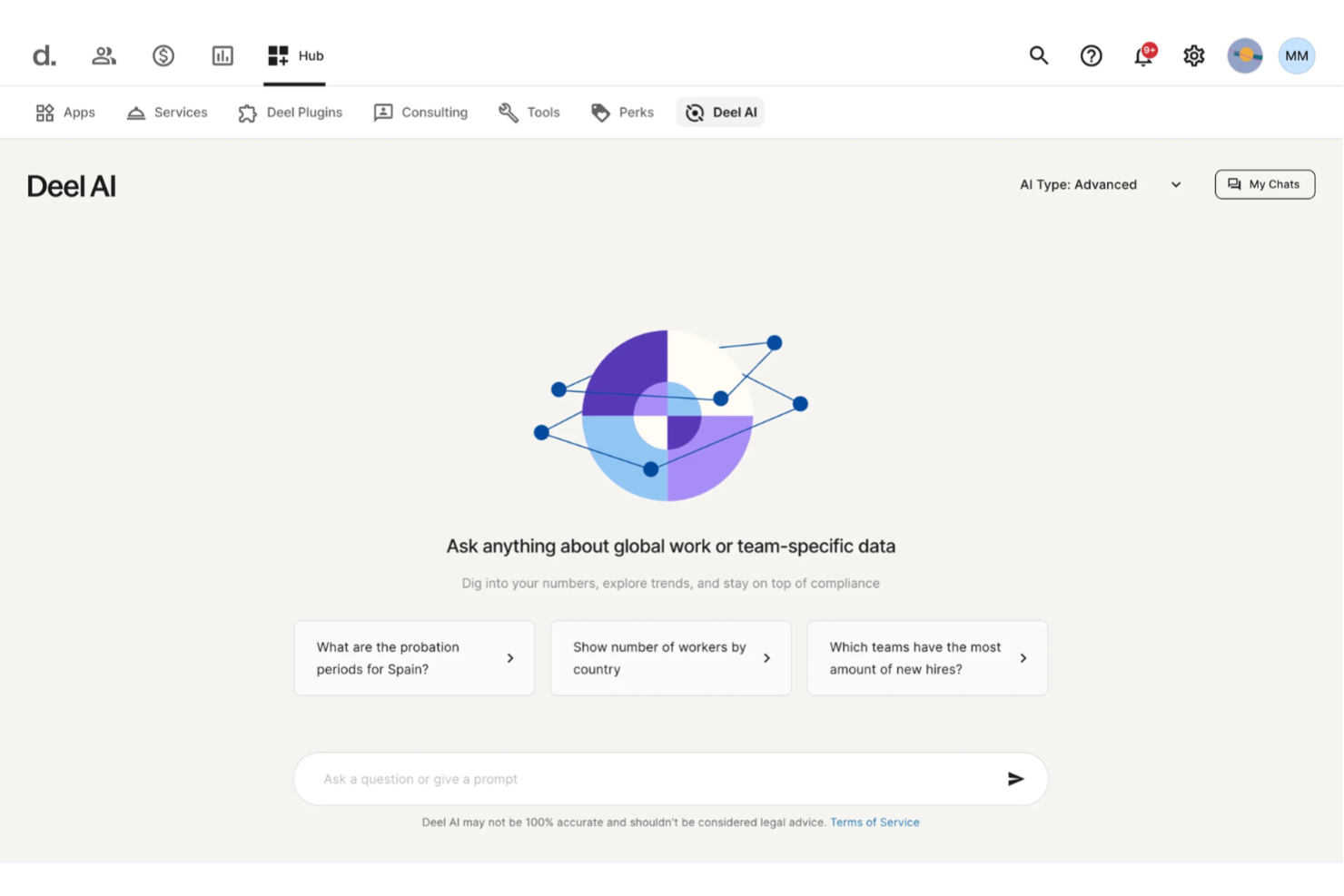
Deel AI gives you a way to make smarter workforce decisions by turning your people data, global compliance knowledge, and HR workflows into actionable insights. If you’re shaping an AI strategy for a distributed or scaling team, the platform helps you cut through complexity with instant, context-aware guidance on hiring, compensation, compliance, and internal operations.
Why I Picked Deel
I picked Deel because it extends beyond everyday HR automation and functions as a strategic intelligence layer built directly into your workforce data. Its page-aware insights, compliance interpretation, and AI-generated org reporting offer the kind of real-time context you need when shaping your hiring, compensation, or expansion strategy. I appreciate that it’s trained by HR and legal experts across 150+ countries, giving you jurisdiction-specific clarity when making decisions that carry business risk. This makes Deel AI a strong fit for teams building an AI strategy around global operations, compliance guidance, and data-driven workforce planning.
Deel Key Features
Aside from its compliance intelligence and contextual insights, you’ll find these useful:
- Compensation Benchmarking Insights: Surfaces salary ranges and market medians for roles across regions, supporting strategic workforce planning.
- Localized Contract Generation: Automatically creates contracts that adhere to local labor laws, reducing legal risks and ensuring compliance.
- AI-Powered Compliance Monitoring: Continuously tracks changes in local employment laws, providing alerts and updates to keep your operations compliant.
- 24/7 AI Support: Offers round-the-clock assistance for HR and payroll inquiries, minimizing the need for manual intervention and support tickets.
Deel Integrations
Integrations include BambooHR, Workday, Xero, QuickBooks, Expensify, Netsuite, Greenhouse, Okta, Slack, and Microsoft 365. An API is available for custom integrations.
Pros and Cons
Pros:
- Salary benchmarking supports global workforce planning decisions
- Page-aware summaries help teams interpret data in real time
- Offers strategic insights by combining internal data with expert compliance knowledge
Cons:
- Not designed for enterprise-wide AI planning outside HR, payroll, and compliance
- Compliance outputs still need human review for high-risk decisions
New Product Updates from Deel HR

Deel HR Introduces AI-Powered ATS for Hiring
Deel HR introduces an AI-powered ATS built into its platform. This update enhances hiring efficiency by automating sourcing, screening, and workflows across the recruitment process. For more information, visit Deel HR’s official site.
 .
.

Canva is a graphic design platform used by individuals and businesses for creating visual content. It's popular among marketers, educators, and small business owners for its easy-to-use design tools and templates, enhanced by AI capabilities like automatic layout suggestions and image editing.
Why I picked Canva: Canva functions as a design copilot, suggesting layouts and generating visuals automatically. Canva’s AI features let you create polished designs and images in minutes. You can use Text to Image to generate original visuals, Magic Write to craft text content, and Magic Design to instantly build layouts from ideas or existing files. These capabilities make Canva ideal for non-designers who want professional results without creative bottlenecks.
Standout Features & Integrations:
Features include AI image generation, smart layout design, Magic Write for text creation, brand kits, and real-time collaboration. Canva offers an extensive template library, stock assets, and built-in editing tools to fine-tune visuals.
Integrations include Google Drive, Dropbox, HubSpot, Mailchimp, Slack, Microsoft Teams, Instagram, Facebook, LinkedIn, Pinterest, and YouTube.
Pros and Cons
Pros:
- Helps you keep brand designs steady
- Offers smart layout suggestions
- Speeds up visual content creation
Cons:
- Can lag with large image files
- Limited control for custom elements


Zapier is an automation tool designed for businesses and teams looking to connect different apps and automate workflows. It helps users automate repetitive tasks by creating custom workflows called "Zaps," which execute actions across various platforms.
Why I picked Zapier: You can automate your workflow processes without needing extensive technical skills. The platform's intuitive interface allows you to set up triggers and actions that save time and reduce manual effort. It connects tools through secure API integrations, enabling automation across 7,000+ apps. These features make it ideal for enhancing productivity and efficiency in your operations.
Standout Features & Integrations:
Features include AI-powered workflow creation, multi-step Zaps, conditional logic, and custom AI agents that automate tasks like customer support, lead routing, and reporting.
Integrations include Google Sheets, Gmail, Slack, Trello, Dropbox, Mailchimp, HubSpot, Salesforce, Asana, and QuickBooks.
Pros and Cons
Pros:
- Handles data transfers automatically
- Reduces manual work in daily tasks
- Lets you connect many work tools
Cons:
- Some zaps break after app updates
- Complex flows need frequent testing


Upmetrics is a business planning software designed for entrepreneurs, startups, and business strategists who need to create detailed business plans and pitches. It simplifies the planning process with AI-driven templates and financial forecasting tools.
Why I picked Upmetrics: You can quickly generate business plans using its AI Business Plan Generator, which analyzes datasets from your financial inputs to generate forecasts. The software offers financial forecasting features that help you visualize potential business outcomes. Its intuitive interface ensures that you can focus on strategy without getting bogged down in technical details. These capabilities make Upmetrics a valuable tool for anyone needing to craft detailed business strategies quickly and effectively.
Standout Features & Integrations:
Features include financial forecasting, customizable business templates, and pitch deck creation. These tools help you present your business ideas clearly and effectively, making it easier to communicate your vision to stakeholders.
Integrations include QuickBooks, Xero, Google Drive, Dropbox, Slack, Microsoft Excel, Trello, Asana, Evernote, and Zoho.
Pros and Cons
Pros:
- Useful for investor presentations
- Helps you forecast outcomes easily
- Lets you plan finances visually
Cons:
- Hard to link multiple plans together
- Needs practice for accurate forecasting


Built on OpenAI’s GPT architecture, ChatGPT is an AI language model with a wide range of users, from developers to businesses looking to automate customer interactions. It excels in generating human-like text, providing users with a tool for content creation, customer support, and more.
Why I picked ChatGPT: You can leverage its natural language processing capabilities to create engaging and coherent text. Its ability to understand context and deliver accurate responses makes it ideal for chatbots and virtual assistants. The model, developed by OpenAI, comes with safety approaches similar to Anthropic’s model alignment standards. These capabilities ensure it meets diverse communication needs effectively.
Standout Features & Integrations:
Features include context-aware text generation, multi-turn conversation handling, and prompt-based customization. ChatGPT integrates with many business tools for extended functionality
Integrations include Microsoft Teams, Slack, Zendesk, HubSpot, Salesforce, WordPress, Shopify, Discord, Intercom, and Google Workspace.
Pros and Cons
Pros:
- Handles varied prompts from your users
- Works well for team brainstorming
- Writes natural text in seconds
Cons:
- Needs human review for accuracy
- May misread vague context


Aha! is a product development tool primarily used by product managers and development teams to create visual roadmaps and manage product strategies. Its AI capabilities include an AI assistant that aids in productivity by organizing customer feedback and centralizing product information.
Why I picked Aha!: Aha! stands out for its ability to connect strategy with execution through visual roadmaps and integrated feedback loops. The Aha! AI assistants use proprietary algorithms to organize customer feedback and prioritize product ideas, and turn ideas into actionable product plans. It stands out with its ability to centralize product data, ensuring all team members have access to essential information, making it the best for product roadmaps with AI.
Standout Features & Integrations:
Features include tools for visual roadmapping, idea tracking, and customer feedback management. You can also benefit from centralized product information, which keeps your team aligned. Aha! provides templates and training resources to help you make the most of its features.
Integrations include Jira, Slack, Salesforce, Azure DevOps, Google Analytics, Microsoft Teams, GitHub, Confluence, Trello, and Zendesk.
Pros and Cons
Pros:
- Tracks customer feedback effectively
- Lets you plan product launches visually
- Connects strategy with daily work
Cons:
- Takes time to master the full setup
- Can slow down with big portfolios

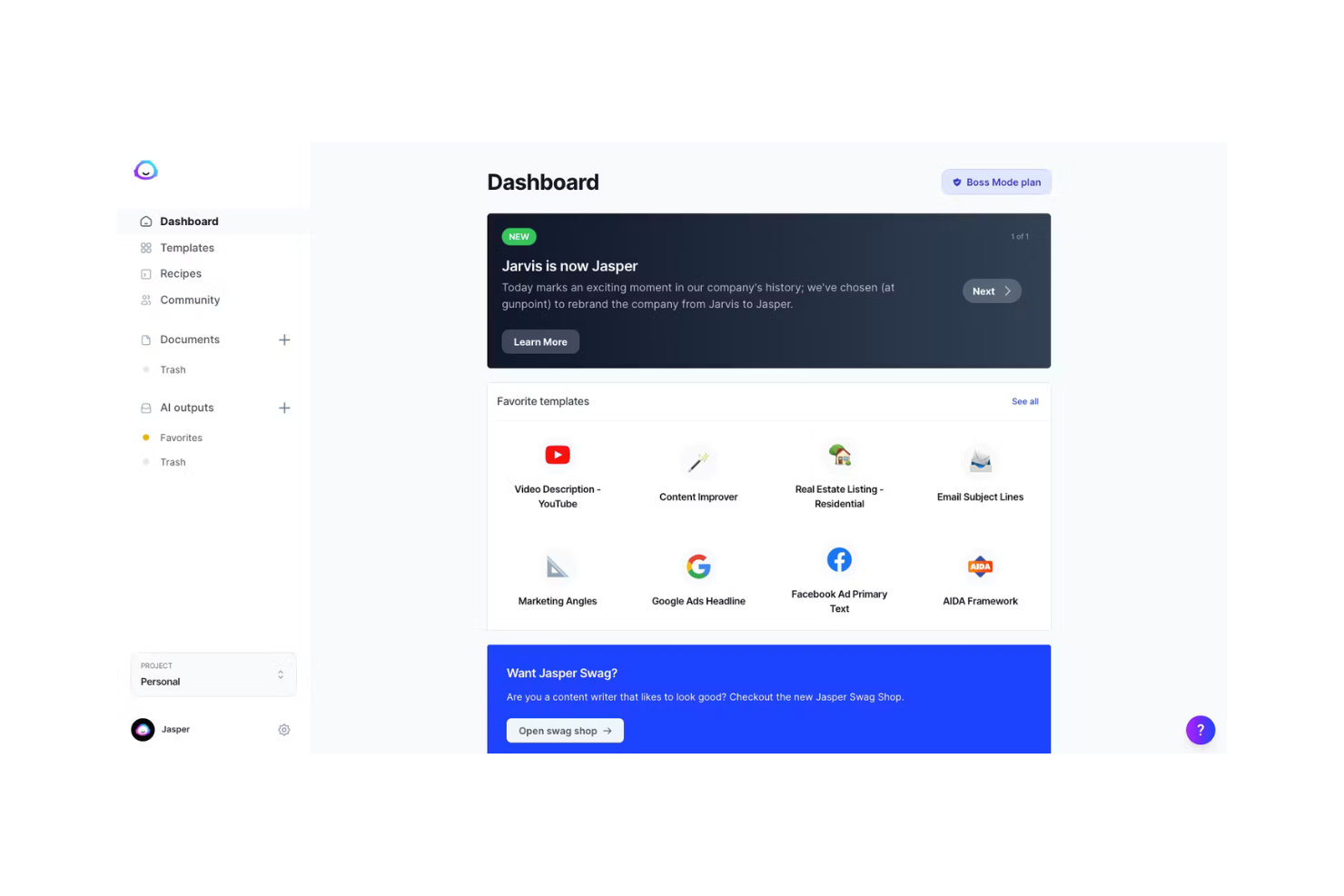
Jasper is an AI writing tool designed for marketers, content creators, and businesses that need to generate high-quality written content quickly. It helps create blogs, social media posts, emails, and more with its AI-driven text generation capabilities.
Why I picked Jasper: Your team will benefit from its ability to generate diverse content efficiently. The AI model offers various tones, making it suitable for different copywriting styles and marketing strategies. Its user-friendly interface ensures you can start creating content with minimal setup. These features make Jasper a versatile choice for content-driven teams.
Standout Features & Integrations:
Features include brand voice customization, consistent tone, and high-quality outputs for both long-form document support as well as blogs and campaigns. Jasper also provides prebuilt templates for ads, emails, and social captions
Integrations include HubSpot, Shopify, WordPress, Google Docs, SurferSEO, Grammarly, Copyscape, SEMrush, Facebook, and Instagram.
Pros and Cons
Pros:
- Works well for marketing and SEO teams
- Supports multiple tones and formats
- Generates diverse, on-brand content fast
Cons:
- Can repeat phrases in long drafts
- Needs edits for factual checks


Notion AI is a productivity tool designed for teams and individuals who need a flexible workspace for notes, tasks, and collaboration. It enhances productivity by offering AI-driven suggestions and helps teams improve organization, communication, and overall customer experience through intelligent task automation.
Why I picked Notion AI: It can handle everything from copywriting to project management without switching tools. Its built-in AI agents automate repetitive work, generate meeting notes, and assist with research and organization. The platform’s flexibility makes it ideal for teams that want to unify documents, tasks, and collaboration in one place.
Standout Features & Integrations:
Features include a range of AI products for writing and editing, custom agents for task automation, AI meeting notes, and enterprise search across your workspace. Notion also integrates with a wide range of apps to extend its functionality.
Integrations include Slack, Google Drive, Trello, Asana, GitHub, Microsoft Teams, Zapier, Typeform, Figma, and Evernote.
Pros and Cons
Pros:
- Suggests ideas as you write notes
- Helps organize scattered project info
- Combines writing and planning in one
Cons:
- Heavy AI tone in text
- Can slow down with large databases


Beautiful.ai is a presentation tool designed for professionals and teams who need to create visually appealing slideshows quickly. It leverages AI to automate design tasks, ensuring your presentations are both professional and engaging.
Why I picked Beautiful.ai: You can create stunning presentations without the need for design skills, thanks to its AI-driven features. The tool automatically adjusts layouts and design elements, saving you time and effort. Its smart templates adapt to your content, maintaining consistency and visual appeal. These features make it perfect for anyone looking to enhance their presentation quality efficiently for email marketing or any type of ecommerce initiatives.
Standout Features & Integrations:
Features include smart templates, automatic layout adjustments, and design consistency. You can focus on your content while the tool handles the design, providing a polished final product effortlessly.
Integrations include PowerPoint, Google Slides, Slack, Dropbox, Box, Microsoft Teams, Zoom, Trello, Asana, and Canva.
Pros and Cons
Pros:
- Saves significant design time
- Keeps decks consistent and on brand
- Generates slides automatically from text prompts
Cons:
- Can’t tweak templates deeply
- Few advanced animation options


Hightouch AI Decisioning is an AI-driven platform designed for businesses aiming to enhance marketing strategies across various industries like retail, finance, and healthcare. It automates decision-making processes, allowing teams to shift from manual campaigns to adaptive, personalized customer interactions.
Why I picked Hightouch AI Decisioning: Your team can benefit from its ability to automate marketing workflows and strategies using machine learning and reinforcement to personalize customer interactions. This feature is what sets it apart, enabling data-driven decisions that optimize messaging, offers, and channels. The platform’s integration with over 250 tools ensures real-time insights and effective communication. It's ideal for companies looking to scale personalized marketing solutions efficiently.
Standout Features & Integrations:
Features include reinforcement learning-based decisioning agents, real-time optimization of messages and offers, and automated personalization across channels. It also supports transparent guardrails, allowing teams to define boundaries for AI actions.
Integrations include Salesforce, Google Ads, Facebook Ads, Marketo, HubSpot, Shopify, Snowflake, Segment, Redshift, and BigQuery.
Pros and Cons
Pros:
- Keeps customer data secure in your own warehouse
- Learns continuously from real-time data
- Automates complex, multi-channel decisions
Cons:
- Harder to track hidden model logic
- Setup takes technical know-how
Other AI Strategy Tools
Here are some additional AI strategy tools options that didn’t make it onto my shortlist, but are still worth checking out:
- Quantive StrategyAI
For continuous strategy alignment
- Julius (Julius Works)
For influencer marketing insights
- Tability
For rapid strategy creation
- Grammarly
For AI-driven writing feedback
- WorkBoard
For strategy and OKR alignment
- Perplexity AI
For AI-powered question answering
- IBM Watson Studio
For AI model deployment
- Google DeepMind
For advanced AI research
- Miro AI
For visual collaboration enhancements
- Snowflake Cortex AI
For data platform integration


AI Strategy Tool Selection Criteria
When selecting the best AI strategy tools to include in this list, I considered common buyer needs and pain points like the need for data-driven decision-making and the challenge of aligning strategies across teams. I also used the following framework to keep my evaluation structured and fair:
Core Functionality (25% of total score)
To be considered for inclusion in this list, each solution had to fulfill these common use cases:
- Aligning strategic goals
- Automating decision-making processes
- Providing data-driven insights
- Facilitating collaboration across teams
- Tracking key performance indicators
Additional Standout Features (25% of total score)
To help further narrow down the competition, I also looked for unique features, such as:
- Predictive analytics capabilities
- Customizable dashboards
- AI-driven recommendations
- Real-time data integration
- Advanced security protocols
Usability (10% of total score)
To get a sense of the usability of each system, I considered the following:
- Intuitive user interface
- Minimal learning curve
- Accessibility across devices
- Customization options
- Clear navigation paths
Onboarding (10% of total score)
To evaluate the onboarding experience for each platform, I considered the following:
- Availability of training videos
- Access to interactive product tours
- Use of templates for quick setup
- Support through chatbots
- Offering of webinars for guidance
Customer Support (10% of total score)
To assess each software provider’s customer support services, I considered the following:
- 24/7 support availability
- Multiple support channels
- Responsiveness to inquiries
- Comprehensive knowledge base
- Personalized assistance options
Value For Money (10% of total score)
To evaluate the value for money of each platform, I considered the following:
- Competitive pricing models
- Feature offerings vs. cost
- Discounts for annual subscriptions
- Scalability of pricing plans
- Return on investment potential
Customer Reviews (10% of total score)
To get a sense of overall customer satisfaction, I considered the following when reading customer reviews:
- Overall satisfaction ratings
- Commonly mentioned pros and cons
- Frequency of updates and improvements
- Feedback on customer service
- Reports on software reliability
How to Choose AI Strategy Tool
It’s easy to get bogged down in long feature lists and complex pricing structures. To help you stay focused as you work through your unique software selection process, here’s a checklist of factors to keep in mind:
| Factor | What to Consider |
|---|---|
| Scalability | Can the tool grow with your business? Consider if it handles increased data and users without performance issues. |
| Integrations | Does it work with your existing systems? Check compatibility with tools like CRM, ERP, or data analytics platforms. |
| Customizability | Can you tailor it to your needs? Look for options to modify workflows, dashboards, and reports to fit your processes. |
| Ease of use | Is it user-friendly? Evaluate if your team can learn it quickly without extensive training or support. |
| Implementation and onboarding | How long will setup take? Consider the resources and time needed for a smooth transition and full adoption. |
| Cost | Does it fit your budget? Compare pricing plans and consider the total cost of ownership, including hidden fees. |
| Security safeguards | Are data protections strong? Look for features like encryption, access controls, and compliance with regulations like GDPR. |
| Support availability | Is help readily accessible? Check if the vendor offers 24/7 support, multiple contact options, and a comprehensive help center. |
What Are AI Strategy Tools?
AI strategy tools are software solutions that use artificial intelligence to enhance strategic planning and decision-making processes. These tools are typically used by business leaders, strategists, and managers who seek to optimize operations and drive data-driven decisions.
Features like predictive analytics, automated reporting, and real-time data insights help with aligning goals, improving efficiency, and making informed decisions. Overall, these tools provide valuable insights and automation to support strategic business growth.
Features
When selecting AI strategy tools, keep an eye out for the following key features:
- Predictive analytics: Uses AI to forecast trends and outcomes, aiding in proactive decision-making.
- Automated reporting: Automatically generates reports to save time and ensure accuracy in data analysis.
- Real-time data insights: Provides up-to-date information to support timely strategic decisions.
- Customizable dashboards: Allow users to tailor views and reports to fit specific business needs.
- Goal alignment tools: Help ensure that team efforts are focused on strategic objectives through AI-driven insights.
- Integration capabilities: Connects with existing systems to provide a cohesive workflow and data consistency.
- AI-driven recommendations: Offers suggestions based on data patterns to enhance decision-making processes.
- Security safeguards: Protects sensitive data with encryption and compliance features.
- User-friendly interface: Ensures ease of use so teams can quickly adopt and benefit from the tool.
- Scalability: Supports business growth by accommodating increasing data volume and user numbers.
Benefits
Implementing AI strategy tools provides several benefits for your team and your business. Here are a few you can look forward to:
- Enhanced decision-making: AI-driven insights and recommendations lead to more informed business choices.
- Increased efficiency: Automated reporting and data processing free up time for strategic tasks.
- Better goal alignment: AI tools help ensure team efforts are in sync with business objectives.
- Improved forecasting: Predictive analytics offer a clearer view of future trends and potential outcomes.
- Cost savings: By optimizing processes and reducing manual tasks, AI tools can lower operational costs.
- Data-driven strategies: Real-time insights allow for strategies based on current and relevant data.
- Scalability support: AI tools can grow with your business, accommodating increased data and user needs.
Costs and Pricing
Selecting AI strategy tools requires an understanding of the various pricing models and plans available. Costs vary based on features, team size, add-ons, and more. The table below summarizes common plans, their average prices, and typical features included in AI strategy tools solutions:
Plan Comparison Table for AI Strategy Tools
| Plan Type | Average Price | Common Features |
|---|---|---|
| Free Plan | $0 | Limited access to basic features, community support, and limited trial period for premium features. |
| Personal Plan | $5-$25/user/month | Access to core features, basic analytics, and email support. |
| Business Plan | $30-$75/user/month | Advanced analytics, team collaboration tools, priority support, and integration capabilities. |
| Enterprise Plan | $100+/user/month | Customizable solutions, dedicated account manager, enhanced security, and full integration support. |
AI Strategy Tools FAQs
Here are some answers to common questions about AI strategy tools:
How can you tell if an AI strategy tool is worth the cost?
Start by looking at how much time or effort your team saves after using it for a few weeks. Track simple things like how quickly you can make decisions or finish reports. If your team spends less time on manual work and gets better results, that’s a good sign it’s paying off. Keep notes so you can show the impact clearly.
What should you know about where your data goes?
Ask the vendor where your information is stored and who can access it. If your company has rules about keeping data in certain regions, make sure the tool follows them. It’s also smart to check how backups are handled and whether you can ask for your data to be deleted later.
How can you avoid getting stuck with the wrong tool?
Before buying, check if you can easily download your data or switch to another system later. Avoid tools that make it hard to export your work or charge extra to leave. Start small with a short trial before you commit long-term. That way, you’ll know it truly fits your needs.
How do you keep people involved when using AI tools?
Even with good AI, you still need human judgment. Decide which tasks need someone to review the AI’s work before it’s shared or used. Give your team simple steps to check accuracy or tone. Keep those rules easy to follow so everyone stays on the same page.
How do you make sure the AI gives reliable answers?
Feed the tool with accurate and recent information whenever you can. Encourage your team to double-check facts before using AI-generated content. If something looks off, flag it and fix it quickly. Regular reviews help keep your results trustworthy over time
What should you ask about support before you buy?
Find out how fast the vendor replies when there’s a problem. Ask if they guarantee uptime or promise help within certain hours. It’s also worth checking what happens if you decide to cancel, like how they’ll return or delete your data. Knowing this upfront saves headaches later.