Payroll for Dentists: Pay Structures, Tax & Compliance


What I can tell you upfront is that payroll for dentists is much more layered than payroll for most businesses. You're managing salaried associates, hourly hygienists, production-based pay, and healthcare compliance all at once. In my experience, that complexity is where costly mistakes tend to hide.
This guide walks you through everything: pay structures, worker classification, setup steps, tax rules, compliance requirements, and benefits. I'll also cover common mistakes I see dental practices make and what good payroll software can do to reduce your risk. Whether you're running your first practice or tightening up an existing process, you'll leave with a clear, actionable path forward.
What Makes Payroll for Dental Practices Different
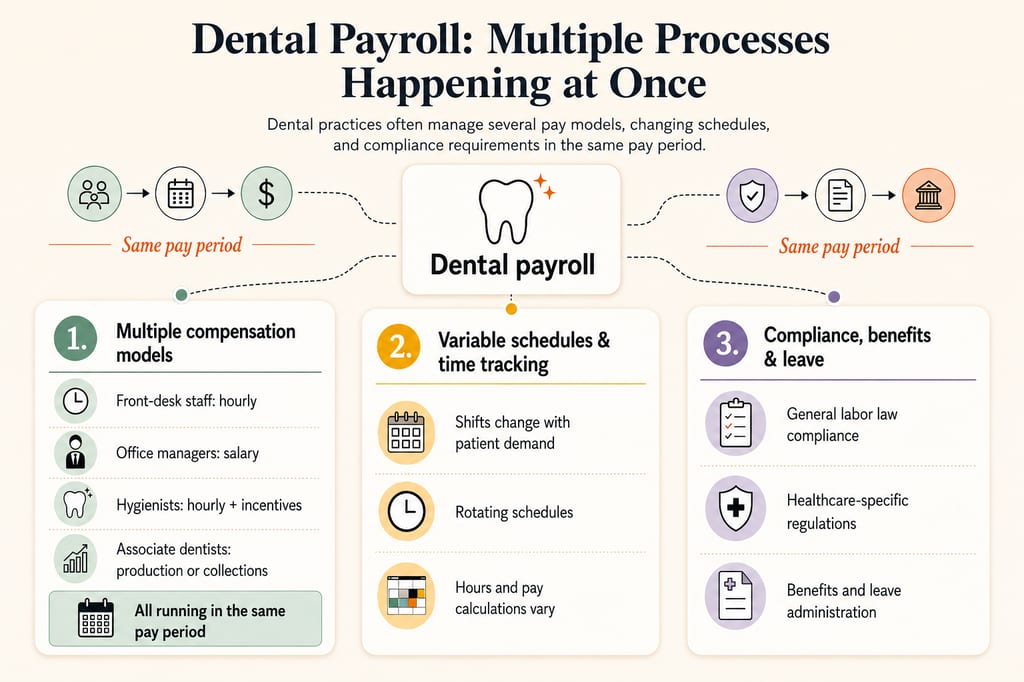
As I said, dental payroll is different because you're running multiple compensation models at once, whereas most businesses deal with one pay structure. In this case, you're dealing with three or four simultaneously.

Two more factors amplify that complexity: variable schedules and healthcare-specific compliance. Staff hours often fluctuate with patient demand and rotating shifts, making accurate time tracking and payment calculations more challenging.
On top of that, dental offices must follow general labor laws and healthcare-specific regulations, which often makes it necessary to keep up with compliance monitoring and can complicate the administration of benefits and leave policies.
Managing Multiple Pay Structures
Dental payroll gets complicated quickly because different roles can follow completely different compensation models within the same practice.
Cheri Joseph, a payroll operations consultant with 30+ years of experience who previously processed payroll for dental and healthcare practices at Oasis Outsourcing, says that it has been her biggest challenge as well.
The most challenging part was the multiple conflicting pay structures. Front desk and office managers are easy—they’re very basic. One gets paid hourly, the other salaried. It’s when you get to the dental hygienists and associate dentists; now that’s where the challenges lay.

Joseph says the complexity becomes more pronounced when those compensation models interact with overtime rules and disconnected systems:
It creates OT miscalculations and, more times than often, their dental practice software does not talk well with most payroll systems. And this within itself creates manual workflows, which opens us up to errors.
How Dental Practices Pay Different Roles
Dental practices often use several pay structures at once. Here’s a quick look at how common dental roles are typically paid and the main payroll issue to watch for.
| Role | Common pay model | Watch for |
|---|---|---|
| Associate dentists | Salary or % of production/collections | How production is defined and minimum guarantees |
| Hygienists | Hourly + possible production bonus | Overtime and bonus calculations |
| Dental assistants | Hourly | Overtime and changing schedules |
| Front-desk staff | Hourly | Extra hours and overtime |
| Office managers | Salary or hourly | Correct classification and overtime eligibility |
How to Pay Associate Dentists
Associate dentists are typically paid on one of two models: a flat salary or a production/collections-based percentage. Production pay is more common, and it aligns the associate's income with what they're actually generating for the practice. A common structure is a percentage of collections (often 25–35%), sometimes with a guaranteed daily or monthly minimum.
The difficult part for us was the reconciliation. Every month we were comparing reports from our practice-management software with payroll, and whenever something changed retroactively, we had to go back to an associate and explain why money they had already been paid needed to be adjusted on their next payroll.

When an associate is paid on production, you need clear definitions in place: Which production counts? Gross or net of adjustments? What happens on a slow week where production falls below the minimum? Document all of this before you run a single paycheck.
Hourly Staff: Hygienists and Assistants
Front office assistants, dental assistants, and hygienists are typically non-exempt employees and may be eligible for overtime pay. That matters because many practices pay hygienists a base hourly rate plus a production bonus, and both need to be factored into the overtime rate calculation (not just the base). More on that in the mistakes section.
For hygienists paid on a base plus production model, confirm how and when production bonuses are calculated and paid, and make sure those bonuses are clearly itemized on pay stubs.
Admin and Front-Desk Staff
Admin staff are almost always salaried or hourly non-exempt. The key risk here is overtime. If your front-desk coordinator is covering for a sick colleague and crosses 40 hours, that time is overtime, regardless of whether it was planned. Tracking tools that capture hours in real time are worth every cent.
Worker Classification: Employees vs. Independent Contractors
Misclassifying a worker is one of the most expensive payroll mistakes a dental practice can make. The IRS and state labor departments closely scrutinize the misclassification of employees as independent contractors. By choosing to classify an associate as a W-2 employee, you can mitigate your legal risks.
The IRS Control Test
Worker classification is determined by the economic reality of the relationship. If the practice owner controls the clinical schedule, provides the equipment, and dictates the patient list, the worker is an employee. A contract that calls someone a contractor doesn't change that. If the agency believes the worker is an employee based upon all relevant factors, a contract designating the associate as an independent contractor will be viewed as merely self-serving and, therefore, worthless.
Who Is Usually an Employee in a Dental Office?
In the majority of instances, associate dentists and dental hygienists are more appropriately classified as employees rather than independent contractors. Because a dental hygienist works under the supervision of a dentist and uses the practice's equipment and facility, they almost always meet the federal and state definitions of an employee.
The exception is the true per-diem or traveling professional who works independently and serves multiple clients, such as per-diem dental hygienists or travel nurses. Even then, state-level tests may override federal guidance. Some states, like California (AB5 law), have strict guidelines that make it difficult to classify dentists as independent contractors.
The Cost of Getting It Wrong
In many situations, a practice can be required to satisfy unpaid federal and state employment taxes, as well as FICA taxes. These taxes are in addition to penalties, not to mention the legal fees that a practice may incur in attempting to defend its misclassification. I'd strongly recommend consulting an employment attorney before finalizing any contractor arrangement.
How to Set Up Payroll for a Dental Practice: Step-by-Step
If you're setting up payroll for the first time, work through these steps in order:
- Get your EIN: Apply for an Employer Identification Number through the IRS before you can run payroll or file taxes. If you operate across states, check each state's registration requirements separately.
- Register for state and local payroll taxes: Each state has its own tax account registration process. Some also have local-level income taxes. Do this before your first pay date.
- Classify every worker correctly: Before anyone gets paid, determine whether each person is a W-2 employee or a 1099 independent contractor using the IRS control test covered above.
- Collect onboarding documents: Gather a signed W-4 (federal withholding), your state's equivalent withholding form, a completed I-9 for employment eligibility, and direct deposit authorization for each employee.
- Choose a pay schedule: Bi-weekly (every two weeks, 26 pay periods per year) is the most common in dental practices because it balances consistency with manageable cash flow. Semi-monthly (24 periods) also works, but watch state laws—some states mandate minimum pay frequency.
- Set up time tracking: Choose a system that captures clock-in and clock-out at the minute level, including huddle time and end-of-day cleanup. Verbal reporting or paper timesheets create the overtime disputes you want to avoid.
- Configure pay types in your payroll system: Set up each earnings code—hourly, salary, production percentage, bonuses—so calculations run automatically each period.
- Run a test payroll: Before you pay anyone, run a test cycle and verify gross pay, withholdings, and net pay for at least one employee in each pay category.
Payroll Taxes, Withholdings, and Deductions for Dental Offices
Federal Taxes
Every dental practice employee is subject to federal income tax withholding based on the W-4 they submitted, as well as FICA taxes—Social Security (6.2%) and Medicare (1.45%). You match those FICA contributions as the employer. Federal Unemployment Tax (FUTA) applies to the first $7,000 of each employee's wages each year.
State and Local Taxes
State income tax rates and rules vary significantly. Some states have no income tax; others have local jurisdiction taxes on top of state taxes. You need to register, withhold, and remit to each applicable jurisdiction—not just the state where your practice is headquartered, but potentially any state where an employee lives or works.
Deductions
Pre-tax deductions reduce an employee's taxable income and your FICA liability. These typically include:
- Health insurance premiums: Employee contributions under a group health plan
- Dental and vision coverage: If you offer ancillary benefits
- 401(k) or SIMPLE IRA contributions: Pre-tax deferrals within IRS limits
- Flexible spending accounts (FSAs) and health savings accounts (HSAs)
Post-tax deductions—like Roth 401(k) contributions or certain voluntary benefits—come out after taxes are calculated.
Handling Bonuses and Non-Cash Rewards
Employees are entitled to one and a half times their regular rate of pay, including bonuses and commissions, as their overtime compensation. That means if you pay a hygienist a production bonus, that bonus is part of their regular rate for overtime calculations—not a separate add-on you can exclude. This is one of the most commonly missed rules in dental payroll.
Compliance and Recordkeeping Every Dental Practice Must Know
FLSA Basics
The Fair Labor Standards Act (FLSA) sets the federal floor for minimum wage and overtime. Federal law requires overtime pay for eligible employees working over 40 hours per week. Some states go further, particularly for healthcare workers who are on call or work split shifts. Most clinical and administrative staff in a dental practice are non-exempt and entitled to overtime pay.
Offering compensatory time off instead of overtime pay is illegal in most private-sector workplaces. Yet some dental practices may inadvertently use this approach, thinking it's a valid alternative. Don't do it.
State-Specific Rules to Watch
Beyond federal law, state rules can add requirements around:
- Meal and rest breaks: Employees are often entitled to meal and rest breaks depending on state laws. Failing to provide these breaks or pay employees for missed breaks is a common oversight.
- Paid sick leave: Many states mandate a minimum amount of accrued paid sick leave.
- Pay frequency: Some states require weekly or bi-weekly payroll by default.
- Final paycheck timing: Most states have strict deadlines for issuing a final paycheck after termination.
Recordkeeping Requirements
Under the FLSA, you're required to keep payroll records for at least three years. These records should include hours worked each day and week, pay rates, total wages paid, deductions taken, and any overtime calculations. Store them securely—and if you're using cloud-based payroll software, confirm that records are accessible and backed up.
HIPAA and Payroll Data
Payroll data often touches protected health information (PHI) when benefits deductions are tied to healthcare coverage. Limit access to payroll systems to only the people who need it. Check that only the right people—usually the owner, practice manager, and maybe one trusted administrator—have access to your payroll system. Remove access for any former office managers or outside vendors you no longer use.
Common Dental Payroll Mistakes (and How to Avoid Them)
These are the errors I see come up most often in dental practices. Most are avoidable with the right systems in place:
- Excluding production bonuses from the overtime rate: Overtime is calculated correctly based on the regular rate, which may include certain bonuses. If you're calculating overtime only on a hygienist's base hourly rate and ignoring their production pay, you're likely underpaying.
- Misclassifying non-exempt staff as exempt: Exemption depends on their role and salary under the Fair Labor Standards Act. Many dental office staff are non-exempt and must receive overtime pay.
- Sloppy timekeeping: Without a reliable system for tracking hours worked, employers risk underpaying staff or mismanaging overtime pay. Relying on verbal reports or outdated systems can lead to errors.
- Paying bonuses late: Late production bonuses aren't just bad for morale. More than half of the workforce (53%) would consider leaving if their employer repeatedly made payroll mistakes. In a tight labor market, that's a real retention risk.
- Keeping terminated employees active: Take former employees out of your active payroll and benefits systems so they don't get paid or receive benefits by mistake. Ensure that all final paychecks, including any required PTO payouts, have been issued and accurately recorded.
- Not updating pay rates after raises: If a raise goes into effect and isn't updated in the payroll system immediately, you're either underpaying or creating a correction cycle that costs time and goodwill.
Handling Employee Benefits: PTO, Health Insurance, and Retirement
PTO Accrual on Variable Schedules
PTO accrual is straightforward on a fixed schedule—it gets complicated when hygienists work three days one week and five the next. I'd recommend an hours-based accrual method (e.g., X hours of PTO earned per hour worked) rather than a flat weekly or bi-weekly credit. It's fairer to part-time and variable-schedule staff, and it holds up better under state scrutiny.
Check your state's rules on PTO payout at termination. Several states require you to pay out all unused accrued PTO in the final paycheck, which makes it even more important to track balances accurately throughout the year.
Health and Dental Coverage Deductions
If you offer group health coverage, employee premium contributions typically come out pre-tax under a Section 125 cafeteria plan. Set these up correctly in your payroll system so they're excluded from federal income tax and FICA withholding. If they're coded incorrectly as post-tax deductions, employees and the practice both overpay.
Retirement Plans
Dental practices most commonly offer 401(k) plans or SIMPLE IRA plans. Both have annual contribution limits set by the IRS. Employee deferrals reduce taxable income; employer matches may or may not be pre-tax depending on plan design. Whatever you offer, payroll and your retirement plan administrator need to be in sync—deductions must hit the right accounts on time to avoid compliance issues.
The True Cost of Payroll for a Dental Practice
Payroll as a Percentage of Collections
Staff compensation is the single largest overhead category in any dental practice. The benchmark range is 25–30% of net collections, including all wages, payroll taxes, health insurance contributions, retirement plan matches, and any bonuses paid to non-doctor team members. On a $1.2 million practice, that 25–30% range translates to $300,000 to $360,000 in total staff costs.
Staff payroll above 32% of collections is a red flag. When you're trending above that, the root cause is usually overstaffing relative to patient volume, above-market pay rates without corresponding productivity, or excessive overtime from poor scheduling.
What Payroll Services Actually Cost
The cost for payroll software for a small-to-mid-size dental practice typically runs between $50 and $200 per month, plus a per-employee fee. Full-service payroll providers (who handle tax filings and year-end forms on your behalf) generally cost more, but they transfer the compliance burden off your team.
The Hidden Costs of Getting It Wrong
You can do payroll yourself, but the more pay structures, overtime rules, and tax obligations you manage, the more room there is for costly mistakes. Payroll errors carry costs beyond the correction itself: IRS penalties for late deposits, back-pay obligations, state labor board fines, and legal fees if a classification dispute goes to litigation.
In a practice where payroll is a major expense, even small errors—and the time it takes to fix them—can quickly chip away at margin.
Choosing the Right Payroll Software or Service for Your Practice
In-House vs. Outsourced Payroll
Running payroll in-house with software gives you real-time control and visibility. Managing payroll in-house may seem cost-effective initially. However, it can become labor-intensive, requiring significant time and resources. Staff members must stay updated with changing tax laws and payroll regulations. This not only diverts valuable time from core dental operations but also heightens the risk of non-compliance, which can lead to fines and penalties.
Outsourcing transfers that compliance responsibility to a third party. According to a survey by the American Dental Association (ADA), 52% of dental practices outsource some or all of their payroll functions. For most solo and small group practices, I think outsourcing is the smarter default, especially if the person running payroll is also managing the front desk.
10 Best Payroll Software for Dental Practices
If you’re ready to compare providers, these are some of the payroll platforms worth considering for dental practices.
Clicks on the links below may earn a commission, which supports our independent testing and review of software and services. Learn more about how we stay transparent.


Must-Have Features for Dental Payroll Software
Look for these capabilities before committing to any platform:
- Production pay support: The system should handle percentage-of-collections pay natively, not through manual workarounds.
- Weighted-average overtime calculations: Essential when employees mix hourly and production pay in the same week.
- Time-tracking integration: Direct sync between your time-tracking tool and payroll eliminates manual entry and the errors that come with it.
- Automated tax filing: Federal, state, and local tax deposits and filings should happen automatically—not be left to you to schedule.
- Employee self-service: Staff should be able to access pay stubs, W-2s, and PTO balances without calling the office manager.
- Multi-location support: If you run more than one practice location, you need a single login with location-level reporting.
- Connected employee data: Look for payroll software that either includes or integrates closely with your HR and time-tracking systems. When employee records, hours, PTO, benefits, and payroll data live in connected systems, you reduce duplicate entry and the risk of conflicting information between platforms.
- Practice management integration: Dental payroll data often originates outside the payroll system itself. Production, collections, adjustments, and refunds may all be tracked in your practice management software, which means payroll accuracy depends heavily on how well those systems work together. Oestervemb says integration issues with reconciliation has changed how he thinks about dental payroll software:
The biggest lesson for me has been that dental compensation really lives inside the practice-management software, not the payroll system. Payroll is almost the last step. Most of the mistakes happen in the gap between those two systems.
Questions to Ask Before You Commit to a Payroll Provider
Once you’ve defined your practice’s requirements, use those needs to pressure-test potential providers. Ask how they handle production-based compensation, retroactive adjustments, overtime calculations, payroll corrections, and integrations with your dental practice management system.
If you’re comparing several providers, a formal payroll RFP can help you ask the same questions consistently and compare responses side by side.
- Does the platform natively support production-based pay, or will I need to calculate it manually each period?
- How does it handle weighted-average overtime across mixed pay types?
- Will it file taxes on my behalf in every state where I have employees?
- What does the implementation process look like, and how long does it take?
- What support is available if something goes wrong on a pay date?
Frequently Asked Questions
Who is responsible for payroll in a dental office?
The practice owner is ultimately responsible. Day-to-day execution is typically handled by an office manager, practice administrator, or a third-party payroll provider. Regardless of who processes it, the owner is liable for any errors or compliance failures.
How often should I run payroll?
Biweekly is the most common cadence in dental practices; it balances predictability for employees with manageable cash flow for the practice. Check your state’s minimum pay frequency requirements before finalizing your schedule.
What laws affect dental payroll processing?
At minimum, you’re subject to the FLSA, IRS payroll tax regulations, and your state’s wage and hour laws. Depending on your location, you may also face local income tax obligations, state-specific paid leave mandates, and healthcare-adjacent regulations that touch benefits administration.
Can I run payroll myself, or should I outsource?
You can run it yourself with the right software—but I’d think carefully about the time cost. The U.S. has about 135,000 dental practices employing more than a million people, and most are small offices where the person running payroll also runs the front desk. If that’s your situation, outsourcing is worth a serious look.
Ready to Find the Right Payroll Tool for Your Practice?
Once you know what your practice needs, choosing payroll software that handles production-based pay, weighted overtime, and automated tax filing will save you more time and risk than any other operational decision you make.