
40 Best Employee Survey Tools of 2026 for Staff Feedback

20 Best Employee Survey Tools Shortlist
Here's my pick of the 20 best software from the 40 tools reviewed.


The best employee survey tools help you gather real-time feedback, measure engagement, and act on insights—so you can build a stronger, more connected workplace.
With remote work, hybrid teams, and shifting employee expectations, it’s easy for morale issues and process gaps to fly under the radar. A well-designed survey platform bridges that visibility gap with continuous pulse checks, sentiment analysis, and thoughtful question templates—all in one place.
From anonymous feedback and real-time dashboards to benchmarking and follow-up workflows, the right tool empowers leaders to listen, understand trends, and take timely action.
After evaluating 30+ platforms and hands‑on testing features like multilingual support and AI-powered analysis, I’ve curated the top solutions that are intuitive, evidence‑based, and built to scale as your team evolves.
Why Trust Our Software Reviews
We've been testing and reviewing HR software since 2019. During that time we've tested more than 2,000 tools for different HR use cases and written over 1,000 comprehensive software reviews.
As HR professionals ourselves, we know how critical and difficult it is to make the right decision when selecting software.
We invest in deep research to help our audience make better software purchasing decisions. Learn how we stay transparent, and take a look at our software review methodology.
Table of Contents
- Best Software Shortlist
- Why Trust Our Software Reviews
- Compare Specs
- Best Employee Survey Tool Reviews
- Related HR Software Reviews
- Selection Criteria for Employee Survey Tools
- How to Choose Employee Survey Tools
- Trends in Employee Survey Tools
- What are Employee Survey Tools?
- Benefits
- Features of Employee Survey Tools
- Costs and Pricing for Employee Survey Tools
Best Employee Survey Tools: Pricing Comparison Chart
This comparison chart summarizes pricing details for my top employee survey tool selections to help you find the best software for your budget and business needs.
| Tool | Best For | Trial Info | Price | ||
|---|---|---|---|---|---|
| 1 | Best for identifying survey themes | Free demo available | Pricing upon request | Website | |
| 2 | Best for employee feedback analysis | Free trial + free plan + free demo available | From $39/month (billed annually) | Website | |
| 3 | Best tool for global, multilingual surveys | Free demo available | From $5/employee/month | Website | |
| 4 | Best for real-time actionable feedback insights | Free 14-day trial + free demo available | Pricing upon request | Website | |
| 5 | Best for anonymous feedback | Free 14-day trial + free plan available | From $5/user/month (billed annually) | Website | |
| 6 | Best for science-backed survey templates | Free demo available | From $11/seat/month | Website | |
| 7 | Best for performance and talent development | Free demo available | Pricing upon request | Website | |
| 8 | Best for predictive workforce insights | Free demo available | Pricing upon request | Website | |
| 9 | Best for real-time employee surveys | Free plan available | From $19/month | Website | |
| 10 | Best for reports that drive action | Free forever plan (up to 1 user) | Pricing upon request | Website | |
| 11 | Best for continuous pulse feedback | 30-day free trial | From $3/user/month | Website | |
| 12 | Best for customizable pulse surveys | Free demo available | Pricing upon request | Website | |
| 13 | Best for eNPS surveys | 30-day free trial + free demo available | From $1/user/month + free plan available | Website | |
| 14 | Best for pulse checks and sentiment analysis | Free demo available | From $4.50-$11.70/employee/month | Website | |
| 15 | Best with a template library | Free demo available | Pricing upon request | Website | |
| 16 | Best with meeting agendas and recognition | Not available | Pricing upon request | Website | |
| 17 | Best for prebuilt forms and automated deployment | Free plan available | From $30/user/month (billed annually) | Website | |
| 18 | Best drag-and-drop survey builder | 14-day free trial | From $49 per month | Website | |
| 19 | Best idea-gathering for business change | Free plan available (for up to 10 users) | From $3/user/month | Website | |
| 20 | Best for analyzing large amounts of survey data | 7-day free trial + free demo | Pricing upon request | Website |
-

Checkr
Visit WebsiteThis is an aggregated rating for this tool including ratings from Crozdesk users and ratings from other sites.4.5 -
Kudoboard
Visit WebsiteThis is an aggregated rating for this tool including ratings from Crozdesk users and ratings from other sites.4.8 -
Native Teams
Visit WebsiteThis is an aggregated rating for this tool including ratings from Crozdesk users and ratings from other sites.4.9



Best Employee Survey Tool Reviews
Here’s a brief description of each employee survey platform to showcase each tool’s best use case, some noteworthy features, and screenshots to give a snapshot of the user interface.


WorkTango helps HR teams and business leaders gather actionable employee feedback through customizable surveys and analytics, helping them understand workforce sentiment and drive engagement across organizations of all sizes.
Who Is WorkTango Best For?
WorkTango suits mid-size to enterprise HR teams that need a structured way to collect, analyze, and act on employee feedback at scale.
Why I Picked WorkTango
WorkTango earns its spot on my shortlist because of how well it handles the hardest part of employee surveys: making sense of open-text responses at scale. I particularly like the AI Comment Themes feature, which automatically surfaces recurring topics from open-ended survey responses when a survey closes. Instead of spending hours reading through hundreds of comments, my team immediately sees recurring topics. WorkTango Coach takes this further by letting you ask plain-language questions about your survey data and get instant answers that connect qualitative feedback to quantitative scores.
WorkTango Key Features
- Pulse surveys: Send short, frequent surveys to track employee sentiment in real time between larger engagement cycles.
- Benchmarking: Compare your survey results against industry and company-size benchmarks to contextualize your scores.
- Anonymous feedback: Employees can submit responses anonymously, with configurable confidentiality thresholds to protect identity.
- Action planning: Managers can build structured action plans directly from survey results to address identified issues.
WorkTango Integrations
Integrations include UKG, Microsoft Teams, Outlook, ADP, BambooHR, Confetti, HireRoad, Merge, and Slack.


Sogolytics helps HR teams and organizations design, distribute, and analyze employee surveys to uncover actionable insights and improve workplace engagement.
Who Is Sogolytics Best For?
Sogolytics is a good fit for mid-size to large organizations with HR teams that need detailed survey analytics to drive data-informed employee experience decisions.
Why I Picked Sogolytics
Sogolytics earns its spot on my shortlist because of how far it goes with employee feedback analysis. I particularly like the sentiment analysis feature, which automatically categorizes open-ended responses so my team doesn't have to manually sift through hundreds of comments. The real-time dashboards let us slice data by department, tenure, or role, making it easy to spot patterns that would otherwise get buried in a spreadsheet. I also rely on the automated trend reports to track how employee sentiment shifts over time across survey cycles.
Sogolytics Key Features
- Customizable survey templates: Choose from pre-built employee survey templates that you can tailor to match your organization's specific feedback goals.
- Automated survey distribution: Schedule and send surveys via email or SMS with automated reminders to boost response rates.
- Anonymous feedback collection: Configure surveys to collect responses anonymously, encouraging more honest employee input.
- Multi-language support: Deploy surveys in multiple languages to gather feedback from employees across different regions.
Sogolytics Integrations
Integrations include Salesforce, Microsoft Teams, Google Sheets, Slack, HubSpot, Zapier, Mailchimp, Tableau, Google Analytics, and Oracle Eloqua.
Pros and Cons
Pros:
- Templates and multilingual support reduce setup time for global teams
- Trend-analytics let you track feedback over time, not just one survey
- Advanced logic helps tailor surveys to each respondent
Cons:
- Setting up reports or dashboards may need extra training
- Learning curve for customizing complex logic
New Product Updates from Sogolytics

Sogolytics Launches AI-Powered Experience Navigator
Sogolytics introduces Experience Navigator, an AI-powered tool for building strategy and action plans. This update helps teams turn goals into tailored execution plans with relevant metrics and projects in minutes. For more information, visit Sogolytics’ official site.
 .
.
Deel HR helps global organizations gather employee feedback across borders, making it easier for HR teams to manage surveys, track engagement, and support diverse workforces in multiple countries.
Who Is Deel HR Best For?
Deel HR is a strong fit for HR teams at mid-size to enterprise companies managing employees and contractors across multiple countries and time zones.
Why I Picked Deel HR
Deel HR earns its spot as one of the best on my shortlist because its survey tools are built from the ground up for global teams. I like that surveys in Deel Engage support multilingual delivery, so employees across different countries can respond in their own language—something that genuinely changes response quality and participation rates. I also find the anonymous feedback controls useful, since they let HR teams adjust anonymity settings per survey, which matters when you're navigating different cultural norms around candor. The centralized analytics dashboard surfaces eNPS scores and engagement drivers across regions, allowing me to compare sentiment in a team in Brazil with one in Germany without stitching together separate reports.
Deel HR Key Features
- Pulse surveys: Send short, recurring surveys to track employee sentiment over time without survey fatigue.
- Custom survey templates: Build surveys from pre-made templates tailored to common HR use cases like onboarding and performance.
- 1:1 meeting tools: Schedule and structure manager-employee check-ins directly within the platform.
- Performance review cycles: Set up and automate review cycles with configurable timelines and participant groups.
Deel HR Integrations
Integrations include FaceUp, Snowflake, DefensX, Microsoft Finance, Kintsugi, ReFresh OS, Revo.ai, Keeper, Human Interest, and Everyminute.
New Product Updates from Deel HR

Deel HR Introduces AI-Powered ATS for Hiring
Deel HR introduces an AI-powered ATS built into its platform. This update enhances hiring efficiency by automating sourcing, screening, and workflows across the recruitment process. For more information, visit Deel HR’s official site.
 .
.
ThriveSparrow helps HR teams and business leaders gather employee feedback, track engagement trends, and uncover actionable insights to improve workplace culture and performance.
Who Is ThriveSparrow Best For?
ThriveSparrow is a strong fit for mid-sized companies with dedicated HR teams looking to build a continuous employee feedback culture.
Why I Picked ThriveSparrow
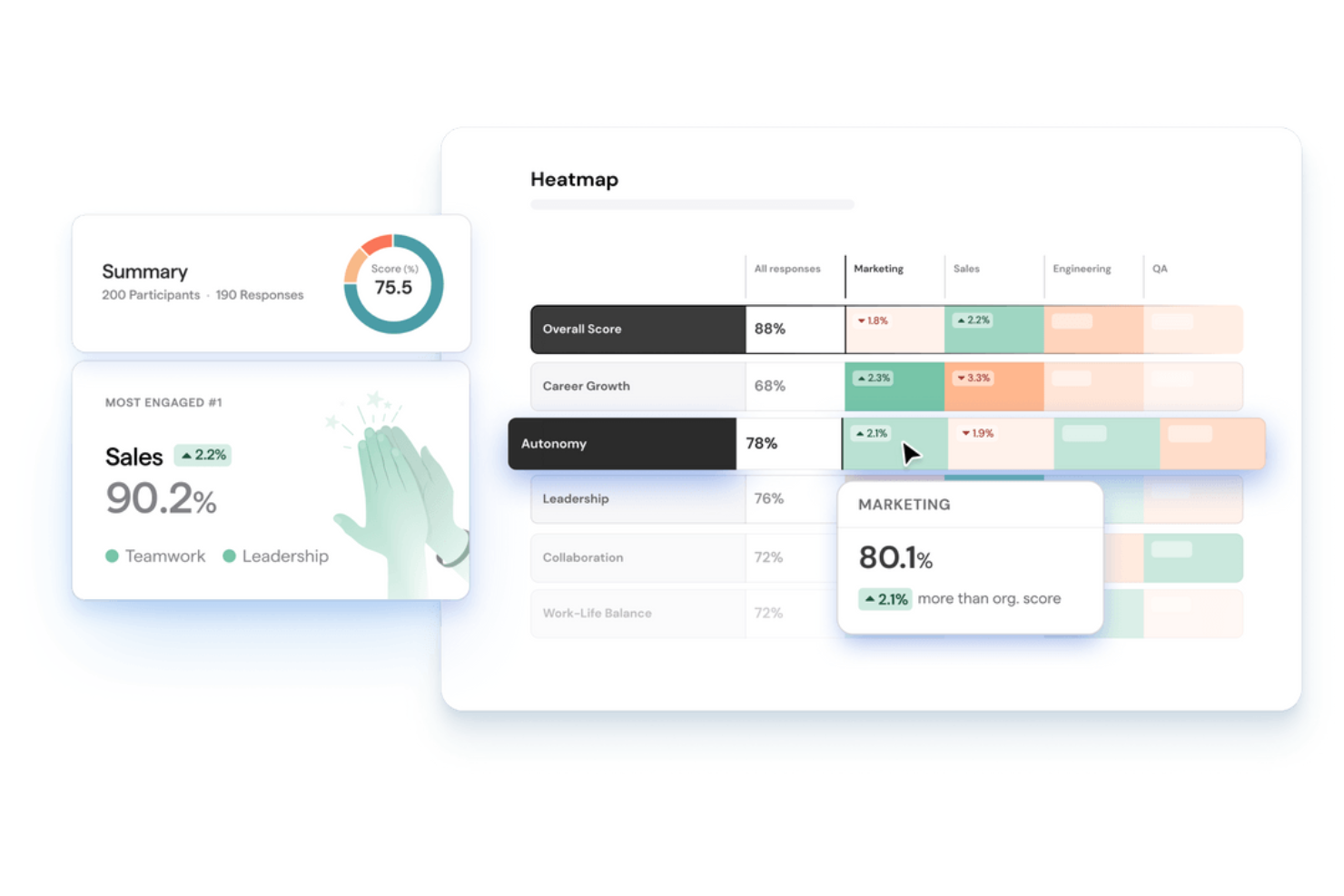
I picked ThriveSparrow as one of the best because of how it closes the gap between collecting feedback and actually doing something with it. What I find most useful is the AI sentiment analysis, which reads through open-text responses and surfaces what employees are really feeling—so I'm not manually combing through hundreds of comments to spot a trend. Pair that with the engagement heatmaps, and I can see where morale is shifting across teams or departments in real time. From there, ThriveSparrow generates action plans directly tied to those insights, so the next step is never a guessing game.
ThriveSparrow Key Features
- Pulse surveys: Send automated, recurring short surveys to capture employee sentiment on a regular cadence across teams.
- Employee NPS surveys: Measure employee loyalty and advocacy with eNPS surveys and track shifts over time using heatmaps.
- QR code survey sharing: Distribute surveys via QR codes to reach deskless or field-based employees without email access.
- Multilingual survey support: Deploy surveys in 100+ languages and translate responses to capture feedback from global teams.
ThriveSparrow Integrations
Integrations include BambooHR, ADP, Google, Microsoft Teams, and Bob.
Pros and Cons
Pros:
- Heatmaps and visual analytics help you spot issues by team or department
- Continuous feedback loop via recurring surveys keeps your finger on morale
- Quick survey launch using pre-built templates and question banks
Cons:
- Interface is less customizable than some advanced competitors
- Fewer native integrations vs larger enterprise platforms
New Product Updates from ThriveSparrow

ThriveSparrow Introduces Awards for Formal Recognition
ThriveSparrow introduces Awards, a new feature designed for company-wide recognition of meaningful achievements beyond everyday kudos. Teams can now acknowledge major wins with structured awards that carry visibility, points, and optional approvals. For more information, visit ThriveSparrow's official site.
 .
.
Workleap Officevibe helps HR teams and managers in growing organizations collect, analyze, and act on employee feedback through automated surveys and actionable insights that improve engagement and workplace culture.
Who Is Workleap Best For?
Workleap Officevibe is a good fit for mid-sized companies where managers need a structured, ongoing way to understand how their teams are feeling.
Why I Picked Workleap
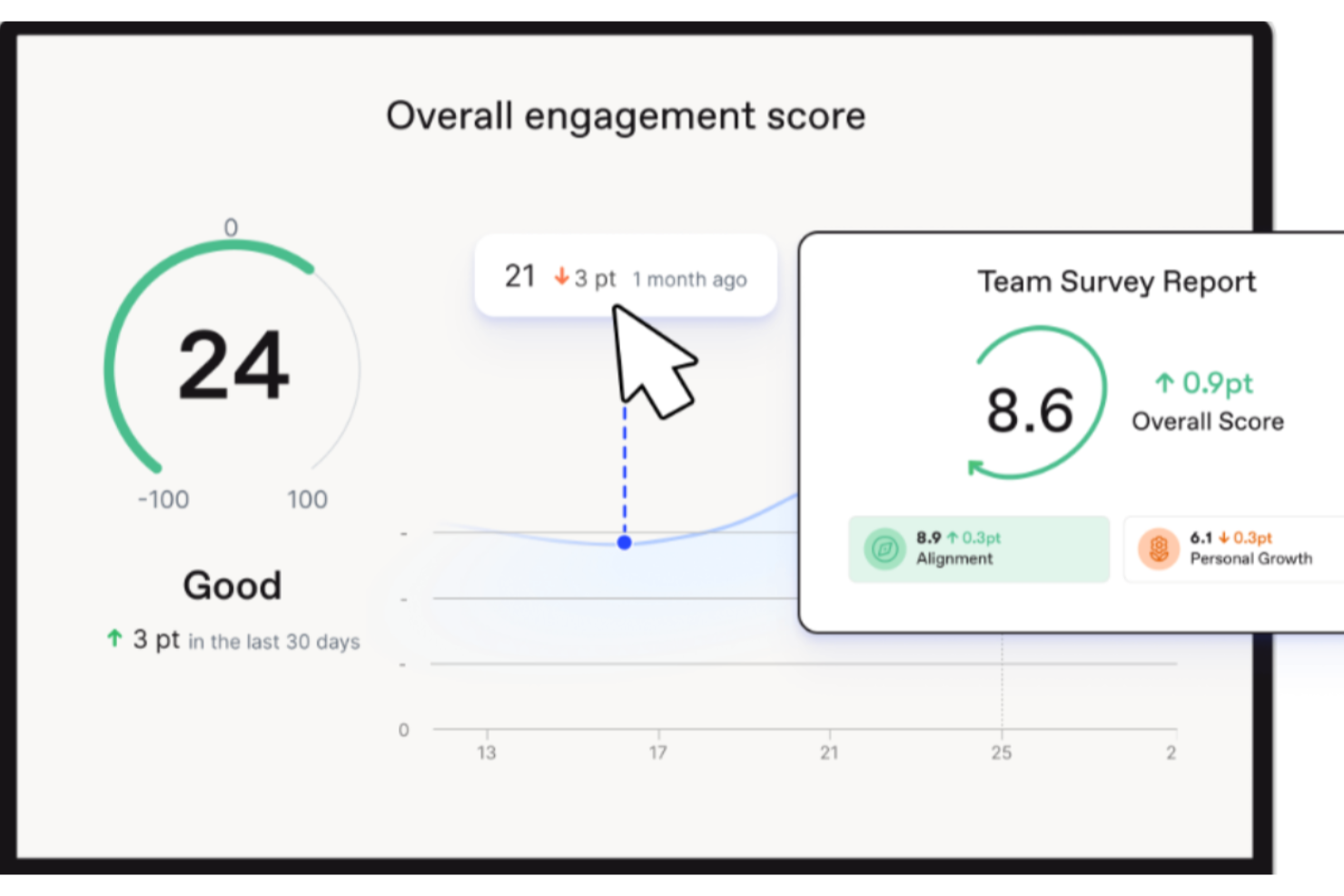
I picked Workleap Officevibe because it treats anonymous feedback as a trust-building mechanism rather than just a data-collection feature. When employees know their responses are genuinely protected, you get more honest answers—and Officevibe enforces this by only surfacing feedback results when a minimum number of responses is reached, preventing anyone from being identified. I also like the anonymous messaging thread, where managers can reply to feedback without knowing who sent it, keeping the conversation going while preserving confidentiality. AI-powered highlights translate anonymous responses into clear themes and suggested actions, so managers have clear next steps.
Workleap Key Features
- Pulse surveys: Frequent, lightweight check-ins that track engagement patterns across teams over time.
- Structured onboarding surveys: Science-backed surveys sent to new hires during their first weeks to measure early engagement.
- Good Vibes recognition cards: Peer-to-peer recognition cards that let employees send appreciation to teammates directly within the platform.
- DEIB assessments: Monthly built-in surveys that measure diversity, equity, inclusion, and belonging across the organization.
Workleap Integrations
Integrations include Slack, Microsoft 365, Google Workspace, BambooHR, HiBob, ADP Workforce Now, ChartHop, Dayforce, Paychex, and Workday.
Pros and Cons
Pros:
- Built-in peer recognition fosters positive team culture
- Lets you track engagement trends and act on real data
- Encourages honest feedback via anonymous channels
Cons:
- Limited advanced reporting features
- Mobile interface lacks full functionality compared to desktop

Lattice gives HR teams and people leaders a platform to gather, analyze, and act on employee feedback, helping organizations of all sizes measure engagement and drive meaningful workplace improvements.
Who Is Lattice Best For?
Lattice is a strong fit for mid-size to enterprise HR teams that need a structured, data-driven approach to employee engagement and performance management.
Why I Picked Lattice
I picked Lattice as one of the best because of how seriously it takes the science behind survey design. The survey templates are built on research-backed frameworks and benchmarked against Mercer data, so when my team runs an engagement survey, we're not just asking questions—we're measuring against industry, region, and company size comparisons that give results real context. I also like the AI analysis layer, which surfaces key drivers and recommended next steps from open-text responses in seconds rather than making HR teams manually comb through comments. The action planning tools let managers move directly from survey results to structured initiatives, which closes the loop between collecting feedback and taking action.
Lattice Key Features
- Pulse surveys: Send short, frequent surveys to track employee sentiment between full engagement cycles.
- Anonymous feedback collection: Employees can submit responses anonymously, giving HR teams more candid data.
- Custom survey builder: Create surveys from scratch or modify existing templates to fit specific team needs.
- Engagement heatmaps: Visualize survey results across departments, teams, and demographics in a single view.
Lattice Integrations
Integrations include ADP, BambooHR, Greenhouse, Gusto, HiBob, Jira, Lever, Microsoft Teams, Slack, and Workday.
Pros and Cons
Pros:
- Detailed demographic filters and benchmark comparisons
- Links engagement data directly to performance and growth discussions
- Science-backed survey templates
Cons:
- Limited flexibility for entirely bespoke survey logic
- Advanced analytics may require some training
New Product Updates from Lattice

Lattice Enables Custom Naming Across the Platform
Lattice enables custom naming flexibility, allowing admins to rename key platform terms to match internal language and workflows. This update helps organizations improve adoption and align the platform with company terminology. For more information, visit Lattice’s official site.
 .
.
Mitratech Perform helps HR teams and managers in growing organizations gather employee feedback, run surveys, and connect insights directly to performance and development processes.
Who Is Mitratech Perform Best For?
Mitratech Perform is a strong fit for mid-sized to enterprise organizations that want to tie employee feedback directly to performance reviews and talent development workflows.
Why I Picked Mitratech Perform
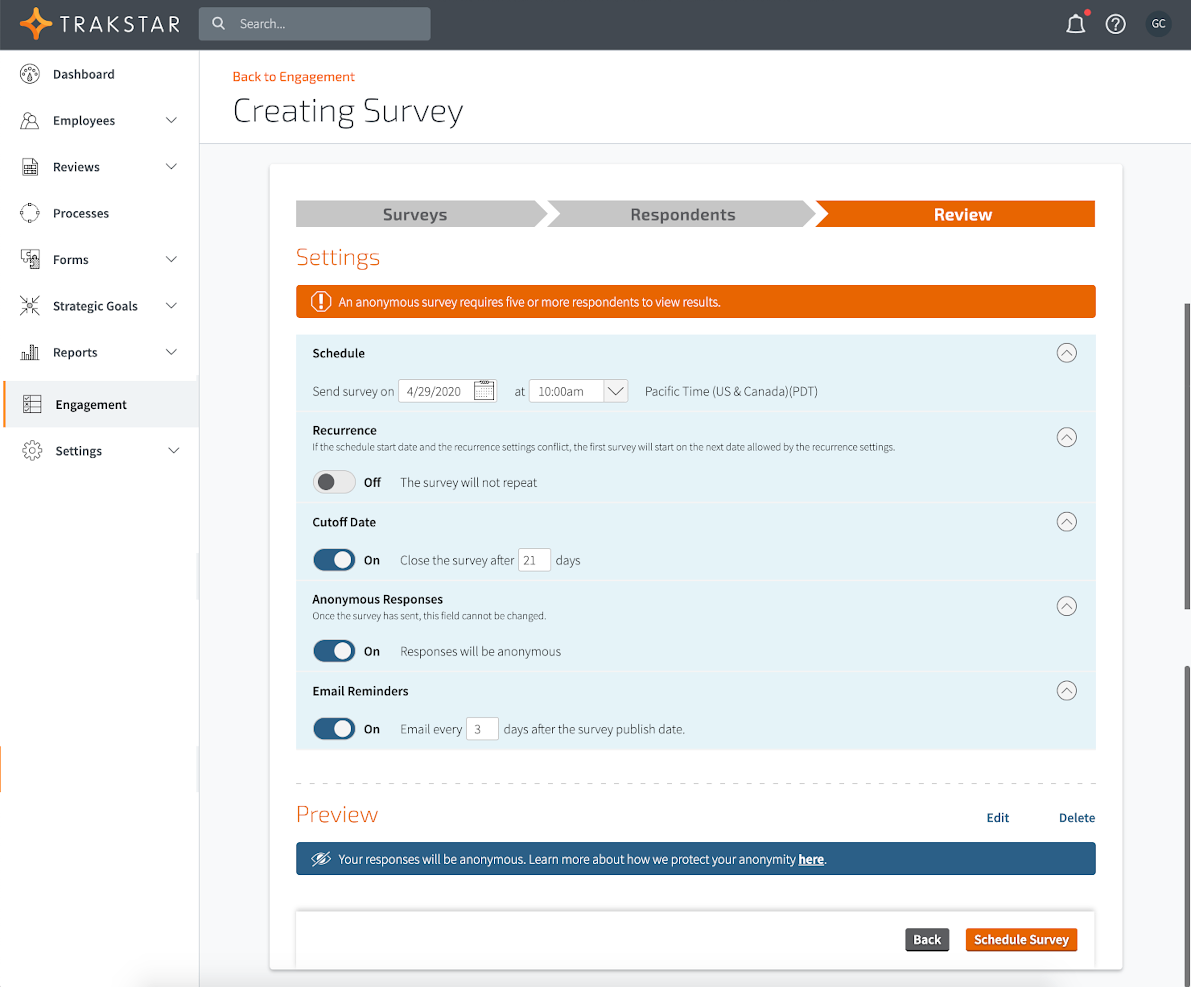
I picked Mitratech Perform as one of the best because of how tightly it connects employee survey feedback to performance and talent development workflows. The engagement surveys in Trakstar Perform let you break down results by department, question, or time period—so when survey data shows a dip in a specific team, I can trace it back to performance trends and act on it directly. I also like the 360-degree review feature, which collects feedback from peers, managers, and even external contacts, with configurable anonymity settings that make responses more honest. Pair that with SMART goal tracking and continuous check-ins, and survey insights don't just sit in a dashboard—they feed directly into development plans and coaching conversations.
Mitratech Perform Key Features
- Pulse surveys: Send short, targeted surveys directly to employees' inboxes and view results in real time as responses come in.
- Survey result segmentation: Filter survey data by group, department, or time period to pinpoint where engagement is high or low.
- Manager check-ins and polls: Run quick polls and structured check-ins between formal review cycles to keep a continuous read on team sentiment.
- Competency assessment: Evaluate employees against defined competencies as part of the review process to identify skill gaps and development needs.
Mitratech Perform Integrations
Integrations include ADP Workforce Now, Paylocity, BambooHR, UKG Pro, Azure, Okta, Google Workspace, Slack, SFTP, and Salesforce.
Pros and Cons
Pros:
- Analytics help identify engagement or performance trends
- Feedback and performance data in one platform
- Scheduled surveys and check-ins that keep engagement ongoing
Cons:
- Custom configuration may be required to map data precisely
- Some features may need setup or HR admin work


LutherOne helps HR teams and business leaders gather actionable employee feedback, combining customizable surveys and real-time analytics to address engagement, performance, and retention challenges across organizations of all sizes.
Who Is LutherOne Best For?
LutherOne is a strong fit for mid-size to large organizations where HR teams need to move beyond basic survey data and connect employee feedback to broader workforce strategy.
Why I Picked LutherOne
I picked LutherOne as one of the best because I love how its predictive engine goes beyond reporting what's already happened. The platform's continuous driver analysis runs in the background, surfacing attrition risk, burnout signals, and performance shifts before they become visible problems — and LutherOne claims its algorithms can predict turnover over a year in advance. I also like that managers don't just get a risk score; they get personalized, people-science-backed recommendations on exactly what to do next. This combination of predictive modeling and prescriptive guidance goes beyond tools that stop at dashboards.
LutherOne Key Features
- Smart question rotation: LutherOne's proprietary algorithm rotates questions across survey cycles, so employees answer only a few questions at a time while the platform captures 100+ insights per year.
- Ad-hoc survey launcher: Beyond continuous surveys, you can deploy pulse surveys, stay/exit interviews, and 360 feedback with custom audiences and anonymity settings.
- Action planning hub: Assign owners, set deadlines, and track progress on survey-driven action plans using list, Kanban, or timeline views — all in one place.
- eNPS tracking: Monitor employee Net Promoter Score alongside engagement data in real-time, interactive dashboards with advanced filtering by team, role, or region.
LutherOne Integrations
Integrations include Slack, Microsoft Teams, Jira, Workday, BambooHR, SAP SuccessFactors, Microsoft Azure Active Directory, Google Workspace, Salesforce, and Okta.
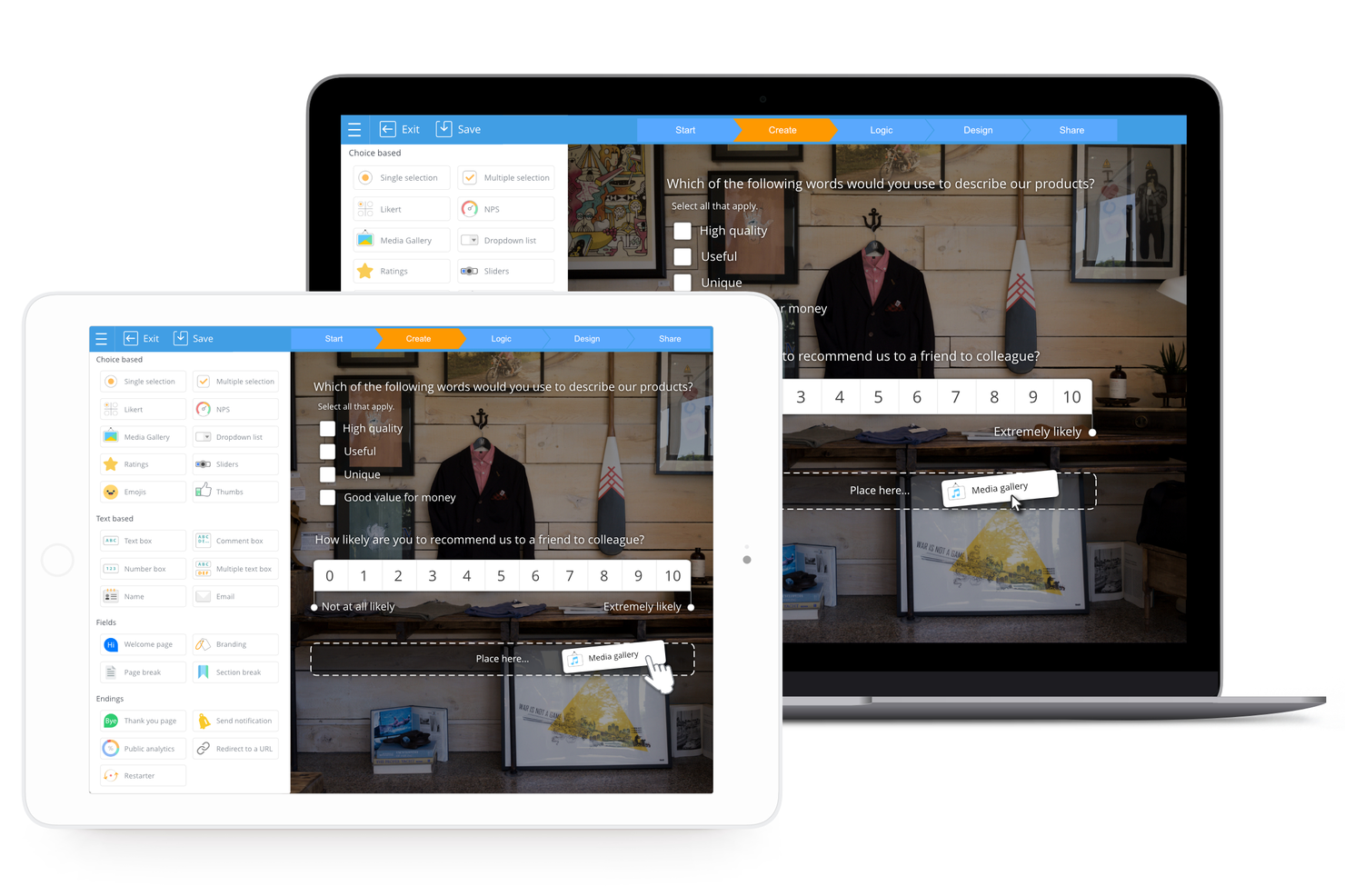
SurveyLegend is an online survey platform designed for HR teams and business leaders who want to gather actionable employee feedback with visually engaging, mobile-friendly surveys that are easy to create and analyze.
Who Is SurveyLegend Best For?
SurveyLegend is a good fit for small to mid-sized businesses that need a straightforward, visually appealing way to collect and review employee feedback without a steep learning curve.
Why I Picked SurveyLegend
SurveyLegend earns its spot on my shortlist because its live analytics feature updates response data in real time, so HR teams can monitor employee sentiment as it comes in rather than waiting for a batch report. I particularly like that you can track individual respondents and filter results by date range, which makes it easy to spot patterns during a specific engagement period or after a company-wide announcement. The geographical reach visualization is a nice touch for distributed teams, showing you at a glance which locations are responding and which aren't. For pulse surveys or time-sensitive feedback initiatives, that kind of immediate visibility shortens the time between feedback and action.
SurveyLegend Key Features
- Likert scale questions: Build mobile-friendly scaled survey questions with multiple Likert items and selection choices to measure employee sentiment across a range of topics.
- Skip and hide logic: Set conditional logic to show, hide, or skip questions based on previous responses, so employees only see questions relevant to them.
- Kiosk mode: Automatically restart surveys after each submission, simplifying collection at shared workstations or in-person feedback stations.
- Instant notifications: Receive an email alert as soon as an employee submits a response, so results arrive as they're submitted.
SurveyLegend Integrations
Integrations include Salesforce, Mailchimp, and Google Sheets.

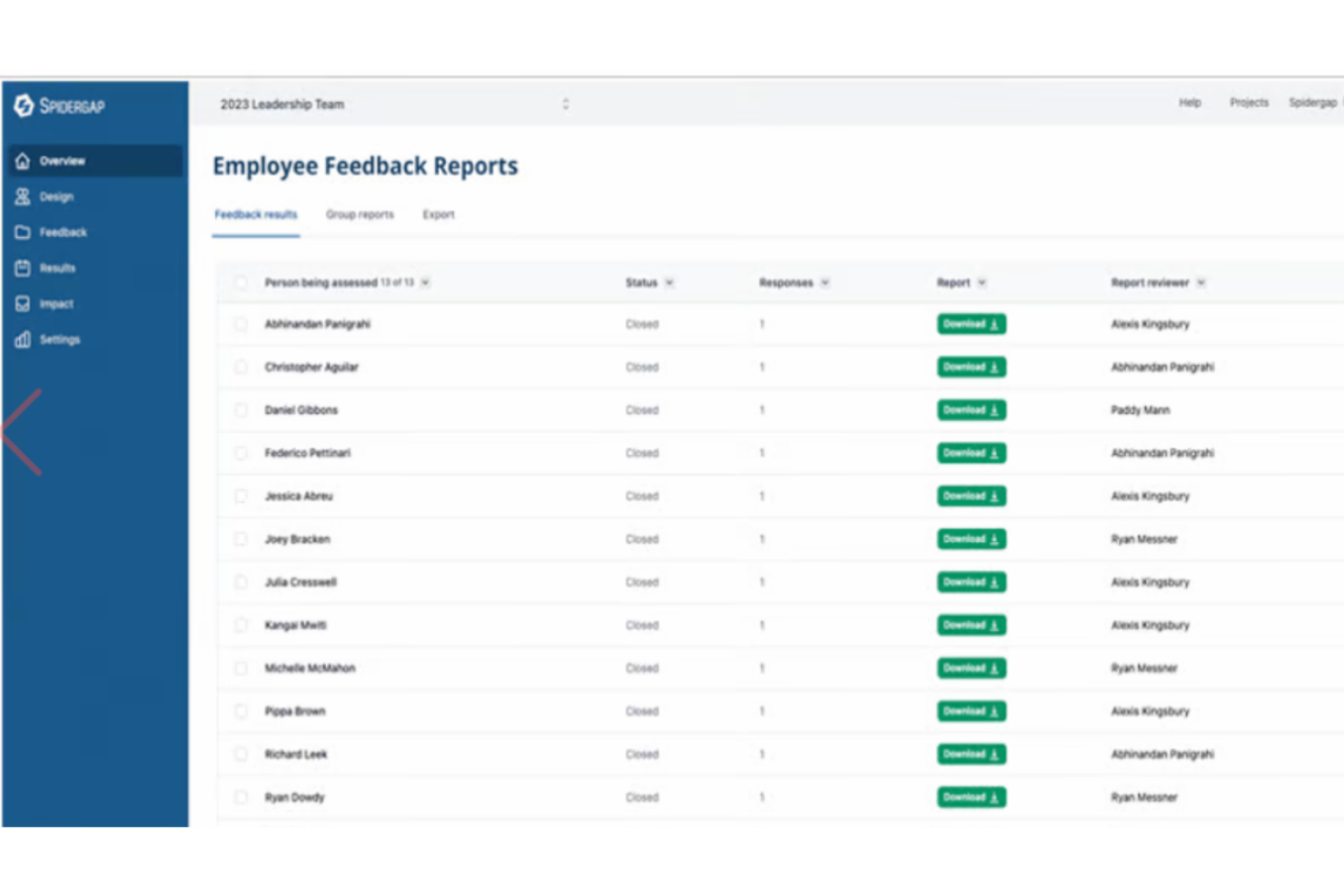
Spidergap 360˚ Feedback helps HR teams and managers in organizations of all sizes collect structured employee feedback, making it easier to identify strengths, development needs, and actionable next steps for professional growth.
Who Is Spidergap 360˚ Feedback Best For?
Spidergap 360˚ Feedback is a good fit for HR teams and people managers who want a dedicated 360-degree feedback tool focused on employee development rather than performance ratings.
Why I Picked Spidergap 360˚ Feedback
Spidergap 360˚ Feedback earns its spot on my shortlist because the reports are built around driving action, not just presenting data. Where most 360-degree tools dump scores and graphs on employees and leave them to figure out what to do next, Spidergap's reports are designed with HR directors and employees in mind—surfacing the areas that need the most attention. I also like the built-in impact survey, which lets you follow up after a feedback cycle to measure whether participants acted on their development priorities. Closed-loop tracking like that is rare in dedicated 360-degree feedback tools.
Spidergap 360˚ Feedback Key Features
- Customizable questionnaires: Build surveys from best practice templates or design your own questions, rating scales, and competency frameworks from scratch.
- Anonymity controls: Set and manage anonymity thresholds so respondents can give honest feedback without being identified.
- Automated reminders: Schedule and send automated follow-up reminders to participants who haven't completed their feedback yet.
- Progress monitoring: Track completion rates across all participants in real time to make sure each person receives enough responses before the cycle closes.
Spidergap 360˚ Feedback Integrations
Integrations include Slack, Microsoft Teams, Okta, Microsoft Azure Active Directory, Google Workspace, BambooHR, HiBob, Workday, and Stripe.
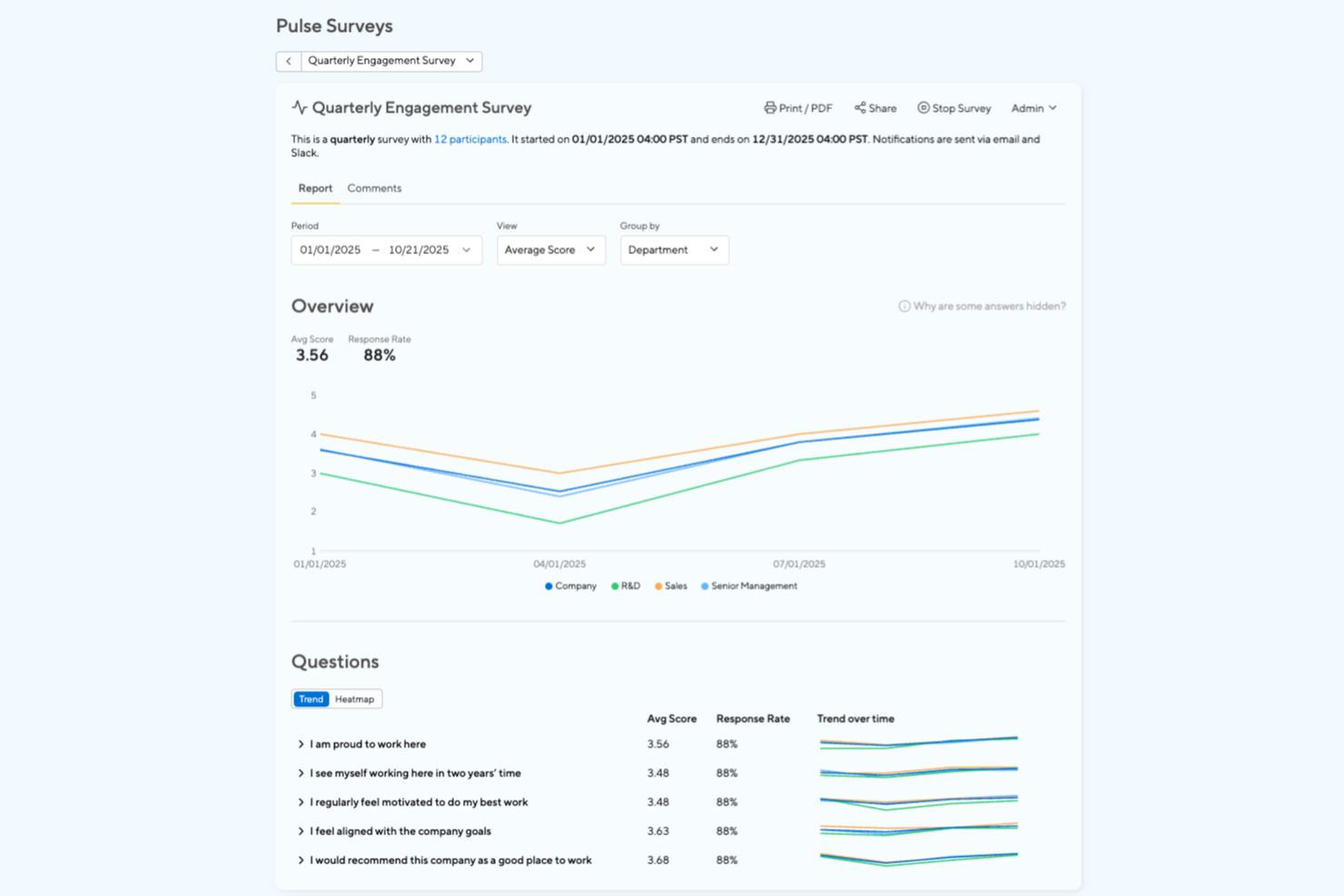
Small Improvements gives HR teams and managers in growing organizations a way to gather actionable employee feedback, run surveys, and support ongoing engagement with tools designed to fit modern performance management and feedback processes.
Who Is Small Improvements Best For?
Small Improvements is a good fit for mid-sized companies that want to combine employee feedback with performance management in a single, lightweight platform.
Why I Picked Small Improvements
Small Improvements earns its spot on my shortlist because of how well it handles continuous pulse feedback without making it feel like a chore for employees or managers. I like that you can send short, recurring pulse surveys on a set cadence, so you're always working with fresh sentiment data rather than relying on a single annual survey. The platform also lets you customize question sets and target specific teams or groups, which means I can track engagement trends at a department level rather than just across the whole organization. The feedback timeline feature ties pulse results to ongoing conversations, so nothing gets collected and forgotten.
Small Improvements Key Features
- 360-degree feedback: Collect structured feedback from peers, direct reports, and managers to give employees a full picture of their performance.
- Performance reviews: Run customizable review cycles with flexible question sets, participant controls, and parallel timelines for different departments.
- Praise tool: Let employees recognize colleagues at any time, with visibility settings that can extend the recognition beyond just the recipient.
- Retention analytics: Use predictive analytics to identify employees who may be at risk of leaving before they hand in their notice.
Small Improvements Integrations
Integrations include Slack, Google Workspace, BambooHR, Okta, OneLogin, Microsoft Teams, Personio, Rippling, Workday, and Namely.


Vantage Circle is an employee engagement platform that helps HR teams and business leaders gather actionable feedback, boost participation, and track sentiment across their organization.
Who Is Vantage Circle Best For?
Vantage Circle is a strong fit for mid-size to large enterprises with HR teams that need a structured, scalable approach to measuring and improving employee engagement.
Why I Picked Vantage Circle
I picked Vantage Circle as one of the best because of how much flexibility it gives HR teams when building pulse surveys. Vantage Pulse comes with 25+ pre-built survey templates covering onboarding, engagement, DEI, and exit surveys, but you can customize them to fit your organization's specific needs. I also like that you can run multiple surveys simultaneously without data overlap, which is something most platforms don't handle well. Additionally, automated milestone surveys for onboarding, work anniversaries, and exits mean my team isn't manually scheduling every touchpoint.
Vantage Circle Key Features
- eNPS tracking: Measures employee net promoter scores over time to give HR teams a consistent benchmark for overall sentiment.
- Two-way anonymous conversations: Lets employees respond openly and managers reply directly within a secure, anonymous thread.
- Multi-language survey support: Delivers surveys in 100+ languages so global and frontline teams can respond in their preferred language.
- Real-time analytics dashboard: Displays eNPS scores, engagement trends, and benchmarks in a single view for quick interpretation.
Vantage Circle Integrations
Integrations include Microsoft Teams, Slack, Yammer, Okta, Azure, Office 365, People Strong, Zoho People, Freshteam, and SAP SuccessFactors.

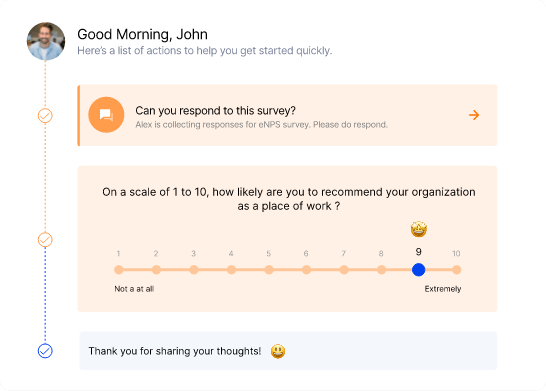
Empuls helps HR teams and business leaders gather actionable employee feedback through customizable surveys, enabling HR teams to measure engagement, understand sentiment, and drive improvements across organizations of any size.
Who Is Empuls Best For?
Empuls is a strong fit for mid-sized to large organizations where HR teams need a structured way to measure and act on employee engagement across distributed or global workforces.
Why I Picked Empuls
I've included Empuls in my top picks because of how well it handles eNPS as a structured, ongoing listening practice rather than a one-off survey. The eNPS survey uses the standard promoter/passive/detractor framework, and it pairs the rating question with an open-ended follow-up, so you're not just getting a score—you're getting the reasoning behind it. Empuls' AI-powered sentiment analysis processes those open-ended responses and surfaces themes, which means my team isn't manually reading through hundreds of comments to figure out what's driving detractor scores. The action planning feature then translates those insights into research-backed, step-by-step recommendations, so there's a clear path from "our eNPS dropped" to "here's what we do about it."
Empuls Key Features
- Lifecycle survey templates: Pre-built survey templates cover key employee touchpoints—onboarding, exit, L&D, performance appraisals, and DEIB—triggered automatically by employee milestones.
- Anonymous survey responses: Employees can submit feedback anonymously, with configurable anonymity settings and response limits per user.
- Multilingual survey distribution: Surveys are available in 20+ global languages, with automatic translation to English for analysis.
- Mood-o-Meter: A one-click sentiment check-in tool that gauges workplace mood in real time between formal survey cycles.
Empuls Integrations
Integrations include Zoho People, SAP, Darwinbox, Akrivia HCM, PocketHRMS, Qualtrics, SurveyMonkey, Typeform, HubSpot, and Salesforce.
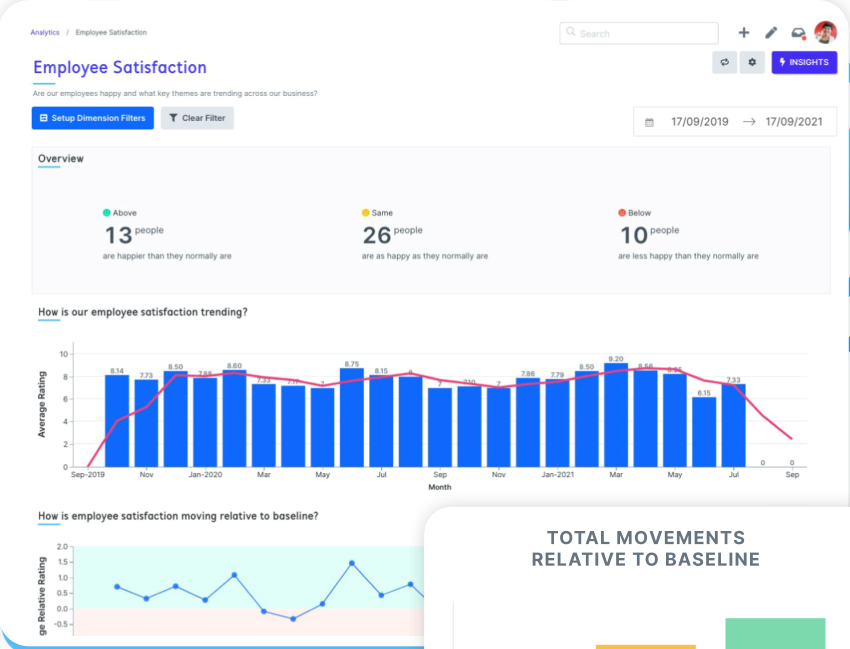
IntelliHR is a people management platform designed for HR teams and business leaders who want to gather, analyze, and act on employee feedback to improve engagement and workplace culture.
Who Is IntelliHR Best For?
IntelliHR is a strong fit for mid-sized to enterprise organizations that need a structured, data-driven approach to tracking employee engagement over time.
Why I Picked IntelliHR
IntelliHR earns its spot as one of the best on my shortlist because of how it handles sentiment analysis across the full range of employee text inputs—not just survey responses. I like that the AI uses natural language processing to score qualitative data from check-ins, diary notes, performance reviews, onboarding feedback, and goal conversations on a scale of -1.0 to +1.0, then aggregates those scores into drillable dashboards. In practice, that means my team can heat-map sentiment across business units, tenure groups, or supervisors without manually reading through hundreds of open-text responses. The wellbeing pulse surveys add another layer, letting you push short, frequent check-ins to employees on autopilot and track how sentiment shifts over time rather than relying on a single annual survey.
IntelliHR Key Features
- eNPS surveys: Run employee Net Promoter Score surveys to measure loyalty and satisfaction across your workforce.
- Automated workflows: Schedule and trigger survey distribution, follow-ups, and reminders based on role, team, or department rules.
- Goal tracking: Set, cascade, and monitor individual and team goals directly within employee profiles.
- Pre-built analytics reports: Access 30+ ready-made reports covering attrition, turnover, compliance, and training investment.
IntelliHR Integrations
Integrations include Greenhouse, Lever, Ashby, BambooHR, Workday, Xero, QuickBooks, Slack, Microsoft Teams, and Okta.
Culture Amp helps HR teams and business leaders collect, analyze, and act on employee feedback with tools designed for organizations focused on engagement, performance, and continuous improvement.
Who Is Culture Amp Best For?
Culture Amp is a strong fit for mid-size to enterprise HR teams that need a structured, data-driven approach to measuring and improving employee engagement.
Why I Picked Culture Amp
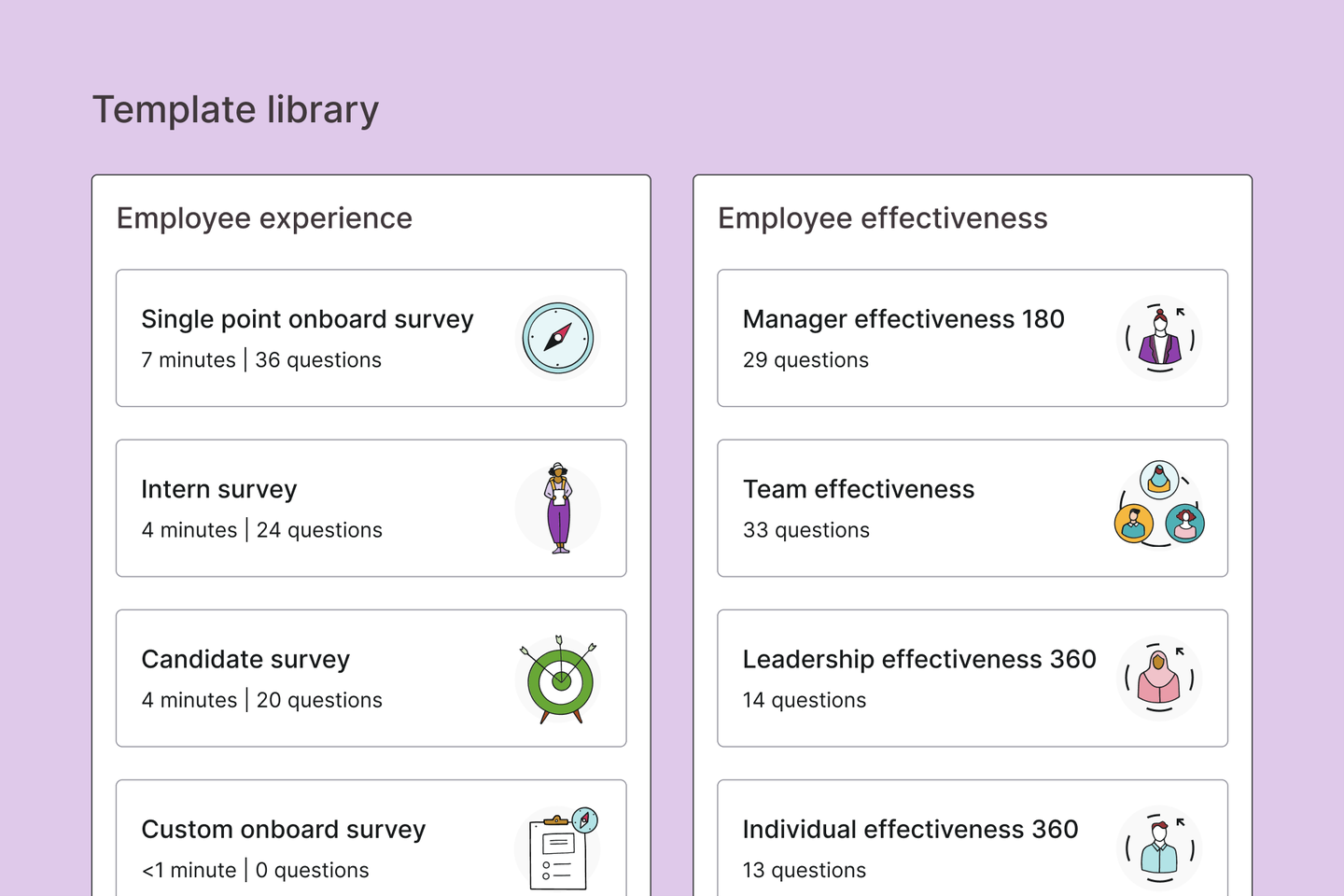
I picked Culture Amp as one of the best because I love the depth of its ready-to-use survey template library. It gives my team access to 40+ research-backed templates built by data scientists and organizational psychologists—covering everything from onboarding and pulse surveys to DEI and offboarding. That means I'm not starting from scratch or guessing at question quality when I need to run a survey on short notice. The templates are grounded in people science, so I can trust the questions are actually measuring what they're supposed to measure.
Culture Amp Key Features
- Benchmarking data: Compare your survey results against Culture Amp's external benchmark database to see how your organization stacks up against industry peers.
- Action planning tools: Managers can build structured action plans directly from survey results, with suggested focus areas tied to specific response data.
- Continuous feedback: Collect ongoing employee feedback outside of formal survey cycles using lightweight check-ins and feedback requests.
- Heatmap reporting: Visualize survey response data across teams, departments, and demographics to quickly spot patterns and outliers.
Culture Amp Integrations
Integrations include BambooHR, Gusto, Personio, Rippling, Slack, Microsoft Teams, Go1, LifeLabs Learning, Pave, and Unmind.
TINYpulse Engage is an employee engagement platform built to help organizations understand sentiment, foster connection, and take action through continuous feedback and recognition.
Why I picked TINYpulse Engage:
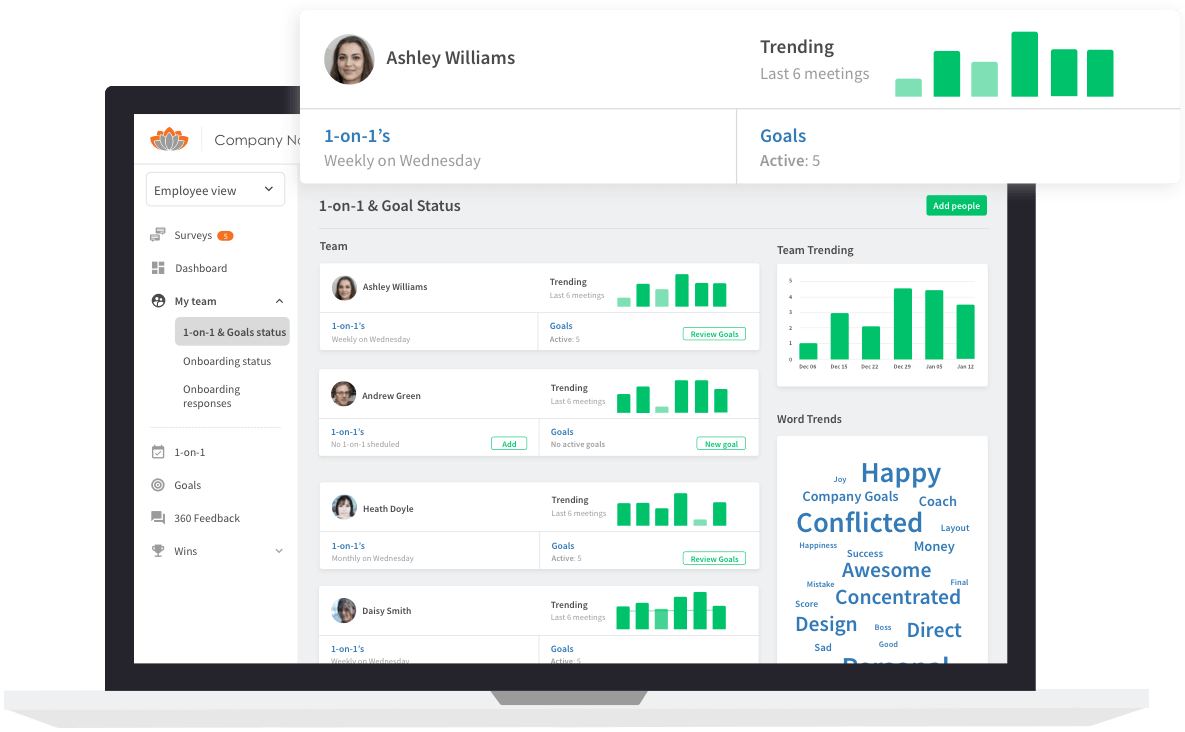
TINYpulse stands out for its commitment to lightweight, frequent feedback, rather than infrequent, heavy surveys. It offers a strong suite of tools for making 1-on-1 meetings more meaningful—sending short pre-meeting surveys to help managers and employees build meeting agendas collaboratively. It also supports 360° feedback, allowing feedback to flow across hierarchy lines whenever needed.
I particularly like the peer recognition features, which let employees appreciate each other’s contributions in real time. Tracking who gives and receives recognition over time helps surface top performers, highlight culture champions, and guide recognition strategies.
TINYpulse Engage Standout Features & Integrations:
Features include pulse (ongoing) surveys, pre-meeting agenda surveys, 360° feedback, and peer recognition and appreciation tools.
The platform protects anonymity (where needed), helping employees feel safe giving honest feedback. It also includes analytics dashboards, trend tracking, and tools to identify key drivers of engagement and prompt action.
Integrations include Slack, Microsoft Teams, and various HR systems—making it easy for employees to participate in feedback and recognition without leaving the tools they already use.
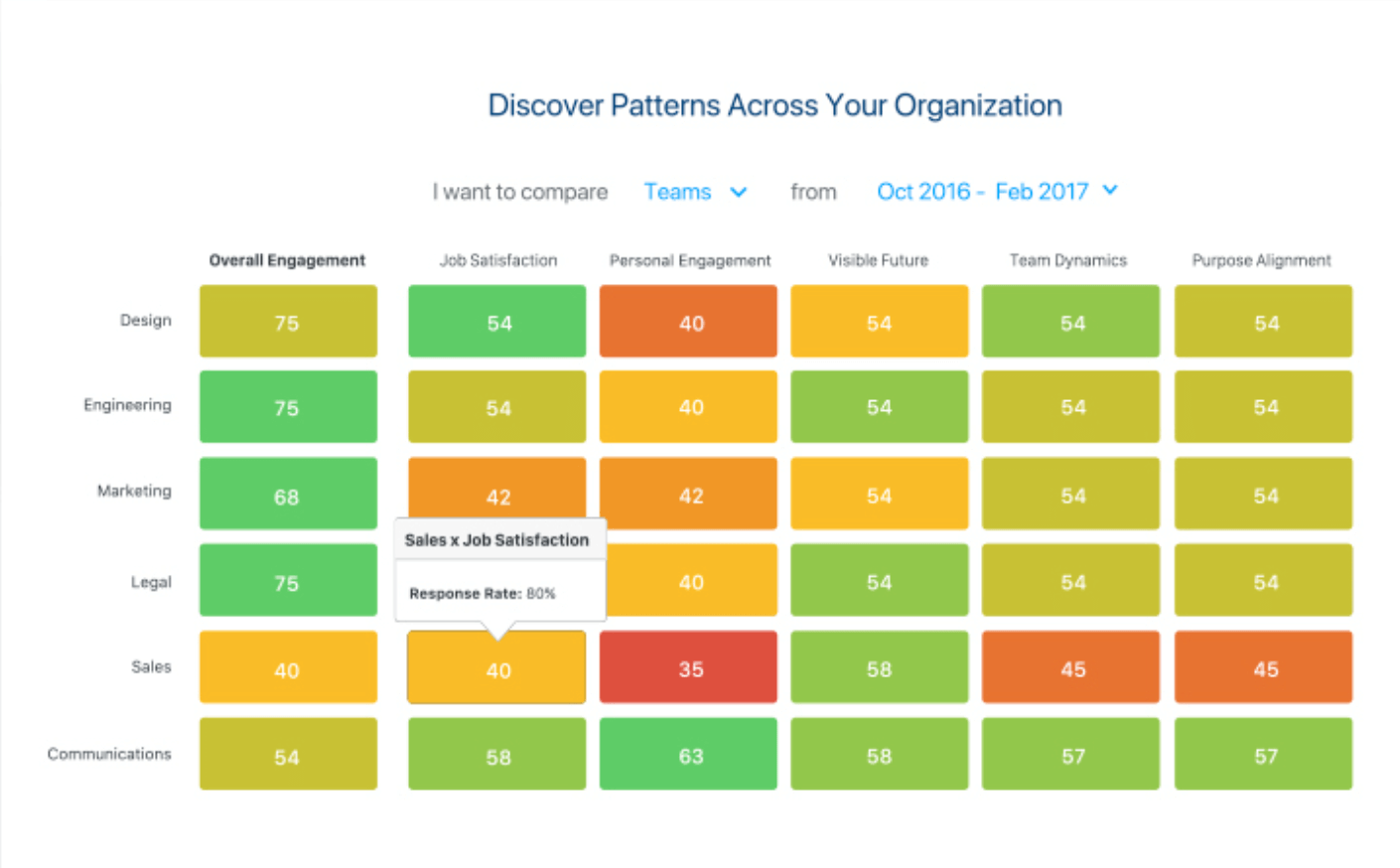
SurveyMonkey is a versatile survey and feedback platform designed to help organizations gather insights from employees, customers, and stakeholders. Known for its ease of use and professional-grade analytics, SurveyMonkey enables businesses to measure engagement, satisfaction, and organizational health with minimal setup and maximum accuracy.
Why I picked SurveyMonkey:
SurveyMonkey stands out for its specialized employee engagement solution, SurveyMonkey Engage, which simplifies feedback collection through prebuilt survey templates and automated deployments. These templates are grounded in social science research, ensuring that each question is thoughtfully crafted to capture meaningful insights about employee sentiment and workplace experience. I particularly value its “whole-person approach,” which helps organizations understand not just how employees feel about their work, but how connected they are to the company culture overall.
SurveyMonkey Standout Features and Integrations:
Features include ready-to-use engagement and pulse survey templates, automated survey scheduling, and real-time analytics dashboards to track results and trends over time. The platform also offers advanced filtering and segmentation tools, allowing HR leaders to pinpoint areas of strength and improvement across departments or demographics.
SurveyMonkey’s analytics engine provides benchmarking tools and data visualization capabilities, making it easy to translate feedback into actionable insights. Its scalability and intuitive design make it suitable for organizations of all sizes, from startups to enterprises.
Integrations include Oracle, Microsoft, Salesforce, and over 100 additional apps, ensuring seamless connectivity with HR systems, productivity tools, and analytics platforms.

SurveyLab is an intuitive employee feedback and survey platform designed to help organizations capture insights, measure engagement, and improve the employee experience. It supports a wide range of survey types—from employee engagement and satisfaction surveys to 360° reviews and pulse checks—making it a versatile solution for HR teams seeking continuous feedback.
Why I picked SurveyLab:
SurveyLab stands out for its ease of use and flexibility. The platform allows HR teams and managers to design surveys tailored to their workforce, with advanced options such as question logic, language customization, and device-based adaptability to ensure a seamless experience for all participants.
I particularly value its ability to automate feedback collection while maintaining a high response rate through features like progress indicators and required questions that guide completion.
For analysis, SurveyLab offers real-time reporting dashboards with advanced filtering and export options, allowing leaders to visualize and compare results instantly.
SurveyLab Standout Features & Integrations:
Features include 360° feedback surveys, employee engagement and satisfaction surveys, pulse checks, and custom logic tools to personalize the survey experience. Its real-time analytics and benchmarking tools allow HR teams to identify trends, track progress over time, and make data-driven decisions. The platform also supports multi-language surveys and mobile-friendly interfaces to increase accessibility and participation rates.
Integrations include Google Analytics, Intercom, Slack, and a broad range of other business tools via Zapier, ensuring seamless connectivity across communication, analytics, and HR systems.
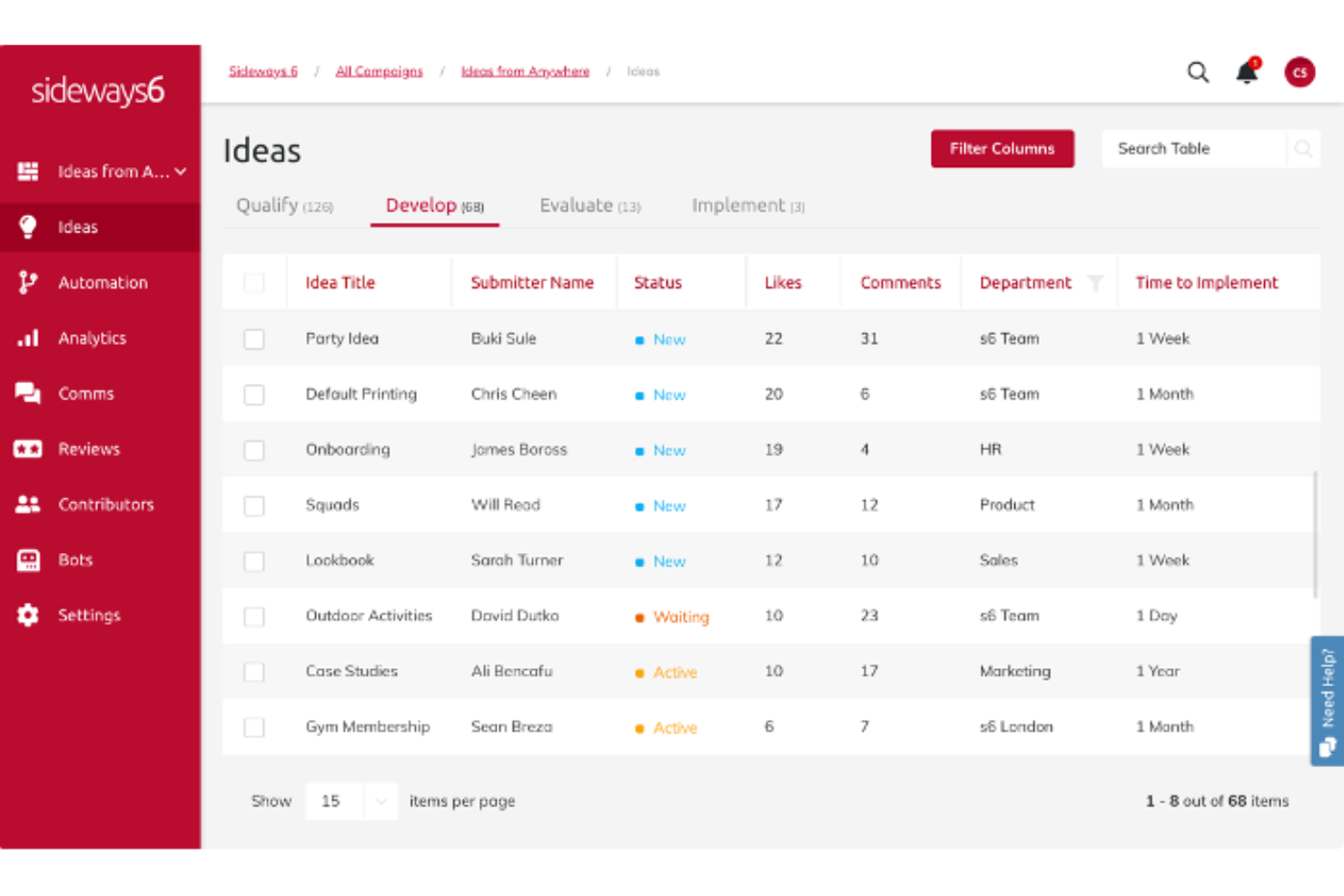
Sideways 6 is an idea management platform designed to help organizations gather, manage, and implement employee ideas effectively. It integrates with existing communication tools like Microsoft Teams, Yammer, and Workplace by Facebook, making it easy for employees to share their thoughts and suggestions without disrupting their usual workflow.
Why I picked Sideways 6: One reason Sideways 6 works as a good employee survey tool is its use of ideas campaigns. These campaigns let you ask specific questions and gather responses from employees in a way that feels more interactive than a typical survey. It’s a more dynamic way to collect insights, where employees can submit ideas, comment on others, and vote. This collaborative aspect means your team is more engaged in the feedback process.
Another helpful feature is Sideways 6’s analytics and reporting. Once the responses come in, you’ll get actionable insights that help you understand trends and themes from the data. You can easily see which ideas resonate most and how employees feel about certain topics.
Sideways 6 Standout Features and Integrations:
Features include customizable workflows, automated reminders, real-time updates, anonymous idea submissions, idea voting, and feedback loops. It also has an AI tool for detecting duplicate ideas and lets you manage your ideas pipeline and create shortlists for the most important ideas.
Integrations include Microsoft Teams, Workplace by Meta, Viva Engage, Interact Intranet, Yammer, and various email systems.
Qualtrics EmployeeXM is an advanced employee experience and engagement platform designed to help organizations capture, analyze, and act on employee feedback throughout the entire lifecycle—from recruitment to exit. It provides deep insights into workforce sentiment and performance, empowering leaders to make data-driven decisions that improve engagement, retention, and culture.
Why I picked Qualtrics EmployeeXM:
Qualtrics EmployeeXM stands out for its powerful analytics and AI-driven insights that go beyond traditional survey tools. The platform allows organizations to collect continuous feedback across multiple touchpoints, such as onboarding, engagement, pulse, and exit surveys, providing a 360° view of the employee experience. I particularly value its ability to compare team-level engagement data, helping leaders quickly identify both high-performing groups and areas that require attention.
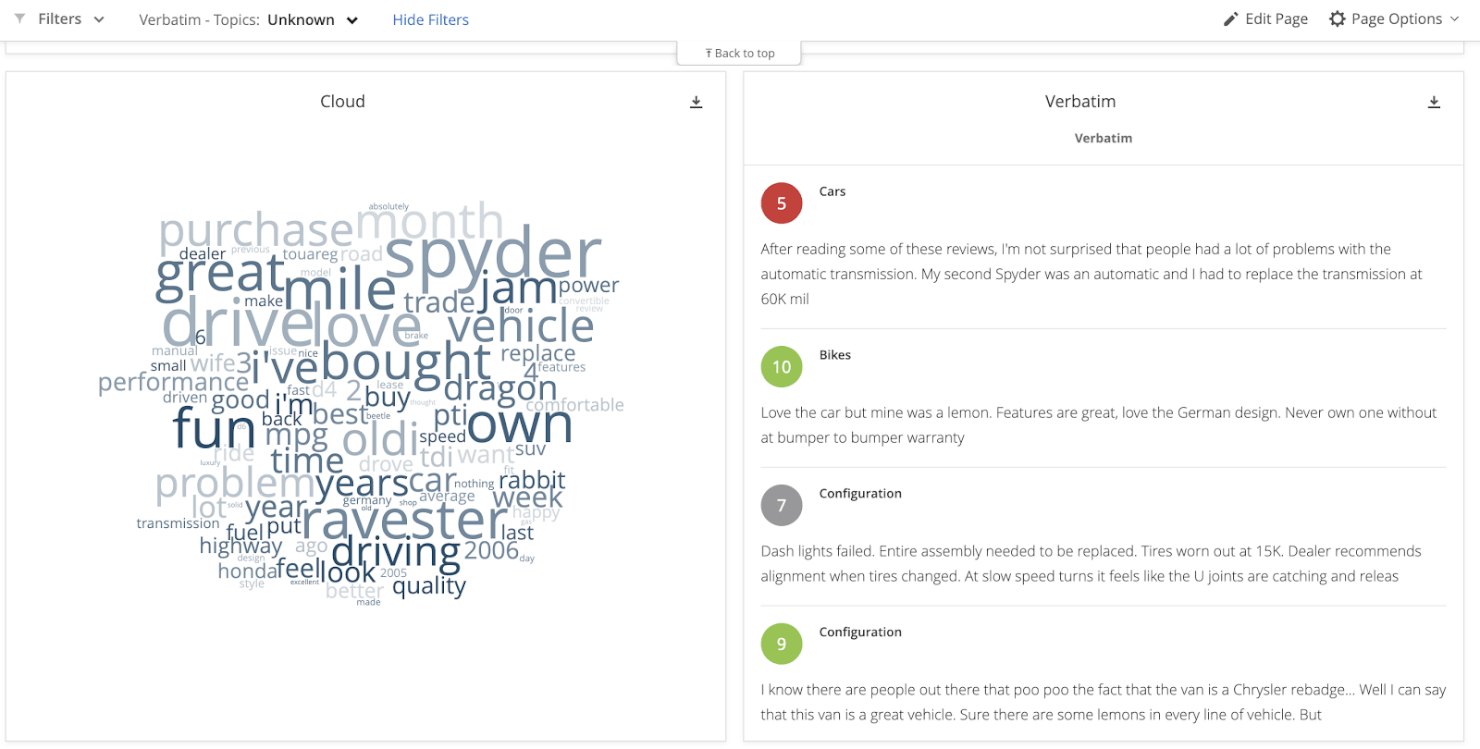
What truly sets Qualtrics apart is its AI-powered text and statistical analysis. The platform’s text analytics automatically identify trends, themes, and sentiment within open-ended survey responses, while its statistics engine uses correlation, regression, and cluster analysis to uncover patterns in large datasets.
Qualtrics EmployeeXM Standout Features & Integrations:
Features include customizable lifecycle surveys, AI-powered text analytics, and advanced statistical tools to detect engagement trends and drivers. The platform’s real-time dashboards make it easy to visualize engagement across teams, departments, or locations, while automated action planning tools help leaders respond effectively to insights.
Qualtrics EmployeeXM also includes benchmarking capabilities, allowing organizations to compare their engagement data with industry standards. Its no-code automation tools make it simple to create custom workflows that trigger actions based on feedback results—without needing technical expertise.
Integrations include popular HR, CRM, and messaging systems, as well as Slack, Microsoft Teams, Salesforce, and marketing platforms, with additional connections available via API and low-code/no-code automation tools.
Other Employee Survey Tools
Here are a few more worthwhile options to help you collect employee feedback that didn’t make the list of the best employee survey tools list:
- Zoho Survey
For real-time insights and analytics
- Teamspective
For integration with Slack or Teams
- Startquestion
Easy-to-use survey tool
- Beams
For providing recommendations to employees
- Leapsome
For connecting feedback with development
- Guusto
For targeting specific employee sub-groups
- Jotform
For enterprise surveys
- PerformYard
For integrated performance and engagement
- ClearCompany
For uncovering employee sentiment
- Motivosity
For modular add-ons
- Sloneek
For AI-driven employee surveys
- Eletive
For real-time pulse surveys
- Primalogik
For holistic employee feedback
- Connecteam
For survey notifications and reminders
- ChartHop
For contextual survey answers
- Paycor
Survey tool within an HCM system
- SurveySparrow
For engaging mobile-first survey designs
- CultureBot
For Slack-integrated employee surveys
- Huckleberry
For voice-based feedback collection
- BlockSurvey
Privacy-first survey platform with end-to-end encryption


Related HR Software Reviews
If you still haven't found what you're looking for here, check out these other related tools that we've tested and evaluated:
- HR Software
- Payroll Software
- Recruiting Software
- Employer of Record Services
- Applicant Tracking Systems
- Workforce Management Software
Selection Criteria for Employee Survey Tools
Selecting the best employee survey tool is a nuanced process that hinges on matching your specific needs and challenges with the features and functionalities that will help you address them effectively.
My approach to evaluating these tools is grounded in personal trials and in-depth research, ensuring a comprehensive understanding of each platform's capabilities.
I also drew on my personal experience collecting employee feedback via surveys when I was an HR administrator.
In that role, I was the one preparing and analyzing surveys to improve the employee experience.
This helped me to pinpoint the standout features that will give you the best return on your investment and simplify the process for you.
Here’s a summary of the evaluation criteria I used to make my final selections for the best employee survey tools:
Core Employee Survey Tool Functionalities (25% of total score): To be considered for inclusion in this list, each tool had to cover the following use cases first:
- Pre-set questions, plus tools to design your own surveys or questionnaires
- The ability to collect anonymous feedback to ensure honest responses
- Tools to analyze employee sentiment to gauge workplace morale
- The ability to track changes in employee satisfaction over time
- Tools to identifying specific areas for organizational improvement.
Additional Standout Features (25% of total score): To help me narrow in on the best employee survey tools out of the numerous options available, I also took note of any unique features, including:
- Advanced sentiment analysis techniques that can parse nuanced feedback
- Comprehensive benchmarking tools that offer industry-specific comparisons
- Real-time notifications for immediate action on critical feedback
- Innovative action planning modules that guide effective response strategies
- Deep integration capabilities with broader HR tech ecosystems
Usability (10% of total score): To evaluate the usability of each feedback tool, I considered the following:
- Intuitive design that requires minimal training to use effectively
- Clear, logical navigation paths through the survey creation and distribution process
- Responsive design that works seamlessly across devices
- Visual analytics dashboards that simplify complex data interpretation
- Either dedicated mobile apps or a mobile-friendly user interface that makes participation easy on both Android and iOS mobile devices
Onboarding (10% of total score): To get a sense of each software provider's customer onboarding process, I considered the following factors:
- Quick setup processes and clear guidance for first-time users
- Comprehensive training materials such as videos, interactive tutorials, chatbots, or other documentation
- Pre-loaded templates that you can customize to your specific needs, including adding your company branding, to speed up onboarding
- Support for migrating employee data into the new platform
Customer Support (10% of total score): To evaluate the level of customer support each vendor offered, I considered the following:
- The availability of multi-channel support, including email, phone, and live chat
- The existence of a self-service knowledge base or other self-help resources to speed up troubleshooting
- The overall quality, responsiveness, and helpfulness of the support team during customer onboarding and post-purchase, as inferred from customer reviews
Value for Price (10% of total score): To gauge the value of each software, I considered the following factors:
- The availability of free trials or demos to test the software before purchasing
- Competitive and transparent pricing models that reflect the software's feature depth and explain which features are included at each level
- Tiered pricing plans that cater to different business sizes, from small to medium-sized businesses (SMBs) up to enterprise-level organizations
Customer Reviews (10% of total score): Evaluating customer reviews is the final element of my selection process, which helps me understand how well a product performs in the hands of real users. Here are the factors I considered:
- Whether a product has consistently high ratings across multiple review platforms, indicating a broad level of user satisfaction
- Specific praises, criticisms, or trends in customer feedback that indicate the software's strengths or areas for improvement
- Whether customer feedback specifically mentions issues with ease of use, customer support responsiveness, or lacking features
Using this assessment framework, I was able to identify the employee survey tools that go beyond basic requirements to offer additional value through unique features, intuitive usability, smooth onboarding, effective support, and overall value for price.
How to Choose Employee Survey Tools
As covered, the right employee survey tool can help you collect valuable insights to improve the employee experience.
To help you figure out which tool best fits your specific needs, keep the following points in mind:
| Factor | What to Consider |
|---|---|
| Ease of Use | Look for a tool with an intuitive interface for both admins and employees. |
| Customization | Check if you can tailor surveys to your organization’s culture, branding, and needs. |
| Question Types | Ensure it supports varied formats (e.g., multiple choice, open-ended, scales). |
| Analytics & Reporting | Look for robust data visualization, trend analysis, and actionable insights. |
| Integration | Confirm it integrates with your existing HRIS, Slack, Teams, or email platforms. |
| Anonymity Options | Ensure the tool allows anonymous responses to encourage honest feedback. |
| Scalability | Choose a tool that can grow with your organization as employee numbers increase. |
| Mobile Accessibility | Verify that surveys are mobile-friendly for remote or on-the-go employees. |
| Cost & Pricing Model | Compare pricing plans—per user, per survey, or flat fee—to match your budget. |
| Support & Training | Check for onboarding help, documentation, and responsive customer support. |
| Benchmarking | Some tools offer industry benchmarks—decide if this is valuable for your organization. |
Trends in Employee Survey Tools
As more organizations recognize the importance of employee feedback for fostering engagement, satisfaction, and productivity, the demand for sophisticated survey tools has surged.
This demand, in turn, drives innovation, leading to the development of features that are more intuitive, comprehensive, and aligned with the needs of modern workplaces.
Here are several trends that are impacting employee survey tools currently:
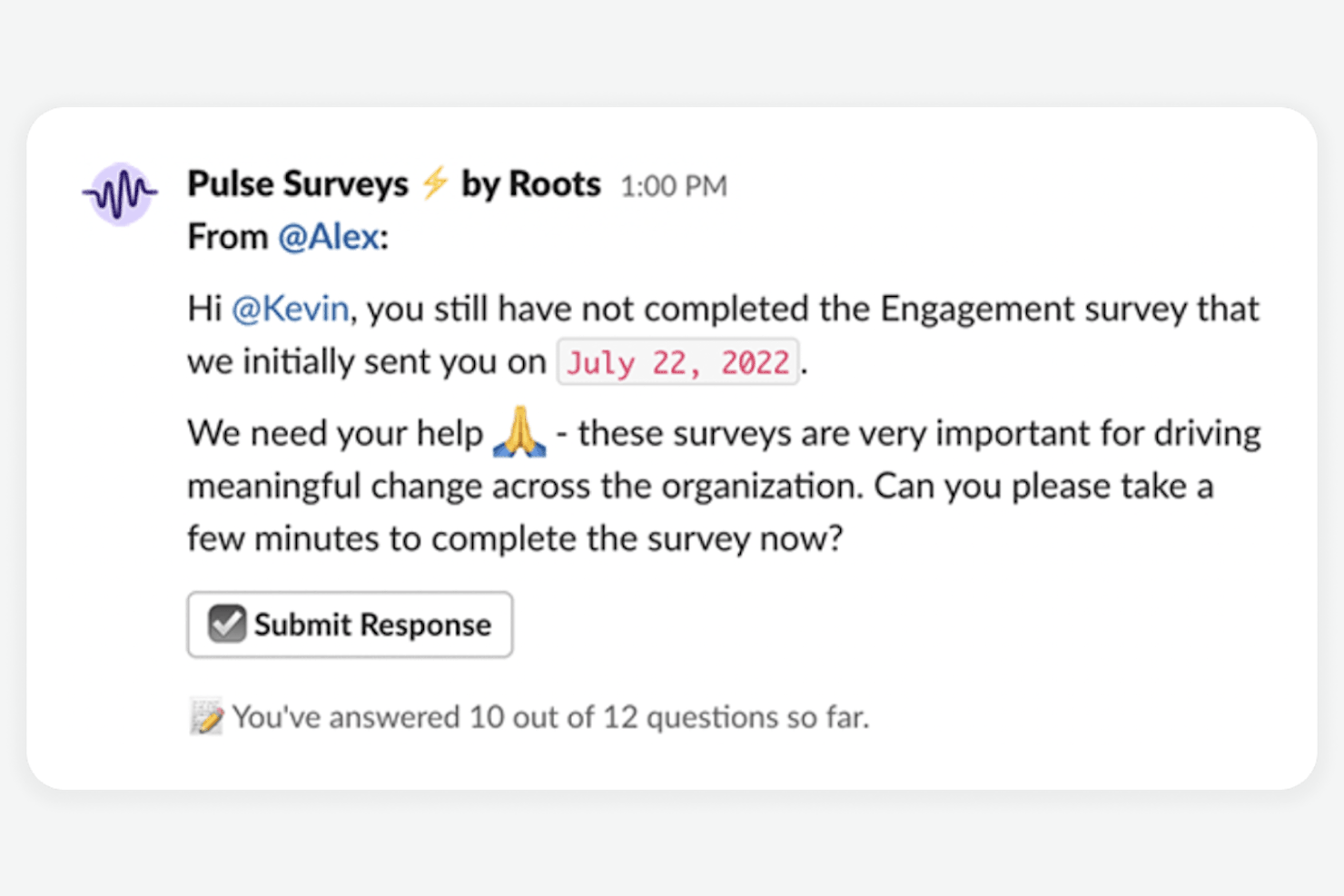
- Integration with Collaboration Platforms: There's a clear trend towards integrating employee survey tools with popular collaboration platforms like Slack to run quick polls. This integration facilitates real-time feedback and makes it easier for employees to participate in surveys without disrupting their workflow.
- Advanced Sentiment Analysis: The ability to analyze open-ended responses through natural language processing (NLP) and machine learning (ML) technologies is rapidly evolving. Many tools now offer sophisticated sentiment analysis features that can accurately gauge the mood and emotions behind employee feedback, providing deeper insights into employee satisfaction and engagement levels. This advancement indicates a move towards more qualitative analysis, allowing HR professionals to understand not just what their employees are saying, but how they feel.
- Customizable and Adaptive Surveys: Flexibility in survey design is becoming increasingly important. Tools that offer customizable and adaptive surveys—where questions can change based on previous answers—are gaining popularity. This allows for more personalized survey experiences, which can improve response rates and the quality of feedback collected.
- Actionable Insights and Recommendations: Beyond collecting and analyzing feedback, many employee engagement survey tools now provide actionable insights and recommendations to tackle issues identified and inform strategies and future decision-making.
- Employee Well-being Focus: Another new functionality that's gaining traction is an increased emphasis on employee well-being. Some tools have introduced features specifically designed to assess and support mental health, work-life balance, and overall well-being. This includes well-being surveys, mood trackers, and resources for mental health support. The rise of this feature reflects a broader recognition of the importance of employee health in the workplace.
Overall, these trends highlight a broader evolution towards more integrated, intelligent, and employee-centric survey tools.
As organizations continue to tackle the challenges of modern workplace dynamics, the demand for tools that can provide deep, actionable insights into employee sentiment will only grow.
What are employee survey tools?
Employee survey tools are digital platforms that help collect and analyze surveys to gather feedback on elements such as employee engagement, satisfaction, and performance. They help organizations understand employee sentiment, identify challenges, and make data-driven improvements. Common features include customizable surveys, real-time analytics, AI-driven insights, and benchmarking capabilities.
Benefits of Employee Survey Tools
Employee survey tools will help you collect valuable employee feedback to help you improve the workplace for current and future workers. Key benefits include:
- Identify and Solve Organizational Challenges: Helps pinpoint issues in leadership, workload, work-life balance, and career development.
- Improve Employee Engagement and Retention: Helps identify what motivates employees and what drives dissatisfaction.
Enhance Workplace Culture: Measures alignment with company values and mission and encourages open communication and transparency. - Supports Data-Driven Decision Making: Provides real-time insights into employee sentiment and, in some cases, uses AI and analytics to predict trends and suggest improvements.
- Helps foster a Culture of Continuous Feedback: Pulse surveys and real-time feedback promote ongoing dialogue and an open culture of feedback.
Key Features of Employee Survey Tools
When choosing employee survey tools, it’s important to look for features that make collecting and acting on feedback easy, secure, and insightful. Here are the key features I recommend keeping in mind:
- Progress tracking: Monitor real-time response rates and quickly identify which teams or departments still need to participate. This helps ensure everyone’s voice is heard and no feedback slips through the cracks.
- Survey customization: Personalize surveys by editing questions, choosing different response types, and adding your company’s branding. This allows you to focus on the topics that matter most to your team.
- Anonymous response options: Let employees share their thoughts honestly by guaranteeing anonymity. In my experience, this leads to more genuine and actionable feedback.
- Automated distribution and scheduling: Set up surveys to be sent automatically and schedule reminders, so you don’t have to manage every step manually. This keeps participation rates high with minimal effort.
- Real-time analytics and reporting: Access dashboards and reports that update instantly as responses come in. You can quickly spot trends and act on feedback without delay.
- Benchmarking tools: Compare your results to industry standards or previous surveys. This helps you measure progress and identify areas for improvement.
- Multi-language support: Reach your entire workforce by offering surveys in multiple languages, making it easy for everyone to participate no matter where they are.
- Mobile accessibility: Enable employees to complete surveys on their phones or tablets, so they can provide feedback whenever it’s convenient for them.
- Integration with HR systems: Sync survey data with your existing HR software to track engagement over time and streamline follow-up actions.
- Role-based access controls: Protect privacy by ensuring only authorized individuals can view or manage sensitive survey data.
AI Features in Employee Survey Tools
Modern employee survey tools are increasingly leveraging artificial intelligence to deliver deeper insights and streamline the feedback process. Here are some standout AI-powered features to look for:
- AI-driven sentiment analysis: Instantly analyze open-ended responses to detect employee sentiment, uncovering hidden patterns and emotions in feedback that might otherwise go unnoticed.
- Automated theme and trend detection: AI can group similar responses together, highlight recurring topics, and flag urgent issues, saving you hours of manual review.
- Predictive analytics: Some tools use AI to forecast trends in employee engagement, helping you anticipate potential challenges and proactively address them.
- Smart survey suggestions: AI can recommend the most relevant questions or optimal survey timing based on past engagement data, making your surveys more effective and timely.
- Actionable insights and recommendations: Receive AI-generated suggestions for follow-up actions, so you can move from feedback to meaningful improvements faster.
By incorporating these AI features, employee survey tools not only make it easier to collect feedback, but also empower you to understand and act on it with greater confidence and speed.
Costs & Pricing for Employee Survey Tools
Employee survey tools pricing covers various plans and pricing options, each designed to meet different organizational needs, from small startups to large enterprises.
Understanding the specifics of each plan will help you select the most suitable option for your organization, ensuring you get the functionality you need at a price that fits your budget.
Plan Comparison Table for Employee Survey Tools
| Plan Type | Average Price | Price Per User | Common Features |
|---|---|---|---|
| Free | $0 | $0 | Basic survey functionalities, limited questions and responses, and basic analytics |
| Basic | $5 - $40 per month | $2 - $5 per user/month | Enhanced survey capabilities, unlimited questions, advanced analytics, and email support |
| Professional | $50 - $150 per month | $5 - $10 per user/month | All Basic features, plus integration capabilities, custom branding, advanced analytics, and priority support |
| Enterprise | Custom pricing | Quote based | All Professional features, plus advanced security features, dedicated support, and custom integrations |
When selecting a plan, consider both your immediate needs and potential future requirements. Starting with a basic plan and scaling up as your organization grows and your needs become more complex is a practical approach. Remember, the right employee engagement survey tool can significantly impact your ability to gather valuable feedback and improve employee satisfaction and engagement.
Employee Survey Tools: FAQs
Do you still have some questions about what employee survey tools have to offer? These answers to frequently asked questions should get you sorted out:
What is the best employee survey tool?
The best employee survey tool depends on your specific needs. No two tools are the same, each will have its pros and cons, the trick is putting in the research and using resources such as this one to find the best solution for you.
What are the legalities of employee survey tools?
The legalities surrounding employee survey tools can vary depending on the jurisdiction and the specific practices of your organization. However, there are some general legal considerations that apply in many cases. Here are some key legal aspects to keep in mind when using employee survey tools:
- Privacy laws: When you’re collecting personal information from employees or storing employee data, you need to be sure it’s in compliance with relevant privacy laws. Look for GDPR, HIPAA, SOC 2, and other compliance certifications.
- Protecting employee anonymity: For anonymous surveys, make sure specific safeguards are in place to protect employee anonymity. For example, some tools may not display anonymous feedback unless a certain number of responses are collected.
- Ensuring informed consent: Employees should be informed about the purpose of the survey, how the data will be used, and who will have access to the results. Obtaining clear and informed consent from participants is essential.
- Anti-discrimination laws: Make sure your survey questions don’t solicit information that could lead to discrimination based on race, gender, age, disability, religion, or other protected characteristics.
- Retaliation and whistleblower protection: Employees must protected from retaliation for their responses. Your staff needs to feel safe to express their opinions without fear of reprisal.
- Handling survey results with care: Set up appropriate user access permissions and establish protocols for how survey results may be used at your company. Don’t share individual responses without consent, and aggregate data to maintain anonymity.
What types of surveys can be conducted with employee survey tools?
You can use employee survey tools to create:
- Employee engagement surveys
-
Pulse surveys (short, frequent check-ins)
-
Onboarding and exit surveys
-
360-degree feedback surveys
-
Diversity, equity, and inclusion (DEI) surveys
-
Training feedback surveys
How can I integrate employee survey tools with my existing HR software?
Integration capabilities vary widely among employee survey tools. Many are able to integrate with popular HR software platforms through APIs or pre-built connectors. When selecting a survey tool, look for ones that can connect to your existing HR software, either through a native integration or by using a flexible API to set up a custom integration.
Integrations between survey tools and employee management systems are important because they make it much quicker and faster to administer surveys. For example, by integrating both systems, you can quickly select the employees you want to survey, whether that’s a specific department, a distinct office, or your entire organization. This integration prevents the need for you to import recipient information into the system, saving a lot of time.
Can I customize surveys to match my company's branding?
Yes, many employee survey tools offer extensive customization options that allow companies to tailor surveys to match their branding, including logos, colors, and fonts. This helps to create a more engaging and familiar experience for employees, potentially improving response rates and the quality of feedback.
Branding elements are also important in cases where you want to survey participants who are external to your organization, such as your customers or potential candidates. By preparing your survey in line with your corporate identity, you’ll reinforce a positive perception of your employer brand.