




Lattice is a talent management system built for HR teams that need to connect performance reviews, goal setting, employee engagement, and career development in a single platform. I'd consider it a strong pick over Culture Amp if you want more than engagement surveys and feedback tools, as Lattice adds career pathing and compensation management into the mix, so you're not piecing together separate tools to cover the full employee lifecycle.
Lattice Evaluation Summary

- From $4/user/month (billed annually)
- Free demo available
Why Trust Our Software Reviews
We’ve been testing and reviewing HR software systems since 2019. As HR experts ourselves, we know how critical and difficult it is to make the right decision when selecting software.
We invest in deep research to help our audience make better software purchasing decisions. We’ve tested more than 2,000 tools for different HR management use cases and written over 1,000 comprehensive software reviews. Learn how we stay transparent & our software review methodology.
Lattice Overview
Lattice excels in aligning team goals with company objectives, making it a standout choice for fostering employee engagement and performance.
pros
-
Strong employee engagement tools with surveys, pulse checks, and analytics.
-
Modular platform lets you expand features as organizational needs evolve.
-
Compensation management integrates directly with performance and talent review workflows.
cons
-
Advanced enterprise customization options are less flexible than some competitors.
-
Mobile experience is useful but less robust than desktop functionality.
-
Some advanced workflows require purchasing multiple modules to fully unlock.
Is Lattice Right For Your Needs?
Who Would be a Good Fit for Lattice?
Lattice is perfect for growing tech startups and mid-sized companies that want to improve team alignment and engagement. If your HR department is focused on performance management and continuous feedback, Lattice’s intuitive interface and robust features will fit right in. Companies looking to foster a feedback-rich culture and align team goals with broader company objectives will find Lattice’s capabilities particularly beneficial.
-
Startups and Small Businesses
Lattice is easy to implement and manage for smaller teams that want structured performance management without enterprise-level complexity.
-
Mid-Sized Growing Organizations
You can scale performance management, engagement, and career development without building overly complex HR processes.
-
Tech and SaaS Companies
Lattice helps your teams stay aligned with goals, feedback, and development workflows in fast-moving, high-growth environments.
-
People-First Organizations
Lattice works well if you prioritize employee engagement, manager coaching, recognition, and continuous feedback across teams.
-
Remote and Hybrid Teams
The platform keeps distributed employees connected through engagement surveys, 1:1s, updates, and collaborative feedback workflows.
-
Manager Enablement Priorities
Lattice gives managers structured coaching, check-in, and development tools that support stronger employee conversations and accountability.
Who Would be a Bad Fit for Lattice?
Small businesses with limited resources might struggle with Lattice because the initial setup can be time-consuming, and your team might need time to adapt. Industries with minimal focus on performance metrics, like certain creative fields, may not benefit from Lattice’s goal-setting features. If your organization doesn’t prioritize continuous feedback, Lattice’s core functionalities might seem unnecessary.
-
Small Startups
Your limited resources might make Lattice’s setup and adaptation challenging.
-
Creative Fields
If your industry doesn’t focus on performance metrics, Lattice’s goal-setting features may not add value.
-
Traditional Offices
A workplace that doesn’t prioritize feedback might find Lattice’s continuous feedback tools unnecessary.
-
Single-Person Teams
Lattice’s team alignment features won’t offer benefits for a solo operation.
-
Non-Performance-Based Roles
Roles that don’t rely on performance metrics might not need Lattice’s tracking features.
-
Industries with Static Goals
If your industry doesn’t require frequent goal adjustments, Lattice’s dynamic goal-setting capabilities may not be useful.
How We Test & Score Our Tools
We’ve spent years building, refining, and improving our software testing and scoring system. The rubric is designed to capture the nuances of software selection and what makes a tool effective, focusing on critical aspects of the decision-making process.
Below, you can see exactly how our testing and scoring works across seven criteria. It allows us to provide an unbiased evaluation of the software based on core functionality, standout features, ease of use, onboarding, customer support, integrations, customer reviews, and value for money.
Core Functionality (25% of final score)
The starting point of our evaluation is always the core functionality of the tool. Does it have the basic features and functions that a user would expect to see? Are any of those core features locked to higher-tiered pricing plans? At its core, we expect a tool to stand up against the baseline capabilities of its competitors.
Standout Features (25% of final score)
Next, we evaluate uncommon standout features that go above and beyond the core functionality typically found in tools of its kind. A high score reflects specialized or unique features that make the product faster, more efficient, or offer additional value to the user.
We also evaluate how easy it is to integrate with other tools typically found in the tech stack to expand the functionality and utility of the software. Tools offering plentiful native integrations, 3rd party connections, and API access to build custom integrations score best.
Ease of Use (10% of final score)
We consider how quick and easy it is to execute the tasks defined in the core functionality using the tool. High scoring software is well designed, intuitive to use, offers mobile apps, provides templates, and makes relatively complex tasks seem simple.
Onboarding (10% of final score)
We know how important rapid team adoption is for a new platform, so we evaluate how easy it is to learn and use a tool with minimal training. We evaluate how quickly a team member can get set up and start using the tool with no experience. High scoring solutions indicate little or no support is required.
Customer Support (10% of final score)
We review how quick and easy it is to get unstuck and find help by phone, live chat, or knowledge base. Tools and companies that provide real-time support score best, while chatbots score worst.
Customer Reviews (10% of final score)
Beyond our own testing and evaluation, we consider the net promoter score from current and past customers. We review their likelihood, given the option, to choose the tool again for the core functionality. A high scoring software reflects a high net promoter score from current or past customers.
Value for Money (10% of final score)
Lastly, in consideration of all the other criteria, we review the average price of entry level plans against the core features and consider the value of the other evaluation criteria. Software that delivers more, for less, will score higher.
Core Features
Goal Setting
Lattice lets you align your team's goals with company objectives, making tracking progress straightforward. You’ll find it easy to set, adjust, and monitor goals with clear visibility.
Performance Reviews
This feature supports continuous feedback and regular performance evaluations. You’ll foster a culture of growth with its intuitive review cycles.
Feedback Tool
Lattice encourages ongoing feedback between peers and managers. Your team will benefit from real-time insights and constructive comments.
1:1 Meetings
Lattice helps you schedule and document one-on-one meetings efficiently. It ensures that you and your team stay on the same page.
Analytics and Reporting
You get valuable insights into team performance and engagement through detailed analytics. It's easy to identify trends and make informed decisions.
Employee Engagement
Lattice provides tools to measure and enhance employee engagement levels. Your organization can boost morale and productivity through targeted actions.

Standout Features
Customizable Review Cycles
Lattice allows you to tailor performance reviews to fit your company’s unique needs. You’ll appreciate the flexibility to design cycles that match your organizational culture.
Real-Time Feedback
This feature lets your team share feedback instantly, promoting a culture of transparency and improvement. Your employees can engage continuously without waiting for formal review periods.
Ease of Use
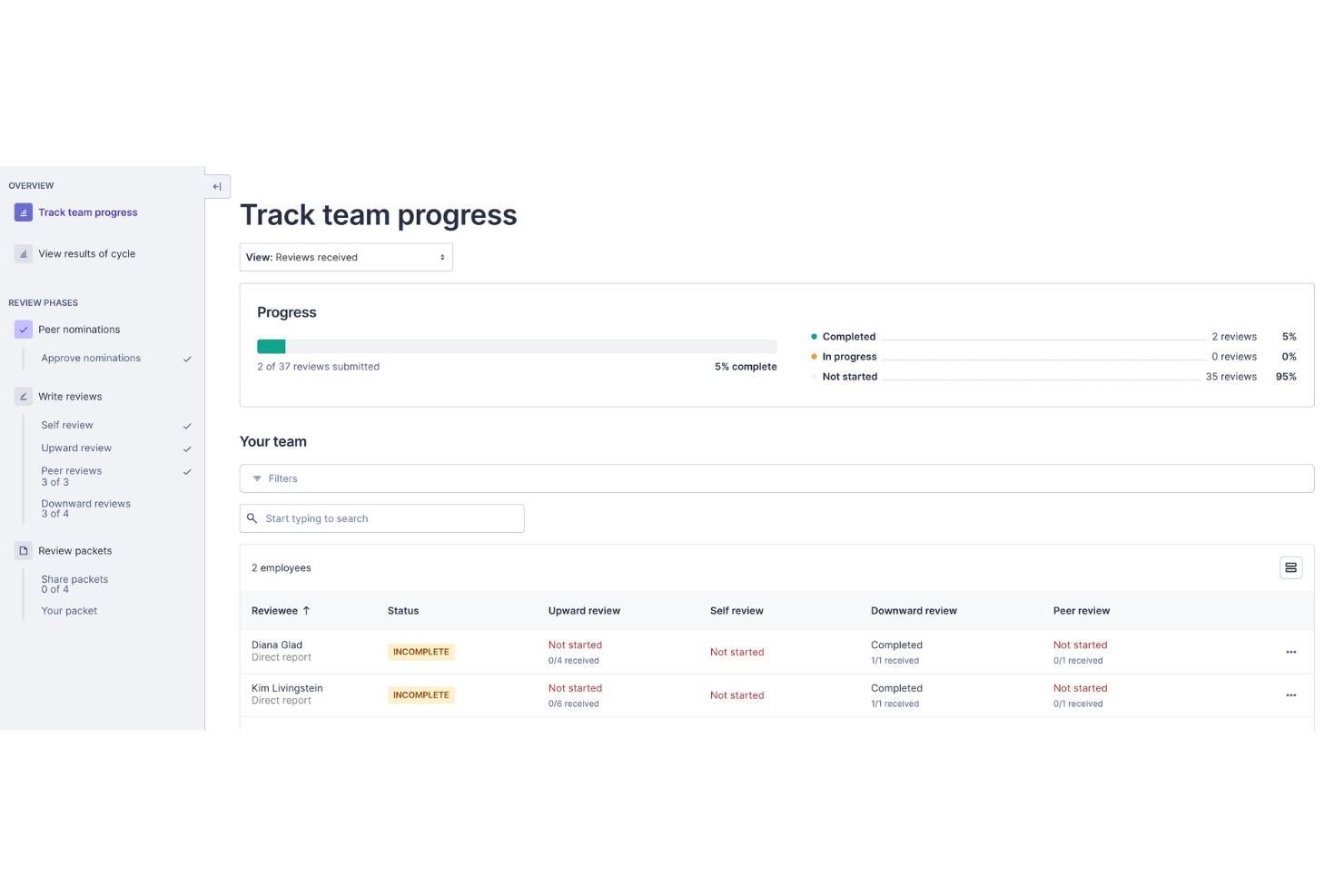
Lattice scores well for ease of use, offering a clean and intuitive interface that simplifies your people management tasks. You’ll find the navigation straightforward, with features like goal setting and feedback tools easily accessible. While the initial setup might take time, once configured, your team will navigate it with ease. Users appreciate how it streamlines performance management, making it less of a chore and more of a collaborative process.

Onboarding
Lattice offers a comprehensive onboarding experience, though it might take some time to fully implement. You’ll have access to extensive resources and support, helping your team get up to speed quickly. Users appreciate the guided tutorials and documentation that make the transition smoother. While the setup can be detailed, the support team is responsive, ensuring your questions are addressed promptly, which helps in realizing value sooner.
Customer Support
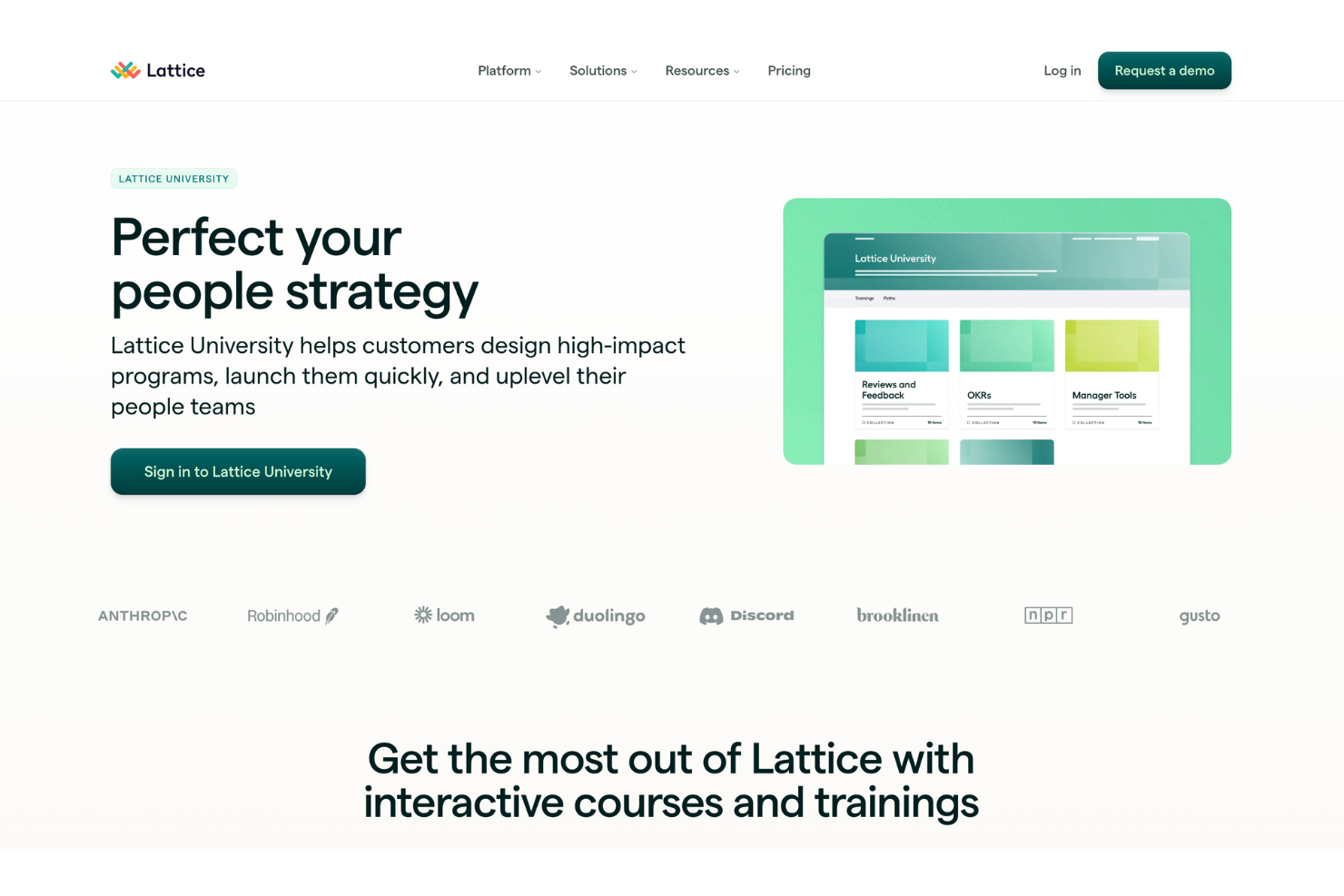
Lattice excels in customer support, offering multiple channels to assist you effectively. You’ll find their support team responsive and knowledgeable, addressing your queries swiftly. Users often praise the helpfulness of their customer service, which includes live chat, email, and extensive online resources. This robust support system ensures that any issues you encounter are resolved quickly, helping your team maintain productivity without unnecessary downtime.
Integrations
Integrations include ADP, BambooHR, Gusto, Greenhouse, Checkr, Employee Navigator, Microsoft Teams, Google Suite, Lever, UKG, Workday, and Asana.

Value for Money
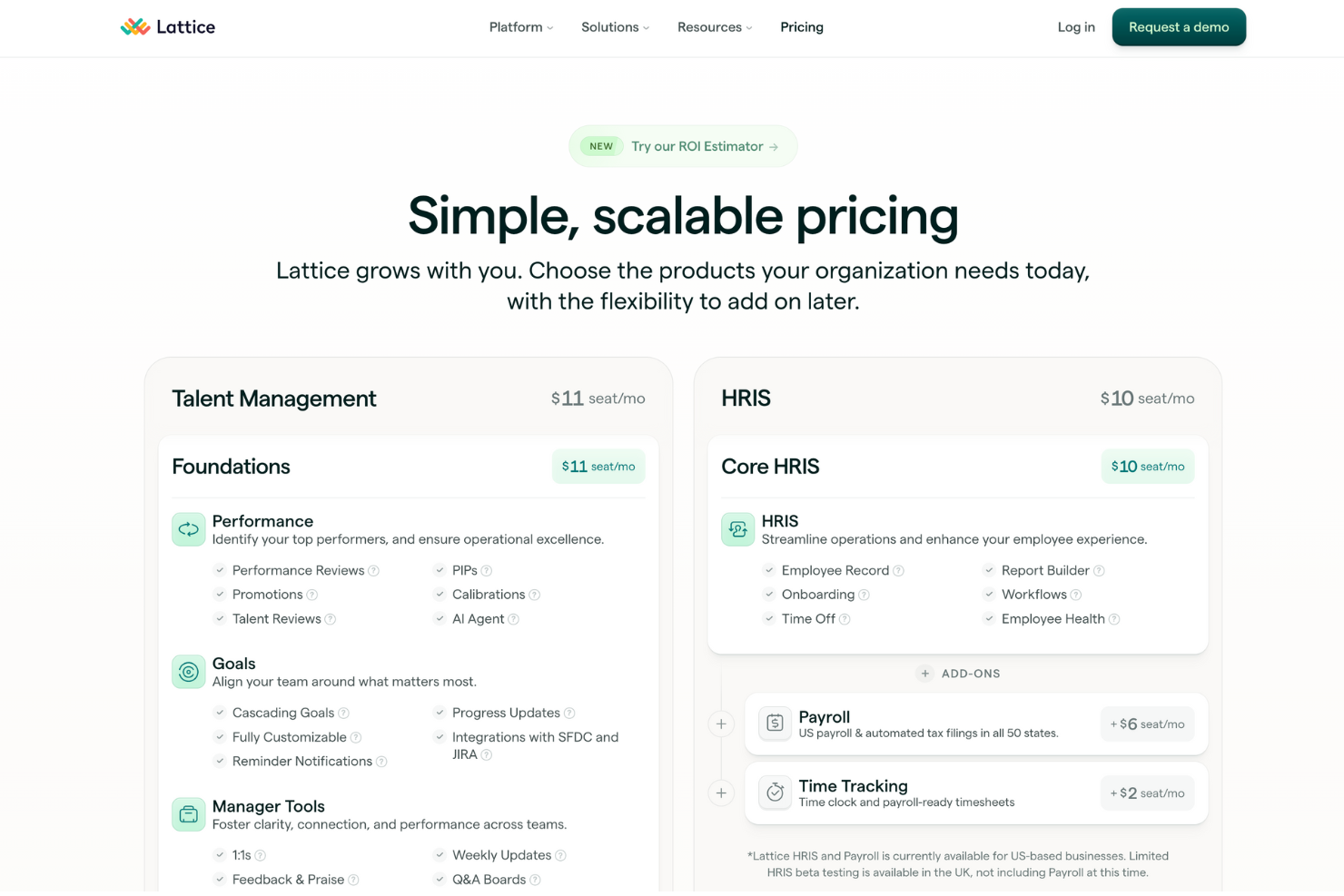
Lattice pricing offers strong performance and people management tools at fair rates, especially for growing teams that want to connect HR, feedback, and engagement in one place. Users find the features worth the cost, though pricing can climb with added modules and larger teams.
- Talent Management: Core tools for performance reviews, goals, feedback, and engagement.
- HRIS: Adds employee data management and reporting in one integrated platform.
- Add-ons: Optional features for compensation, OKRs, analytics, and other advanced tools.
New Product Updates from Lattice

Lattice Introduces MCP Connector for AI Chat Tools
Lattice has launched Lattice MCP to make it easier for teams to use AI chat tools with their existing Lattice talent information. By connecting LLMs directly to key people data, customers can surface insights and context faster without leaving their preferred chat interface. Highlights include:
- Lattice MCP: Connects Lattice talent data with Claude, ChatGPT, and other LLM tools for AI-assisted workflows.
- Performance Data Access: Brings reviews, 1:1 notes, feedback, goals, and updates into AI chat conversations.
- AI Talent Insights: Helps teams draft reviews and summarize coaching insights using existing employee data.
Visit Lattice's official site for more details.
 for more details.
Lattice Expands Data Imports and Logs
Lattice improves data workflows with expanded integrations, imports, API access, and reporting options. These updates help teams connect data sources, automate updates, and access more complete activity records. Highlights include:
- BambooHR Custom Fields: Sync tabular custom fields from BambooHR for more complete employee profiles.
- Expanded Data Imports: Manage more custom field types through CSV uploads and SFTP imports.
- Goals Write API: Create and update goals programmatically through the public API.
- Improved Logs: Access expanded 1:1 logs, Talking Point logs, and backdated calendar events.
Visit Lattice’s official site for more details.

Lattice Adds Calibration Updates and Compensation Context
Lattice adds calibration workflow upgrades, inline compensation editing, and review context for compensation planning. These updates help teams manage calibration sessions, update recommendations, and make compensation decisions with more context. Highlights include:
- Calibration Updates: Resize and reorder columns, edit groups inline, apply scoped filters, and delete groups in bulk.
- Compensation Recommendations: Edit recommendations directly from the table with compensation details in view.
- Review Context: View calibration notes and tags from linked review cycles during compensation planning.
Visit Lattice’s official site for more details.

Lattice's Richer Engagement Insights With New Filters and Benchmarks
Lattice improves engagement insights with Job Architecture filters, Management Type filters, and updated benchmarks. These updates help teams segment survey results and better understand performance across different employee groups. Highlights include:
- Engagement Filters: Filter survey results by Job Level, Job Function, Job Type, Job Title, and Management Type.
- 2025 Benchmarks: Compare engagement results using updated Mercer & Lattice benchmark data.
- Expanded Survey Insights: Apply new filters across engagement, onboarding, and exit surveys.
Visit Lattice’s official site for more details.
Lattice Specs
- 360 Degree Feedback
- API
- Application Tracking
- Attendance Tracking
- Budgeting
- Calendar Management
- Dashboard
- Data Export
- Data Import
- Data Visualization
- Employee Database
- Employee Engagement
- Employee Incentive Management
- Employee Onboarding
- External Integrations
- Feedback Management
- Forecasting
- Multi-User
- Notifications
- Onboarding
- Scheduling
- Timesheets
- Vacation & Absence Calendar
Lattice FAQs
How does Lattice handle data security and compliance?
Can Lattice support remote teams effectively?
How does Lattice facilitate employee engagement?
What kind of reporting capabilities does Lattice offer?
How customizable are Lattice’s performance reviews?
How does Lattice support goal alignment?
Is Lattice suitable for large organizations?
What kind of training and support does Lattice offer for new users?
Lattice Company Overview & History
Lattice is a people-management platform headquartered in San Francisco, California, that helps your team with performance, feedback and engagement tools. It was founded in 2015 and has grown to serve over 5,000 organizations, raising more than $330 million and reaching a valuation near $3 billion. While it’s mostly a standalone product, it recently launched an HRIS solution to work smoothly with its core talent-suite.
Lattice Major Milestones
- 2015: Founded by Jack Altman and Eric Koslow.
- 2016: Launched its talent-management product.
- 2022: Raised $175 million in Series F at a ~$3 billion valuation.
- 2023: Announced the launch of the Lattice HRIS to round out its platform.
What's Next?
To remain up to date on all the latest in people management, subscribe to our newsletter for leaders and managers. You'll receive insights and offerings tailored to leaders and HR professionals straight to your inbox.