

10 Best Employee Feedback Software Of 2026

10 Best Employee Feedback Software Shortlist


With so many different employee feedback software available, figuring out which is right for you is tough. You know you want to collect and analyze feedback efficiently to help you identify trends and areas for improvement, but you need to figure out which tool is best. In this post, I'll help you make your choice easier by sharing my insights on the best employee feedback software for collecting and analyzing responses based on my personal HR experience.
What is Employee Feedback Software?
Employee feedback software solutions are digital tools that help you collect, analyze, and draw insights from your staff’s feedback. They allow you to measure employee engagement, satisfaction, and development over time by uncovering feedback trends and monitoring employee sentiment. These advanced survey tools also support anonymous feedback collection to help organizations get truthful feedback from their employees without fearing repercussions.
Using employee feedback software can improve your employee engagement, retention, and satisfaction levels by giving employees a voice and promoting an open dialogue within your organization. They can also help you identify corporate weaknesses for future improvements and make better data-driven decisions.
Why Trust Our Software Recommendations
Our team has been testing and reviewing software since 2012. As HR experts ourselves, we know how difficult—and important—it is to choose the right software.
For this guide, we evaluated tools using hands-on testing and independent research, scoring tools using our selection criteria. We also draw on insights from industry thought leaders and practicing HR experts.
Our reviews reflect our human editorial judgment, not a sales pitch.
Expert reviewers:
Employee Feedback Software Comparison Table
This comparison table summarizes pricing details for my top employee feedback software selections:
| Tool | Best For | Trial Info | Price | ||
|---|---|---|---|---|---|
| 1 | Best for seamless employee surveys for remote teams | Free demo available | From $5/user/month | Website | |
| 2 | Best for automated pulse surveys | Free demo available | Pricing upon request | Website | |
| 3 | Best for tying survey feedback to recognition workflows | Free demo available | Pricing upon request | Website | |
| 4 | Best for employee performance feedback | Free demo available | Pricing upon request | Website | |
| 5 | Best for government, small business, & non-profits | 30-day free trial + free demo available | From $2.50/user/month (billed annually) | Website | |
| 6 | Best for team-led action on feedback | 21-day free trial available | From $6/user/month (billed annually) | Website | |
| 7 | Best with fixed anonymity safeguards | Free plan + free trial + free demo available | From $4/user/month (billed annually) | Website | |
| 8 | Best as AI for business | Free demo available | From $8/user/month | Website | |
| 9 | Best for turning feedback into action plans | 14-day free trial + free demo available | From $2/user/month | Website | |
| 10 | Best for 360-degree feedback | Free demo available | From $5/user/month (billed annually) | Website |


Overviews of the 10 Best Employee Feedback Software
Here’s my evaluation of the best employee feedback platforms available now, with brief descriptions of their outstanding features and explanations of why I included them on my list.
Deel HR
Best for seamless employee surveys for remote teams

Deel HR is an employee feedback platform that lets you create, distribute, and analyze employee surveys, manage feedback cycles, and centralize feedback data for remote and global teams.
Who Is Deel HR Best For?
Deel HR is a strong fit for HR teams managing distributed or international workforces who need a centralized way to collect and act on employee feedback across time zones and regions.
Why I Picked Deel HR
I picked Deel HR as one of the best because its survey tools are built specifically for the realities of distributed teams. The survey builder lets you launch engagement, pulse, or fully custom surveys in minutes, with controls for anonymity and automated scheduling—so you're not manually chasing responses across time zones. I also like that survey results feed directly into a centralized analytics dashboard that surfaces eNPS scores, engagement drivers, and sentiment trends in one place. From there, my team can move straight into action planning using connected Goals, Learning, and Career tools without ever leaving the platform.
Below are the key features.
Deel HR Key Features
- 360° performance reviews: Run multi-rater review cycles where employees receive structured feedback from peers, managers, and direct reports in one place.
- AI-assisted feedback drafting: Use built-in AI to draft competency libraries, review templates, and feedback text, reducing the time spent starting from scratch.
- Career development plans: Build individual development plans tied to defined career progression frameworks, so employees can see clear paths for growth.
- Anonymous reporting tool: Give employees a secure, confidential channel to raise concerns through a built-in whistleblowing feature that sits within the same HR platform.
Deel HR Integrations
Deel HR offers native integrations with Slack, Greenhouse, BambooHR, Workday, HiBob, and Okta. An API is available for custom integrations.
Pros and Cons
Pros:
- Compliance documents auto-populated for each country
- Offers fast money withdrawals
- Can work with cryptocurrency
Cons:
- Limited customization and flexibility
- Can be difficult to set up
New Product Updates from Deel HR

Deel Expands Stablecoin Wallet to 80+ Countries
Deel expands its Stablecoin Wallet to 80+ countries with dollar-backed balances and optional rewards. This gives eligible contractors more ways to hold and manage earnings inside Deel. For more information, visit Deel’s official site.
 .
.
Best for automated pulse surveys
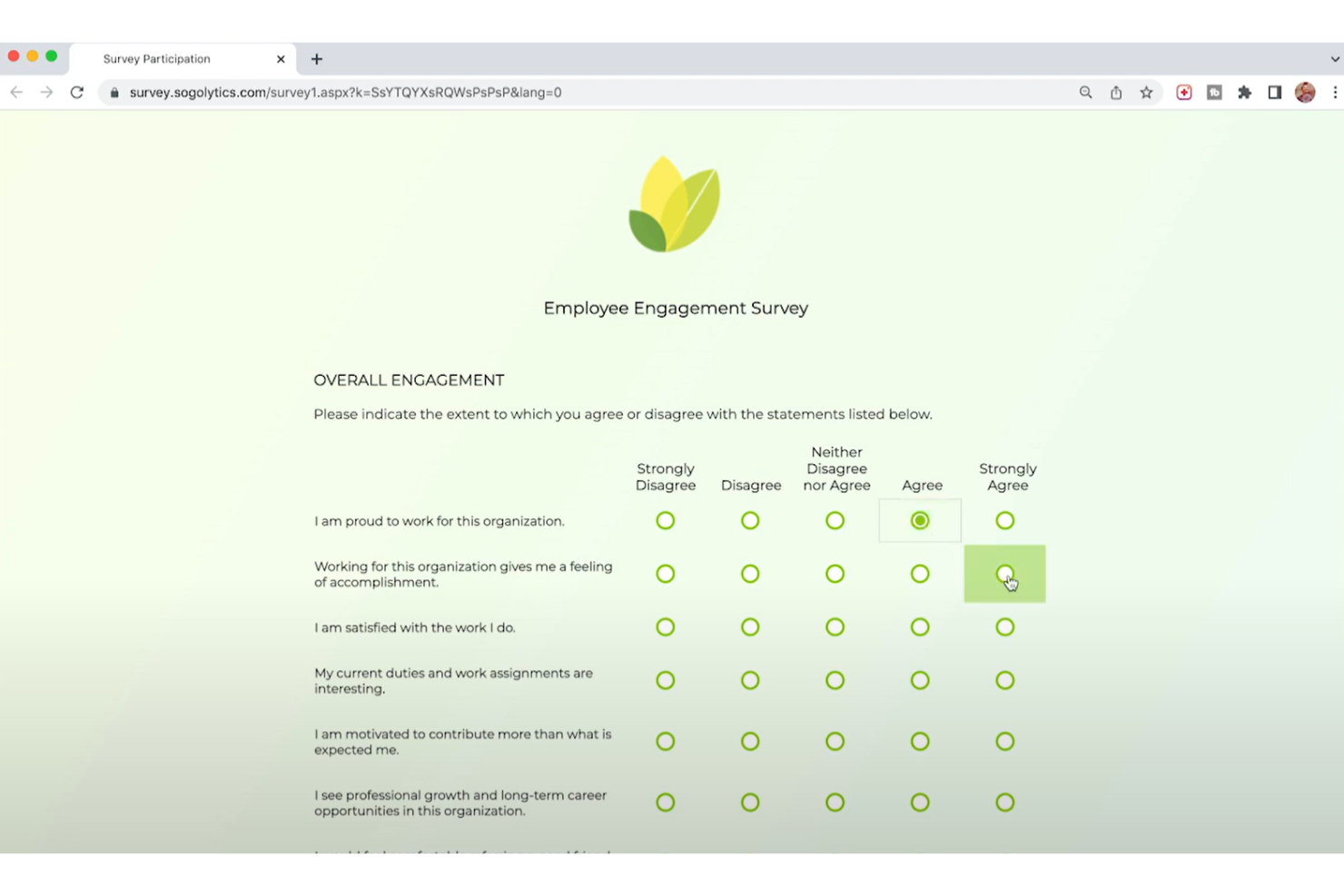
Sogolytics is an employee feedback software platform that lets you create, distribute, and analyze surveys with advanced automation, real-time analytics, and customizable templates.
Who Is Sogolytics Best For?
Sogolytics is a good fit for HR teams at mid-size to large organizations that need a structured, data-driven approach to collecting and acting on employee feedback.
Why I Picked Sogolytics
I picked Sogolytics as one of the best because of how well its automation handles the repetitive side of pulse survey programs. You can schedule pulse surveys at regular intervals, set up automated reminders, and let the platform run the cadence without manual intervention each cycle. What I really like is that the NLP-powered sentiment analysis works on open-text responses in real time—so when an employee writes in a free-form field, Sogolytics decodes sentiment automatically, so you don't have to read hundreds of comments manually. The guaranteed anonymity feature is built into the platform at the survey level, which makes a real difference in getting candid responses on sensitive topics like manager relationships or workload concerns.
Sogolytics Key Features
- Employee journey mapping: Track and trigger surveys at key lifecycle milestones—onboarding, stay interviews, and exit—by linking dates in the Directories feature.
- eNPS and ESAT tracking: Monitor employee Net Promoter Score and satisfaction scores in a unified EX dashboard alongside well-being trends.
- Key driver analysis: Identify the specific factors most influencing engagement, burnout, or turnover across departments, roles, or tenure groups.
- 360-degree feedback collection: Gather multi-source input from peers, managers, and direct reports to support individual development and performance reviews.
Sogolytics Integrations
Sogolytics offers native integrations with Microsoft Teams, Google Workspace, Salesforce, and Zapier. An API is available for custom integrations.
Pros and Cons
Pros:
- Includes tools for tracking employee engagement over time
- Supports multilingual surveys for diverse teams
- Offers a wide range of survey customization options
Cons:
- Could offer more report customization
- Advanced survey logic is limited to higher-tier plans
New Product Updates from Sogolytics
Sogolytics Adds Shareable Track, Automated Imports, and Folder Permissions
Sogolytics adds shareable Track links, expanded Import Automation sources, and folder-level permissions. These updates make it easier to share distribution insights, automate data intake, and manage project access. For more information, visit Sogolytics’ official site.
 .
.
Nectar
Best for tying survey feedback to recognition workflows
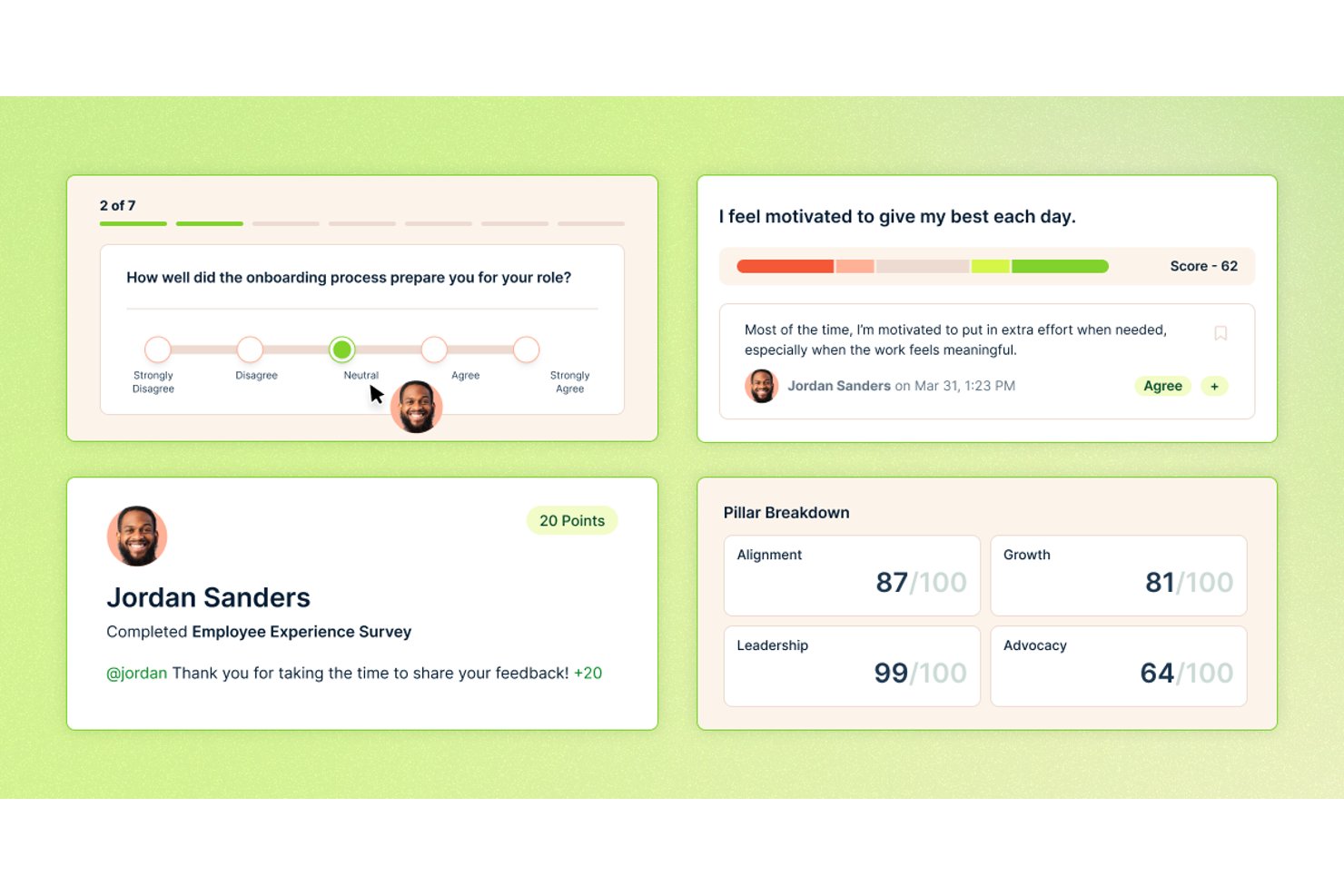
Nectar is an employee feedback and recognition platform that combines pulse surveys, eNPS, anonymous feedback channels, and engagement analytics with built-in recognition and communications workflows.
Who Is Nectar Best For?
Nectar suits HR teams and people ops managers who want to connect employee sentiment data directly to recognition and follow-up workflows in one platform.
Why I Picked Nectar
Nectar earns its spot on my shortlist because it's the only tool I've seen that routes survey results directly into recognition and communication workflows without any manual handoff. When SafeTalk™ surfaces an anonymous concern or an eNPS cycle flags a dip in a specific team, managers can send a shoutout, draft a comms update, or trigger a Flows automation in the same platform. That closed loop between listening and responding is what sets Nectar apart in this category.
Nectar Key Features
- SafeTalk™ anonymous two-way chat: HR and managers can reply to anonymous survey comments and ask follow-up questions without revealing the respondent's identity.
- Nectar Signals health scores: Each employee, team, and department receives a 0–100 health score grouped into five tiers, with six-month trend lines and AI plain-language explanations.
- Lifecycle-triggered surveys via Flows: A no-code workflow builder sends surveys automatically based on hire date, work anniversary, HRIS changes, or external API triggers.
- Survey completion incentives: Employees earn Nectar points for completing surveys, including anonymous ones, to encourage participation across frontline and deskless teams.
Nectar Integrations
Nectar offers integrations with Workday, BambooHR, Rippling, ADP, Slack, Microsoft Teams, and Google Chat. It also supports custom connections through a public API and Zapier.
Pros and Cons
Pros:
- Incentivizes participation from frontline employees
- SafeTalk™ enables anonymous two-way conversations
- Connects survey feedback with recognition workflows
Cons:
- Lacks dedicated action-plan tracking tools
- No current 360-degree feedback cycles
New Product Updates from Nectar

Nectar Enhances Clara AI With Live Platform Data
Nectar introduces live platform data access and expanded knowledge coverage for Clara AI. The updates improve response accuracy and speed while enabling Clara AI to answer questions across more recognition and rewards features. For more information, visit Nectar's official site.

Best for employee performance feedback

Mitratech Perform is an employee feedback and performance management platform that offers tools for continuous feedback, customizable review cycles, goal tracking, and analytics.
Who Is Mitratech Perform Best For?
Mitratech Perform is a good fit for HR teams and people managers who need a structured, scalable approach to performance reviews and ongoing employee feedback.
Why I Picked Mitratech Perform
Mitratech Perform earns its spot on my shortlist because of how well it handles structured, multi-directional feedback. I particularly like the 360-degree feedback feature, which pulls input from peers, managers, and direct reports to give a fuller picture of how an employee is performing—not just how their manager sees them. I also use the continuous feedback tools to capture real-time notes throughout the year, so review conversations aren't built from memory alone. The customizable review templates let my team design evaluation cycles that reflect our actual competencies and values, rather than forcing everyone into a generic format.
Mitratech Perform Key Features
- Goal tracking and setting: Set individual and team goals, define a pathway to reach them, and monitor progress over time.
- Pulse surveys and check-ins: Gather employee sentiment through pulse surveys, manager check-ins, and polls to track engagement alongside performance.
- Competency assessment: Evaluate employees against defined competencies to identify skill gaps and top performers across the organization.
- Automated reminders: Trigger automatic notifications to managers and employees when performance reviews are due or actions are needed.
Mitratech Perform Integrations
Integrations include ADP Workforce Now, UKG Pro, Trakstar Learn, Slack, Azure Active Directory, Okta, Google Workspace, and SAML.The tool supports API-based integrations for custom connections.
Pros and Cons
Pros:
- Responsive and helpful customer support team
- Customizable goals and goal tracking
- Robust platform for managing performance
Cons:
- Full feature set may not be needed by all
- Pricing details are not transparent


Express Evaluations is an employee feedback software platform that provides customizable evaluation forms, automated reminders, and reporting tools for structured performance reviews.
Who Is Express Evaluations Best For?
Express Evaluations is a strong fit for government agencies, small businesses, and non-profits that need a straightforward, affordable way to run structured employee performance reviews.
Why I Picked Express Evaluations
I picked Express Evaluations as one of the best because its pricing model is built around the budget constraints of government agencies, small businesses, and non-profits. The Essentials plan covers custom evaluation templates, automated notifications, and digital signatures without requiring a large HR team to manage it. I particularly like the digital signature feature—it removes the paper-based approval workflows that are still common in government and non-profit settings. The bias detection in reporting is also a practical touch, helping smaller organizations flag inconsistencies in evaluation results that a lean HR team might miss.
Express Evaluations Key Features
- Pulse surveys: Send short, recurring surveys to employees to gather real-time sentiment data between formal review cycles.
- Manager/employee check-ins: Conduct structured one-on-one check-ins with optional ratings and notes logged directly in the platform.
- 360-degree evaluation tool: Collect feedback on an employee from multiple reviewers, including peers, direct reports, and managers.
- Performance improvement plans: Build, assign, and track formal improvement plans for employees who need structured development support.
Express Evaluations Integrations
Integrations include ADP Workforce Now, Paylocity, BambooHR, UKG Pro, Azure, Okta, Google Workspace, Slack, Salesforce, Eddy, and Employee Navigator. An API is available for custom integrations.
Pros and Cons
Pros:
- Comprehensive reporting features
- Supports performance improvement plans
- Customizable evaluation templates
Cons:
- Limited integration options with other HR systems
- No mobile application for on-the-go access

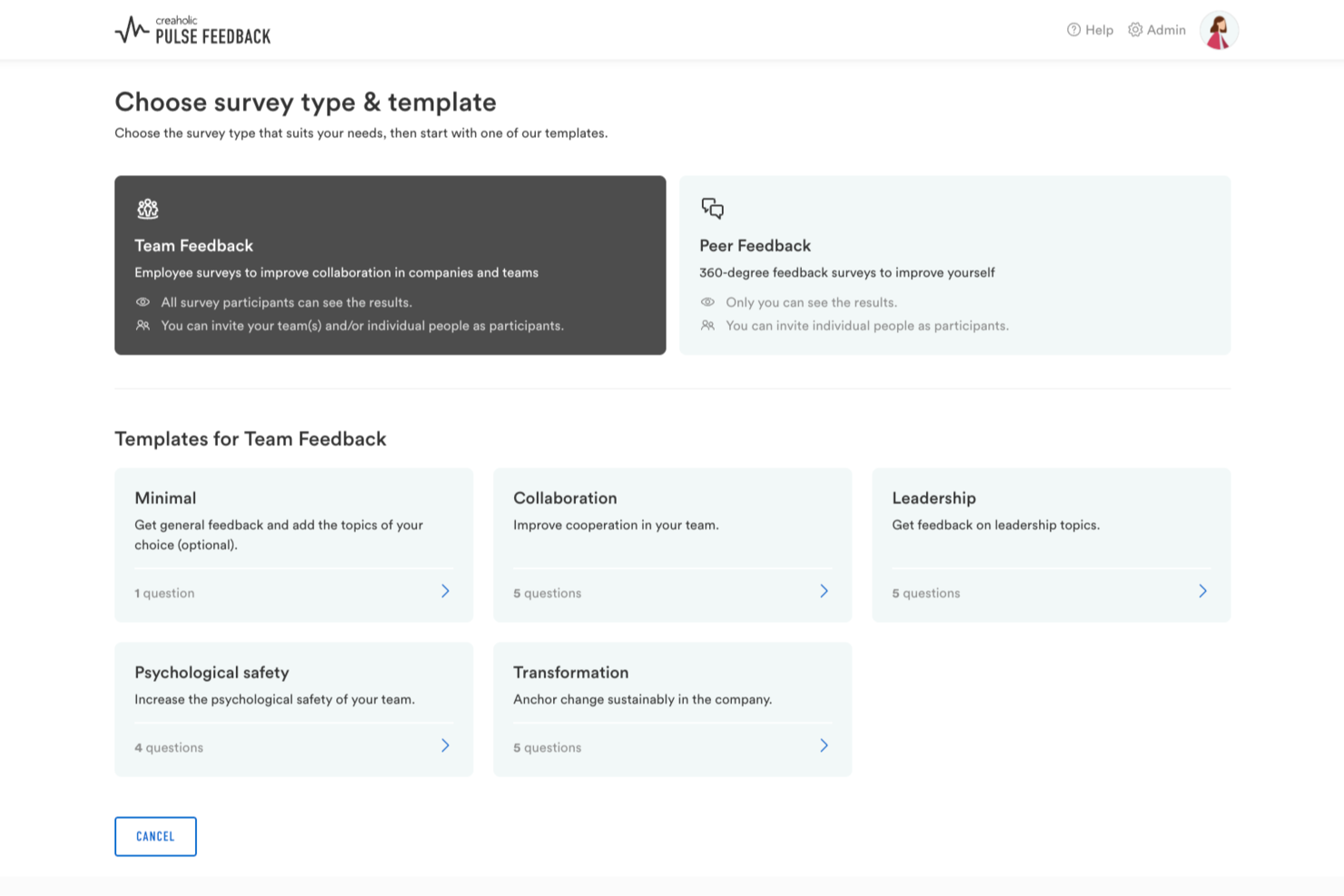
Pulse Feedback is a Swiss-developed employee feedback platform that combines pulse surveys, 360-degree feedback, engagement measurement, and AI-powered insights with guided team discussion tools. Alongside the software, hands-on consulting support is available to guide organizations through every stage of the process—from custom questionnaire design to post-survey results workshops.
Who Is Pulse Feedback Best For?
Pulse Feedback is a good fit for HR teams, executives, and people managers in mid-sized to large organizations looking for a flexible feedback solution paired with optional expert guidance to improve organizational culture and employee engagement.
Why I Picked Pulse Feedback
I've included Pulse Feedback in my top picks because it's one of the more complete tools I've seen for measuring company culture over time, not just capturing a one-time snapshot. I particularly like the time comparison feature, which lets you track how culture metrics shift across survey cycles, and the benchmark comparison, which puts your results in context against internal or external references. On top of that, the AI-guided discussion moderator brings teams together to work through results in structured sessions, so culture data actually leads somewhere.
Pulse Feedback Key Features
- 360-degree feedback: Collect structured feedback on individuals from managers, peers, and direct reports within the same survey cycle.
- Scientifically validated question library: Access 120+ pre-built survey questions grounded in organizational research to reduce setup time.
- Bottom-up surveys: Let individual employees or teams create and send their own surveys, not just top-down HR-led ones.
- AI chat: Query your survey results conversationally to surface patterns and specific data points without manually digging through reports.
Pulse Feedback Integrations
Native integrations are not clearly documented; however, the platform does support Single Sign-On (SSO) with Microsoft 365 credentials.
Pros and Cons
Pros:
- Built-in constructive feedback prompts guide responses
- Bottom-up surveys initiated by any employee
- AI-guided team sessions for discussing results
Cons:
- Limited third-party app integrations available
- Survey creation can feel complex for larger surveys
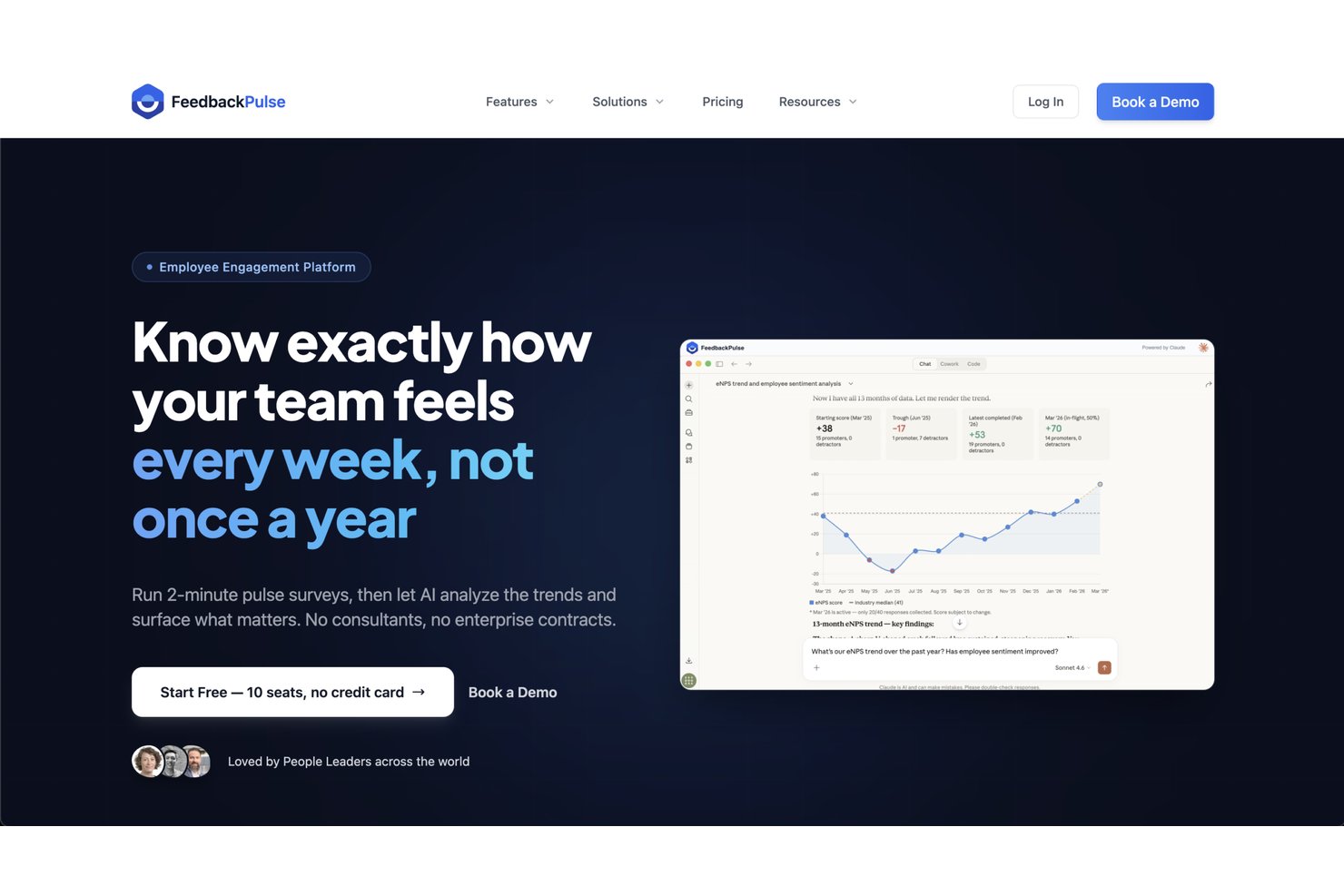
FeedbackPulse is a feedback and engagement platform that brings together pulse surveys, 360° reviews, performance cycles, eNPS tracking, and peer recognition in one place.
Who Is FeedbackPulse Best For?
FeedbackPulse is a good fit for HR teams at mid-sized companies that need a dedicated tool for running structured feedback and engagement programs.
Why I Picked FeedbackPulse
I've included FeedbackPulse in my top picks because it gives HR teams genuine control over how feedback programs are structured and sequenced. I like that survey templates are fully editable, so you can adapt questions by team, location, or lifecycle stage without rebuilding from scratch each cycle. You can also mix survey types, pulse, eNPS, onboarding, and exit, into a single recurring workflow rather than managing them as separate processes. That kind of configurability is what makes FeedbackPulse feel like a tool built around how HR actually operates.
FeedbackPulse Key Features
- 360° peer reviews: Run structured peer review cycles with anonymous-by-default settings and manager review tracks built in.
- AI-powered text analysis: Automatically surfaces themes and summaries from open-text survey responses across large response sets.
- Automated survey reminders: Set reminder schedules with daily send caps and cooldown controls to avoid over-surveying employees.
- Peer recognition wall: Let employees send public kudos to colleagues, visible across the organization in a shared recognition feed.
FeedbackPulse Integrations
FeedbackPulse offers a smaller set of integrations at this stage. It connects with Slack for delivering survey invitations and reminders as direct messages, and supports AI assistant access through the Model Context Protocol (MCP), with documented connections for Claude Desktop and Claude.ai. A native API and automation tooling, including Zapier-style workflows, are listed as planned but not yet available.
Pros and Cons
Pros:
- Peer review visibility controls protect fairness
- Combines surveys, reviews, and recognition
- Built-in AI summaries of survey responses
Cons:
- No mobile app currently offered
- Limited third-party native integrations available
Best as AI for business
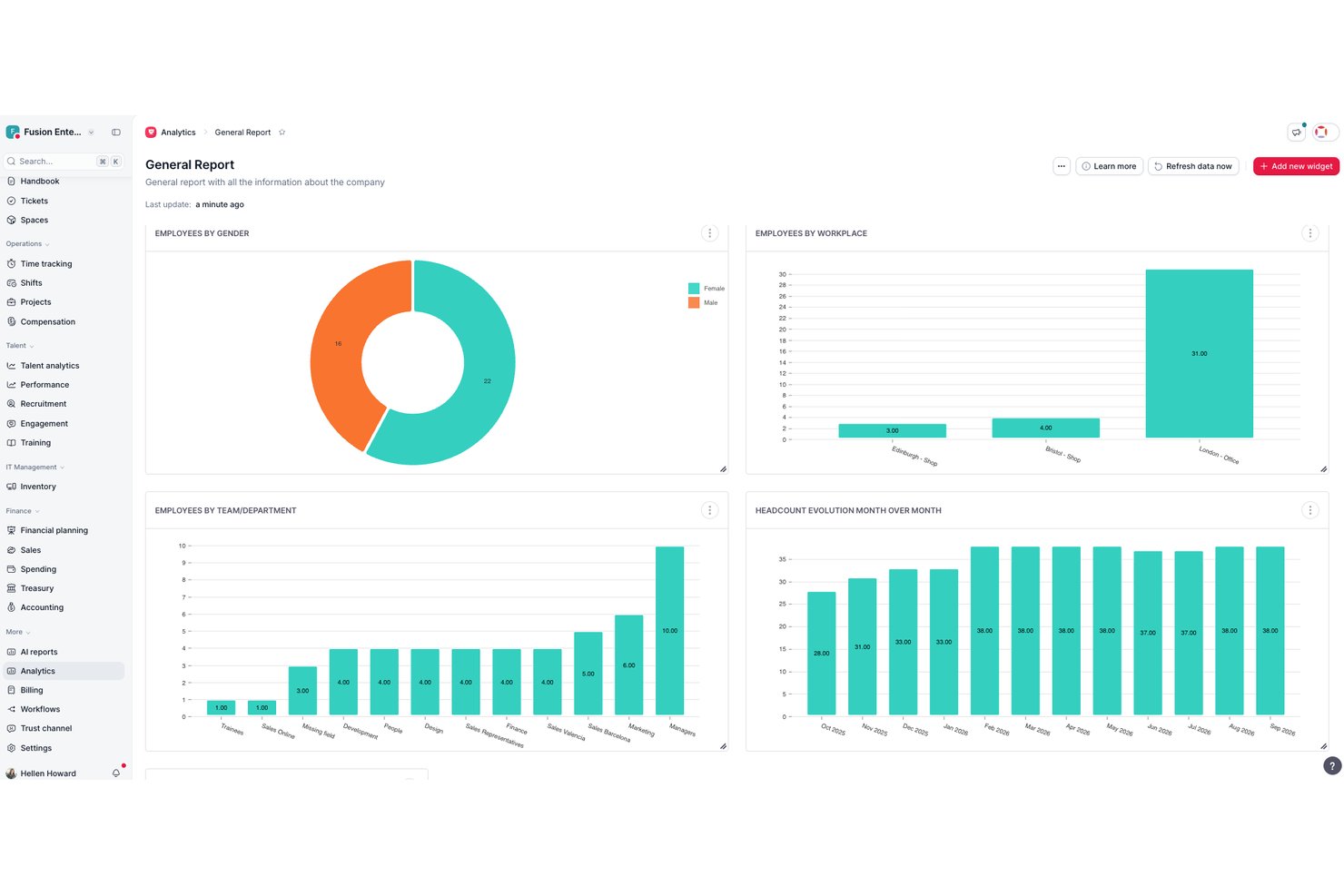
Factorial is a broad HR platform that brings together performance reviews, 360-degree feedback cycles, engagement surveys, eNPS tracking, and AI-assisted analysis tools in one place.
Who Is Factorial Best For?
Factorial suits teams that want performance reviews, engagement surveys, and core HR workflows managed in one AI-assisted platform rather than spread across separate tools.
Why I Picked Factorial
I've included Factorial in my top picks because its AI sits at the center of how feedback actually gets used, not just collected. I particularly like how the AI tool One lets you compare survey cycles side by side, summarize open feedback, and filter insights by specific groups without digging through raw data manually. Paired with a full suite of 180° and 360° review cycles and an Engagement Insight Dashboard, Factorial connects structured performance feedback to real analysis in one place.
Factorial Key Features
- eNPS and climate surveys: Gather employee net promoter scores and run climate surveys built on Gallup's 12 engagement questions to measure workplace sentiment.
- 9-box grid assessment: Plot employees on a 9-box grid to assess team performance and identify strengths across your organization.
- Peer competency assessments: Run 180°, 270°, and 360° competency evaluations that compare self, manager, and peer responses side by side.
- Mobile survey access: Employees can complete surveys directly from the Factorial mobile app, making participation easier across distributed teams.
Factorial Integrations
Factorial offers marketplace integrations including Slack, Google Workspace, Microsoft Azure, LinkedIn, and Microsoft Power BI. It also supports a public API, API keys, OAuth 2.0, webhooks, SDKs, OpenAPI, and Zapier.
Pros and Cons
Pros:
- Employees can complete surveys on mobile
- 360-degree reviews include peer and upward feedback
- AI summarizes feedback and compares survey cycles
Cons:
- Action plans lack completion tracking
- Custom reports can require workarounds
Best for turning feedback into action plans

ThriveSparrow is employee feedback software that lets you run pulse surveys, gather anonymous input, analyze engagement data, and create action plans based on real-time insights.
Who Is ThriveSparrow Best For?
ThriveSparrow is a good fit for HR teams at small to mid-sized companies that need a structured way to collect employee feedback and follow through on it.
Why I Picked ThriveSparrow
ThriveSparrow earns its spot as one of the best on my shortlist because it doesn't just collect feedback—it gives you a direct path from survey results to structured action. I particularly like the action plans feature, which lets you create a plan in a single click straight from an engagement report, then break it down into checklists and assign tasks to specific people. When a pulse survey flags low scores in a particular team or category, my team can move immediately from insight to ownership without switching tools. The heatmap view highlights which groups are underperforming against benchmarks, so action plans are targeted rather than generic.
ThriveSparrow Key Features
- 360-degree feedback: Collect multi-rater feedback from peers, managers, and direct reports to give employees a full-circle view of their performance.
- AI sentiment analysis: Analyzes open-text survey responses to surface the emotions and themes behind employee answers, flagging signs of burnout or disengagement.
- Multilingual surveys: Run surveys in 100+ languages and translate responses automatically, so you can gather feedback from global or distributed teams.
- eNPS surveys: Measure employee loyalty with a single-question survey format, then track shifts in advocacy scores over time using built-in reporting.
ThriveSparrow Integrations
Integrations include Slack, Microsoft Teams, Google Workspace, Google Chat, HiBob, and various HRIS systems through Merge. ThriveSparrow offers an API for custom integrations.
Pros and Cons
Pros:
- Offers peer-to-peer recognition
- Real-time feedback mechanisms
- Provides valuable insights into employee engagement
Cons:
- Fewer integrations compared to other platforms
- Lacks advanced features that larger organizations might require

PerformYard
Best for 360-degree feedback
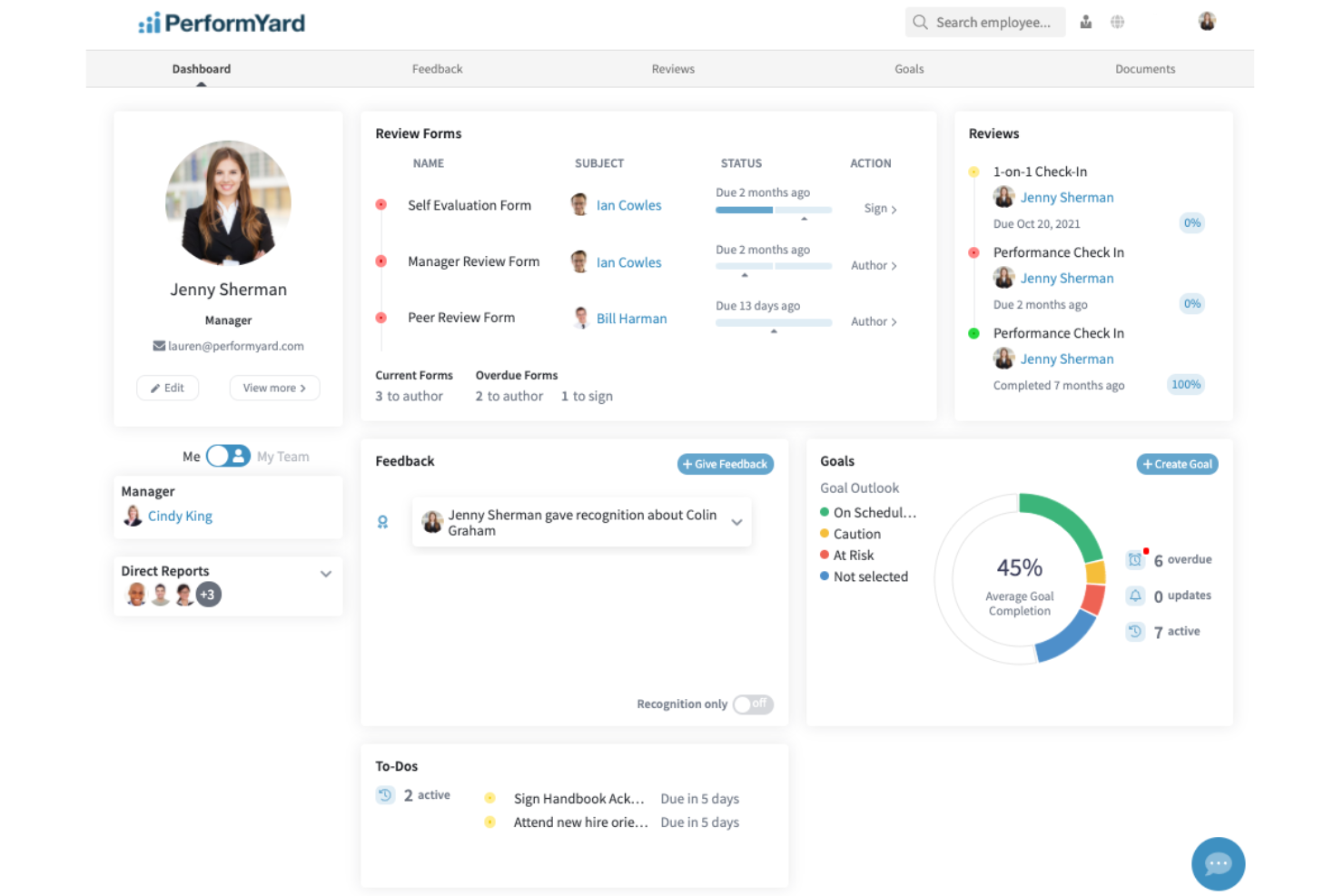
PerformYard is employee feedback software that lets HR teams and managers run structured performance reviews, gather 360-degree feedback, and manage ongoing feedback cycles in one platform.
Who Is PerformYard Best For?
PerformYard is a good fit for mid-sized organizations where HR teams need a structured, customizable approach to performance management and employee feedback.
Why I Picked PerformYard
PerformYard earns its spot as one of the best on my shortlist because of how much flexibility it gives you when setting up 360-degree feedback. I like that you can pull in feedback from direct reports, peers, managers, and even people outside your organization—all within the same review cycle. That external feedback option is something I don't see often, and it's genuinely useful for roles with client-facing responsibilities. The platform also lets you combine self-assessments and multiple manager evaluations in a single review, so you get a layered picture of performance rather than a one-sided snapshot.
PerformYard Key Features
- Continuous feedback: Request, give, and receive ongoing feedback between review cycles, including employee recognition and performance notes.
- Goal management: Set and track individual, team, and company-level goals, with cascading goal alignment to broader organizational objectives.
- Employee engagement surveys: Build fully custom surveys—from onboarding to exit interviews—with a live response dashboard and participation tracking.
- Performance reporting and analytics: View performance trends over time and across teams using dashboards, 9-box grids, rankings, and data exports.
PerformYard Integrations
PerformYard offers native integrations with Microsoft Teams, Slack, HRIS platforms for employee data, and SSO providers for one-click login. An API is available for custom integrations.
Pros and Cons
Pros:
- Performance data and analytics
- Goal tracking capabilities
- Wide range of feedback collection methods
Cons:
- Review cycle setup can be non-intuitive for some users
- Custom reporting is limited
Other Options
Here are some other employee feedback tools you should check out. Even though they didn’t make it into my top 10 list, they’re still effective solutions:
- SurveyLegend
For mobile-friendly surveys
- Spidergap 360˚ Feedback
For customizable feedback processes
- Lattice
For AI-powered people insights
- Vantage Circle
For real-time employee feedback collection
- SurveyMonkey
For survey templates
- Culture Amp
For small HR departments
- CultureMonkey
For measuring employee engagement
- Workleap
For anonymous, aggregated feedback data
- ChartHop
For ad-hoc feedback collection
- Qualtrics XM
For AI-powered insights


How I Evaluate Employee Feedback Software
I look at these tools in two layers: the core capabilities—like pulse surveys and anonymous channels—any platform must have, and the differentiators that make one a better fit than another.
Core Functionality (Table Stakes For This List)
When I'm selecting tools for my list, I rank each one on a scale from 0 (does not offer the functionality) to 5 (excels in this area) for each core functionality listed below. Then, I calculate the tool's total score into a percentage. Each tool needs to achieve a minimum total score of 65% to be considered for inclusion.
- Pulse & Engagement Surveys: I check whether a platform supports both quick recurring pulse checks and longer engagement surveys, and whether it offers flexible scheduling like weekly, monthly, or quarterly cadences.
- Anonymous Feedback Channels: Beyond a simple anonymity toggle on surveys, I look for always-on channels like suggestion boxes or anonymous threads that let employees raise concerns anytime.
- Survey Template Library: A strong library saves HR teams from building every survey from scratch. I evaluate the breadth of templates across use cases like eNPS, onboarding, exit, and DEI.
- Feedback Analytics & Reporting: I evaluate how well each tool lets you segment data by team, department, or tenure and whether it surfaces trends over time rather than just raw response counts.
- Action Planning Tools: Collecting feedback matters only if you act on it. I look for guided plans, task assignments, and progress tracking that connect directly to survey results.
- 360-Degree & Peer Feedback: I check whether a platform supports multi-directional feedback flows—peer reviews, upward manager feedback, and self-assessments—beyond standard top-down surveys.
Once I have a list of tools that meet the criteria, I consider what sets each platform apart.
Differentiating Factors (What Sets Vendors Apart)
Here's how I compare and contrast different vendors:
Standout Features
I look for AI sentiment analysis that can parse open-text responses and surface recurring themes—especially valuable after a company-wide survey generates thousands of comments. External benchmarking is another differentiator, since it lets HR leaders contextualize eNPS or engagement scores against similar-sized organizations and build a stronger case for investment. Manager enablement dashboards matter too. The best ones give team leads direct visibility into their group's feedback data alongside coaching prompts and recommended actions.
Beyond Features
Data privacy and compliance are top of mind because feedback data is inherently sensitive. I check for anonymity thresholds that prevent re-identification in small teams, plus GDPR and SOC 2 compliance. HRIS integrations also weigh heavily—platforms that sync with Workday, BambooHR, or ADP keep employee rosters current without manual uploads. Finally, I evaluate how well a vendor supports outcomes tracking, like correlating engagement scores with turnover trends, so HR leaders can show measurable impact from their feedback programs.
People Also Ask
Curious to learn more about employee feedback software? Here are some popular questions – answered, of course.
What are the most effective ways to collect employee feedback?
There are different ways to collect employee feedback, each with its own advantages and disadvantages:
- Surveys: Even though companies have been using surveys for decades, employee surveys still represent one of the most effective ways of collecting employee feedback.
- One-on-one interviews: Talking face-to-face with someone can be invaluable. However, this method has a major downside – it can deter people from sharing their real thoughts and feelings.
- Anonymous feedback: This method can be highly effective because it enables employees to share their thoughts freely. The downside is that some people might not treat anonymous surveys too seriously, given that they’re protected by anonymity.
- Pulse surveys: Short and frequent check-ins can help you understand your employees. And the best thing about pulse surveys is that they can help you uncover trends or themes, so you can take immediate action.
- 360-degree feedback: 360-degree feedback sessions can be eye-opening. Employees receive feedback from managers, peers, and subordinates, so they can understand how to improve their performance and behavior.
What are the most effective ways to give employees feedback?
Here are several tried-and-true methods that can help you offer valuable feedback without being negative and upsetting your employees:
- SBI method: SBI stands for Situation, Behavior, and Impact. It enables you to describe specific situations, the observable behavior of the employee, and the impact that behavior had on your team. This method is good when sharing negative feedback.
- STAR method: STAR stands for Situation, Task, Action, and Result. It enables you to describe the situation where the employee excelled, the task they were assigned, the action they performed, and the result they achieved. This method is good when sharing positive feedback.
- Sandwich method: This method recommends sandwiching a negative feedback between two positive ones so you can soften the blow of criticism.
Why is collecting employee feedback important?
Collecting employee feedback is important because it can:
- Improve employee morale, satisfaction, retention, and productivity
- Build a positive company culture based on trust and transparency
- Increase employee engagement and alignment with your company’s goals
What kind of employee feedback should you ask for, and how often?
You should ask for both positive and negative feedback. As for the frequency, you should ask for feedback at least once per year. Ideally, you would ask employees to feel free to share feedback at any time.
For additional tips, take a look at 8 Effective Ways to Get Employee Feedback. We’ve covered the pros and cons of each feedback collection method too.
Other Employee Feedback Software Reviews
Interested in other types of employee engagement tools beyond just feedback collection? Take a look at these other types of software as well:
- Best AI Employee Feedback Software
- Best 360 Degree Feedback Software for Employee Reviews
- Best Employee Survey Tools for Staff Feedback
- Best Employee Recognition Platforms for Celebrating Top Talent
- Best Employee Engagement Software
- Best Employee Evaluation Software for Performance Reviews & Recognition
- Best Performance Management Software for Continuous Feedback
- Best OKR Software