

10 Best Employer of Record in Chile: Reviewed in 2026

10 Best Employer of Record Chile Shortlist


Are you thinking about building a team in Chile but not ready to register a legal entity there just yet? Instead of navigating the registration process with the Servicio de Impuestos Internos (SII), the Commercial Registry, and the Official Gazette, I recommend using an Employer of Record (EOR) service in Chile to manage your local employment responsibilities.
A Chilean employer of record service allows you to legally hire, manage, and pay employees based in Chile without needing to open a Chilean entity. It also ensures that your team stays compliant with local labor rules monitored by the Dirección del Trabajo.
This gives your employees the support they need locally while giving you the freedom to scale quickly and compliantly. The only question left is, which EOR service is the right fit for hiring in Chile?
Why Trust Our Reviews
We’ve been testing and reviewing HR software and services since 2019. As HR professionals ourselves, we know how critical and difficult it is to make the right decision when selecting a new HR service provider to work with.
We invest in deep research to help our audience make better partnership decisions. We’ve tested more than 2,000 tools and reviewed hundreds of service providers for different HR use cases, and written over 1,000 comprehensive reviews. Learn how we stay transparent, and take a look at our review methodology for more details.
Best Employer of Record in Chile: Comparison Chart
This comparison chart summarizes pricing details for my top Employer of Record selections for hiring staff in Italy to help you find the best EOR service for your budget and business needs.
| Service | Best For | Trial Info | Price | ||
|---|---|---|---|---|---|
| 1 | Best for compliant hiring under Chilean labor law | Free demo available | From $599/user/month | Website | |
| 2 | Best for budget-conscious remote team expansion | Free demo available | From $199/user/month | Website | |
| 3 | Best for AI-powered compliance contract management | Free demo available | Pricing upon request | Website | |
| 4 | Best for 48-hour onboarding with capped deposits | Free demo available | From $199/user/month | Website | |
| 5 | Best for 24/5 dedicated support | Free demo available | Pricing upon request | Website | |
| 6 | Best for AI-backed payroll automation | Free demo available | From $499/employee/month | Website | |
| 7 | Best for dedicated local HR experts | Free demo available | From $499/month | Website | |
| 8 | Best for competitive localized benefits packages | Free demo available | From $29/contractor/month | Website | |
| 9 | Best for cost calculators and market insights | Free demo available | From $599/employee/month | Website | |
| 10 | Best for local HR expertise in 187 countries | Free demo available | Pricing upon request | Website |


-

Remote People
Visit WebsiteThis is an aggregated rating for this tool including ratings from Crozdesk users and ratings from other sites.5 -
Paycom
Visit WebsiteThis is an aggregated rating for this tool including ratings from Crozdesk users and ratings from other sites.4.3 -
edays
Visit WebsiteThis is an aggregated rating for this tool including ratings from Crozdesk users and ratings from other sites.4.7



Reviews of the Best Employer of Record Services in Chile

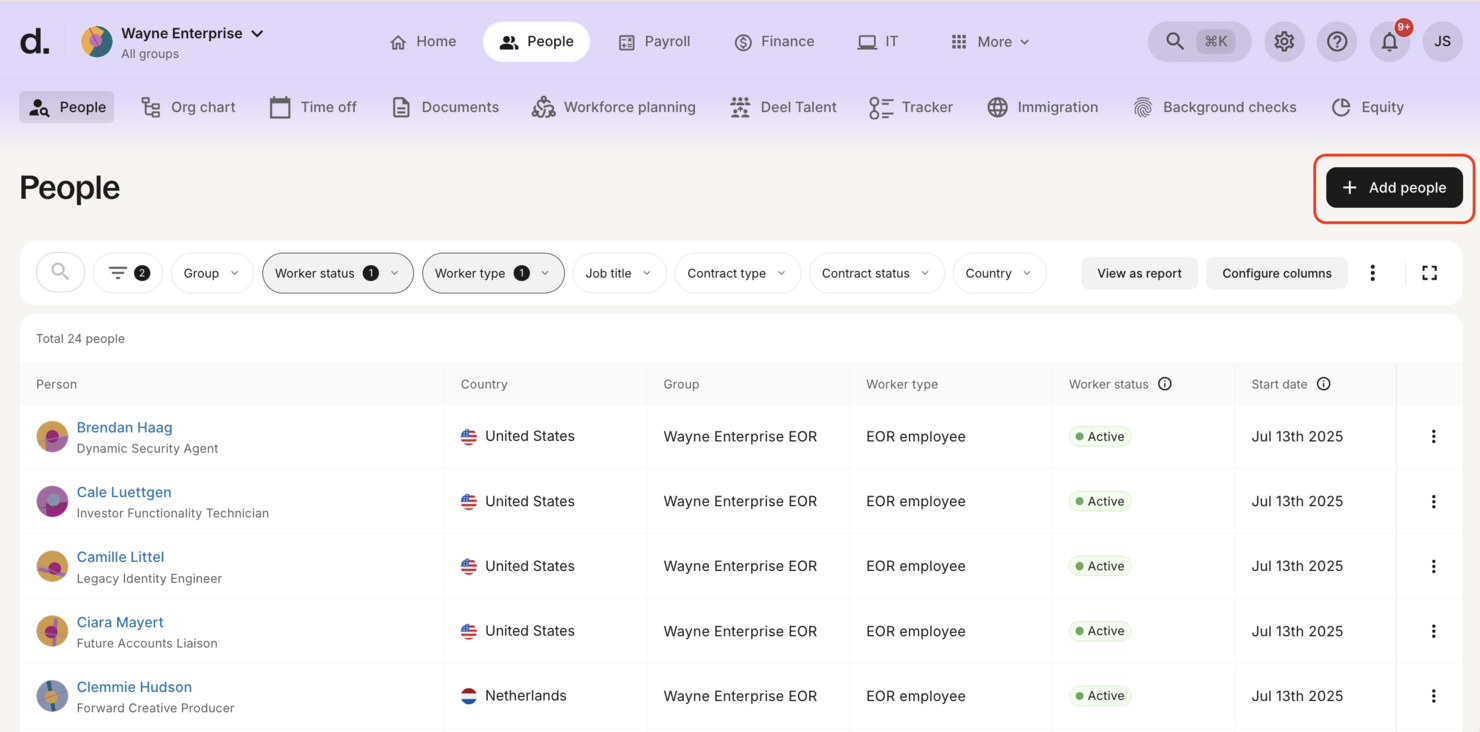
Deel Hire is an employer of record platform that covers hiring, onboarding, payroll, tax filings, benefits, and compliance across 150+ countries—all from a single platform.
Who Is Deel Hire Best For?
Deel Hire is a strong fit for globally distributed companies that need to hire and pay employees across multiple countries without setting up local entities.
Why I Picked Deel Hire
I've included Deel Hire in my top picks because it's one of the few EOR platforms that builds locally compliant employment contracts directly into its onboarding flow—so when you hire in Chile, your contract reflects Chilean labor code requirements from day one, not as an afterthought. I also like that Deel Hire handles Chilean payroll tax filings and statutory benefit contributions inside the same platform where you manage contracts and time off. That means my team isn't toggling between systems or chasing a local partner to confirm whether AFP and health insurance deductions were filed correctly.
Deel Hire Key Features
- Global HRIS: Store and manage employee records, documents, and org data for your entire workforce in one place.
- Expense management: Employees submit expenses directly in Deel, and you approve and reimburse in local currency.
- Offboarding management: Manage terminations with country-specific severance calculations and document handling.
- Background checks: Run pre-employment background checks on new hires without leaving the Deel platform.
Deel Hire Integrations
Deel offers integrations through its App Store across HR, accounting, and payroll categories, including BambooHR, Workday, NetSuite, QuickBooks, Xero, Expensify, SAP, and Hubstaff. It's available on Zapier and has an API for custom integrations with your HRIS, finance, and ERP systems.
Pros and Cons
Pros:
- Auto-generates country-specific employment contracts
- Contractor-to-employee conversion in one platform
- Owns local entities in 150+ countries
Cons:
- Per-employee costs add up for startups
- Support response slows during payroll periods

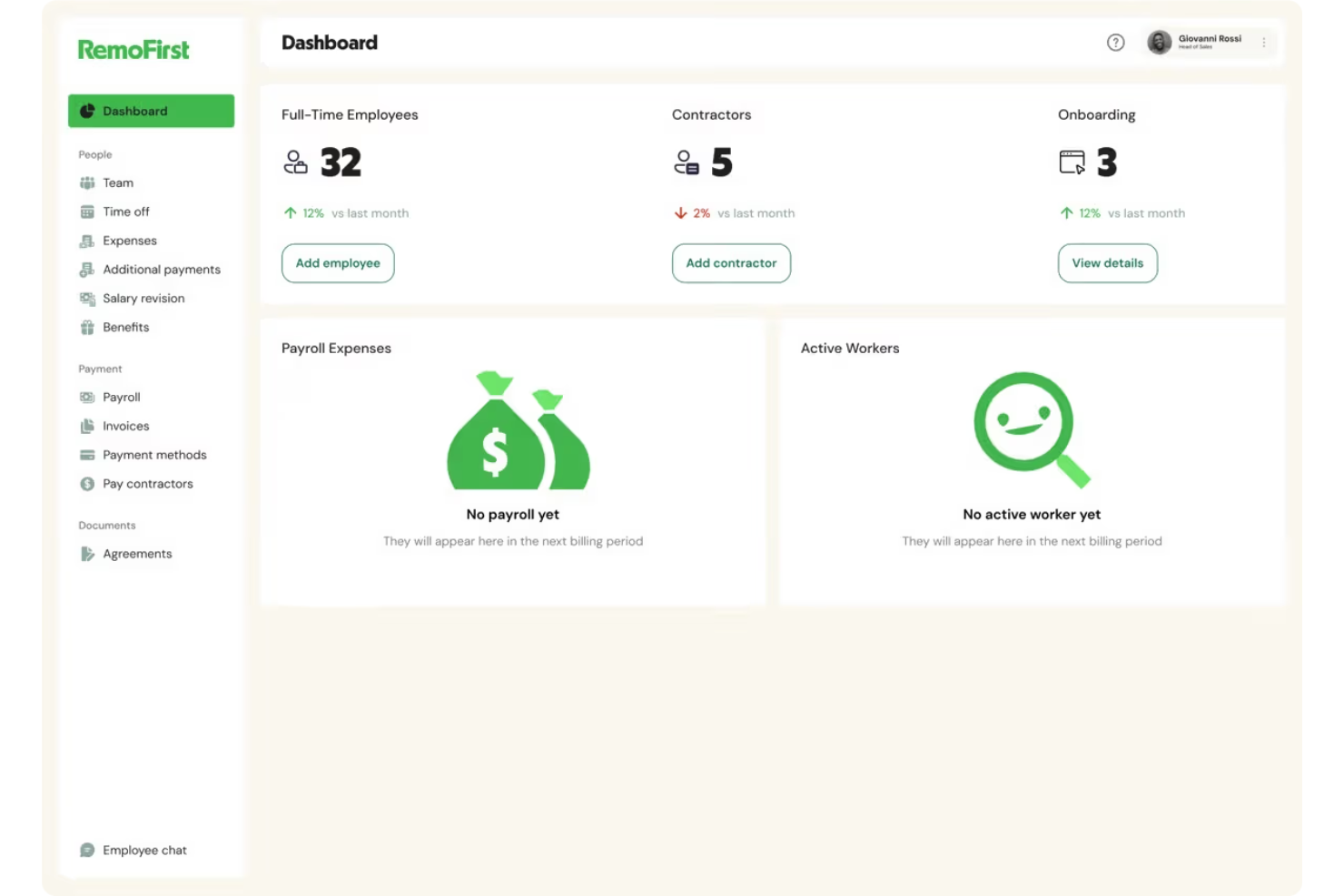
RemoFirst is an EOR platform that handles employment contracts, payroll, benefits, and compliance for full-time employees and contractors across 180+ countries, including Chile.
Who Is RemoFirst Best For?
RemoFirst is a natural fit for startups and small businesses hiring their first remote employees in Chile or other international markets.
Why I Picked RemoFirst
I picked RemoFirst as one of the best because its flat $199/employee/month pricing with no minimum headcount or long-term contracts makes it one of the most accessible EOR options for teams expanding into Chile on a tight budget. I also like that it aggregates your entire global team's payroll into a single invoice, so you're not managing separate payments per country. On top of that, RemoFirst's local partner model means Chilean labor law expertise is built into how compliance is handled, not bolted on.
RemoFirst Key Features
- RemoHealth: Offer Chilean employees private health insurance or localized health plans through RemoFirst's built-in global health coverage network.
- Visa and work permit support: Manage visa applications and work permits for employees relocating to or from Chile, with support across 85+ countries.
- Equipment provisioning: Order and ship laptops and other work equipment directly to new Chilean hires during the onboarding process.
- Time-off and bonus management: Approve time-off requests, process legally required bonuses like Chile's gratification, and manage benefits directly from the platform dashboard.
RemoFirst Integrations
RemoFirst offers a small set of native integrations, including BambooHR and ADP Workforce Now, with the company actively building new integrations across HR, benefits, payroll, and automation categories. It also includes GoCardless for payroll funding via direct debit. An API is available for custom integrations.
Pros and Cons
Pros:
- No minimum headcount or contract lock-in
- Invoices in six major currencies
- Onboards Chilean employees in one to three days
Cons:
- Per-employee costs add up for startups
- Support response slows during payroll periods
New Product Updates from RemoFirst

RemoFirst Launches BambooHR Integration
RemoFirst has launched a BambooHR integration for enhanced global hiring and HR management. For more details, visit RemoFirst's official site.
 .
.
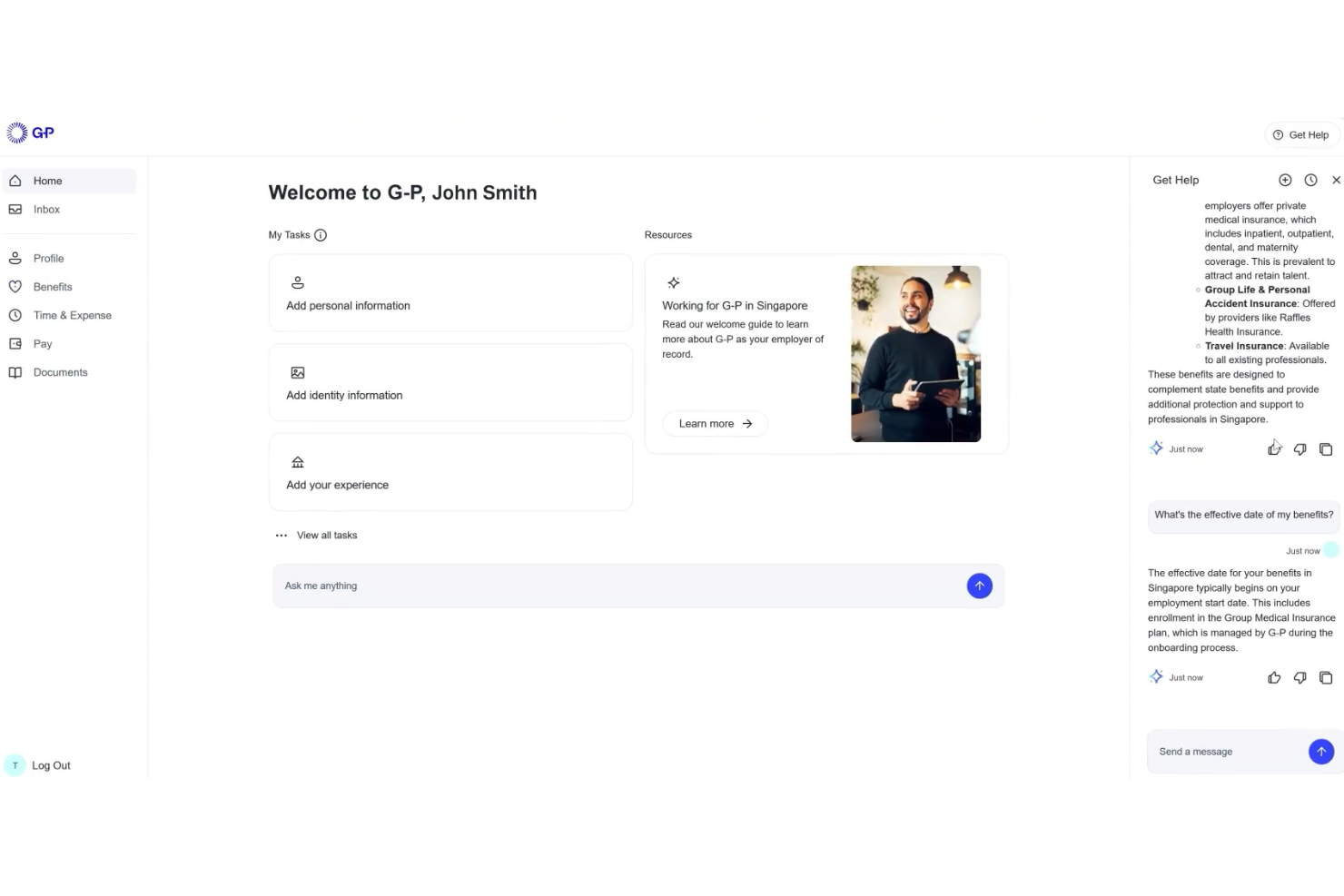
G-P is an EOR platform with AI-powered compliance tools, contract generation, and payroll management across 180+ countries, including Chile, with two tiered packages covering onboarding, benefits, and workforce reporting.
Who Is G-P Best For?
G-P is a strong fit for enterprise HR and legal teams that need AI-assisted contract compliance across multiple countries, including Chile.
Why I Picked G-P
I've included G-P in my top picks because its Global Compliance Engine is genuinely impressive for Chile-specific contract work. It auto-generates locally compliant employment contracts, flags real-time compliance issues, and supports multiple languages, so Spanish-language contracts don't need manual review. I also like G-P Assist, the in-platform AI agent that answers Chile-specific HR and legal questions instantly, cutting the back-and-forth with legal counsel.
G-P Key Features
- Self-serve employee onboarding: Employees complete their own onboarding directly in the platform, including document submission and right-to-work verification.
- Payroll management: Run error-free payroll in 150 currencies, with tools to handle bonuses, commissions, and exceptions without manual workarounds.
- Benefits management: View, configure, and update locally competitive benefits packages for Chilean employees through a self-service interface.
- Reporting and analytics: Build custom workforce reports with pre-set templates or create your own using G-P Assist directly in the dashboard.
G-P Integrations
G-P offers native integrations with ADP TotalSource, ADP Workforce Now, Paylocity, BambooHR, Personio, TriNet, UKG Pro, UKG Ready, Workday, SAP SuccessFactors, HiBob, Microsoft Entra ID, Google Workspace, and Okta / Auth0. An API is available for one-way or bi-directional custom integrations with other platforms in your tech stack.
Pros and Cons
Pros:
- Dedicated account managers in your time zone
- Country-specific compliance resource library included
- Owned entities in 180+ countries
Cons:
- Third-party payroll processing limits direct control
- No built-in performance management tools

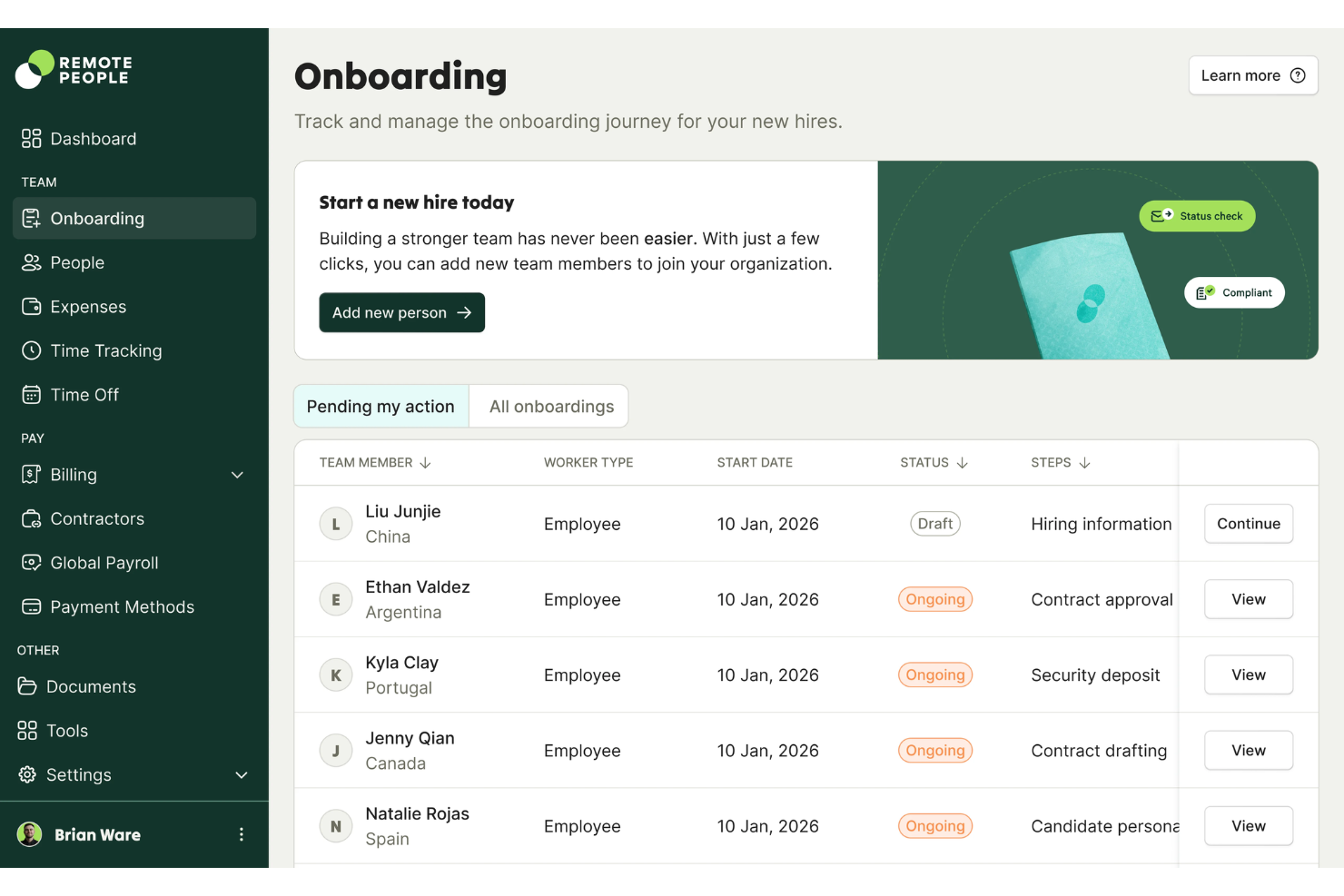
Remote People is an EOR platform that handles employment contracts, payroll, statutory benefits, taxes, and compliance for full-time hires across 150+ countries, including Chile, all through a single dashboard.
Who Is Remote People Best For?
Remote People is a strong fit for growing SMEs that need to hire full-time employees in Chile or other Latin American markets quickly, without tying up capital in large security deposits.
Why I Picked Remote People
Remote People earns its spot on my shortlist because its 48-hour onboarding is backed by a real workflow: candidates receive a digital invite, upload their documents, and sign a locally compliant Chilean employment contract on the same day. I also like that its capped security deposit model sets it apart from most EOR providers, which typically require a full month of payroll upfront. That matters when you're hiring senior roles in Chile, where uncapped deposits can tie up serious cash.
Remote People Key Features
- Equity management: Administer compliant stock options and RSUs for Chilean employees, with local tax filings handled directly through the platform.
- Expense management: Submit, approve, and reimburse employee expenses in a single workflow, with country-specific tax treatment applied automatically.
- Compliance monitoring: Track Chilean labor law updates in real time, with changes pushed to contracts, payslips, and benefits before they take effect.
- Reporting and analytics: Access real-time headcount, cost-of-employment, and compliance dashboards across every country you're hiring in.
Remote People Integrations
Remote People offers 100+ integrations, including Workday, SAP SuccessFactors, BambooHR, HiBob, NetSuite, and QuickBooks. An API is available for custom integrations with your existing tech stack.
Pros and Cons
Pros:
- Line-by-line payroll cost breakdowns per country
- Capped security deposits for higher-salary roles
- Built-in recruiting services most EORs lack
Cons:
- Ambiguous response times reported by some users
- Limited integration ecosystem versus mature competitors
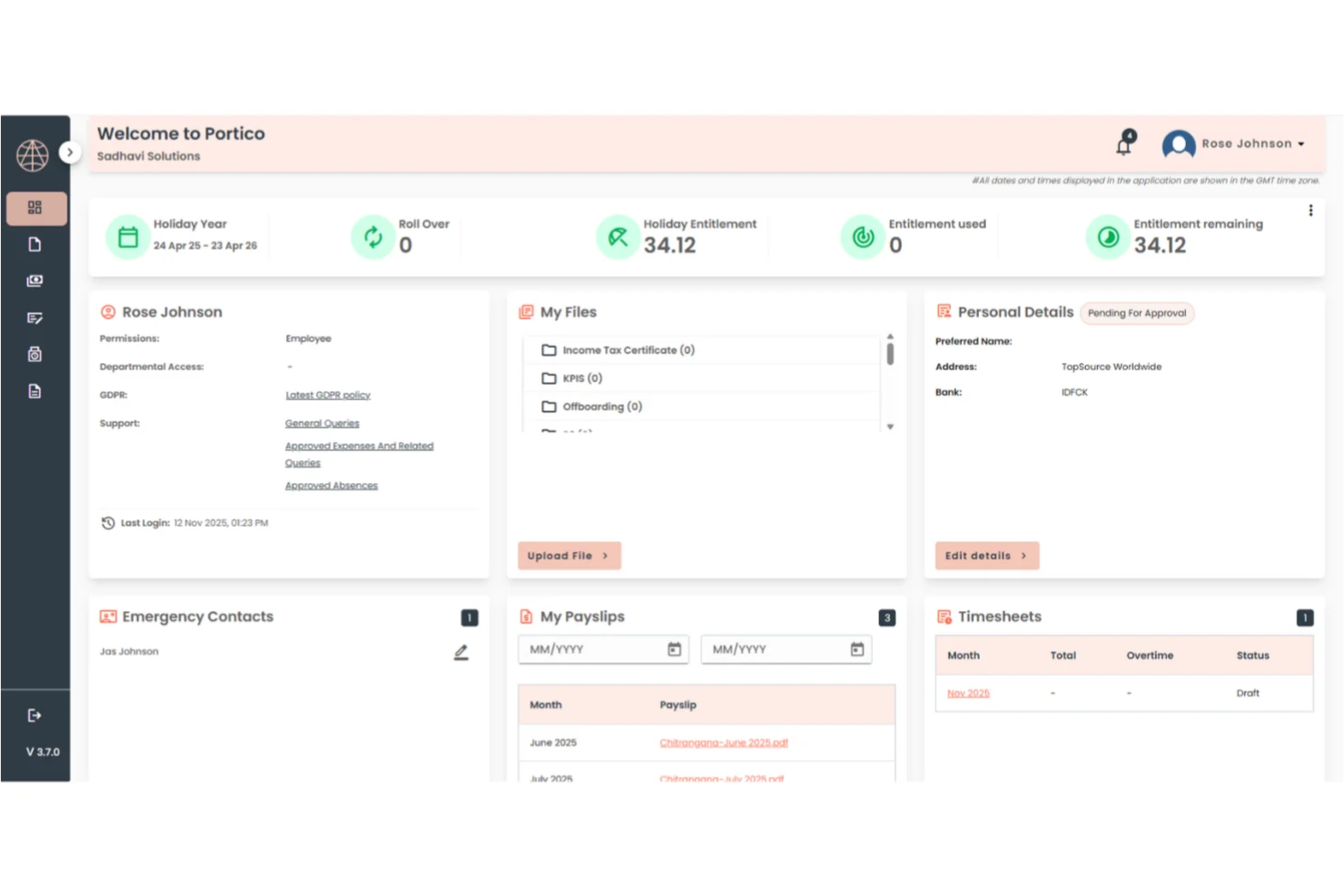
TopSource is an employer of record and global payroll platform that covers hiring, payroll processing, benefits administration, compliance management, and employee onboarding across 180 countries.
Who Is TopSource Best For?
TopSource is a strong fit for small to mid-sized businesses making their first international hires and needing hands-on guidance through local employment laws and payroll compliance.
Why I Picked TopSource
TopSource earns its spot on my shortlist because of something surprisingly rare among EOR providers: real 24/5 phone access to in-country experts, not a generic help desk. When a Chilean payroll question comes up mid-cycle, I can reach a regional specialist directly by phone to resolve it fast. I also like that every account gets a dedicated success manager who runs quarterly audits of your global talent strategy, so compliance gaps in Chile get caught proactively rather than reactively.
TopSource Key Features
- Customizable employment contracts: Draft and adjust Chilean employment contracts with tailored notice periods, probation terms, and IP clauses while staying compliant with local labor law.
- Bespoke benefits configuration: Build locally relevant benefits packages for Chilean hires, including health insurance, pension plans, wellness perks, and paid leave, with input from in-country specialists.
- Global employment dashboard: Manage all Chilean and international employees from a single platform, with visibility into payroll, onboarding status, and compliance across your full workforce.
- Salary benchmarking data: Access current compensation data for Chilean roles to set competitive pay and inform hiring decisions before you make an offer.
TopSource Integrations
TopSource offers HRIS integrations with Workday, SAP SuccessFactors, UKG, BambooHR, HiBob, Personio, and Keka, plus ATS integrations with Greenhouse, Lever, Workable, SmartRecruiters, Ashby, Teamtailor, and JazzHR. An API is available for custom integrations, and a dedicated integration specialist team supports setup and configuration.
Pros and Cons
Pros:
- Dedicated customer success manager per account
- Applies country-level tax rules inside payroll workflows
- Owns its own payment processing platform
Cons:
- Invoice line items sometimes need manual verification
- Relies on in-country partners, not owned entities
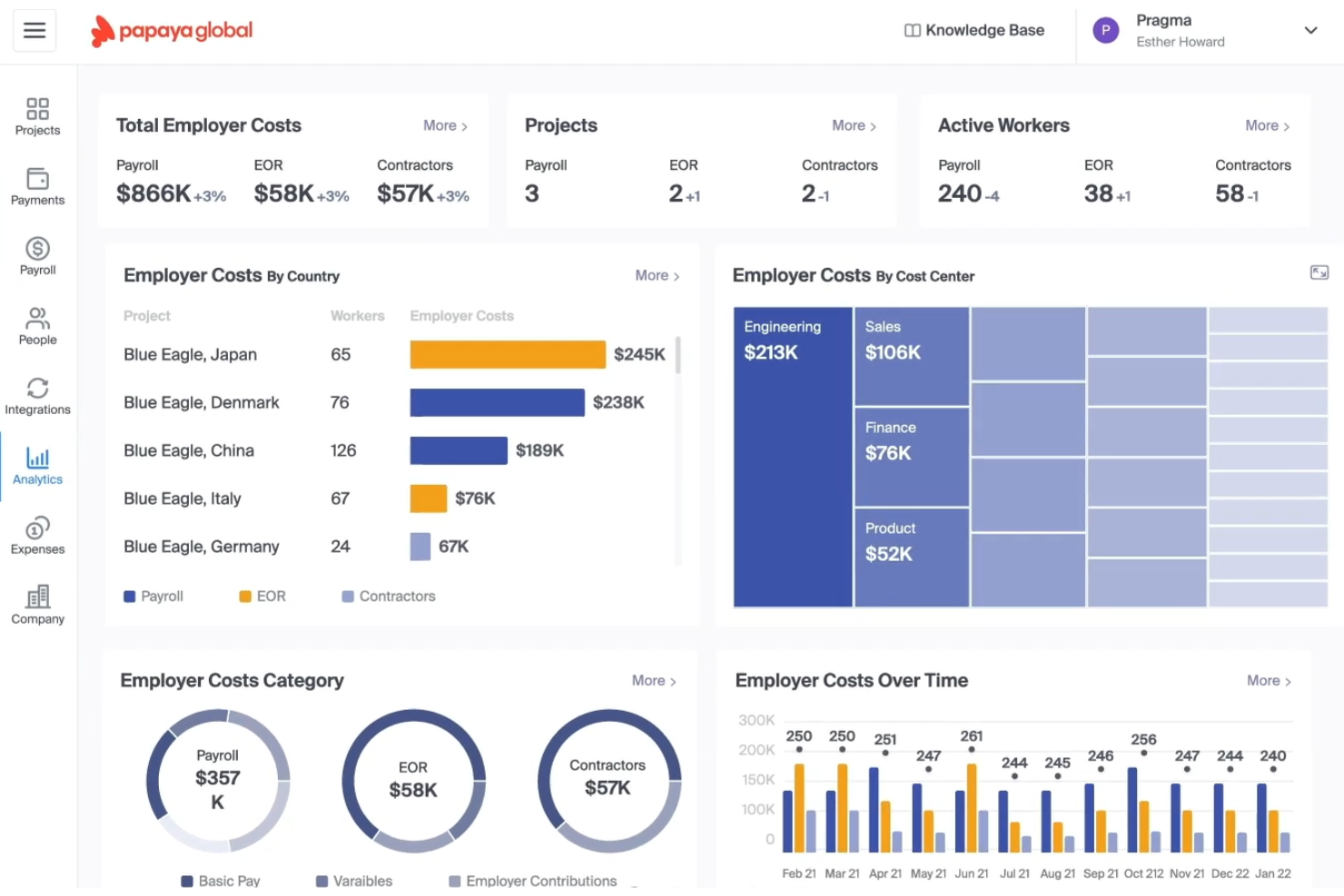
Papaya Global is an EOR and global workforce management platform that handles payroll processing, worker classification, local compliance, and benefits administration across 160+ countries, including Chile.
Who Is Papaya Global Best For?
Papaya Global is a strong fit for mid-market and enterprise HR teams managing payroll across multiple countries simultaneously.
Why I Picked Papaya Global
I've included Papaya Global in my top picks because its AI-backed payroll automation goes well beyond basic calculations. Its AI-powered validation agent checks every payroll run against local compliance rules in 160+ countries, reaching 99.7% data accuracy by flagging anomalies like duplicate payments or misclassified workers before money moves. I also like the AI Data Cloud Connectors, which pull HR and finance data from existing systems automatically and cut implementation down to four weeks. For a Chilean hire, that means your first payroll cycle runs on validated, locally compliant data without months of manual setup.
Papaya Global Key Features
- Global benefits administration: Set up and manage health plans and statutory benefits for Chilean employees directly within the platform, without sourcing third-party providers.
- Employee mobile app: Give Chilean hires a self-serve portal to access payslips, update personal details, and check payment status from their phone or browser.
- Mass onboarding support: Use bulk imports, templates, and country-specific guardrails to onboard large groups of Chilean employees in a single workflow.
- Workforce analytics: Access real-time headcount, payroll spend, and compliance status across all countries, including Chile, in one centralized dashboard.
Papaya Global Integrations
Papaya Global offers cloud connectors with SAP SuccessFactors, Oracle HCM, NetSuite, Workday HCM, BambooHR, SAP Fieldglass, SAP On-Prem, Namely, HiBob, PrismHR, Personio, Expensify, Replicon, UKG, Sage, and Beeline, among others. An API is available for custom integrations.
Pros and Cons
Pros:
- Dedicated customer success manager per account
- Applies country-level tax rules inside payroll workflows
- Owns its own payment processing platform
Cons:
- Invoice line items sometimes need manual verification
- Relies on in-country partners, not owned entities

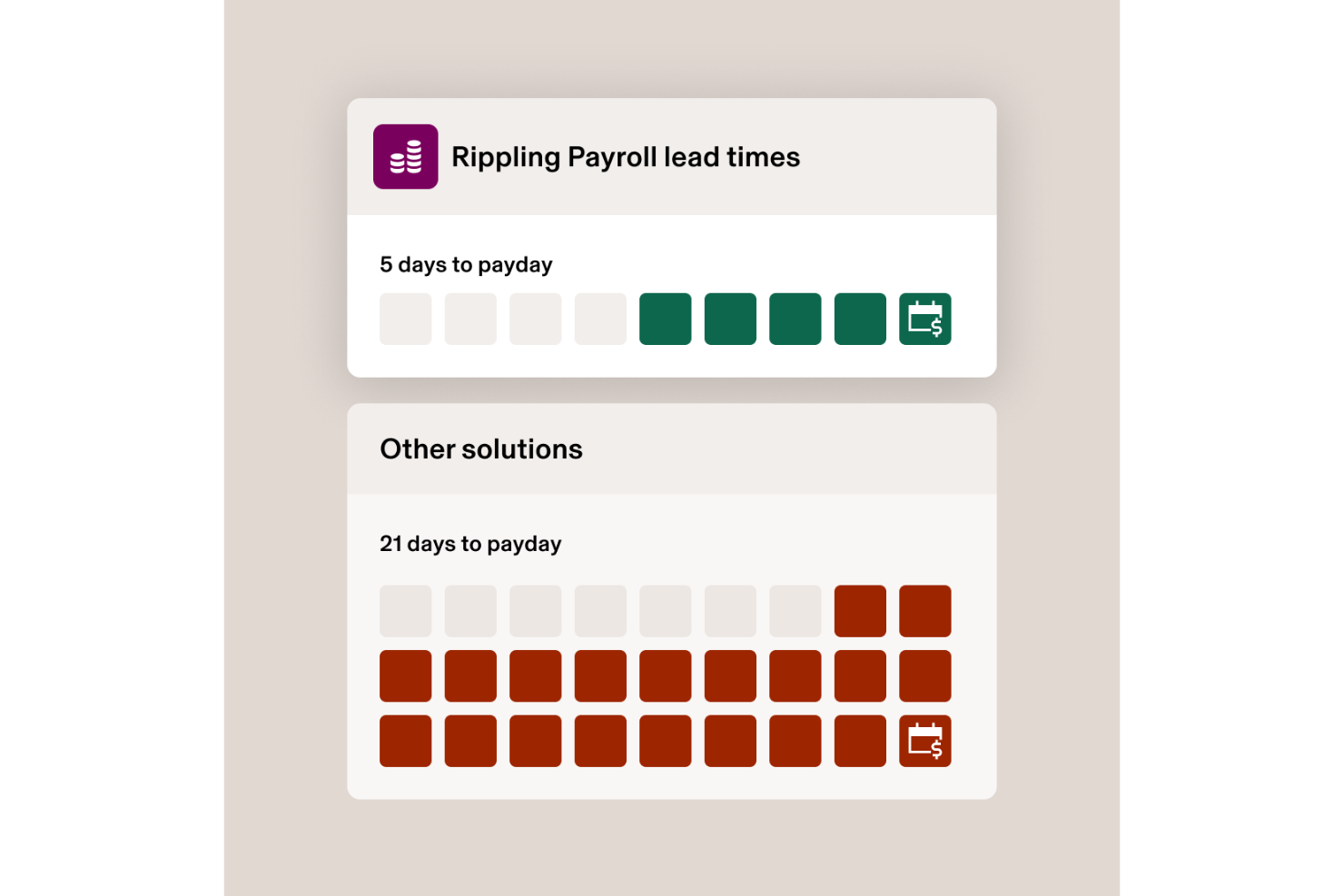
Rippling is a global employer of record platform that combines local employment contracts, payroll processing, tax compliance, benefits administration, and IT provisioning into a single workforce management system.
Who Is Rippling Best For?
Rippling is a strong fit for mid-sized to enterprise companies hiring remote employees or contractors in Chile who want HR, payroll, and IT managed in one place.
Why I Picked Rippling
Rippling is one of my top picks because I love that hiring someone in Chile through the EOR triggers a single automated workflow that covers employment contracts, Chilean payroll, and IT provisioning simultaneously. Most EOR tools stop at HR—Rippling also handles device management and app access, so a new hire in Santiago gets their laptop shipped and software accounts activated as part of the same onboarding flow. I find Workflow Studio especially useful for building these cross-functional automations without any code.
Rippling Key Features
- Local compliance monitoring: Rippling tracks Chilean labor law changes and automatically updates payroll calculations and employment terms.
- Benefits administration: Enroll Chilean employees in locally relevant health and retirement benefits directly within the platform.
- Expense management: Employees submit expenses in CLP and receive reimbursements in local currency without leaving the platform.
- Workforce analytics: Access real-time headcount, payroll spend, and HR data across your Chilean workforce from a centralized dashboard.
Rippling Integrations
Rippling offers 650+ integrations through its App Shop, including QuickBooks Online, Xero, NetSuite, and Sage Intacct, as well as Slack and Zendesk, Google Workspace, and Jira. An API access package is available for building custom integrations.
Pros and Cons
Pros:
- Automated onboarding triggers across connected modules
- Unified dashboard for local and EOR employees
- Built-in IT device provisioning for remote hires
Cons:
- Customer support limited to business hours
- EOR pricing is not publicly listed
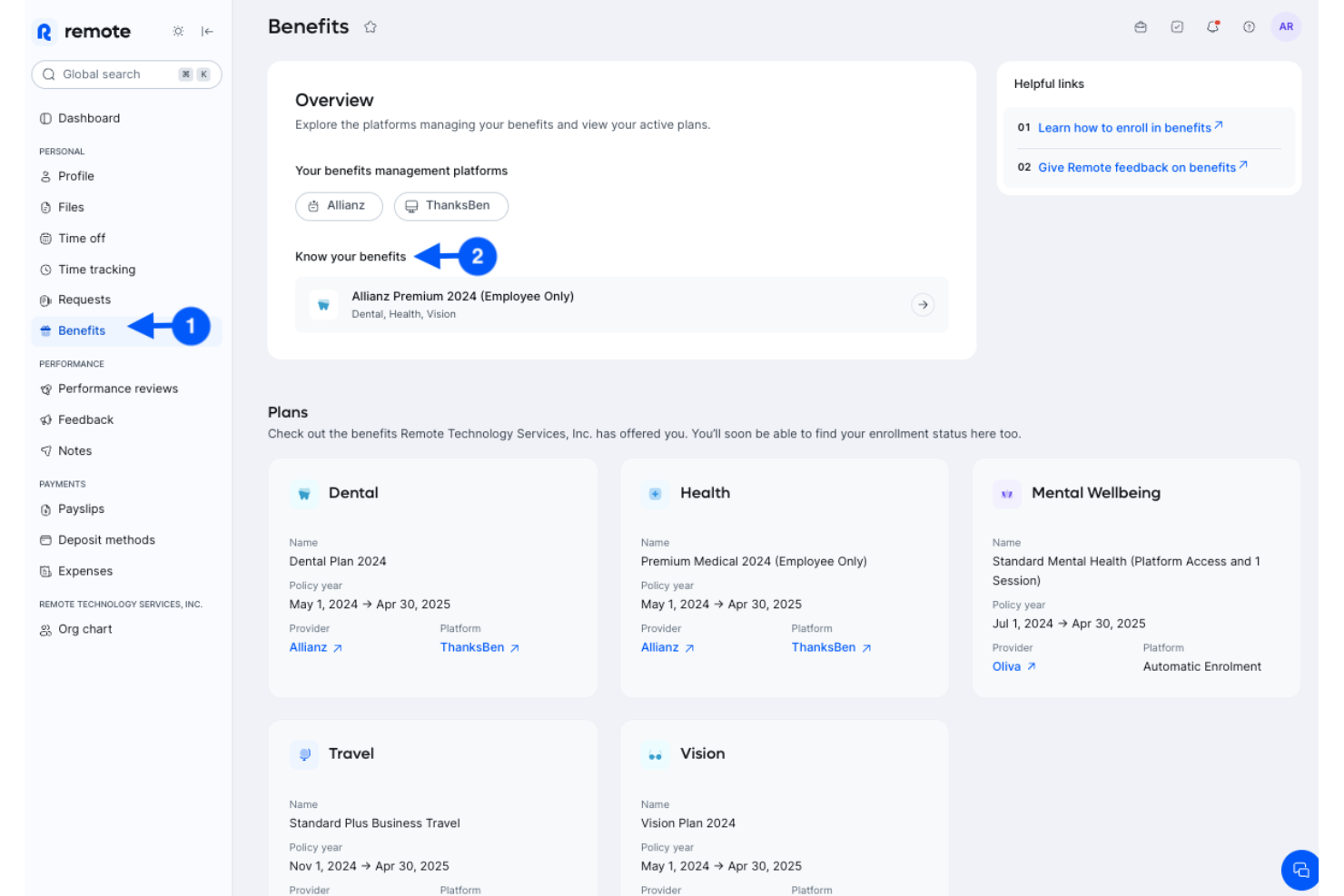
Remote is a global EOR platform that handles payroll processing, tax compliance, benefits administration, contractor management, and equity management for international employees, including those based in Chile.
Who Is Remote Best For?
Remote is a strong fit for fast-scaling tech companies hiring across Latin America who need a locally compliant employment structure in Chile without setting up a legal entity.
Why I Picked Remote
Remote is one of my top picks because of how deliberately it builds out its Chile-specific benefits offering. Most EOR providers give you a static benefits package, but Remote's Chile page documents exactly what's in the bundle: health, dental, vision, mental health, pension, and life and disability insurance. I also like that Remote doesn't mark up benefits premiums or administration costs, which means your Chilean hire gets the full value of the package without inflated overhead baked in.
Remote Key Features
- IP guard: Remote's two-step IP transfer process ensures you retain full ownership of invention rights from Chilean employees, with a traceable chain of transfers.
- Equity and stock options support: Remote provides country-specific tax guidance for offering stock options and equity plans to Chilean hires.
- Contractor-to-employee conversion: Switch Chilean contractors to full-time EOR employees directly within the platform, with localized contracts already in place.
- Built-in background checks: Run background checks on Chilean candidates during the onboarding flow without leaving the Remote platform.
Remote Integrations
Remote offers native integrations with BambooHR, Workday, HiBob, Personio, Greenhouse, QuickBooks, Xero, NetSuite, Slack, and Vanta, among others. It also connects with Zapier and provides an API for custom integrations.
Pros and Cons
Pros:
- No markup on benefits administration costs
- Customizable benefits beyond statutory minimums
- Owns legal entities directly in Chile
Cons:
- Limited onboarding status visibility for employers
- Slower reimbursement and off-cycle payment processing

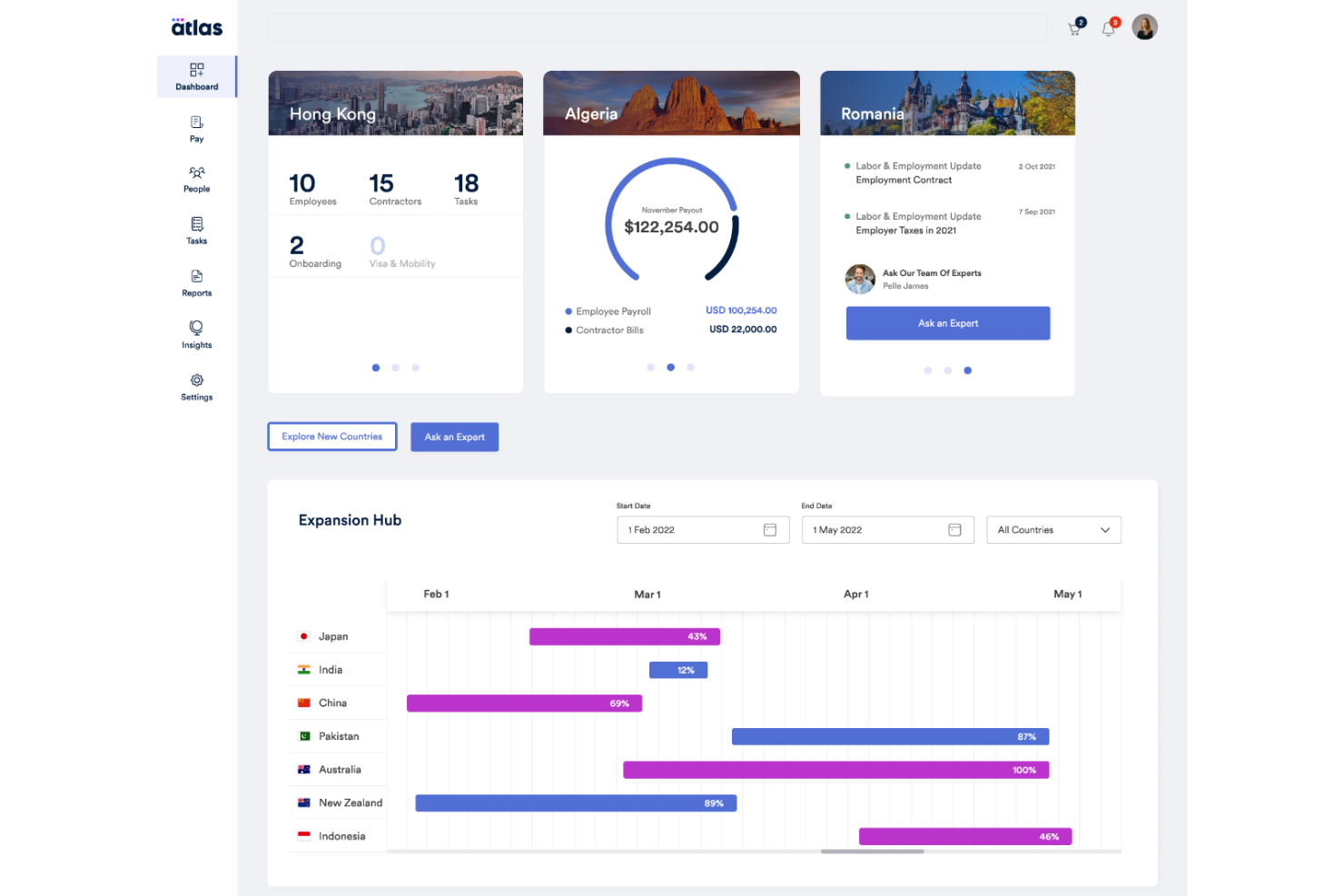
Atlas HXM is a direct EOR platform that handles employment compliance, payroll, benefits, and workforce expansion into Chile without requiring you to set up a local entity.
Who Is Atlas HXM Best For?
Atlas HXM is a strong fit for finance, private equity, and life science companies that need detailed workforce cost modeling before committing to hiring in Chile.
Why I Picked Atlas HXM
I picked Atlas HXM as one of the best because of how seriously it approaches pre-hire cost transparency for Chile. Its Global Employee Cost Calculator lets you input a gross salary, select Chile as the country, and get a full breakdown of mandatory employer costs—including pension contributions and statutory add-ons—before you've hired anyone. You can also run side-by-side country comparisons, which is genuinely useful if you're deciding between Chile and another market. That level of pre-decision financial visibility is something most EOR platforms don't offer directly within the platform.
Atlas HXM Key Features
- Global Compliance Risk Calculator: Run a free assessment of your exposure to misclassification and false employment risks across Chile and other markets.
- AI-powered payroll reporting: Generate quarterly and annual payroll reports with headcount, gross wages, and allowances, with AI analysis flagging upcoming workforce cost changes.
- Global Salary Calculator: Pull current salary benchmarks for Chilean roles to build competitive, market-aligned compensation offers.
- Contractor-to-employee conversion support: Transition Chilean contractors to full-time EOR employees with Atlas managing reclassification, contract updates, and compliance throughout.
Atlas HXM Integrations
Atlas HXM offers a smaller set of native integrations, including BambooHR, Workday, and SAP SuccessFactors. An API is available for custom integrations, but the pre-built connector library is narrower than competitors like Deel or Rippling.
Pros and Cons
Pros:
- Visa sponsorship coverage in 100 countries
- Real-time salary and employment cost benchmarks
- Direct EOR model with owned Chile entity
Cons:
- Multiple contacts for different service areas
- No standalone payroll for existing entities
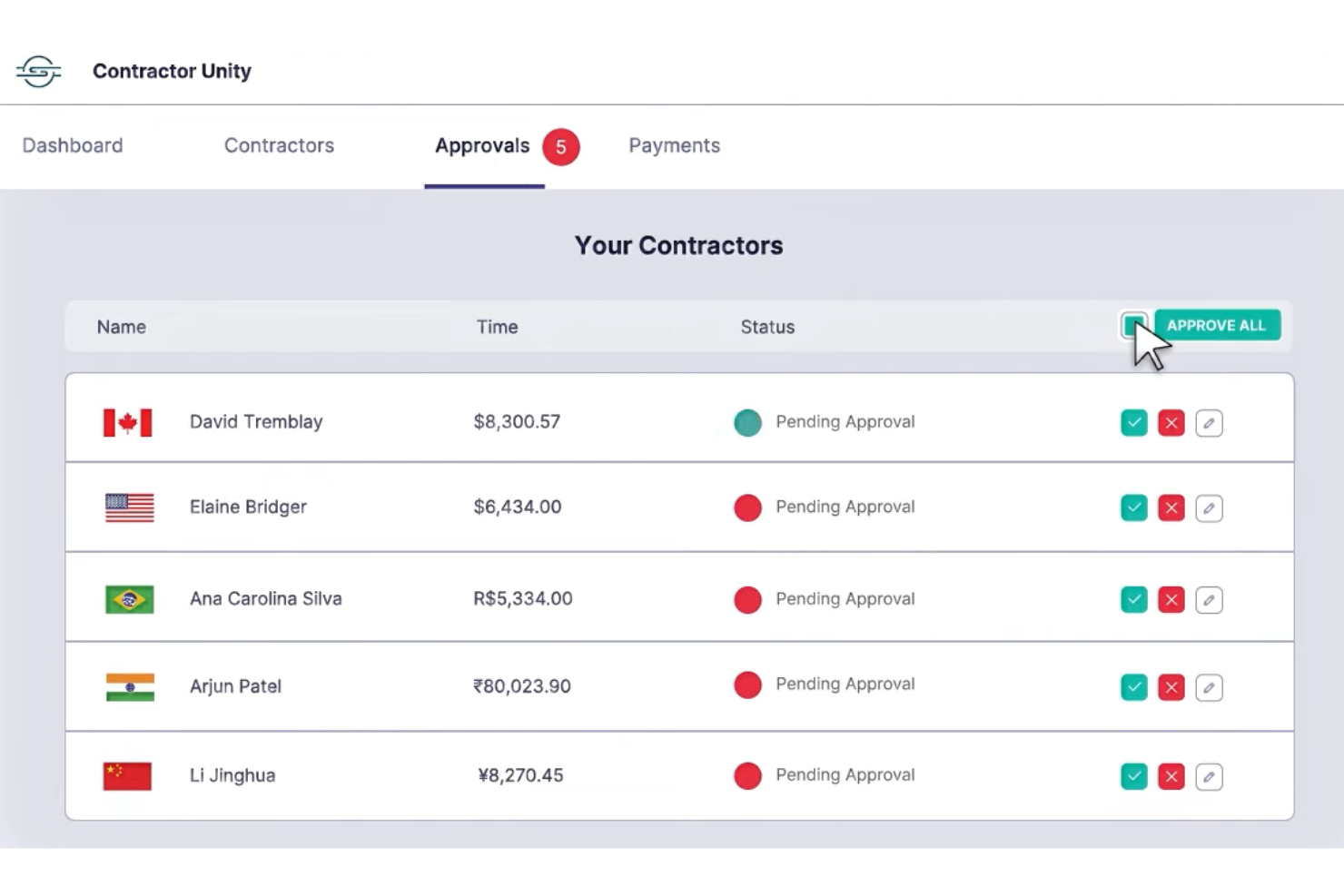
SafeGuard Global is an EOR and global workforce platform that covers payroll, HR, contractor management, entity setup, and compliance across 187 countries, backed by in-country local experts.
Who Is SafeGuard Best For?
SafeGuard is a strong fit for mid-to-large enterprises hiring across multiple regions who need on-the-ground HR guidance rather than a self-serve platform.
Why I Picked SafeGuard
SafeGuard earns its spot as one of the best on my shortlist because of the depth of its in-country HR support model. When you hire in Chile, you get a dedicated local HR contact who lives and works in-country, speaks the language, and knows Chilean labor law from the ground up. I find this especially valuable when navigating Chile-specific situations like termination requirements or statutory benefits disputes, where a centralized, self-serve platform simply can't give you the guidance you need. The HR & Benefits add-on also lets you embed local HR professionals directly into your day-to-day operations.
SafeGuard Key Features
- Country-specific onboarding forms: Generate and manage Chile-specific employment contracts and onboarding paperwork directly in the platform, with instant contract previews before submission.
- Spend analytics dashboard: View real-time labor cost data for your Chilean workforce by country, currency, and contract type, including payroll tax amounts and turnover rate.
- Worker classification tool: Run a guided assessment to determine whether a Chilean worker should be classified as an independent contractor or an EOR employee before you hire.
- Global recruitment: Source and place permanent, temporary, and fractional talent in Chile through SafeGuard's in-country recruiter network, then transition them directly into EOR employment.
SafeGuard Integrations
SafeGuard has held a certified Workday integration since 2010, the longest-standing HRIS connector in the EOR category, and the Global Unity platform also supports SAP SuccessFactors and other enterprise HRIS connections. SafeGuard's embedded partnership program lets HR tech providers and PEOs fully integrate the EOR solution into their workforce management ecosystem. An API is available for custom integrations, but the pre-built connector library is narrower than competitors like Deel or Remote.
Pros and Cons
Pros:
- 17 years of cross-border compliance history
- Contractor-to-employee conversion built in
- 400+ in-country HR experts worldwide
Cons:
- Onboarding timelines slower than newer competitors
- Platform interface feels dated and enterprise-heavy
Other Chilean Employer of Record Services
Here are some additional EOR service providers in Chile that didn’t make it into my shortlist but are still worth checking out:
- Skuad
For employer success support
- Multiplier
For multilingual support and service offerings
- Borderless AI
For AI-driven payroll in 5 days
- Oyster HR
For remote hiring and compliance in 180+ countries
- Justworks
For PEO and EOR services with payroll and compliance
- NNRoad
For employment outsourcing and HR services worldwide
- Bradford Jacobs
For customized EOR and global expansion support
- Boundless
For statutory compliance and local benefits
- Rivermate
For fast onboarding
- Express Global Employment
For scalable solutions


Selection Criteria for Employer of Record Chile
Uncovering the best EOR services for this list required a deep understanding of how these services can alleviate common challenges, such as legally hiring employees abroad, managing international payments, ensuring compliance with local labor laws, providing competitive benefits, and facilitating smooth onboarding.
I also used the following framework to keep my evaluation structured and fair:
Core EOR Services (25% of total score):
To be considered for inclusion in this list, each EOR provider had to offer these basic services:
- Handling payroll and taxes
- Managing compliance with local laws
- Providing employee benefits
- Supporting visa and work permits
- Facilitating onboarding processes
Additional Standout Services (25% of total score):
To help further narrow down the competition, I also looked for unique or especially valuable services, such as:
- Offering multilingual support
- Providing global expansion insights
- Managing contractor conversions
- Delivering data security solutions
- Customizing employee benefits packages for the Chilean market
Industry Experience (10% of total score):
To get a sense of the industry experience of each provider, I considered the following:
- Years of operation in the industry
- Number of countries served
- Expertise in specific sectors
- Client testimonials and case studies
- Presence of industry certifications
Customer Onboarding (10% of total score):
To evaluate the customer onboarding experience for each provider, I considered the following:
- Speed of the onboarding process
- Clarity of onboarding instructions
- Availability of onboarding support
- User-friendliness of the platform
- Flexibility to adapt to unique needs
Customer Support (10% of total score):
To assess the level of customer support each provider offers, I considered the following:
- Availability of 24/7 support
- Response time to inquiries
- Access to dedicated account managers
- Quality of technical support
- Multilingual customer service options
Value for Price (10% of total score):
To evaluate the pricing and potential ROI of working with each provider, I considered the following:
- Transparency of pricing structure
- Comparison with industry averages
- Inclusion of additional services
- Flexibility of pricing plans
- Evidence of cost savings for clients
Customer Reviews (10% of total score):
To get a sense of the overall satisfaction of existing customers, I considered the following when reading customer reviews:
- Frequency of positive feedback
- Common themes in negative reviews
- Specific mentions of service quality
- Reports of successful problem resolution
- Overall ratings and recommendations
How to Choose an Employer of Record in Chile
It’s easy to get bogged down in long lists of services and complex pricing structures. To help you prioritize the things that matter most for your business, keep the following factors in mind:
| Factor | What to Consider |
|---|---|
| Business Objectives | Align the provider's services with your strategic goals. Ensure they can support your expansion plans and specific industry needs. |
| Service Scope and SLAs | Review the range of services and service level agreements. Ensure they cover all necessary aspects, such as payroll, compliance, and benefits. |
| Support Availability | Check if they offer 24/7 support and dedicated account managers. This is crucial for resolving issues quickly, especially across different time zones. |
| Costs and Pricing Structure | Look for transparent pricing and compare it to industry averages. Consider any hidden fees and ensure they fit within your budget. |
| Communication and Reporting | Evaluate how they communicate updates and provide reports. Regular, clear communication is essential for staying informed on compliance and payroll matters. |
| Compliance Expertise | Ensure they have strong knowledge of local labor laws. This is critical to avoid legal issues and penalties. |
| Technology Integration | Consider how well their platform integrates with your existing HR systems. This can save time and reduce errors in managing your workforce. |
| Reputation and Reviews | Look at customer reviews and testimonials to gauge satisfaction. Positive feedback and high ratings can indicate reliable service. |
What is an Employer of Record in Chile?
An Employer of Record (EOR) in Chile is a third-party provider that legally employs workers in Chile on behalf of a foreign company. While your business directs the employees’ day-to-day work and projects, the EOR takes on all formal employment responsibilities as the legal employer. This includes processing payroll, withholding and submitting taxes, handling social security contributions, drafting compliant contracts, and ensuring adherence to local labor laws.
Using an EOR service in Chile is useful for businesses that want to hire Chilean talent without opening a local branch or navigating legal red tape. It removes the need to register a Chilean entity, helps reduce compliance risks, and gives your team a faster way to get started in the Chilean market.
Why Use an Employer of Record Service in Chile?
The Chilean market is highly regulated, and the transition to a 42-hour work week in 2026 has made manual payroll a compliance nightmare for foreign firms.
- Managing the "40-Hour" Transition: Chile is currently in a phased reduction of the work week (from 45 to 40 hours). In April 2026, the limit dropped to 42 hours. An EOR ensures your contracts and overtime calculations are automatically adjusted to this new legal ceiling.
- Gratificación Legal (Profit Sharing): Unlike many countries where bonuses are discretionary, Chile mandates "Gratificación." Most companies choose the "Article 50" model (25% of gross salary). An EOR handles the math and caps this correctly, preventing you from overpaying or falling into a legal dispute.
- Swift Onboarding: Setting up a Sociedad por Acciones (SpA) in Chile involves multiple notarial steps and a tax ID (RUT) process that can take 3–5 months. An EOR bypasses this, allowing you to hire a "Santiaguino" developer in 5–10 days.
Deciding Between an EOR and a Legal Entity in Chile
Chile is a "paperwork-heavy" jurisdiction. Unless you plan to hire 20 or more people or engage in local retail/physical operations, the EOR is the standard choice.
Comparison Table: Chile Market Entry (2026)
| Criteria | Employer of Record (EOR) | Local Legal Entity (SpA / SRL) |
|---|---|---|
| Setup Time | 5–10 Business Days | 3–5 Months |
| Entity Setup Cost | None | $2,500 – $5,000 USD (Legal/Notary) |
| Ongoing Admin | Zero (Managed by EOR) | High (Monthly IVA, F29, and Annual F22) |
| Work Week (2026) | Automated (42-hour limit) | You must manage the reduction manually |
| Labor Liability | Shifted to the EOR | Fully Yours (Strict labor courts) |
| Best For | 1–20 employees; Tech/SaaS | Large hubs; Permanent local operations |
EOR vs. Permanent Establishment in Chile
Chile’s Internal Revenue Service (SII) is sophisticated and digitizes nearly all tax reporting. If your Chilean team is performing core business activities—like negotiating local contracts or closing sales—you risk triggering Permanent Establishment (PE).
How EORs Protect From Permanent Establishment Risk
- Contractual Buffer: The employment contract is between the EOR's Chilean entity and the worker. This prevents your foreign headquarters from appearing as an "unregistered branch."
- Tax Compliance: The EOR remits the 27% Corporate Income Tax (where applicable) and local payroll taxes (AFP/Health) directly to the SII, satisfying local revenue requirements without your entity needing a Chilean tax ID.
- Local "Agent" Strategy: Because the EOR is the domestic "legal employer," the foreign company is viewed as a client of a local service provider, rather than a foreign entity operating directly in Chile.
Hiring in Chile: Important Details
Here are some key details to note if this is your first time hiring staff located in Chile. Your EOR provider will manage these compliance details on your behalf. However, proactively informing yourself of these details is always recommended before you invest your resources into sourcing staff based in Chile.
In Chile:
- Employment laws are primarily established by the Chilean Labor Code (Código del Trabajo), with oversight and enforcement by the Labor Directorate (Dirección del Trabajo).
- Employers can engage workers under various contractual arrangements, including full-time, part-time, temporary, seasonal, and independent contractor agreements.
- Mandatory payroll deductions in Chile include several employment and social security contributions, such as:
- Pension Fund Contributions (Administradoras de Fondos de Pensiones or AFP)
- Health Insurance Contributions (Instituciones de Salud Previsional or ISAPRE for private insurers, or FONASA for the public system)
- Unemployment Insurance (Seguro de Cesantía)
- Workplace Accident Insurance (Seguro de Accidentes del Trabajo y Enfermedades Profesionales)
- Spanish is the official language in Chile. However, indigenous languages such as Mapudungun and Aymara are also spoken in certain regions.
- The standard working week in Chile:
- Now limited to a maximum of 42 hours (down from 44 in 2025 and 45 in 2024). This will continue to be reduced until it reaches 40 hours in 2028.
- Work days must be distributed over no fewer than five and no more than six consecutive days. The workday should not exceed 10 hours, and employees are entitled to at least one 24-hour rest period during the workweek.
- Overtime in Chile is regulated by the Labor Code. Employees may work up to two hours of overtime per day, compensated at a rate of 150% of the regular pay. Overtime agreements must be in writing and are subject to specific conditions outlined in the law.
- In Chile, employees are typically paid on a monthly basis. The country does not have a statutory 13th or 14th-month salary payment system.
- Paid annual leave in Chile starts at 15 working days for employees who have completed at least one year of continuous service. After ten years of service, an additional day is added for every three years of employment.
- Chile has 14 national public holidays. In addition to national holidays, several regional holidays are observed in specific areas. For example, the Day of the Region of Arica and Parinacota is celebrated on June 7 in that region.
- National public holidays in Chile include:
- New Year's Day (January 1)
- Good Friday (Variable date)
- Holy Saturday (Variable date)
- Labor Day (May 1)
- Navy Day (May 21)
- Saints Peter and Paul (June 29)
- Virgin of Carmen (July 16)
- Assumption of Mary (August 15)
- Independence Day (September 18)
- Army Day (September 19)*
- Columbus Day (October 12)
- Reformation Day (October 31)
- All Saints' Day (November 1)
- Immaculate Conception (December 8)
- Christmas Day (December 25)
- Parental Flexibility: Employees who are parents or caregivers of children under 12 now have the right to request "staggered" start and end times (up to one hour) to better balance childcare.
- Chile offers maternity leave and parental leave. During these leaves, employees receive their regular pay, funded by the social security system.
- Maternity/Parental leave: Mothers are entitled to a total of 24 weeks of leave (6 weeks prenatal and 18 weeks postnatal/parental). The postnatal portion can be shared with the father.
- Paternity leave entitlement is five days, which can be taken consecutively or within the first month after birth.
- Paid sick leave is available in Chile. The first three days are typically unpaid unless the illness exceeds that period. From the fourth day onward, employees receive a sick pay benefit funded by the health insurance system, provided they have a medical certificate.
- The probationary period in Chile is generally two weeks for laborers and up to three months for administrative or professional employees. During this time, either party may terminate the employment without cause.
- The termination terms in Chile are governed by the Labor Code. The required notice period is typically 30 days, but this can vary depending on the circumstances and length of service.
- Severance pay is a statutory benefit for Chilean employees who are dismissed without cause. It is calculated based on years of service and capped at 11 months' salary.
- Additional considerations for Chilean employers:
- Companies with more than 25 employees must ensure that at least 85% of their workforce is of Chilean nationality.
- Electronic Registration: Employers are now required to register all employment contracts and terminations digitally on the Dirección del Trabajo (DT) website within 15 days of signing.
*Note: When September 18 and 19 fall on a weekend, additional bridge days are sometimes granted by law.
Tax Overview for Employers in Chile (2026)
Employer-side contributions in Chile are relatively low, but the 2026 Pension Reform has introduced new phased increases.
| Contribution Branch | Rate (%) | Notes |
|---|---|---|
| Disability & Life (SIS) | ~1.50% | Paid by employer. |
| Accident Insurance (Mutual) | ~0.93% – 3.4% | Varies by industry risk. |
| New Pension Reform (2026) | 1.00% | Phased increase started in 2025/2026. |
| Unemployment Insurance | 2.40% | For indefinite contracts. |
| Total Employer Burden | ~6.5% – 8.5% | Excludes Gratificación Legal. |
Note: Employee Deductions: Unlike most countries, the Pension (10% + AFP fee) and Health (7%) are deducted from the employee's gross, not paid on top by the employer.
Total Cost of Employment in Chile
To budget accurately, you must look at the "Super-Gross" salary, which in Chile is heavily influenced by the mandatory Gratificación Legal.
1. The "Base Gross" vs. The "Chilean Gross"
When you offer an employee $1,500 USD, that is the Base Gross. However, Chilean law requires every employer to share profits with employees. Instead of calculating actual company profits (which is complex), 90% of companies use the Article 50 model:
- The Rule: You must pay an additional 25% of the salary every month as a "Legal Gratification."
- The Cap: This 25% is capped at 4.75 times the Minimum Monthly Wage.
- The Result: Even if you agree on a $1,500 salary, the law says you actually owe the employee $1,500 + ~$240 (the cap). In the eyes of the Chilean government, the "Gross Salary" for this employee is actually $1,740.
2. The "Employer Burden" (Taxes You Pay)
Once the salary is set at $1,740 (Base + Gratification), the employer must pay insurance on top of that. Unlike the employee's pension and health (which come out of their $1,500), these three items come out of your pocket:
- SIS (Disability & Life): ~1.5%.
- Mutual (Accident Insurance): ~0.93% (base rate).
- 2026 Pension Reform: A new 1% mandatory employer contribution that started as part of the 2025/2026 gradual reform.
Total Employer Burden: ~3.43% to 4% of the $1,740.
3. The EOR Management Fee
This is the only part of the "Super-Gross" that isn't a government requirement. This is what you pay the EOR to handle the legal liability, the payroll filing, and the tax reporting. For a single employee, a $450 - $600 USD fee is standard.
| Cost Layer | Amount (USD) | Who gets it? |
|---|---|---|
| Net Pay | ~$1,200.00 | The Employee (Money in bank) |
| Employee Deductions | ~$300.00 | AFP (Pension) & Health Insurance |
| BASE GROSS | $1,500.00 | The "Sticker Price" on the contract |
| Gratificación (Article 50) | ~$240.00 | The Employee (Mandatory legal bonus) |
| Employer Burden (Ins.) | ~$112.50 | The Government / Insurance Funds |
| SUPER-GROSS | $1,852.50 | The Real Cost of the Human |
| EOR Service Fee | $450.00 | The EOR Provider |
| TOTAL MONTHLY BILL | $2,302.50 | Your Total Outflow |
Key Employer of Record Services
When selecting an EOR provider in Chile, keep an eye out for the following key services:
- Payroll management: Ensures employees are paid accurately and on time, handling tax deductions, employer taxes, and local compliance requirements.
- Compliance support: Helps your business adhere to local labor laws and regulations, reducing legal risks.
- Employee benefits: Provides competitive benefits packages tailored to local standards, enhancing employee satisfaction.
- Visa and work permits: Assists with obtaining necessary documentation for international employees, facilitating smooth onboarding.
- Onboarding assistance: Streamlines the process of integrating new employees into your team, ensuring compliance from day one.
- Expense management: Tracks and reimburses employee expenses, maintaining accurate financial records.
- Multilingual support: Offers assistance in multiple languages, improving communication with diverse teams.
- Data security: Protects sensitive employee information, ensuring compliance with data protection laws.
- Technology integration: Ensures the provider’s platform works seamlessly with your existing HR systems, saving time and reducing errors.
- Global expansion insights: Provides guidance on entering new markets, supporting strategic business growth.
AI Features of Employer of Record Services in Chile
AI is still an emerging layer in EOR platforms and is not yet standard across all providers in Chile. Most EOR solutions rely on automation, structured workflows, and local expertise to manage Chilean labor law, payroll, statutory benefits, and compliance requirements.
That said, AI is beginning to support efficiency in managing Chile’s employment and payroll administration. Below are the most relevant capabilities and where they add value:
- Automated contract generation: Uses localized templates aligned with Chilean labor law, sometimes enhanced with AI, to create compliant employment agreements and reduce manual drafting.
- Compliance monitoring support: Tracks updates to labor regulations, tax rules, pension contributions, health insurance requirements, and other statutory obligations.
- Payroll anomaly flagging: Identifies inconsistencies in payroll data, including errors in deductions, contributions, leave balances, or benefit calculations.
- Workflow automation for onboarding: Guides employees through onboarding steps such as document collection, payroll setup, and statutory enrollment requirements.
- Document organization and tagging: Helps manage employment contracts, payslips, compliance records, and employee documentation in a centralized system.
- Workforce reporting and insights: Provides visibility into payroll costs, headcount, hiring activity, and workforce distribution in Chile.
- Chat-based support tools: Offers automated responses to common HR and payroll questions, helping teams navigate Chile-specific employment processes more efficiently.
Benefits of Employer of Record
Partnering with an EOR provider in Chile offers several benefits for your team and your business. Here are a few benefits you can look forward to:
- Quick Market Entry: For organizations aiming to test new markets or hire talent in new countries where they have no legal presence, an EOR offers a swift and efficient solution to initiate operations, saving time and resources.
- Simplified Global Payroll: Using an EOR service simplifies the complex process of managing international payroll, including tax deductions, withholdings, and currency conversions for your employees worldwide.
- Global Compliance & Risk Mitigation: By managing compliance, an EOR service provides expertise in navigating the intricacies of employment laws, tax regulations, and insurance requirements in multiple jurisdictions, helping businesses safeguard their operations against compliance-related risks.
- Enhanced Benefits Negotiation: By leveraging their extensive networks and purchasing power, EORs can negotiate better international insurance rates and secure competitive benefit packages on your behalf, enhancing your ability to attract and retain top talent worldwide.
- Improved Cost Effectiveness: Using an EOR service is a cost-effective way for businesses to enter new markets, compared to the significant costs of establishing a new foreign entity. The latter option involves significant upfront legal fees, plus other costs related to office infrastructure, staffing, and local benefits and insurance coverage.
Understanding the benefits of an EOR service is crucial for strategic planning and operational efficiency. If you’re looking towards international markets for growth opportunities, partnering with an EOR provider offers a streamlined, cost-effective, and compliant pathway to global expansion.
Costs and Pricing Structures of Employer of Record Chile
EOR services in Chile typically follow a per-employee, per-month pricing model, offering scalability and predictability for businesses expanding internationally. The cost of these services can vary based on several factors, including the provider's range of services, the complexity of compliance requirements, and the level of support offered.
In Chile, EOR service fees generally range from $199 to $2,000 per employee per month.
Alternatively, some EOR providers charge 2% to 12% of the employee's annual compensation.
Key factors that can influence the pricing of an EOR service include:
- Custom Requirements: Any specific needs beyond the standard service offering may also contribute to the monthly cost. This may include customized solutions for recruitment, specialized employee onboarding, or unique compliance requirements, all of which can affect pricing.
- Number of Employees: The total number of employees being managed can also impact the cost. In some cases, higher volumes may lead to volume discounts, making per-employee costs more economical.
- Employee Seniority and Role Complexity: The level and nature of the roles being filled can also impact the monthly cost. Senior positions or roles requiring special qualifications may increase the price due to higher benefits and compensation management costs.
- Complex Industry Regulations: Some industries have more compliance requirements than others, especially if safety is a concern. Therefore, compliance with specific industry standards may require more comprehensive services, which affects the price.
- Level of support: EOR providers that offer enhanced support services like 24/7 assistance or dedicated account managers may result in higher fees due to their increased staffing requirements to offer these services.
When evaluating EOR providers in Chile, it's essential to assess your organization's specific needs and compare offerings to ensure you receive the best value and compliance support.
Why Hire Employees in Chile?
Chile is one of the most attractive hiring destinations in Latin America for companies looking to build global teams. It offers a well-educated workforce, reliable digital infrastructure, and a favorable time zone alignment with the US—all of which make remote work and daily collaboration smooth and efficient.
The Chilean talent market is especially strong in fields like tech, finance, engineering, and renewable energy. Santiago has grown into a regional innovation hub, and many professionals are fluent in English, making communication easy across borders. For companies seeking skilled, dependable talent abroad, Chile delivers both quality and cost-effectiveness.
Employer of Record Chile: FAQs
Here are some answers to common questions about EOR providers in Chile:
How does an EOR handle IP transfer upon termination?
In Chile, an Employer of Record (EOR) typically defines intellectual property (IP) ownership at the beginning of employment to avoid disputes later on. Under Chilean law, IP created within the scope of employment can belong to the employer, but clear contractual terms are important to confirm that ownership is assigned to the client company. Upon termination, the EOR helps ensure those rights are properly upheld by executing any required documentation and coordinating the return of work-related materials.
How do Employer of Record providers handle compliance?
Employer of Record providers manage compliance by staying up-to-date with local labor laws and regulations. They monitor these rules on an ongoing basis to ensure your business adheres to these laws, reducing the risk of legal issues. This includes managing payroll deductions, taxes, and employee benefits according to Chilean standards.
Can an Employer of Record help with hiring international employees?
Yes, an EOR can help hire international employees by handling visas and work permits. They facilitate the legal aspects of employing foreign workers so you can focus on finding the right talent. This support is crucial for expanding your team across borders.
What industries benefit most from using an Employer of Record?
Industries like technology, finance, healthcare, and manufacturing often benefit from using an EOR service. These industries frequently deal with complex regulations and international expansion. An EOR simplifies these challenges, allowing you to focus on your core business.
How do EOR providers charge for their services?
EOR providers typically charge based on pricing models like subscription-based, per-employee-per-month, or project-based fees. The cost depends on the services you need and the number of employees managed. It’s important to understand their pricing structure to budget effectively.
What level of support can I expect from an Employer of Record?
You can expect varying levels of support, from basic HR assistance to 24/7 customer support. Many providers offer dedicated account managers to help with your needs. It’s essential to choose a provider that matches your support expectations to ensure a smooth experience.
How do I choose the right Employer of Record provider for my business?
To choose the right provider, consider factors like their service scope, industry experience, and pricing structure. Evaluate their ability to handle your specific business needs and compliance requirements. Gathering quotes and comparing providers can help you make an informed decision.
This content is provided for general informational purposes only and does not constitute legal, tax, or other professional advice. It may not be complete, accurate, or current, and laws and practices may change without notice and vary by jurisdiction. You should not act on this information without obtaining advice from qualified legal or tax counsel in the relevant jurisdiction regarding your specific circumstances.