

10 Best Employer of Record Services in Denmark for 2026

Best Employer of Record Services in Denmark Shortlist


Employer of record services in Denmark let you hire, pay, and manage employees in Denmark without setting up a local entity. If you’re expanding into Denmark or need to compliantly onboard talent, choosing the right EOR partner is essential for smooth payroll, contracts, and local compliance. In this guide, you’ll find a clear comparison of top EOR providers, so you can confidently pick the best fit for your team’s needs, budget, and growth plans.
Why Trust Our Software Reviews
Our team has been testing and reviewing software since 2012. As HR experts ourselves, we know how difficult—and important—it is to choose the right software.
For this guide, we evaluated tools using hands-on testing and independent research, scoring tools using our selection criteria. We also draw on insights from industry thought leaders and practicing HR experts.
Our reviews reflect our human editorial judgment, not a sales pitch.
Expert reviewers:
Employer of Record Services in Denmark: Comparison Chart
This comparison chart summarizes pricing details for my top employer of record selections for hiring staff in Denmark to help you find the best EOR service for your budget and business needs.
| Tool | Best For | Trial Info | Price | ||
|---|---|---|---|---|---|
| 1 | Best for enterprises | Free demo available | From $599/employee/month | Website | |
| 2 | Best with integrated time tracking add-on | Not available | From $599/employee/month | Website | |
| 3 | Best for Danish pension management | Free demo available | From $199/employee/month | Website | |
| 4 | Best for contract generation | Free demo available | From $599/employee/month | Website | |
| 5 | Best for bulk multi-currency payroll payments | Free demo available | From $99/employee/month | Website | |
| 6 | Best for European compliance certification | Free demo available | From $549/employee/month | Website | |
| 7 | Best for Danish IP Shield protection | Free demo available | From $699/user/month | Website | |
| 8 | Best for localized Nordic support specialists | Free demo available | From $399/user/month | Website | |
| 9 | Best for direct-entity Danish employment | Free demo available | From $599/user/month | Website | |
| 10 | Best for localized contracts | Free demo available | From $199/employee/month | Website |


Employer of Record Services in Denmark Reviews
Below are my detailed summaries of the best Employer of Record services in Denmark that made it onto my shortlist. My reviews offer a detailed look at the features, best use cases, and pricing of each platform to help you find the best one for you.
G-P
Best for enterprises
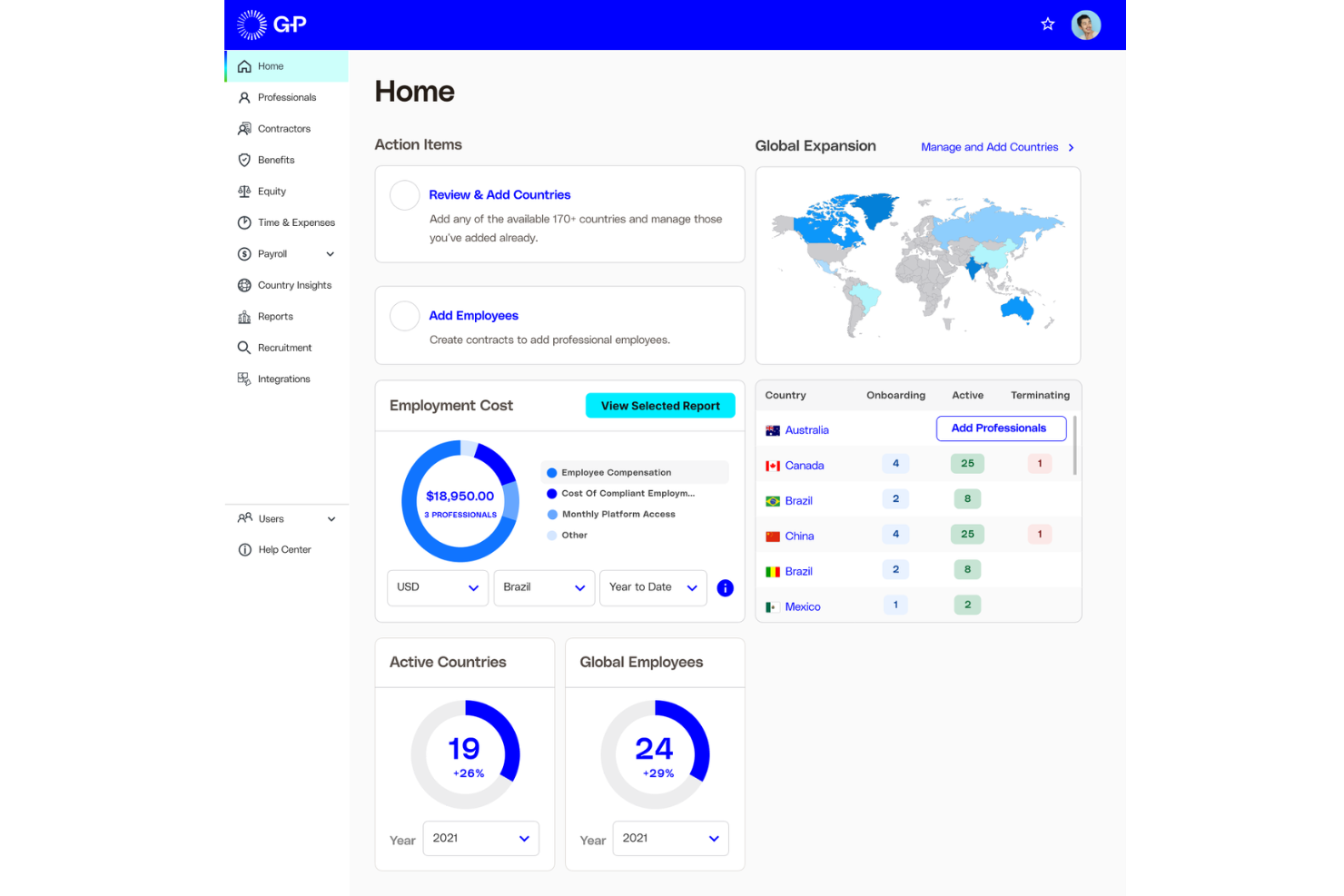
G-P (Globalization Partners) is a global Employer of Record platform for Denmark that centralizes onboarding, payroll, compliance, and workforce management for distributed teams.
Who Is G-P Best For?
Enterprises and large organizations managing complex, multi-country payroll and compliance needs in Denmark.
Why I Picked G-P
I picked G-P as one of the best because I can manage the Denmark hiring process at scale with enterprise-grade controls and audit trails. I like that my team can automate onboarding and payroll for large Danish workforces while tracking compliance in a single dashboard. I also use G-P’s in-country legal experts to handle complex Danish employment regulations.
G-P Key Services
- Global payroll engine: Processes multi-currency payroll for Denmark-based employees.
- Employment contract management: Generates and stores Denmark-compliant contracts digitally.
- Time-off tracking: Monitors Danish public holidays, vacation, and sick leave.
- Document vault: Secures payslips, contracts, and compliance documents for Danish employees.
G-P Integrations
Integrations include ADP Workforce Now, Paylocity, BambooHR, UKG Pro, Workday, and more.
Pros and Cons
Pros:
- Vistra partnership for entity transition
- Direct-owned local Danish infrastructure Integrated
- Proprietary G-P Gia AI compliance agent
Cons:
- Significant admin document requirements
- Limited mid-cycle payroll modification flexibility
Best with integrated time tracking add-on
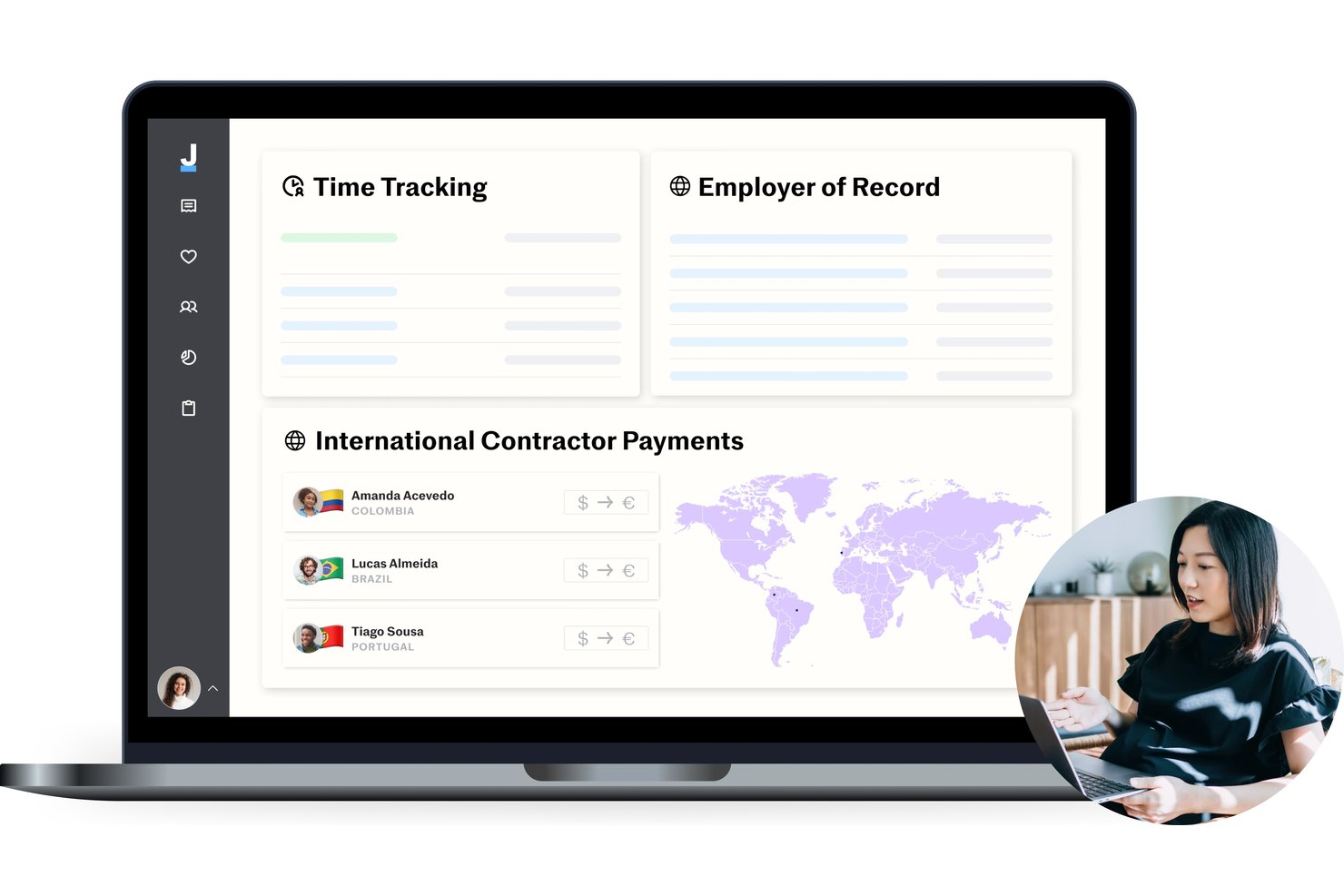
Justworks is an employer of record platform that offers payroll, HR, compliance, benefits administration, global hiring capabilities, and integrated add-ons for international contractor management.
Who Is Justworks Best For?
Justworks suits small to midsize companies looking to manage global payroll, HR, and compliance from a single platform.
Why I Picked Justworks
I picked Justworks as one of the best because I can bundle global payroll and HR with an integrated time tracking add-on, letting my team handle attendance and hours alongside compliance, benefits, and international hiring from one dashboard.
Justworks Key Features
- Global payroll processing: Automate payments and filings for employees in multiple countries.
- Benefits administration: Manage health, dental, vision, and 401(k) enrollment from one platform.
- HR document management: Store and organize employee agreements, policies, and tax forms securely.
- Compliance alerts: Get notifications about regulation changes to stay ahead on labor and tax requirements.
Justworks Integrations
Justworks offers native integrations with 15Five, Carta, Brex, Accurate, Expensify, QuickBooks, Xero, Greenhouse, and more. An API is available for custom integrations.
Pros and Cons
Pros:
- Offers integrated contractor management features
- Built-in US and global payroll processing
- Direct access to HR compliance experts
Cons:
- Advanced benefits only on highest tier
- Denmark-specific expertise not clearly documented

Best for Danish pension management
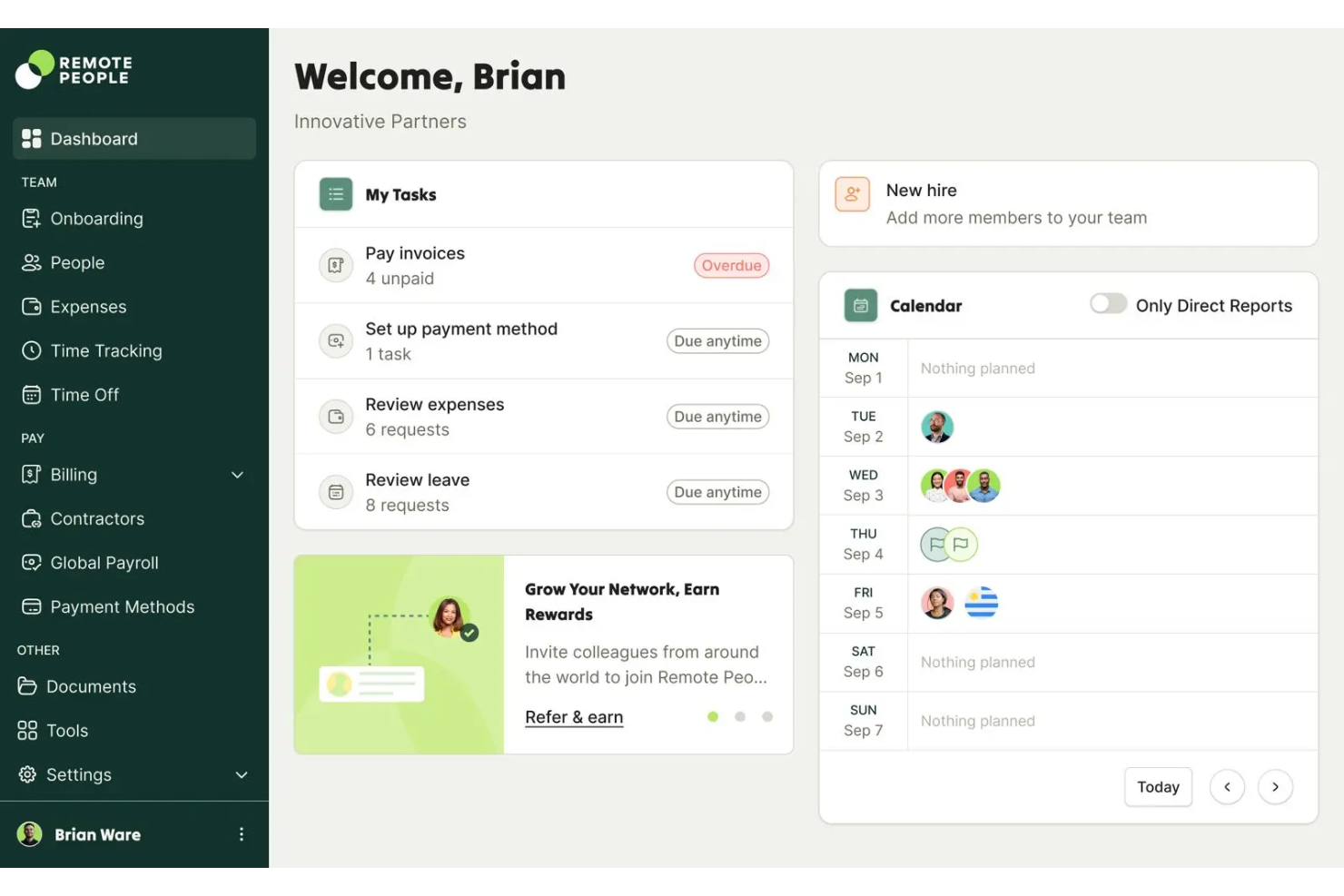
RemotePeople is an Employer of Record platform for Denmark that centralizes employment contracts, payroll, HR compliance, and local benefits administration for companies hiring Danish employees.
Who Is RemotePeople Best For?
HR teams at international companies managing Danish employee pensions and local compliance.
Why I Picked RemotePeople
I picked RemotePeople because I need a provider that handles Danish pension contributions and reporting without manual intervention. My team uses RemotePeople to automate pension enrollment and deductions for Danish employees. I also like that it manages local tax compliance and employment contracts in Denmark.
RemotePeople Key Services
- Localized onboarding workflows: Guides new hires through Denmark-specific onboarding steps.
- Automated payroll processing: Calculates and pays salaries in compliance with Danish regulations.
- Employment contract management: Generates and stores compliant Danish employment contracts.
- Time-off and leave tracking: Monitors vacation, sick leave, and public holidays for Danish employees.
RemotePeople Integrations
Integrations are not publicly listed.
Pros and Cons
Pros:
- Integrated end-to-end global recruitment sourcing
- Six-month employee replacement hiring guarantee
- Handles Danish pension contributions automatically
Cons:
- Manual credit card payment processing fees
- Reliance on third-party Danish partners
Best for contract generation
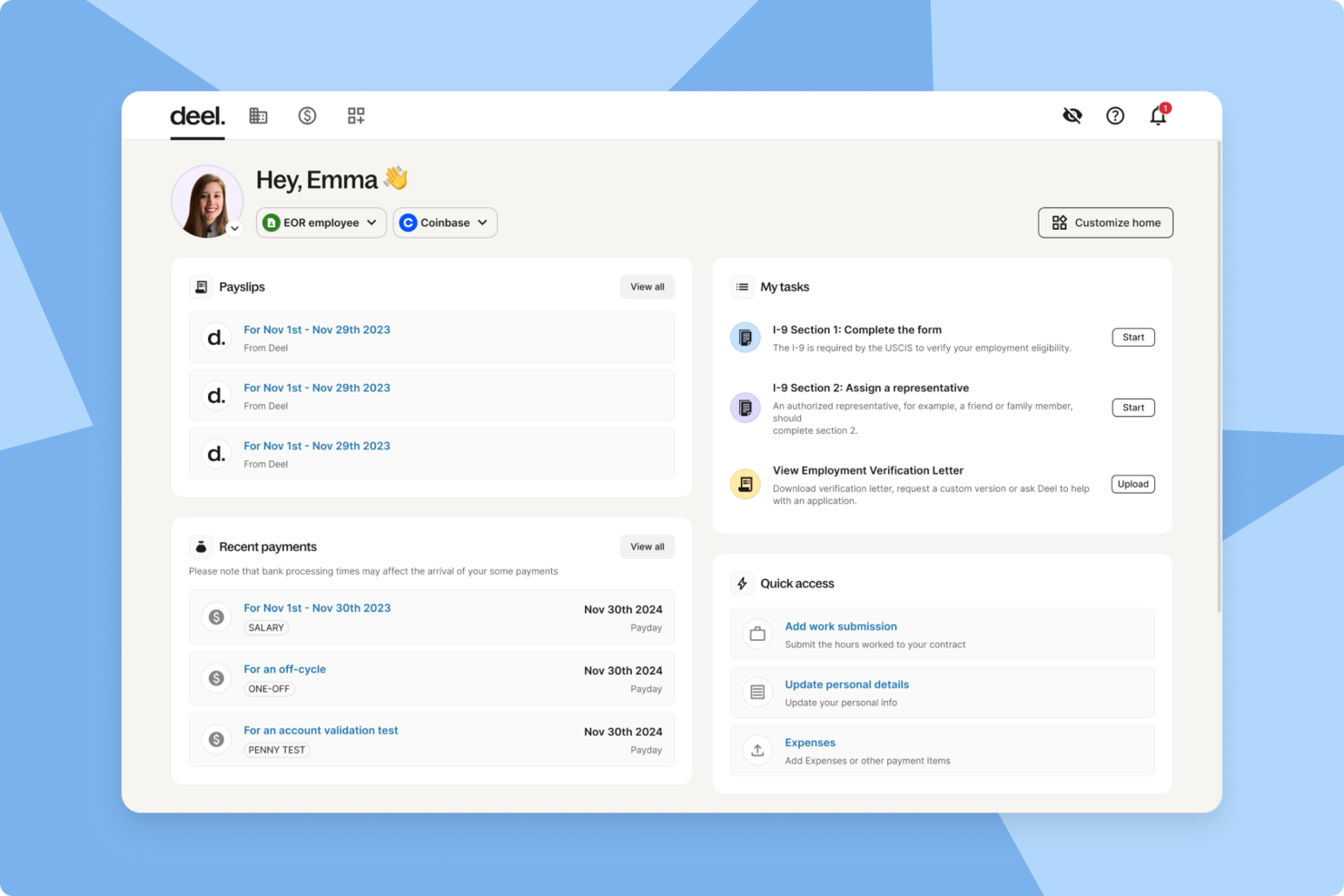
Deel Hire is an employer of record platform for Denmark that offers compliant hiring, employment contracts, global payroll, automated onboarding, benefits setup, and localized HR management through a unified dashboard.
Who Is Deel Hire Best For?
Deel Hire is a good fit for companies of any size that need to hire and pay employees in Denmark without setting up a local legal entity.
Why I Picked Deel Hire
I picked Deel Hire as one of the best for instant contract generation because it eliminates the back-and-forth that usually comes with hiring someone in Denmark. When you enter a new hire's details, Deel automatically populates a Denmark-compliant employment agreement—pulling in the correct statutory language, probation period norms, and local labor law requirements without you needing to draft anything from scratch. I also like that in select countries, including Denmark, the platform supports automated quote generation, meaning the employment cost breakdown comes back immediately rather than waiting up to a business day. You can even preview a draft employment agreement as a PDF before accepting the quote, so you're reviewing the actual contract language before anything is signed.
Deel Hire Key Features
- Global payroll: Run payroll for Danish employees and contractors in local currency, with tax withholdings handled automatically.
- Benefits administration: Enroll Danish employees in locally compliant benefits packages, including pension and health coverage options.
- Expense management: Employees can submit expenses directly through the platform for review and reimbursement.
- HR document storage: Store and manage employment documents, contracts, and compliance records in a centralized employee profile.
Deel Hire Integrations
Deel Hire offers native integrations with Workday, BambooHR, HiBob, Greenhouse, Lever, Ashby, Okta, QuickBooks, NetSuite, Slack, and Xero. An API is available for custom integrations.
Pros and Cons
Pros:
- Automated onboarding for Danish employees
- Native integration with top HRIS platforms
- Multi-country payroll managed from one screen
Cons:
- Contractor conversion process sometimes requires support
- Some localization documentation only in English

Best for bulk multi-currency payroll payments
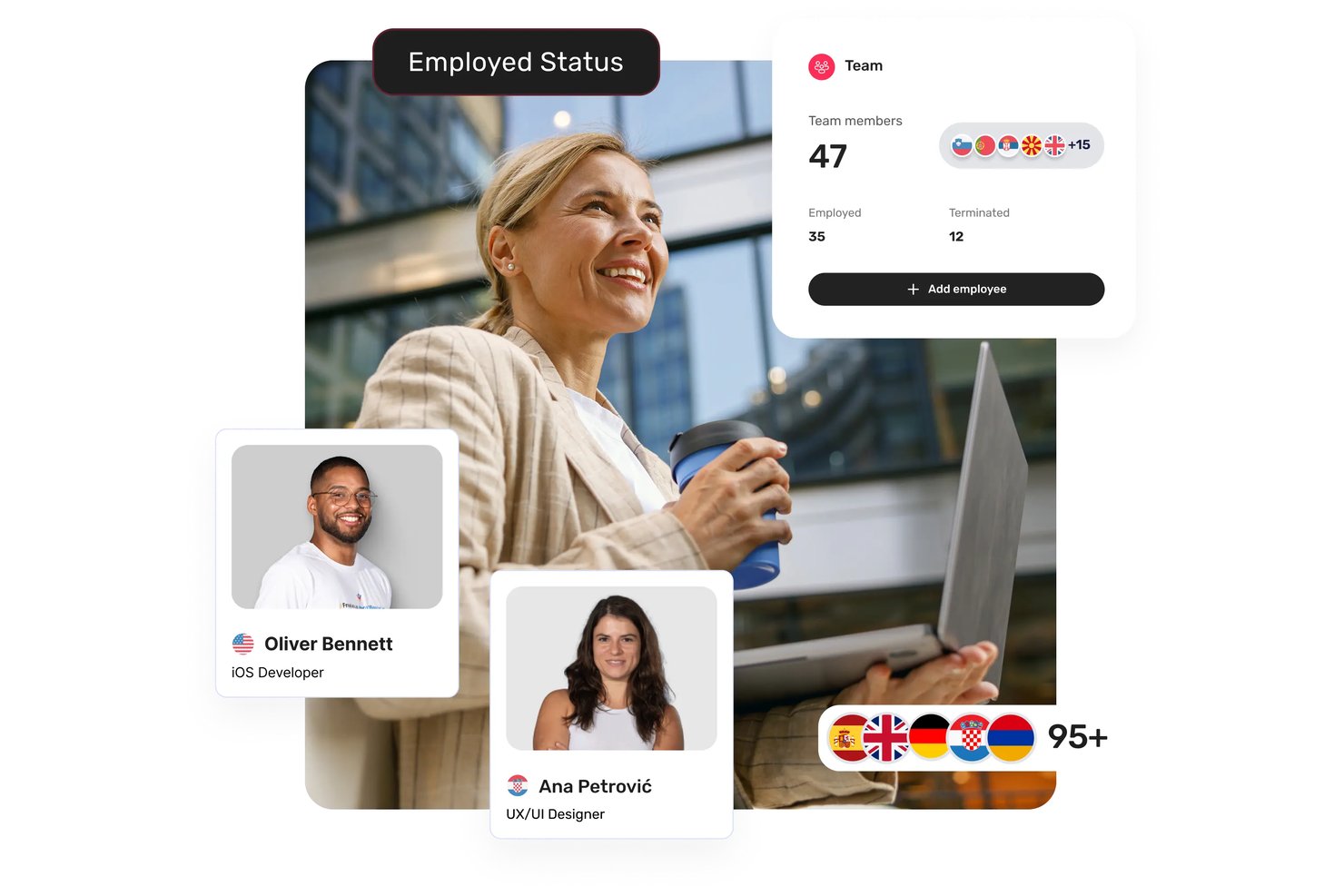
Native Teams is an employer of record platform designed for hiring and payroll in Denmark, providing local employment contracts, automated compliance, multi-country payroll, and localized benefits administration.
Who Is Native Teams Best For?
HR teams handling payroll for distributed or international employees across Denmark and multiple countries.
Why I Picked Native Teams
I picked Native Teams as one of the best because I can handle multi-currency payroll payments in bulk, automate localized onboarding for Danish employees, and manage compliant contracts across multiple countries from a single platform.
Native Teams Key Features
- Automated tax compliance: Calculates and handles taxes for Danish and international employees.
- Localized benefits management: Provides access to local benefits tailored to Denmark’s labor requirements.
- Integrated expense tracking: Offers a built-in tool to manage reimbursement requests and approvals.
- Real-time payroll reporting: Delivers instant, detailed payroll records for admins and accountants.
Native Teams Integrations
Native integrations are not clearly documented. An API is available for custom integrations.
Pros and Cons
Pros:
- Expense card and benefit management features
- Localized Danish contracts and compliance support
- Bulk payroll management for multiple countries
Cons:
- Native integrations not clearly documented
- Limited public user reviews available

Best for European compliance certification
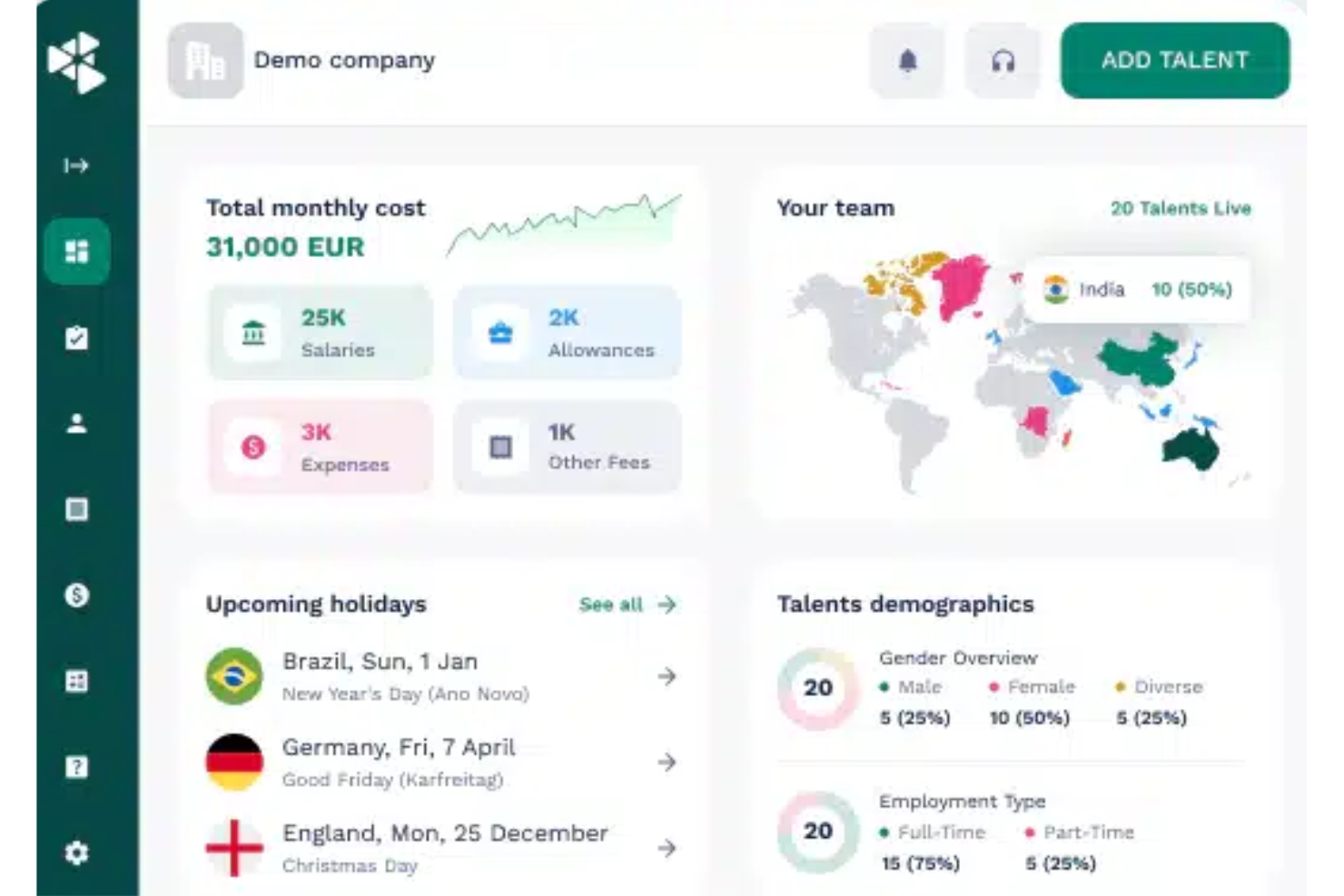
WorkMotion is an Employer of Record platform designed for hiring, onboarding, payroll, and compliance management for international employees, with a focus on supporting Denmark-based employment.
Who Is WorkMotion Best For?
HR teams at European companies needing certified compliance for hiring and managing employees in Denmark.
Why I Picked WorkMotion
I picked WorkMotion as one of the best because I can rely on its European compliance certification to confidently hire and manage employees in Denmark. I like that my team can automate contract generation and payroll processing while staying aligned with Danish and EU labor regulations. I also use WorkMotion’s compliance monitoring tools to keep up with regulatory changes specific to Denmark.
WorkMotion Key Services
- Employee self-service portal: Lets employees access payslips, contracts, and personal data online.
- Automated onboarding workflows: Guides new hires through document submission and compliance steps.
- Time-off management: Tracks vacation, sick leave, and public holidays for Denmark-based staff.
- Expense reimbursement processing: Allows employees to submit expenses for approval and payment within the platform.
WorkMotion Integrations
Integrations include Gusto, HiBob, Google Workspace, Factorial, BambooHR, and more.
Pros and Cons
Pros:
- Native Western European subsidiary establishment support
- Built-in net salary comparison calculator
- IEC Gold Certificate compliance auditing
Cons:
- Multiple separate invoices per payroll cycle
- Automated platform locks for overdue invoices
Remote
Best for Danish IP Shield protection
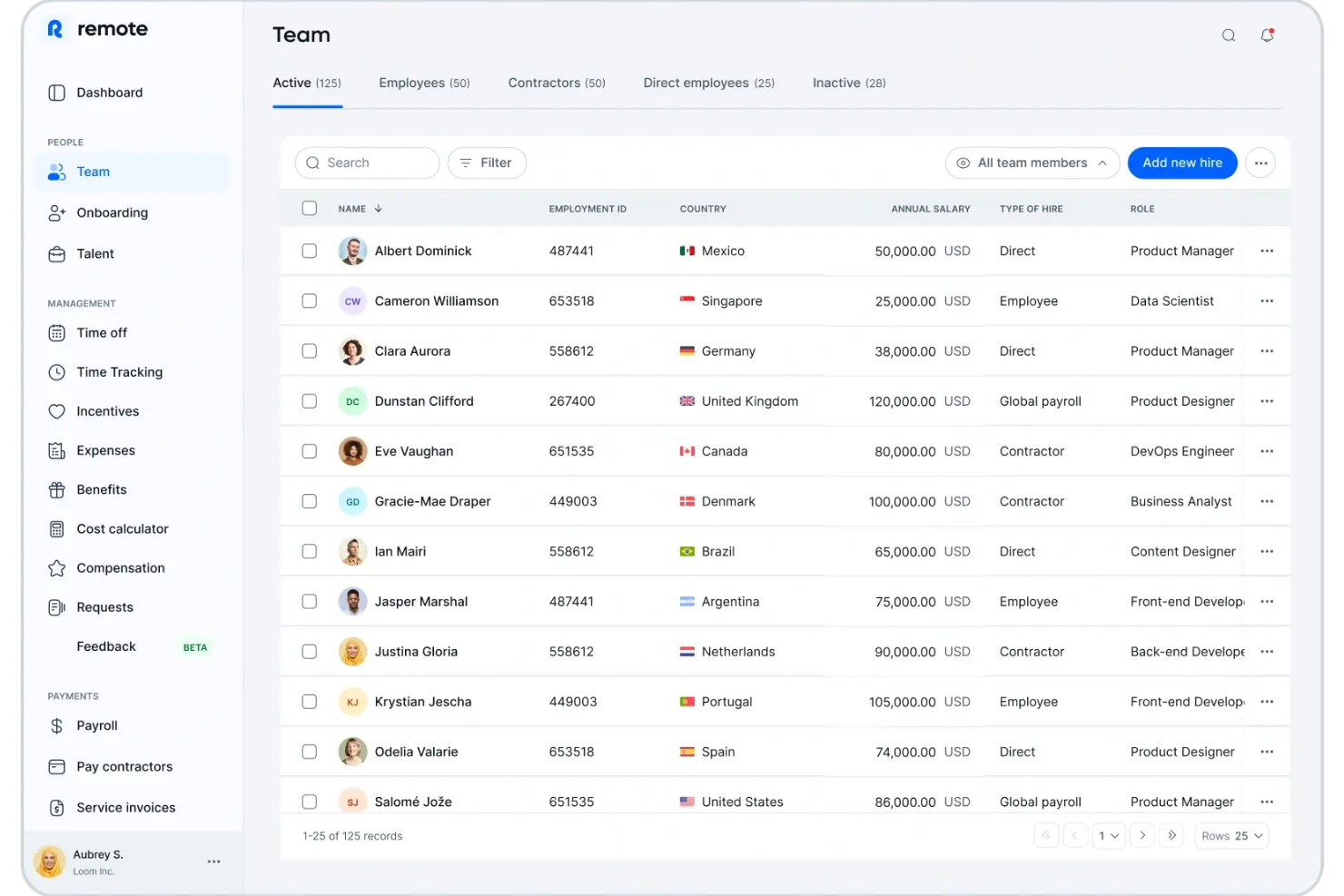
Remote is an Employer of Record platform for Denmark that centralizes global payroll, local compliance, onboarding, HR administration, and contractor management for distributed teams hiring in multiple countries.
Who Is Remote Best For?
Global HR teams at tech companies hiring employees in Denmark who need IP protection.
Why I Picked Remote
I picked Remote as one of the best because I rely on its Danish IP Shield to protect my company’s intellectual property when hiring in Denmark. My team uses Remote to draft compliant Danish employment contracts that include IP assignment and confidentiality clauses. I also like that Remote manages local payroll and statutory benefits, so I don’t have to coordinate with multiple vendors.
Remote Key Services
- Automated payroll processing: Calculates and pays salaries in compliance with Danish regulations.
- Localized onboarding workflows: Guides new hires through Denmark-specific onboarding steps.
- Time-off and leave management: Tracks vacation, sick leave, and public holidays for Danish employees.
- Expense reimbursement tools: Lets employees submit expenses for approval and reimbursement within the platform.
Remote Integrations
Remote offers native integrations with BambooHR, HiBob, Greenhouse, Slack, and Personio. An API is available for custom integrations.
Pros and Cons
Pros:
- Localized statutory benefits automated enrollment
- Automated payroll for Danish employees
- Danish IP Shield protects company IP rights
Cons:
- Significant security deposit requirements upfront
- Rigid fixed-date payroll processing windows

Pebl
Best for localized Nordic support specialists
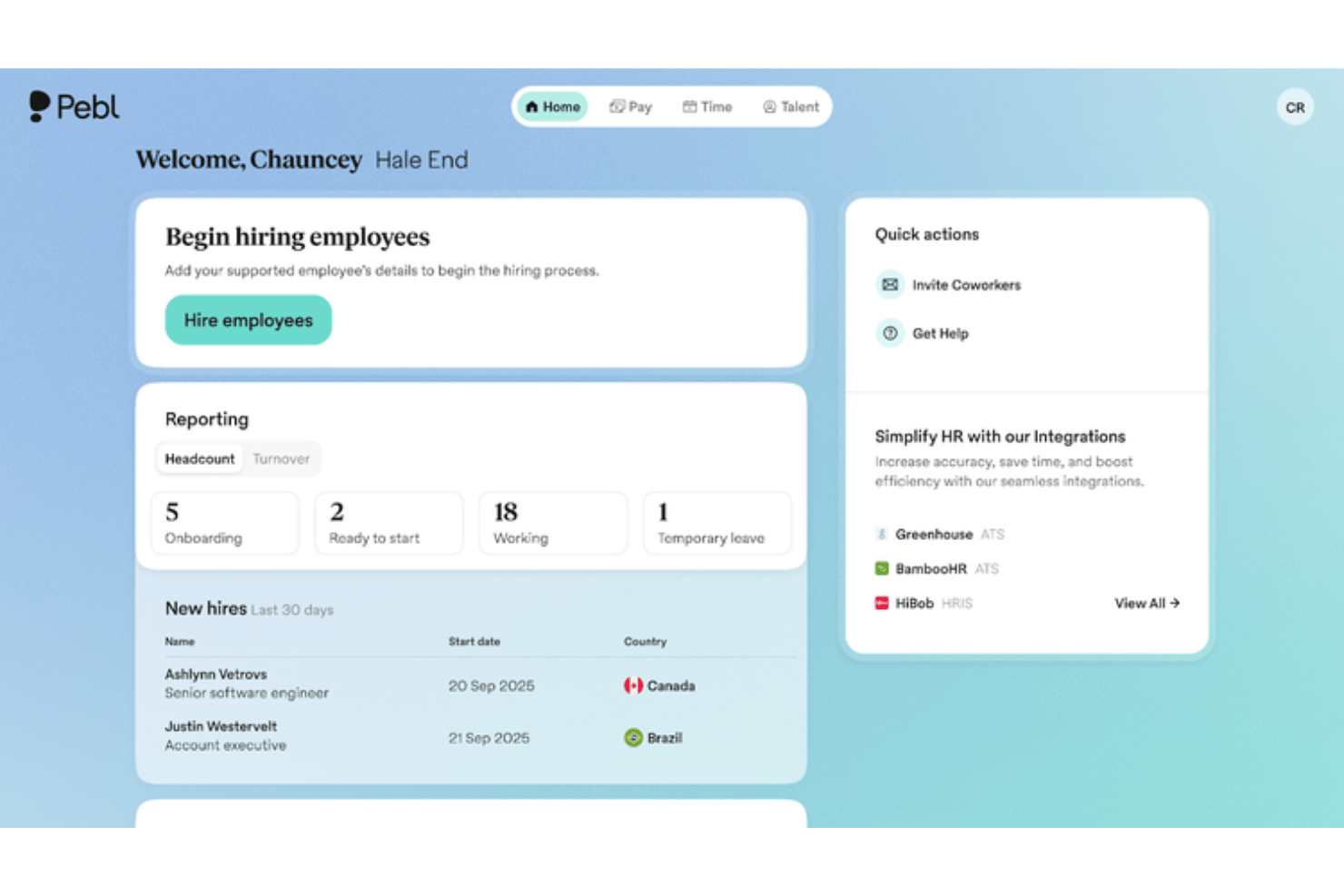
Pebl is an employer of record platform that handles compliant employment, payroll, benefits administration, and onboarding for international hires across 185+ countries, including a registered Danish legal entity for hiring in Denmark and Greenland.
Who Is Pebl Best For?
Pebl works well for companies expanding into Denmark or the broader Nordic region who want a single platform to manage compliant employment across multiple countries without setting up a local entity.
Why I Picked Pebl
I've included Pebl in my top picks because it runs a registered Danish legal entity (Velocity Global Denmark ApS) that's been operating since 2020, meaning your Danish hires are employed by a locally established company, not a third-party affiliate. Its AI assistant, Alfie, handles country-specific compliance queries and onboarding document checks, while its team of 200+ in-house legal experts spans 43 languages, including the Nordic region, giving you localized support without needing to build it yourself.
Pebl Key Features
- Global Work Platform: A centralized dashboard where you can manage hiring, payroll, employee changes, reporting, and offboarding across 185+ countries in one place.
- Alfie AI assistant: An AI tool that answers country-specific compliance questions, reviews onboarding documents, and generates workforce reports from plain-language prompts.
- 250+ integrations and API access: Pre-built connections to tools like Greenhouse, BambooHR, Workday, NetSuite, and QuickBooks, with API access included in the base price.
- Payroll cost calculator: A built-in tool that estimates the full cost of employment in Denmark, including employer contributions, before you commit to hiring.
Pebl Integrations
Pebl advertises 250+ integrations, including Greenhouse, BambooHR, Workday, NetSuite, QuickBooks, and ADP Workforce Now. Its API is included for custom connections with HR, payroll, and finance systems.
Pros and Cons
Pros:
- Alfie provides country-specific compliance guidance
- Fast onboarding with document checks
- Verified Danish legal entity since 2020
Cons:
- Reviews report onboarding and communication delays
- Limited public detail on collective agreements
Best for direct-entity Danish employment
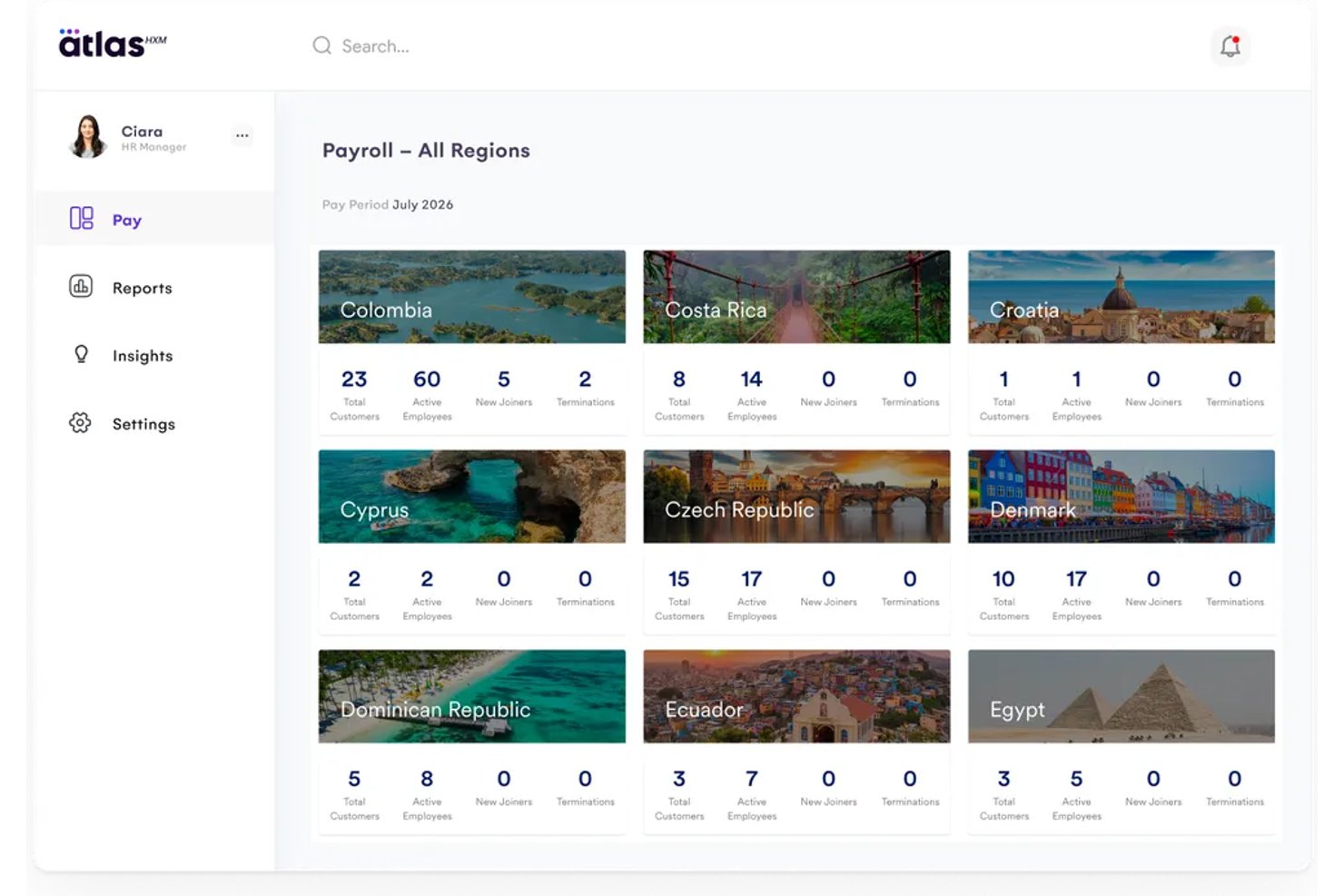
Atlas HXM is a global employer of record platform that handles Danish employment contracts, DKK payroll and tax administration, statutory benefits, work permits, and employee offboarding through its own directly owned legal entities.
Who Is Atlas HXM Best For?
Atlas HXM is a strong fit for global expansion teams that need a single, directly owned legal entity handling Danish employment—not a third-party aggregator.
Why I Picked Atlas HXM
Atlas HXM earns its spot on my shortlist because it operates through fully owned legal entities in 160+ countries, meaning your Danish hire is employed through an Atlas-owned entity, not a third-party aggregator. I find that distinction genuinely important when hiring in Denmark, where CBA compliance and precise statutory payroll (AM-bidrag, ATP contributions, and DKK tax tiers) leave little room for a middleman getting things wrong. Atlas also handles work permits for non-EU nationals through the Danish Immigration Service directly, which matters if you're onboarding talent from outside the EEA.
Atlas HXM Key Features
- DKK payroll and tax administration: Processes Danish payroll with 2026 tax brackets, AM-bidrag (8%), municipal tax, and monthly withholding filings built in.
- ATP and statutory benefits management: Administers ATP contributions (DKK 891/quarter), holiday allowance, sickness benefit, and occupational injury insurance (AES levy) for Danish employees.
- Contractor-to-EOR conversion: Converts existing contractors to compliant EOR employees, or transitions EOR employees to your own Danish entity when you're ready.
- Global management dashboard: Provides centralized payroll progress tracking, approvals, workforce cost reporting, and role-based permissions across all your countries in one view.
Atlas HXM Integrations
Atlas HXM documents integrations with Workday, BambooHR, Sage, Ashby, Paycor, UKG, and Dayforce, plus SSO through Okta, Microsoft, and Google Workspace. Its public integrations page and API documentation do not clearly confirm native connectivity.
Pros and Cons
Pros:
- Reviewers praise responsive account support
- Danish payroll handles ATP and AM-bidrag
- Direct-entity employment reduces aggregator exposure
Cons:
- Platform instability affects mobile users
- Denmark entity details remain undisclosed
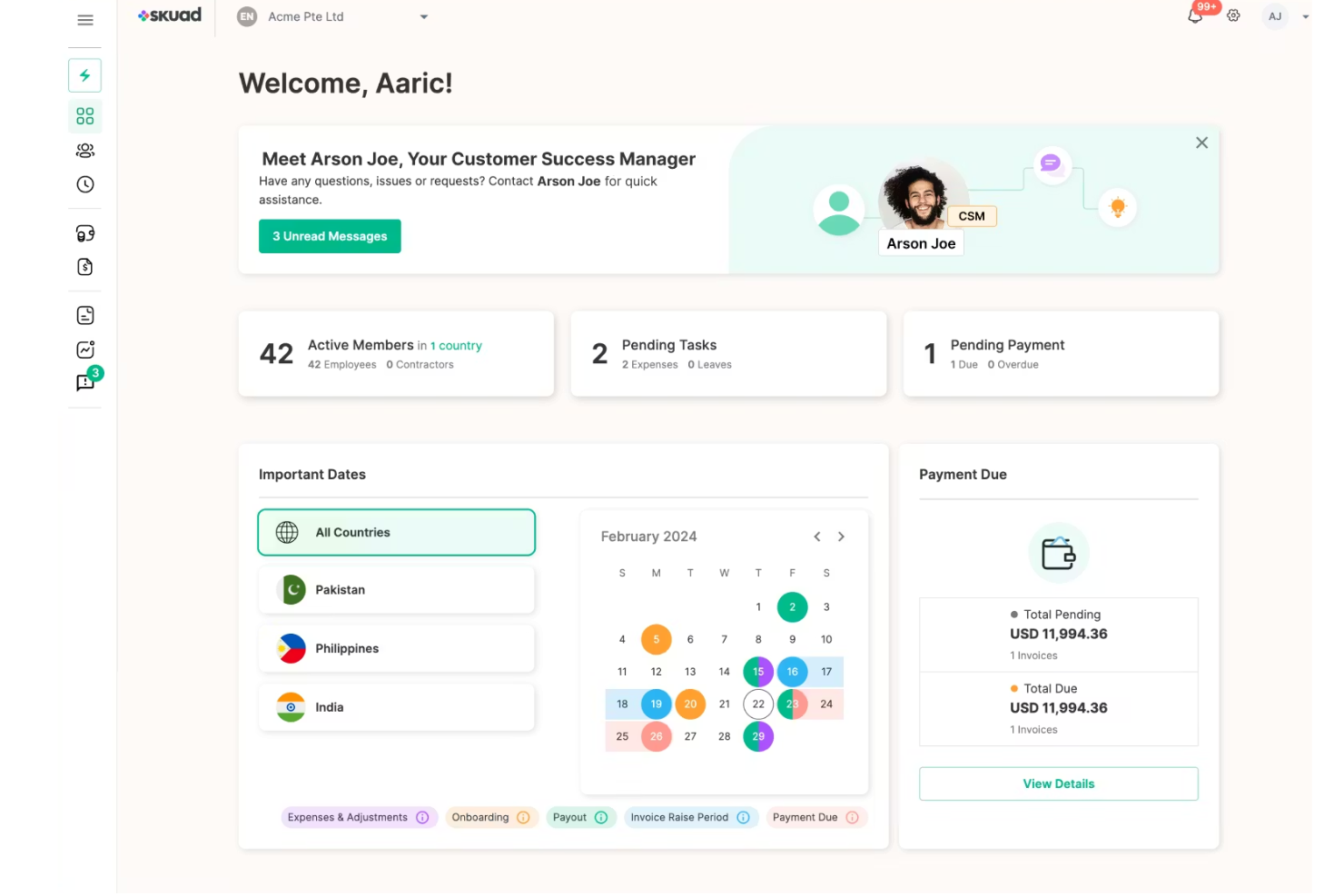
Skuad is an Employer of Record platform for Denmark that lets you hire, onboard, pay, and manage compliance for remote employees and contractors in one system.
Who Is Skuad Best For?
HR teams and founders who need Denmark-specific employment contracts and compliance for remote hires.
Why I Picked Skuad
I picked Skuad as one of the best because I can generate Denmark-specific employment contracts that reflect local labor laws and collective agreements. I like that my team can automate onboarding and payroll for Danish employees while managing statutory benefits in one place. I also use Skuad’s compliance engine to stay updated on Denmark’s evolving employment regulations.
Skuad Key Services
- Multi-country payroll processing: Run payroll for Danish and international employees from a single dashboard.
- Expense management: Track and approve employee expenses within the platform.
- Digital document vault: Store contracts, payslips, and compliance documents securely online.
- Time-off tracking: Monitor vacation, sick leave, and Danish public holidays for all employees.
Skuad Integrations
Integrations include BambooHR, ADP Workforce Now, ADP Run, Deel, and more.
Pros and Cons
Pros:
- Automated misclassification risk assessment engine
- Payoneer-backed high-speed payment infrastructure
- Built-in native time tracking tools
Cons:
- Limited third-party HRIS software integrations
- Lacks performance management features
Other Employer of Record Services in Denmark
Here are some additional Denmark EOR options that didn’t make it onto my shortlist, but are still worth checking out:
- Payoneer WFM
For localized contracts
- Multiplier
For no-fee Danish employee onboarding
- CXC Global
For large-scale contingent workforce programs
- Gloroots
For flat-fee Danish visa sponsorship
- Boundless
For CBA compliance in Danish hiring


How I Evaluate Employer Of Record Services In Denmark
I split my evaluation into three parts, weighting core functionality most: employ workers locally, run Danish payroll, and manage contracts, leave, and terminations. Next, I compare Danish entity transparency and CBA expertise, such as sector-specific agreement guidance. Finally, I consider support, onboarding, GDPR, and transparent pricing.
Core Functionality (Table Stakes For This List)
When I'm selecting tools for my list, I score each one on a scale from 0 (does not offer the functionality) to 5 (excels in this area) for each core functionality listed below. I then convert the total into a percentage to help assess each tool's overall fit, with extra weight on any functionalities I’ve deemed essential.
- Legal Entity & Employment (Essential): I check for a registered Danish entity that employs workers directly and assumes employer-of-record responsibilities.
- Danish Labor Compliance (Essential): I assess Danish contracts, notice periods, leave, terminations, and guidance on collective bargaining agreements.
- Payroll & Tax Administration: I look for accurate Danish payroll, income tax withholding, labor contributions, filings, and payment records.
- Benefits & Pension: I evaluate holiday allowance, parental leave, statutory benefits, and pension contribution administration.
- Contracts & Onboarding: I review localized contract generation, document collection, e-signatures, and onboarding workflows for new Danish hires.
- Multi-Country Visibility: I assess whether one dashboard shows Danish employees alongside global workers with consistent records and reporting.
Once I have a list of tools that meet the criteria, I consider what sets each platform apart.
Differentiating Factors (What Sets Vendors Apart)
Here's how I compare and contrast different vendors:
Standout Features
I look for vendors that disclose their Danish entity ownership status and years of in-country operation, since this transparency signals stability and reduces the risk of service gaps. CBA expertise matters just as much. A provider that can guide you through sector-specific collective bargaining agreements (overenskomster) helps avoid misalignment with union norms, especially in manufacturing or logistics. I also evaluate whether vendors offer in-house immigration support for non-EU hires, covering work permits and CPR registration to speed up onboarding timelines.
Beyond Features
I evaluate whether providers itemize Danish employer costs like ATP contributions, holiday allowance accrual, and pension in their quotes, since hidden fees around offboarding or contract changes can derail budgets. GDPR alignment is equally important—I check data residency practices and whether the vendor offers a clear data processing agreement covering payroll and CPR number handling. I also consider how well each platform integrates with existing HRIS and ATS tools, because duplicate data entry across markets creates real compliance risk during audits.
How to Choose Employer of Record Services in Denmark
It’s easy to get bogged down in long feature lists and complex pricing structures. To help you stay focused as you work through your unique software selection process, here’s a checklist of factors to keep in mind:
| Factor | What to Consider |
| Scalability | Will the solution support your growth in Denmark and other countries as your headcount increases? |
| Integrations | Does the platform connect with your HRIS, payroll, or accounting systems to avoid manual work? |
| Customizability | Can you tailor workflows, document templates, and reporting to fit your Danish HR processes? |
| Ease of use | Is the interface intuitive for both HR teams and Danish employees, minimizing training needs? |
| Implementation and onboarding | How long does setup take, and what support is provided for migrating contracts and payroll data? |
| Cost | Are all fees transparent, including setup, monthly, and offboarding costs for Danish employees? |
| Security safeguards | Does the provider meet GDPR and Danish data protection standards, with clear protocols for breaches? |
| Compliance requirements | How does the tool stay current with Danish labor laws, tax rules, and statutory benefits changes? |
What are Employer of Record Services in Denmark?
Employer of Record services in Denmark are third-party providers that legally employ workers in Denmark on your behalf, handling payroll, contracts, tax compliance, and statutory benefits. These services let you hire Danish employees without setting up a local entity, ensuring your business meets all Danish labor laws and employment regulations.
Why Use an Employer of Record Service in Denmark?
Using an employer of record (EOR) in Denmark allows you to hire employees without setting up a local entity or handling employer registration yourself. To hire directly, you must register with Danish authorities, access the e-Income system, and manage payroll reporting, tax withholding, and statutory contributions. An EOR takes on these responsibilities, letting you onboard employees quickly and stay compliant from day one.
It’s also useful because Denmark’s employment rules rely heavily on collective agreements rather than fixed statutory standards like minimum wage. This makes it harder to benchmark salaries and structure contracts correctly if you’re unfamiliar with the market. An EOR ensures your employment terms, payroll, and contributions align with local expectations while reducing administrative complexity.
Deciding Between an EOR and a Legal Entity in Denmark
When deciding between using an EOR or setting up a legal entity in Denmark, the right choice depends on how quickly you want to hire and how permanent your presence will be.
Setting up a Danish entity (typically an ApS – private limited company) is relatively structured but still requires registration, local administration, ongoing accounting, payroll setup, and compliance with Danish reporting requirements. While manageable, it takes time and local expertise.
An EOR, on the other hand, allows you to hire immediately without establishing a legal presence, as they act as the official employer and handle compliance, payroll, and tax reporting on your behalf.
Here’s how the two options compare:
| Feature | Employer of Record (EOR) | Legal Entity (ApS) |
| Setup Time | Fast (a few days to 1–2 weeks) | Moderate (typically 2–6 weeks depending on setup and banking) |
| Operational Readiness | Immediate hiring capability | Delayed; requires entity setup, bank account, payroll registration |
| Compliance Responsibility | Shared; EOR handles employment, payroll, and tax compliance | Fully on your company |
| Employer Registration | Not required | Required (including e-Income setup) |
| Payroll and Tax Management | Managed by EOR | Must be handled internally or via local providers |
| Administrative Burden | Low | High; ongoing accounting, filings, and reporting required |
| Local Expertise Needed | Minimal | High; requires understanding of Danish labor norms and systems |
| Cost Structure | Service fee per employee | Upfront setup + ongoing operational costs |
| Flexibility | High; easy to scale up or down | Lower; tied to long-term presence |
| Best For | Market entry, remote hiring, testing the market | Long-term operations, larger teams, local expansion |
EOR vs Permanent Establishment in Denmark
When hiring in Denmark, one key risk to be aware of is creating a Permanent Establishment (PE). This happens when a foreign company is deemed to have a taxable presence in Denmark due to ongoing business activities carried out locally.
In Denmark, a PE is generally triggered if your company has a fixed place of business (such as an office) or if employees or representatives in Denmark have the authority to act on behalf of the company in a way that generates business. If a PE is established, your company may become liable for Danish corporate taxes on profits attributed to those local activities, along with additional reporting and compliance obligations.
How EORs Protect From Permanent Establishment Risk
An EOR helps reduce the likelihood of triggering Permanent Establishment by creating a clear legal and operational separation between your company and your Danish workforce.
- Legal employer separation. The EOR is the official employer of record, meaning employees are legally employed by the EOR, not your company, reducing direct tax and legal ties to Denmark.
- No local entity or fixed place of business. Since the EOR provides the employment infrastructure, you can avoid establishing an office or legal presence in your company’s name, both of which are common PE triggers.
- Service-based relationship. Your agreement with the EOR is structured as a B2B service contract rather than a direct employment relationship, helping demonstrate that you are not operating as a local employer.
- Reduced authority risk. EORs can help structure roles so employees are not positioned as representatives who can legally bind your company in Denmark, another key factor in PE assessments.
While an EOR significantly reduces PE risk, it doesn’t eliminate it entirely. If your team in Denmark is heavily involved in revenue-generating activities or decision-making on behalf of your company, you should still seek local tax advice.
Hiring in Denmark: Important Details
Here are some key details to know if this is your first time hiring employees in Denmark. Your EOR provider will manage these compliance requirements for you, but it’s still worth understanding how Danish employment works before you start hiring or comparing providers.
In Denmark:
- Employment terms in Denmark are shaped by both statute and collective agreements. Denmark has a highly regulated labor market, but many practical terms, such as pay levels, overtime rules, and notice provisions, are often set through collective agreements rather than a universal statutory rulebook. Denmark also does not have a statutory minimum wage.
- Compensation needs local benchmarking. Because there is no statutory minimum wage, salaries are generally determined by Danish market practice and collective bargaining coverage. That makes local benchmarking especially important when hiring in Denmark.
- Standard working time is commonly around 37 hours per week. In practice, full-time work in Denmark is typically 37 hours weekly, although exact working hours and any overtime arrangements are usually set out in the contract or collective agreement.
- Probation periods are common, but they are not unlimited. For salaried employees covered by the Danish Salaried Employees Act, the probationary period is typically limited to three months, and shorter notice can apply during that period if it is agreed in the contract.
- Severance pay may apply. Under Danish employment laws, employees with long service (typically 12+ years) may be entitled to statutory severance payments.
- Termination rules depend on the contract and whether the employee is covered by the Salaried Employees Act or a collective agreement. Notice periods must be stated in the contract, and for salaried employees, specific statutory rules apply. Under the Salaried Employees Act, the employee generally gives one month’s notice to resign, while the employer's notice depends on the length of service.
- Employees are entitled to five weeks of paid holiday each year. Holiday allowance generally accrues at 12.5% of salary, equivalent to 2.08 days of holiday per month worked. This is a core employment cost you need to factor into compensation planning.
- Parental leave is substantial. For children born on or after 2 August 2022, parents together have 48 weeks of leave benefits after birth, and as a starting point, each parent has 24 weeks, with part of that leave earmarked and non-transferable for employees. The leave framework is more detailed than a simple “maternity leave only” model.
- Denmark has approximately 11 national public holidays each year. The exact number can vary slightly because several holidays are tied to Easter and change dates annually.
- The standard national public holidays in Denmark include:
- New Year’s Day (January 1)
- Maundy Thursday (March/April, date varies)
- Good Friday (March/April, date varies)
- Easter Sunday (March/April, date varies)
- Easter Monday (March/April, date varies)
- Ascension Day (May, date varies)
- Pentecost Sunday (May/June, date varies)
- Whit Monday (Pentecost Monday) (May/June, date varies)
- Christmas Day (December 25)
- Boxing Day (December 26)
- Holiday observance depends on contracts and collective agreements. Not all holidays are automatically paid days off under statute—whether employees receive time off or additional pay depends on their employment terms or applicable collective agreement.
Tax Overview for Employers in Denmark
While the EOR solution handles payroll, tax withholding, and reporting on your behalf, understanding the structure helps you plan costs and ensure everything is set up correctly.
- Employers act as withholding agents. You are responsible for deducting and remitting employee taxes directly to Danish authorities.
- A-tax (income tax) must be withheld. This is deducted from employee salaries and reported through the e-Income system.
- Labour market contribution (AM-bidrag) is 8%. This is withheld from the employee’s salary and paid alongside income tax.
- ATP pension contributions are mandatory. For full-time employees, ATP is a fixed annual contribution, with the employer paying roughly two-thirds (around 2,272 Danish Krone or DKK annually).
- Payroll must be reported through e-Income. All salary, tax, and contribution data is submitted digitally and feeds into multiple public systems.
- Payments are managed via the tax account system. Employers must meet strict reporting and payment deadlines to avoid penalties.
- Additional labour market schemes may apply. Depending on the situation, employers may need to contribute to schemes such as training or insurance funds.
Features of Employer of Record Services in Denmark
When selecting employer of record services in Denmark, keep an eye out for the following key features:
- Danish payroll processing: Handles salary calculations, tax withholdings, and payments in compliance with Danish regulations, ensuring employees are paid accurately and on time.
- Employment contract management: Drafts, stores, and updates legally compliant Danish employment contracts tailored to local labor laws and company policies.
- Statutory benefits administration: Manages mandatory benefits such as pensions, parental leave, and health insurance, keeping your business aligned with Danish requirements.
- Tax filing and reporting: Prepares and submits all necessary tax documents to Danish authorities, reducing the risk of errors or penalties.
- Employee onboarding and offboarding: Guides new hires and departing employees through Denmark-specific processes, including document collection and exit formalities.
- Compliance monitoring: Tracks changes in Danish labor laws and updates processes to maintain ongoing legal compliance for your workforce.
- Local HR support: Provides access to HR experts familiar with Danish employment practices to answer questions and resolve issues quickly.
- Time-off and leave tracking: Monitors vacation, sick leave, and public holidays according to Danish standards, ensuring accurate recordkeeping and payroll adjustments.
- Expense and reimbursement management: Processes employee expenses and reimbursements in line with Danish tax rules and company policies.
- Data security and GDPR compliance: Protects employee data with security measures and ensures all processes meet Danish and EU data protection standards.
Benefits of Employer of Record Services in Denmark
Implementing employer of record services in Denmark provides several benefits for your team and your business. Here are a few you can look forward to:
- Faster market entry: Hire Danish employees and create global teams quickly without setting up a local entity, thanks to ready-made legal and payroll infrastructure.
- Guaranteed compliance: Stay aligned with Danish labor laws, tax rules, and employee benefits through expert contract management and compliance monitoring.
- Simplified payroll and benefits: Manage salaries, taxes, and mandatory benefits with automated, locally compliant payroll processing and benefits administration.
- Reduced administrative burden: Offload complex HR, onboarding, and offboarding tasks to a provider with local expertise and established workflows.
- Access to local HR support: Get answers to Danish employment questions and resolve issues quickly with support from HR professionals familiar with local practices.
- Improved data security: Protect sensitive employee information with GDPR-compliant data handling and security safeguards.
- Cost predictability: Avoid hidden fees and unexpected expenses with transparent pricing and clear breakdowns of all employment-related costs.
Costs and Pricing of Employer of Record Services in Denmark
Selecting employer of record services in Denmark requires an understanding of the various pricing models and plans available. Costs vary based on features, team size, add-ons, and more. The table below summarizes common plans, their average prices, and typical features included in employer of record services Denmark solutions:
Plan Comparison Table for Employer of Record Services in Denmark
| Plan Type | Average Price | Common Features |
| Free Plan | $0 | Access to basic resources, limited HR support, and informational guides. |
| Personal Plan | $200-$400/employee/mo | Payroll processing, employment contract management, and basic compliance support. |
| Business Plan | $400-$700/employee/mo | Statutory benefits administration, onboarding and offboarding workflows, and local HR support. |
| Enterprise Plan | $700-$1000+/employee/mo | Custom integrations, dedicated account management, advanced compliance monitoring, and priority support. |
Employer of Record Services in Denmark FAQs
Here are some answers to common questions about employer of record services in Denmark:
How does an EOR handle IP transfer upon termination?
In Denmark, intellectual property (IP) created by employees is generally governed by the Danish Copyright Act and the terms of the employment contract. As a baseline, IP created within the scope of employment is typically transferred to the employer, but when using an EOR, the legal employer is the EOR, not your company.
To ensure your company retains full ownership, EOR providers include IP assignment clauses in both the employment contract and the service agreement. These agreements are structured so that all IP created in the course of work is transferred to your company.
Can I use Employer of Record services in Denmark to hire both full-time and part-time employees?
Yes, an EOR service provider in Denmark can support your global workforce by hiring both full-time and part-time staff. This flexibility allows you to attract top talent for various roles while remaining fully compliant with local laws. While many companies also look at engaging independent contractors, using an EOR helps mitigate misclassification risks, ensuring workers receive their legal entitlements.
How quickly can I onboard a new employee in Denmark using an Employer of Record?
You can usually onboard a new employee in Denmark within a few days to two weeks. Timelines depend on document collection, contract review, and any required work permits, but EOR providers are set up to move much faster than setting up your own entity.
For non-EU citizens, the timeline may extend due to work permit requirements. However, many EORs utilize the fast-track scheme for certified companies (particularly in Copenhagen and other tech hubs) or hire via the Positive List for high-demand roles. Providers also handle background checks to ensure a secure and rapid start.
What happens if Danish labor laws change after I’ve hired employees through an Employer of Record?
Your Employer of Record will monitor legal changes and update contracts, payroll, and benefits processes as needed. This helps you stay compliant without having to track every regulatory update yourself.
Do I need to have a registered business in Denmark to use an Employer of Record?
No, you don’t need a registered Danish entity. The Employer of Record acts as the legal employer, so you can hire and pay Danish employees without setting up a local company.
How are taxes and social contributions handled for employees in Denmark?
The Employer of Record calculates, withholds, and remits all required Danish taxes and social contributions. This includes income tax, pension, and other statutory deductions, ensuring full compliance with local regulations.
This content is provided for general informational purposes only and does not constitute legal, tax, or other professional advice. It may not be complete, accurate, or current, and laws and practices may change without notice and vary by jurisdiction. You should not act on this information without obtaining advice from qualified legal or tax counsel in the relevant jurisdiction regarding your specific circumstances.