

10 Best Global Payroll Services in Brazil In 2026

Best Global Payroll in Brazil Shortlist


Global payroll services in Brazil help you manage payments, taxes, and compliance for teams based in Brazil. If you need to pay employees or contractors across borders—without risking errors or missing local regulations—finding the right solution makes all the difference. With rules and reporting that change fast, and a tight labor market, the stakes are high. In this list, I’ll help you compare top global payroll providers for Brazil so you can handle payroll confidently, keep your team paid on time, and stay compliant this 2026.
Why Trust Our Software Reviews
Our team has been testing and reviewing software since 2012. As HR experts ourselves, we know how difficult—and important—it is to choose the right software.
For this guide, we evaluated tools using hands-on testing and independent research, scoring tools using our selection criteria. We also draw on insights from industry thought leaders and practicing HR experts.
Our reviews reflect our human editorial judgment, not a sales pitch.
Expert reviewers:
Best Global Payroll Services in Brazil Summary
This comparison chart summarizes pricing details for my top global payroll provider selections in Brazil to help you find the best fit for your budget, team structure, and compliance needs.
| Tool | Best For | Trial Info | Price | ||
|---|---|---|---|---|---|
| 1 | Best for EOR payroll backed by a owned Brazil entity | Free demo available | From $599/employee/month | Website | |
| 2 | Best for dedicated in-country compliance expertise | Free demo available | From $29/employee/month | Website | |
| 3 | Best for simplified contractor payments | Free demo available | From $459/user/month (billed annually) | Website | |
| 4 | Best for built-in HR compliance features | Free demo available | From $599/user/month | Website | |
| 5 | Best for fast local payroll delivery | Free demo available | Pricing upon request | Website | |
| 6 | Best for customized payroll workflows | Free demo available | Pricing upon request | Website | |
| 7 | Best for HR and payroll integration | Free demo available | Pricing upon request | Website | |
| 8 | Best for AI-powered payroll automation | Free demo available | Pricing upon request | Website | |
| 9 | Best for crypto and fiat payroll options | Free demo available | From $399/employee/month | Website | |
| 10 | Best for multi-country payroll management | Free demo available | From $699/user/month | Website |

Best Global Payroll Services in Brazil Reviews
Below are my detailed summaries of the best global payroll in Brazil solutions that made it onto my shortlist. My reviews offer a detailed look at the features, compliance capabilities, and integrations of each platform to help you find the best one for you.

G-P
Best for EOR payroll backed by a owned Brazil entity
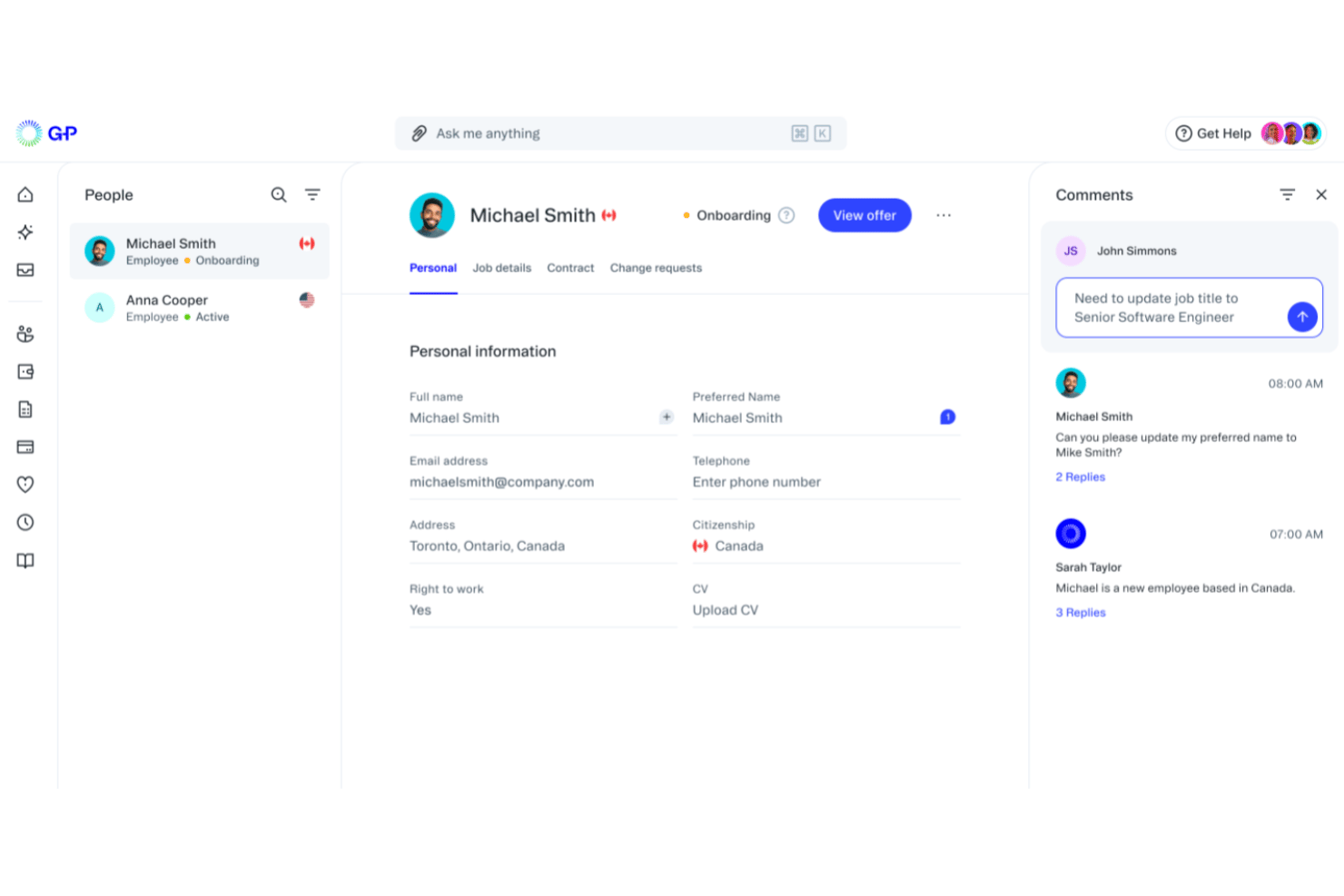
G-P is a global employer of record and payroll platform that processes BRL payroll, administers CLT statutory benefits, and handles eSocial, FGTS, and INSS compliance across 180+ countries from a single platform.
Who Is G-P Best For?
G-P is a strong fit for multinational companies that need to hire and pay Brazilian employees quickly, without setting up a local entity.
Why I Picked G-P
G-P earns its spot on my shortlist because it operates through a wholly-owned Brazilian legal entity (CNPJ), meaning it takes on direct employment liability rather than routing workers through a third-party partner. I find that distinction critical for CLT compliance: G-P handles automated eSocial, RAIS, and CAGED filings directly with Brazilian government portals, and fully administers 13th salary, férias with the mandatory one-third constitutional bonus, and FGTS deposits on your behalf.
G-P Key Features
- G-P Gia AI compliance agent: An AI-powered tool that monitors Brazilian regulatory changes in real time and generates locally compliant employment documents automatically.
- Enterprise HCM integrations: Native, bidirectional connectors to Workday, SAP SuccessFactors, BambooHR, UKG, and HiBob keep employee data synced across your existing HR stack.
- Multi-currency consolidated billing: G-P funds payroll in your home currency and disburses in BRL, issuing a single consolidated invoice across all countries you operate in.
- G-P Contractor payments: A separate contractor product covers 190+ countries, including Brazil, with per-invoice billing and built-in worker classification guidance.
G-P Integrations
G-P offers native integrations with Workday, SAP SuccessFactors, BambooHR, HiBob, UKG Pro, Personio, ADP Workforce Now, and Paylocity. Its API supports custom integrations for broader HR and payroll workflows.
Pros and Cons
Pros:
- Manages CLT statutory benefits and 13th salary
- Automates eSocial, RAIS, and CAGED filings
- Runs payroll through owned Brazilian entity
Cons:
- No public confirmation of PIX payment support
- No payroll-only option for local entities

Best for dedicated in-country compliance expertise
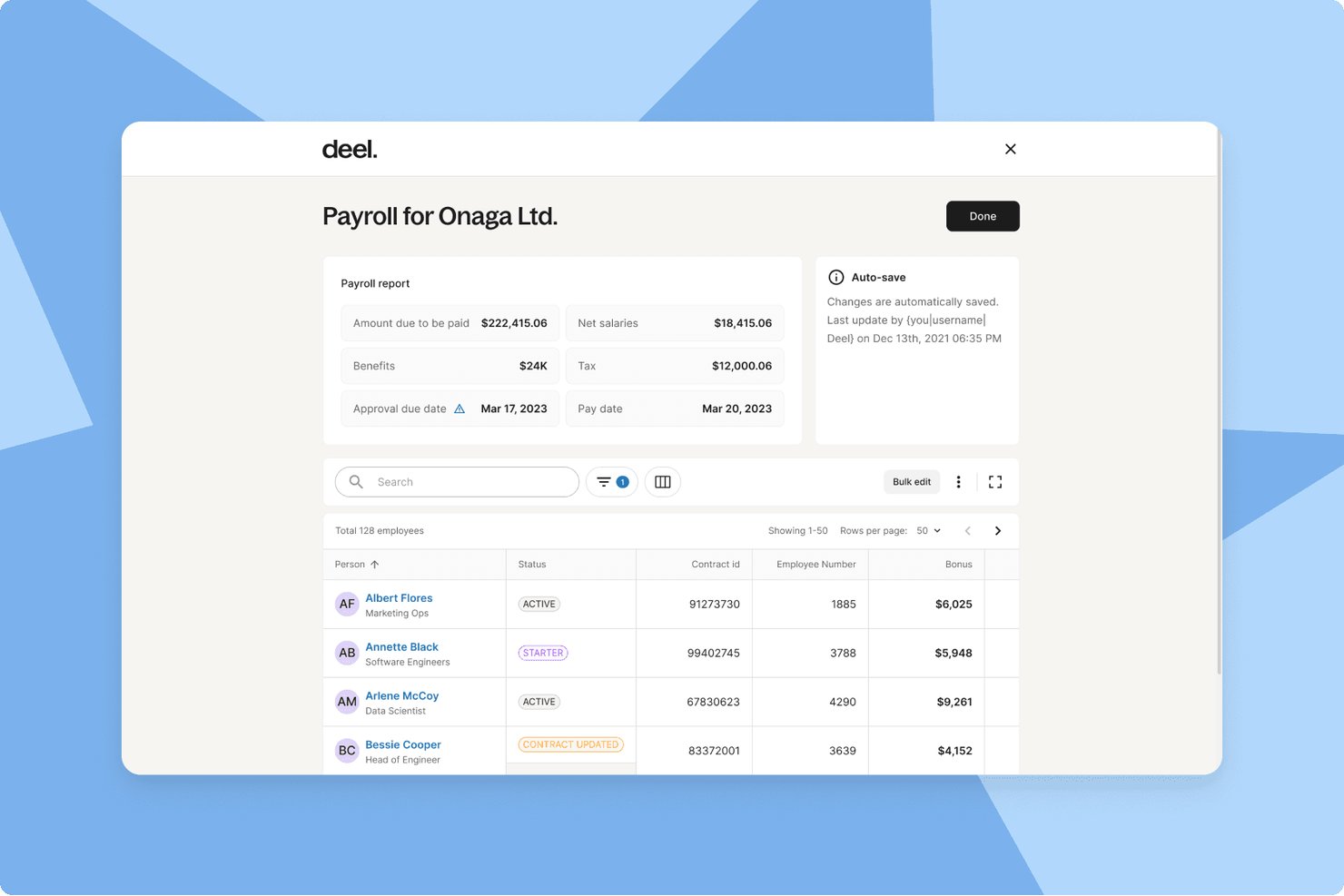
Deel Payroll is a global payroll and HR platform that handles multi-country payroll processing, local tax compliance, eSocial reporting, and statutory benefits management—including full CLT support for Brazilian employees—across 150+ countries.
Who Is Deel Payroll Best For?
Deel Payroll is a strong fit for multinational companies that need to hire and pay employees in Brazil while managing payroll across multiple countries from a single platform.
Why I Picked Deel Payroll
I picked Deel Payroll as one of the best because its 2,000+ in-country compliance experts are backed by a built-in eSocial integrator that auto-maps legal codes and syncs contract, salary, and termination data in real time. I like that INSS, FGTS, and IRRF are calculated automatically, so my team isn't manually chasing Brazilian regulatory updates. When a CLT rule changes, Deel's compliance layer catches it before it becomes a filing issue.
Deel Payroll Key Features
- Multi-worker classification: Manage CLT employees, PJ contractors, and interns in Brazil within a single payroll platform.
- 13th salary and férias automation: Calculate and disburse mandatory 13th month salary, vacation pay, and 1/3 constitutional bonus automatically.
- BRL multi-currency payouts: Fund payroll globally and pay Brazilian workers in local currency using TED and PIX.
- Integrations with HRIS and ERP: Sync payroll data with platforms like BambooHR, Workday, QuickBooks, and NetSuite using native connectors.
Deel Payroll Integrations
Deel Payroll offers integrations with QuickBooks, Xero, BambooHR, Expensify, NetSuite, Sage Intacct, Greenhouse, Workday, SAP, and ADP, among others available through its app store. It also connects with Zapier and provides an API for custom integrations.
Pros and Cons
Pros:
- Covers 150+ countries from one dashboard
- Automates CLT, INSS, FGTS, and IRRF
- Dedicated in-country Brazil compliance experts available
Cons:
- Brazil onboarding can require extensive documentation
- Customer support response times can lag

Best for simplified contractor payments

Multiplier is a global payroll platform that handles multi-country payroll processing, statutory payments, multi-currency salary disbursals, and contractor payments across 150+ countries, including Brazil.
Who Is Multiplier Best For?
Multiplier is a strong fit for mid-sized companies scaling into Latin America that need to manage both employees and contractors in Brazil without setting up a local entity.
Why I Picked Multiplier
I've included Multiplier in my top picks because of how it simplifies contractor management and payment across borders. The bulk payment feature lets me send one instruction to disburse payments to multiple contractors in local currencies simultaneously, which cuts down on manual back-and-forth for Brazil-based PJ (Pessoa Jurídica) workers. Multiplier also auto-generates locally compliant contractor agreements, so onboarding a new Brazilian freelancer doesn't require separate legal review.
Multiplier Key Services
- Statutory payment automation: Multiplier calculates and remits taxes, social contributions, and mandatory deductions for each country, including Brazil.
- Smart payment preview: Review a real-time breakdown of who gets paid, how much, and in which currency before each cycle closes.
- Payroll adjustment handling: Multiplier automatically adjusts pay runs to account for time off, expense claims, or mid-cycle changes.
- Consolidated payroll reporting: Pull headcount, gross-to-net, and cost center reports across all countries and entities in one view.
Multiplier Integrations
Multiplier integrates with QuickBooks, Xero, BambooHR, HiBob, Workday, SAP SuccessFactors, Oracle, Google Workspace, Slack, and Okta.
Pros and Cons
Pros:
- Fast employee onboarding in days
- Multi-currency payroll across 120+ currencies
- One-click contractor invoice consolidation
Cons:
- No native accounting software sync
- Uses partner entities in LATAM regions

Best for built-in HR compliance features
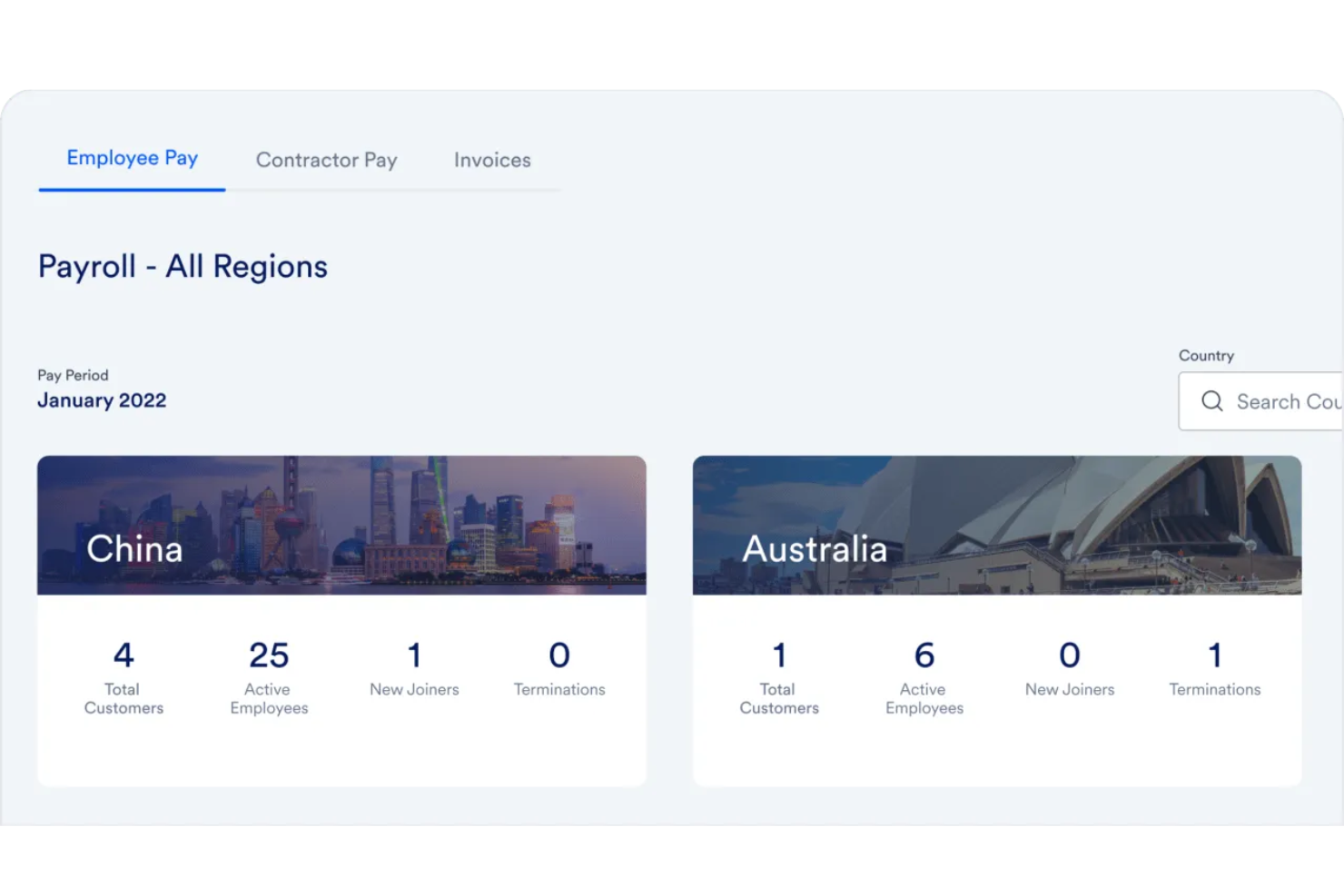
Atlas HXM is a direct employer of record (EOR) platform that handles global payroll processing, local entity employment, compliance management, onboarding, and contractor payments across 160+ countries.
Who Is Atlas HXM Best For?
Atlas HXM is a strong fit for mid-size to enterprise companies hiring across Latin America who need locally compliant employment without setting up their own legal entities.
Why I Picked Atlas HXM
I picked Atlas HXM as one of the best because its compliance infrastructure is genuinely built into the platform, not bolted on as an afterthought. I like that it includes pre-built, locally compliant employment contracts for Brazil and automated compliance alerts that flag regulatory changes as they happen. My team also uses the built-in audit trail to track every employment action, which makes internal reviews far less stressful.
Atlas HXM Key Services
- Central payroll dashboard: Manage salaries, commissions, contractor invoices, benefits, and expenses from a single view.
- Off-cycle payroll processing: Submit and amend off-cycle payroll requests directly in the platform outside of standard pay runs.
- AI-powered payroll analytics: Analyze people and payroll data to forecast upcoming headcount and business needs.
- Country-specific expense rules: View and configure allowable expenses by country to administer location-based benefits correctly.
Atlas HXM Integrations
Integrations are not publicly listed.
Pros and Cons
Pros:
- Single invoice for all global employees
- Tracks local legislation changes in-platform
- Owns legal entities in 160+ countries
Cons:
- Platform can lag under heavy workloads
- Onboarding in Brazil takes 7–10 days

Mercans
Best for fast local payroll delivery

Mercans is a global payroll SaaS platform that runs payroll across 100+ countries through owned local entities, handling gross-to-net calculations, statutory compliance, and multi-currency disbursements.
Who Is Mercans Best For?
Mercans is a strong fit for multinational companies that need to run payroll across several countries simultaneously, particularly where in-country compliance accuracy is non-negotiable.
Why I Picked Mercans
I picked Mercans as one of the best because it runs payroll through its own in-country entities rather than third-party aggregators. That means local tax filings, statutory deductions, and salary disbursements are handled directly, cutting the delays that come with relay-style payroll models. I especially like its dedicated in-country payroll engines, which calculate Brazil's INSS, FGTS, and IRRF deductions natively.
Mercans Key Services
- Multi-user approval flow: Route payroll runs through a configurable, multi-step approval process before disbursement.
- Time and attendance data linking: Connect timesheet data directly to payroll calculations through the HR Blizz platform.
- Statutory filing and payment: Generate and submit statutory filings and payments as part of the payroll run.
- Custom data exports: Download payroll reports in custom formats for reconciliation, auditing, or finance team use.
Mercans Integrations
Integrations include Workday, Oracle, UKG, BambooHR, and Sage.
Pros and Cons
Pros:
- Flexible self-managed or fully outsourced models
- Covers 160 countries from one platform
- In-house payroll engine processes in 48 hours
Cons:
- Pricing requires a consultation to obtain
- Platform interface less polished than competitors

Best for customized payroll workflows

Safeguard Global is a global payroll outsourcing platform that processes multi-country payroll through local experts, with built-in compliance management, a unified payroll calendar, and consolidated reporting across countries.
Who Is Safeguard Global Best For?
Safeguard Global is a strong fit for lean HR and finance teams at mid-size to large companies that need to run multi-country payroll without building an in-house compliance function.
Why I Picked Safeguard Global
I picked Safeguard Global as one of the best because of how it handles customized payroll workflows without requiring a lengthy implementation. Pre-configured country templates and built-in workflow validations mean I can set up payroll in Brazil without building processes from scratch. I especially like the single payroll calendar that maps every country's pay dates and deadlines in one place, which keeps cross-border payroll runs on track.
Safeguard Global Key Services
- Local expert payroll processing: In-country payroll specialists handle end-to-end payroll processing, filings, and compliance for each country, including Brazil.
- Automatic tax rule updates: Country-specific tax rules and payroll regulations are applied automatically on every pay run, with no manual updates required.
- Global payroll dashboard: A single dashboard surfaces headcount spend by country, region, or role for forecasting and budget planning.
- Global benefits administration: Local experts manage sourcing, renewals, and enrollments for mandatory, statutory, and supplemental benefits plans across countries.
Safeguard Global Integrations
Native integrations are not publicly documented.
Pros and Cons
Pros:
- Supports both employees and contractors jointly
- 400+ in-country HR and payroll experts
- Configurable payroll workflows per country
Cons:
- Onboarding timelines slower than newer competitors
- Platform interface feels dated and enterprise-heavy


Rippling is a workforce management platform that runs HR, payroll, and IT on a single system, with a native global payroll engine that handles multi-country payroll, tax filings, and compliance from one employee record.
Who Is Rippling Best For?
Rippling is a strong fit for mid-size to enterprise companies managing employees across multiple countries who want HR and payroll on one platform.
Why I Picked Rippling
I picked Rippling as one of the best because the HR and payroll connection here isn't just a sync, it's a single data layer. When I update a salary, change a job title, or onboard a new hire in Brazil, those changes flow directly into payroll without any manual re-entry. I also like that Rippling handles in-country tax filings and local compliance rules natively, not through a third-party partner network.
Rippling Key Services
- Employer of record (EOR) hiring: Hire workers in Brazil without setting up a local legal entity through Rippling's EOR service.
- Multi-currency pay runs: Run payroll in Brazilian reais alongside other currencies in a single pay cycle.
- Off-cycle payroll: Process one-off payments, bonuses, or termination payouts outside of the standard payroll schedule.
- Payroll approval workflows: Route payroll for review and sign-off before funds are disbursed.
Rippling Integrations
Rippling supports over 650 app integrations through its App Shop, including GitHub, Carta, Jira, HubSpot, Slack, Google Workspace, Salesforce, Zoom, and Microsoft 365, with accounting integrations like QuickBooks Online, Xero, NetSuite, and Sage Intacct that are especially relevant for payroll syncing.
Pros and Cons
Pros:
- No-code workflow automations for payroll
- Automated multi-currency pay runs
- Unifies HR, payroll, and IT data
Cons:
- Reporting can be difficult to customize
- Global payroll sold as paid add-on

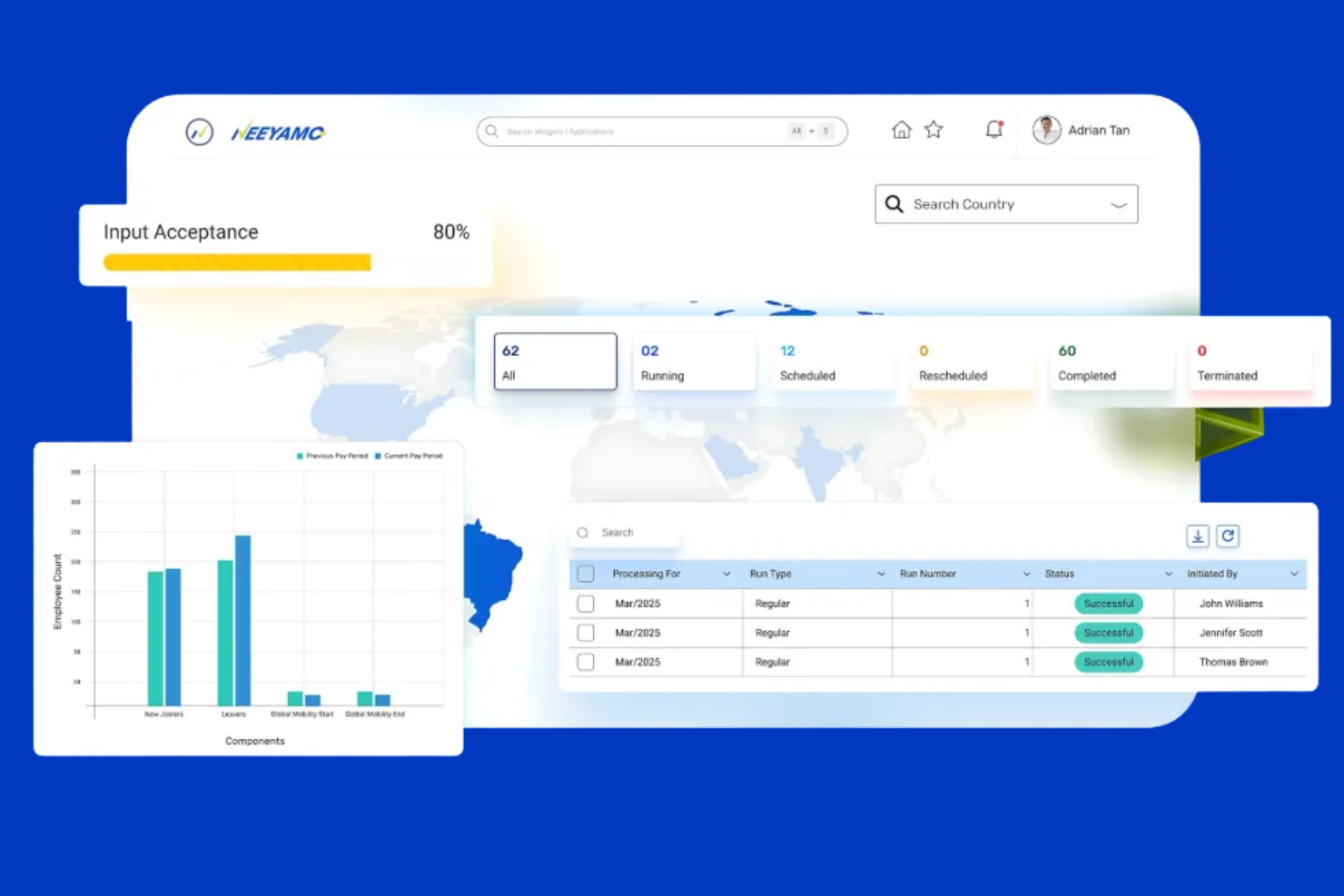
Neeyamo is a global payroll platform built to handle payroll in hard-to-reach markets, including Brazil, using AI, hyper-automation, and robotics to run multi-country payroll from a single system.
Who Is Neeyamo Best For?
Neeyamo is a strong fit for multinational enterprises whose HR teams manage payroll across dozens of countries, including complex markets like Brazil.
Why I Picked Neeyamo
I've included Neeyamo in my top picks because its AI-powered automation directly addresses Brazil's notoriously complex payroll requirements. I like that the platform runs automated variance analysis across pay periods, catching discrepancies before they become costly errors. My team also relies on its parallel payroll processing to run trial and live pay runs simultaneously, which is especially useful when navigating Brazil's eSocial reporting obligations.
Neeyamo Key Services
- Global payroll dashboard: View payroll data across all countries, including Brazil, through interactive dashboards with local insights and alerts.
- Pre-configured deployment instances: Get up and running faster using pre-built templates, artifacts, and best-practice configurations.
- Local compliance codification: Country-specific rules are coded directly into the platform to enforce compliance without manual policy checks.
- Multi-country reporting: Generate consolidated payroll reports across regions from a single global reporting interface.
Neeyamo Integrations
Neeyamo offers certified connectors to major HCM platforms, including Workday, SAP SuccessFactors, Oracle, HiBob, and Darwinbox. It also has its own IntegrationManager, a low-code platform that supports custom integrations with cloud infrastructure like AWS and Azure, along with an API for custom connections.
Pros and Cons
Pros:
- AI tool monitors tax regulation changes automatically
- SOC 2 Type II and ISO 27001 certified
- Native gross-to-net engine in 100+ countries
Cons:
- Setup and customization can take time
- Interface feels dated compared to competitors

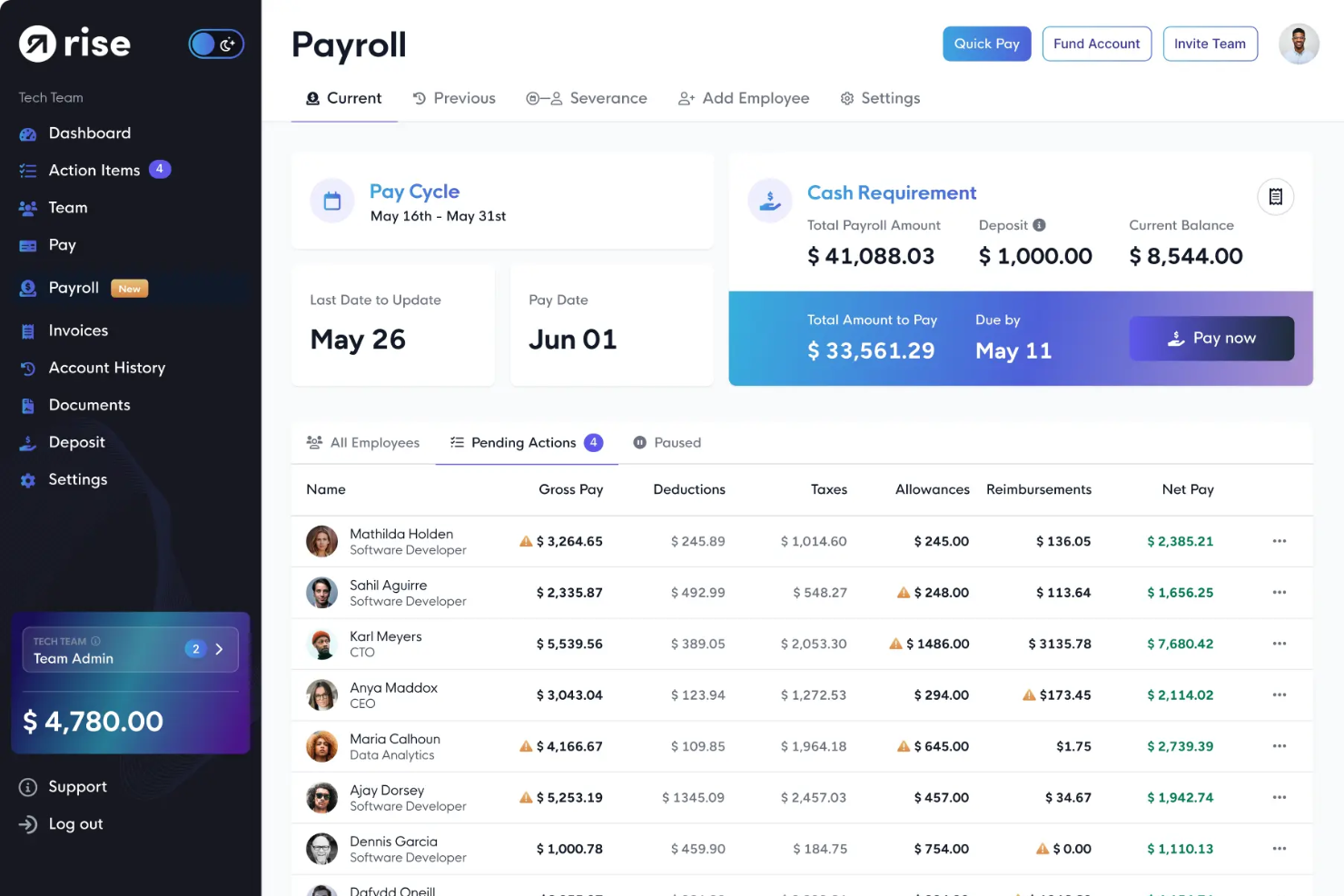
Rise is a global contractor payment platform that processes payroll in both fiat and cryptocurrency, supporting payments to contractors across 190+ countries through traditional bank transfers, stablecoins, and on-chain wallets.
Who Is Rise Best For?
Rise is a strong fit for startups and scaling tech companies that hire independent contractors in Brazil and want to offer payment in crypto, stablecoins, or local currency.
Why I Picked Rise
I've included Rise on my shortlist because it's one of the only contractor payment platforms that lets you fund payroll from either a USD bank account or an on-chain treasury in USDC or USDT. For Brazil, that's genuinely useful since contractors can opt to receive pay in BRL via local bank transfer or withdraw directly to a crypto wallet. I also like Rise's smart contract automation, which triggers payments upon task approval rather than on a fixed pay cycle.
Rise Key Services
- Rise ID: A built-in identity verification layer that authorizes each payment transaction and protects against unauthorized access.
- Invoice processing: Contractors submit invoices or expense claims directly through the platform, giving you a single record of all financial activity.
- Milestone-based payment scheduling: Set up one-time, recurring, or milestone-triggered pay runs to match how your contractors actually work.
- Instant mass payouts: Run large-scale payroll to multiple contractors simultaneously, across currencies and countries, in a single transaction.
Rise Integrations
Rise offers native integrations with accounting tools like Xero, QuickBooks, Campfire, and Rillet, along with blockchain wallets and networks including Coinbase, MetaMask, Gnosis Safe, Ethereum, Solana, and Polygon.
Pros and Cons
Pros:
- Fast local currency withdrawal speeds
- Supports 190+ countries including Brazil
- Pays contractors in fiat or crypto
Cons:
- KYC verification can cause delays
- Contractor-only with no full employee payroll
Remote
Best for multi-country payroll management

Remote is a global payroll platform that runs payroll across 100+ countries, with in-house local experts, a native payments engine, and built-in compliance tools for managing taxes, benefits, and HR data in a single platform.
Who Is Remote Best For?
Remote is a strong fit for mid-size to enterprise companies managing payroll across multiple countries simultaneously, particularly those scaling into new markets without dedicated in-country HR teams.
Why I Picked Remote
I've included Remote in my top picks because it handles payroll across 100+ countries from a single dashboard, which makes it genuinely useful when you're running Brazil payroll alongside multiple other markets at once. I particularly like Remote Watchtower, which monitors regulatory changes and flags anything affecting your payroll automatically. Remote also owns its payroll engines in-house rather than outsourcing to third parties, which means faster support and fewer handoff errors when Brazil's tax rules shift.
Remote Key Services
- Virtual payroll wallet: Fund a central wallet via bank transfer and Remote distributes salary and tax payments to employees and local authorities in local currencies.
- Localized benefits management: Select, enroll, and manage country-specific benefits like health insurance and retirement plans directly within the payroll platform.
- Bulk data uploads: Update employee records and payroll data across multiple countries at once, reducing manual entry across large, distributed teams.
- SOC 2 and ISO 27001 compliance: Remote meets both certifications and requires two-factor authentication and SSO, covering data security requirements for international payroll operations.
Remote Integrations
Remote offers native integrations with BambooHR, Greenhouse, HiBob, Personio, Workday, QuickBooks, Xero, NetSuite, Gusto, and Slack, among others.
Pros and Cons
Pros:
- IP protection built into employment contracts
- Flat monthly fee with no hidden costs
- Runs payroll in 100+ countries natively
Cons:
- Custom reporting requires manual data exports
- Brazil onboarding takes longer than average
Other Global Payroll Options in Brazil
Here are some additional Brazilian global payroll options that didn’t make it onto my shortlist, but are still worth checking out:
- Papaya Global
For consolidated payroll analytics
- RemoFirst
For simplifying remote onboarding
- ADP GlobalView Payroll
For enterprise-scale workforce management
- Borderless AI
For AI-driven contract compliance
- Payoneer Workforce Management
For cross-border contractor payouts
- Native Teams
For managing pensions and benefits
- Playroll
For dual dedicated support managers
- Justworks
For payroll transparency and reporting
- WorkMotion
For localized onboarding workflows
- Lano
For centralizing multi-country pay cycles


How I Evaluate Global Payroll in Brazil
To find the best global payroll services, I evaluate them in two layers: whether they meet CLT and eSocial compliance baselines, and the differentiators that matter most to global HR teams running Brazil operations.
Core Functionality (Table Stakes For This List)
When I'm selecting tools for my list, I rank each one on a scale from 0 (does not offer the functionality) to 5 (excels in this area) for each core functionality listed below. Then, I calculate the tool's total score as a percentage. Each tool needs to achieve a minimum total score of 65% to be considered for inclusion.
- Brazil payroll processing: I check whether the tool handles CLT payroll runs with automated salary components, deductions, and payslips generated in Portuguese.
- Tax compliance: Each tool should automate INSS, IRRF, and FGTS calculations and support eSocial submissions without manual re-entry.
- Statutory benefits management: I look for automated 13th salary installments, vacation pay with the constitutional 1/3 bonus, and transport and meal voucher handling.
- Global payroll consolidation: Brazil payroll data should feed into a unified dashboard alongside other countries so your HQ team gets one consolidated view.
- Multi-currency payments: I evaluate whether you can fund payroll in USD, EUR, or GBP and disburse in BRL with transparent exchange rate visibility.
- EOR or entity support: The tool should offer Employer of Record services, owned-entity payroll, or both, depending on whether you have a CNPJ in Brazil.
Once I have a list of tools that meet these criteria, I consider what sets each platform apart.
Differentiating Factors (What Sets Vendors Apart)
Here's how I compare and contrast different vendors:
Standout Features
eSocial integration is a key differentiator. I look for platforms that submit labor, tax, and social security events to eSocial in real time rather than requiring batch uploads. Union agreement handling also sets vendors apart—some platforms auto-apply wage adjustments and benefits from collective bargaining agreements, which keeps you compliant as rates change. I also evaluate contractor-to-CLT conversion workflows, since misclassification is a real liability in Brazil and guided reclassification with back-pay calculations makes transitions much smoother.
Beyond Features
The entity model matters a lot. I evaluate whether a vendor offers EOR services, owned-entity payroll, or both—and whether you can transition between them as your Brazil team grows. In-country expertise is another factor I weigh heavily. Having Brazil-based payroll specialists and bilingual support during Brazilian business hours makes a real difference when resolving tax filing issues or navigating labor tribunal inquiries. I also check for total cost transparency, especially clear breakdowns of employer burden versus platform fees so there are no surprises at invoice time.
How to Choose A Global Payroll Service in Brazil
It’s easy to get bogged down in long feature lists and complex pricing structures. To help you stay focused as you work through your unique software selection process, here’s a checklist of factors to keep in mind:
| Factor | What to Consider |
| Scalability | Will the tool support growth across new regions, headcounts, and payroll models as your business proceeds with global expansion? |
| Integrations | Can the payroll platform sync with your HRIS, ERP, and accounting software for unified records and financial reporting? |
| Ease of use | How quickly can your team learn, operate, and manage payroll in the tool, including configuration tasks and routine changes? |
| Implementation and onboarding | What level of vendor guidance, documentation, and Brazilian compliance setup do you get during rollout? |
| Customizability | Can you adjust workflows, pay components, templates, or reporting to fit local and international processes? |
| Cost | Are all fees—including currency conversion, compliance filings, and terminations—fully disclosed and aligned with your budget? |
| Security safeguards | Does the platform provide data privacy and security tailored for handling payroll and sensitive employee information? |
| Support availability | Is live, bilingual (Portuguese/English) support accessible across both Brazilian and international time zones for your teams? |
What Are Global Payroll Services in Brazil?
Global payroll services in Brazil refers to platforms or services that enable employers to compliantly pay employees and contractors in Brazil, manage statutory benefits, and fulfill Brazilian tax and labor obligations. These solutions handle CLT payroll, eSocial filings, and local benefits, while typically integrating with global HR or finance systems to unify reporting and processes for international teams.
Why Use Global Payroll Services in Brazil?
Global payroll services help employers pay employees in Brazil while meeting the country's payroll, tax, and reporting requirements. They're particularly useful if you don't have an in-country payroll team or need to manage employees alongside teams in other countries.
You should consider a global payroll provider in Brazil if you need to:
- Manage statutory payroll calculations. Calculate employee INSS, IRRF, FGTS, employer social security contributions, and other mandatory payroll costs using current rates.
- Stay compliant with government reporting. Submit payroll data through eSocial and support related filings such as DCTFWeb and FGTS Digital.
- Handle statutory payroll payments. Process 13th-month salary, vacation pay, the one-third vacation premium, and final payroll calculations when employees leave.
- Keep payroll consistent across countries. Manage Brazil payroll alongside other countries while applying local tax rules, contribution rates, and reporting requirements.
- Reduce compliance risk. Keep payroll calculations aligned with changes to tax rates, contribution ceilings, minimum wage, and payroll reporting requirements.
If you're hiring employees in Brazil without a local payroll function, a global payroll service can help you manage country-specific payroll requirements while giving your HR and finance teams a single process across multiple countries.
How is Payroll Calculated in Brazil?
Calculating payroll in Brazil includes gross remuneration, mandatory employee deductions, employer payroll contributions, statutory payments like vacation and the 13th-month salary when due.
Use the following process to calculate payroll in Brazil:
- Calculate gross remuneration. Start with the employee's contractual monthly salary, then add all earnings due for that pay period, such as overtime pay, commissions, bonuses, shift differentials, night work premiums, hazard pay, and other taxable earnings.
- Add statutory payments due in that payroll cycle. Include any legally required payments, such as vacation pay, the one-third vacation premium, 13th-month salary installments, paid public holidays, or termination payments.
- Calculate employee deductions. Deduct employee INSS (social security) using Brazil's progressive contribution bands. Then calculate IRRF (income tax withholding) based on taxable income after permitted deductions, including INSS contributions and any eligible dependent or simplified deductions.
- Calculate employer payroll costs. Add employer payroll obligations separately from employee pay. These generally include employer INSS, FGTS contributions, workplace accident insurance (RAT), and any applicable third-party contributions.
- Calculate net pay. Subtract employee deductions from gross remuneration to determine the employee's take-home pay.
- Report payroll to the government. Report payroll events through eSocial, which shares payroll information with Brazil's tax and social security authorities and supports DCTFWeb and FGTS Digital reporting.
Keep in mind: Many payroll obligations are also affected by industry-specific Collective Bargaining Agreements (CBAs), which may require higher overtime rates, additional allowances, salary adjustments, or other payments beyond Brazil's statutory minimums.
The example below shows how payroll costs extend beyond an employee's monthly salary.
| Payroll Step | Example |
|---|---|
| Monthly gross salary | BRL 10,000 |
| Employee INSS | Calculated using progressive contribution bands |
| Taxable income | Gross salary less eligible deductions |
| IRRF | Calculated using applicable income tax brackets |
| Employee net pay | Gross salary less INSS and IRRF |
| Employer FGTS | BRL 800 (8%) |
| Employer INSS | Generally BRL 2,000 (20%)* |
| RAT and other statutory contributions | Depends on employer classification |
| Total employer cost | Employee salary plus all employer payroll contributions |
Brazilian Payroll Taxes and Deductions
Employers in Brazil need to calculate both employee deductions and employer payroll contributions. The main employee deductions are INSS and IRRF, while the main employer costs include FGTS, employer INSS, workplace accident insurance, and third-party contributions.
| Payroll Item | 2026 Rate | How It's Calculated |
|---|---|---|
| Employee INSS | 7.5%–14% (progressive) | Apply each contribution rate progressively across the applicable salary bands rather than using a single flat percentage. |
| IRRF (Income Tax) | 0%–27.5% | Calculate tax after deducting employee INSS and any eligible deductions, such as dependent deductions or the monthly simplified deduction. |
| FGTS | 8% | Deposit 8% of the employee's monthly remuneration into the employee's FGTS account. This is paid by the employer and isn't deducted from salary. |
| Employer INSS | Generally 20% | Calculate employer social security contributions based on the employee's monthly remuneration before deductions. |
| RAT (Workplace Accident Insurance) | 1%–3% | Apply the applicable rate according to the employer's occupational risk classification. |
| Third-Party Contributions | Varies | Additional statutory contributions may apply depending on the employer's industry, tax regime, and activities (such as SENAI, SESI, or INCRA contributions). |
Brazilian Leave Entitlements
Leave entitlements affect payroll throughout the year and should be incorporated into payroll planning.
| Leave Type | Payroll Impact |
|---|---|
| Annual Leave | Pay the employee's normal salary before leave begins, plus the mandatory one-third vacation premium. |
| Vacation Premium | Add an additional 33.3% of the employee's regular vacation pay for every statutory vacation period taken. |
| Maternity Leave | Process payroll for 120 days of statutory maternity leave in accordance with Brazil's social security reimbursement rules where applicable. |
| Paternity Leave | Pay statutory paternity leave for eligible employees following the birth, adoption, or legal guardianship for adoption of a child, in accordance with current legal requirements. |
| Sick Leave | Employers generally pay the employee's salary for the first 15 calendar days of sickness. From day 16, eligible benefits are generally paid through INSS. |
| 13th Salary | Pay an additional month's salary each year, typically in two statutory installments, with the final installment due by December 20. |
Note: Employers enrolled in the Empresa Cidadã program may provide extended maternity and paternity leave beyond the statutory minimum, subject to the program's eligibility requirements and tax rules.
Brazilian Public Holidays
There are 12 national public holidays in Brazil. Public holidays affect payroll because employees are generally entitled to paid time off on national, state, and municipal holidays. Employers should map holidays by the employee’s actual work location, since local holidays can change payroll treatment for that pay period.
For payroll teams, the main issue is not just adding holidays to the calendar. You need to identify whether the employee worked that day, whether a premium or compensatory day off applies, and whether the holiday also triggers overtime rules under the relevant Collective Bargaining Agreement.
| Payroll Scenario | Payroll Treatment |
|---|---|
| Employee does not work on a public holiday | Treat the day as paid time off. No salary deduction applies. |
| Employee works on a public holiday | Pay holiday work at the applicable premium rate or provide compensatory time off, depending on the employment arrangement and CBA. |
| Holiday work is treated as overtime | Apply the required overtime or holiday premium, using the higher applicable rule where required by the CBA or labor rules. |
| Holiday falls during vacation | Review whether the day affects vacation counting or payment treatment under the applicable employment terms or CBA. |
| State or municipal holiday applies | Apply the same payroll review for employees working in that specific location. |
Termination Terms in Brazil
Final payroll depends on the reason for termination, including whether the employee resigns, is dismissed with or without cause, or both parties mutually agree to end the employment relationship.
When processing final payroll, you should calculate the following statutory payments.
| Payroll Item | Payroll Treatment |
|---|---|
| Final Salary | Pay salary earned through the employee's final working day. |
| Notice Pay | Provide 30 days of notice period, plus 3 additional days for each completed year of service, up to 90 days, where applicable. |
| Unused Vacation | Pay accrued and unused vacation, including the mandatory one-third vacation premium. |
| Pro-Rated Vacation | Pay any vacation accrued but not yet earned in full where required under Brazilian labor law. |
| Pro-Rated 13th Salary | Pay the portion of the annual 13th salary earned before termination. |
| FGTS | Make final FGTS deposits and, where applicable, calculate the statutory 40% FGTS termination penalty for dismissals without cause. |
| Final Reporting | Report the termination through eSocial and complete any required FGTS Digital reporting. |
Severance pay: Severance may apply depending on the type of termination, with dismissals without cause generally requiring a 40% FGTS fine in addition to final payroll entitlements.
How Is Payroll Compliance Regulated in Brazil?
Payroll compliance in Brazil is regulated through a combination of federal labor, tax, social security, and employment laws. Employers must calculate payroll according to these rules, report payroll data through government systems, and remit taxes and statutory contributions by the required deadlines.
The main payroll compliance requirements are:
| Compliance Area | Employer Requirement |
|---|---|
| eSocial | Report employee admissions, payroll, leave, compensation changes, and terminations through the government's unified reporting platform. |
| Receita Federal | Withhold and remit employee income tax (IRRF) and employer tax and social security contributions. |
| INSS | Calculate and report employee and employer social security contributions using the current contribution rates and ceilings. |
| FGTS Digital | Calculate and pay monthly FGTS contributions and any termination-related FGTS obligations. |
| DCTFWeb | Submit monthly payroll tax declarations using data reported through eSocial and EFD-Reinf. |
Because these systems are connected, payroll data reported in eSocial is used to generate other statutory filings. An error in payroll calculations or employee records can affect tax reporting, FGTS payments, and social security declarations, so employers should ensure payroll data is accurate before submitting each payroll cycle.
Outsourcing Payroll in Brazil
Many companies outsource payroll in Brazil because the country has detailed payroll calculations, multiple government reporting systems, and frequent regulatory updates. You can either work with a local payroll provider that specializes in Brazil or a global payroll provider that manages payroll across multiple countries.
Local Payroll Services Company
A local payroll services company is a good fit if all of your employees are based in Brazil and you already have a legal entity setup there.
Local providers typically help you:
- Calculate monthly payroll, including INSS, IRRF, FGTS, and employer contributions.
- Process statutory payments such as vacation bonus, the one-third vacation premium, and the 13th salary.
- Submit payroll data through eSocial and support DCTFWeb and FGTS Digital filings.
- Process new hires, employee changes, and terminations in line with Brazilian payroll requirements.
- Keep payroll calculations up to date as tax rates, contribution ceilings, and reporting requirements change.
Global Payroll Services Company
A global payroll services company is a better choice if you employ people in Brazil and other countries. Instead of managing separate payroll providers in each market, you can run payroll through a single platform while applying local payroll rules in every country.
Global payroll providers typically help you:
- Process payroll across multiple countries from one system.
- Apply Brazil-specific payroll calculations, tax rates, and statutory contributions.
- Consolidate payroll data and reporting across your global workforce.
- Standardize payroll approvals, reporting, and payment workflows across countries.
- Integrate payroll data with your HRIS, accounting software, and finance systems.
Features of Global Payroll in Brazil
When selecting a global payroll service in Brazil, keep an eye out for the following key features:
- Brazil payroll processing: Automates CLT-compliant salary calculations, deductions, and payslip generation in Portuguese to ensure all payroll runs adhere to Brazilian law.
- Statutory benefits management: Calculates and manages 13th salary, vacation pay with the 1/3 bonus, transport vouchers, and meal allowances required under Brazilian regulations.
- eSocial integration: Connects directly with Brazil's eSocial system to automate labor, social security, and tax event filings, reducing manual effort and risk of non-compliance.
- Multi-currency payments: Supports funding payroll in multiple currencies such as USD, EUR, or GBP, then pays employees and contractors in Brazilian Real (BRL), offering convenient cross-border transactions.
- Automated tax compliance: Handles calculations and filings for INSS, FGTS, IRRF, and other taxes, with built-in updates for evolving regulatory requirements.
- Global payroll consolidation: Centralizes Brazil payroll data alongside other countries in a unified dashboard, allowing for consolidated reporting and analytics.
- EOR or local entity support: Offers Employer of Record services for businesses without a local entity, as well as payroll processing for those with a registered CNPJ in Brazil.
- Union agreement automation: Supports collective bargaining agreements by automatically applying rate changes, dissídios, and category-specific benefits.
- Customizable pay components: Lets you tailor salary elements, allowances, and deductions to match local employment contracts, industry norms, and compliance needs.
- Secure document management: Stores payslips, contracts, and compliance documents securely, enabling safe sharing with employees and auditing authorities.
Benefits of Global Payroll Services in Brazil
Implementing global payroll in Brazil provides several benefits for your team and your business. Here are a few you can look forward to:
- Simplified local compliance: Automated eSocial reporting, tax filings, and statutory benefits calculations reduce the risk of errors and non-compliance penalties.
- Unified global reporting: Consolidated payroll data for Brazil and other regions makes it easier for HR and finance teams to analyze workforce costs and trends.
- Faster, accurate payments: Multi-currency capabilities and automated calculations ensure employees and contractors are paid correctly and on schedule.
- Adaptability as you grow: Support for EOR and local entity models means you can scale or transition operations in Brazil without switching platforms.
- Reduced administrative burden: Payroll automation and self-service features free up HR resources to focus on business priorities, not manual calculations.
- Smooth integration: Pre-built connections with HRIS, ERP, and accounting systems keep employee and financial data consistent across your tech stack.
- Greater transparency: Secure document management and customizable reporting give stakeholders timely access to pay records, costs, and compliance data.
Trends in Brazil Payroll Software
Payroll software in Brazil continues to evolve as employers adapt to digital government reporting and changing compliance requirements. If you're evaluating payroll software, these are the trends shaping the market.
- Native eSocial and FGTS Digital integrations. Payroll platforms increasingly connect directly with Brazil's government reporting systems so employers can submit payroll events and statutory filings from the same platform.
- Automated compliance updates. More payroll providers automatically update tax rates, INSS contribution ceilings, national minimum wage changes, and payroll rules as regulations change, reducing the need for manual configuration.
- Multi-country payroll management. Global employers are adopting platforms that combine Brazil payroll with payroll in other countries while still applying local tax rules, statutory benefits, and reporting requirements.
- Closer HRIS and finance integrations. Payroll software is increasingly connected to HR, time tracking, accounting, and ERP systems to synchronize employee data, payroll costs, and general ledger entries.
- Expanded support for FGTS Digital. As the FGTS Digital platform continues to add new functionality, payroll providers are expanding support for new payment and reporting requirements, including employment-related FGTS obligations.
Costs & Pricing
Selecting global payroll in Brazil requires an understanding of the various pricing models and plans available. Costs vary based on features, team size, add-ons, and more. The table below summarizes common plans, their average prices, and typical features included in global payroll in Brazil solutions:
Plan Comparison Table for Global Payroll Software in Brazil
| Plan Type | Average Price | Common Features |
|---|---|---|
| Free Plan | $0 | Provides limited payroll calculations, basic compliance resources, and access to help documentation. |
| Personal Plan | $20-$50/user/month | Includes single-country payroll processing, statutory benefits management, tax calculation, and standard support. |
| Business Plan | $50-$120/user/month | Offers multi-country payroll, eSocial integration, multi-currency payments, integrations, and reporting tools. |
| Enterprise Plan | $120-$250/user/month | Adds dedicated account management, customizable workflows, union handling, API access, and advanced security. |
Global Payroll Services in Brazil FAQs
Here are some answers to common questions about global payroll services in Brazil:
Does global payroll in Brazil support both employees and contractors?
Yes, most solutions handle payroll for both CLT employees and independent contractors in Brazil. This includes automated calculations for benefits, taxes, and payments according to the type of worker and contract.
How does multi-currency payroll work for teams in Brazil?
Multi-currency payroll lets you fund payroll using USD, EUR, or GBP, while employees and contractors in Brazil receive their pay in BRL. The platform manages currency conversion, provides rate transparency, and reconciles the exchange difference for clear reporting.
Can I use global payroll in Brazil if I don’t have a legal entity in Brazil?
Yes, many vendors offer Employer of Record (EOR) services, letting you hire and pay employees in Brazil without setting up a local entity. They handle compliance, local contracts, and payroll as the legal employer.
What should I ask about compliance when choosing a provider?
Check if the provider supports real-time eSocial submissions, keeps CLT rules updated, manages FGTS, INSS, and IRRF filings, and provides audit support. Ask how they handle collective bargaining agreements and regional labor variations.
How long does implementation usually take?
Implementation for global payroll in Brazil typically takes a few weeks to a couple of months. The exact timeline depends on your company size, current systems, and whether you need EOR services or are running payroll for an existing entity.
This content is provided for general informational purposes only and does not constitute legal, tax, or other professional advice. It may not be complete, accurate, or current, and laws and practices may change without notice and vary by jurisdiction. You should not act on this information without obtaining advice from qualified legal or tax counsel in the relevant jurisdiction regarding your specific circumstances.