

10 Best Employer of Record Services in Thailand in 2026

Employer of Record Services in Thailand Shortlist


Employer of record services let you hire, pay, and manage employees in Thailand without setting up a local entity. If you’re looking to expand your team or tap into Thai talent, these services handle payroll, compliance, and HR admin so you can focus on growth. In this guide, you’ll find my top picks for employers of record providers in Thailand, what makes each one unique, and how they help you stay compliant and competitive in 2026.
Why Trust Our Software Reviews
Our team has been testing and reviewing software since 2012. As HR experts ourselves, we know how difficult—and important—it is to choose the right software.
For this guide, we evaluated tools using hands-on testing and independent research, scoring tools using our selection criteria. We also draw on insights from industry thought leaders and practicing HR experts.
Our reviews reflect our human editorial judgment, not a sales pitch.
Expert reviewers:
Best Employer of Record Services in Thailand Summary
This comparison chart summarizes pricing details for my top employer of record services selections to help you find the best one for your budget and business needs.
| Tool | Best For | Trial Info | Price | ||
|---|---|---|---|---|---|
| 1 | Best for instant employment document generation | Free demo available | From $599/employee/month | Website | |
| 2 | Best for low-cost EOR services for small, early-stage teams | Free demo available | From $99/employee/month | Website | |
| 3 | Best for ESOP and equity pay for Thai hires | Free demo available | From $459/user/month (billed annually) | Website | |
| 4 | Best with dedicated in-country HR support across the full employee lifecycle | Free demo available | Pricing upon request | Website | |
| 5 | Best for a direct entity model with in-country HR teams | Free demo available | From $599/employee/month | Website | |
| 6 | Best for a centralized compliance dashboard and global payroll engine | Free demo available | Pricing upon request | Website | |
| 7 | Best for built-in compliance templates and workflows | Free demo available | From $699/employee/month | Website | |
| 8 | Best for localized onboarding flows and automated tax handling for Thai employees | Free demo available | From $199/employee/month | Website | |
| 9 | Employer of record with global reach and local expertise | Free demo available | From $399/employee/month | Website | |
| 10 | Best for onboarding tracking and automated invoicing | Free demo available | From $199/employee/month | Website |
Employer of Record Services in Thailand Reviews
Below are my detailed summaries of the employer of record services that made it onto my shortlist. My reviews offer a detailed look at the features, pricing, and compliance capabilities of each platform to help you find the best one for you.

Best for instant employment document generation
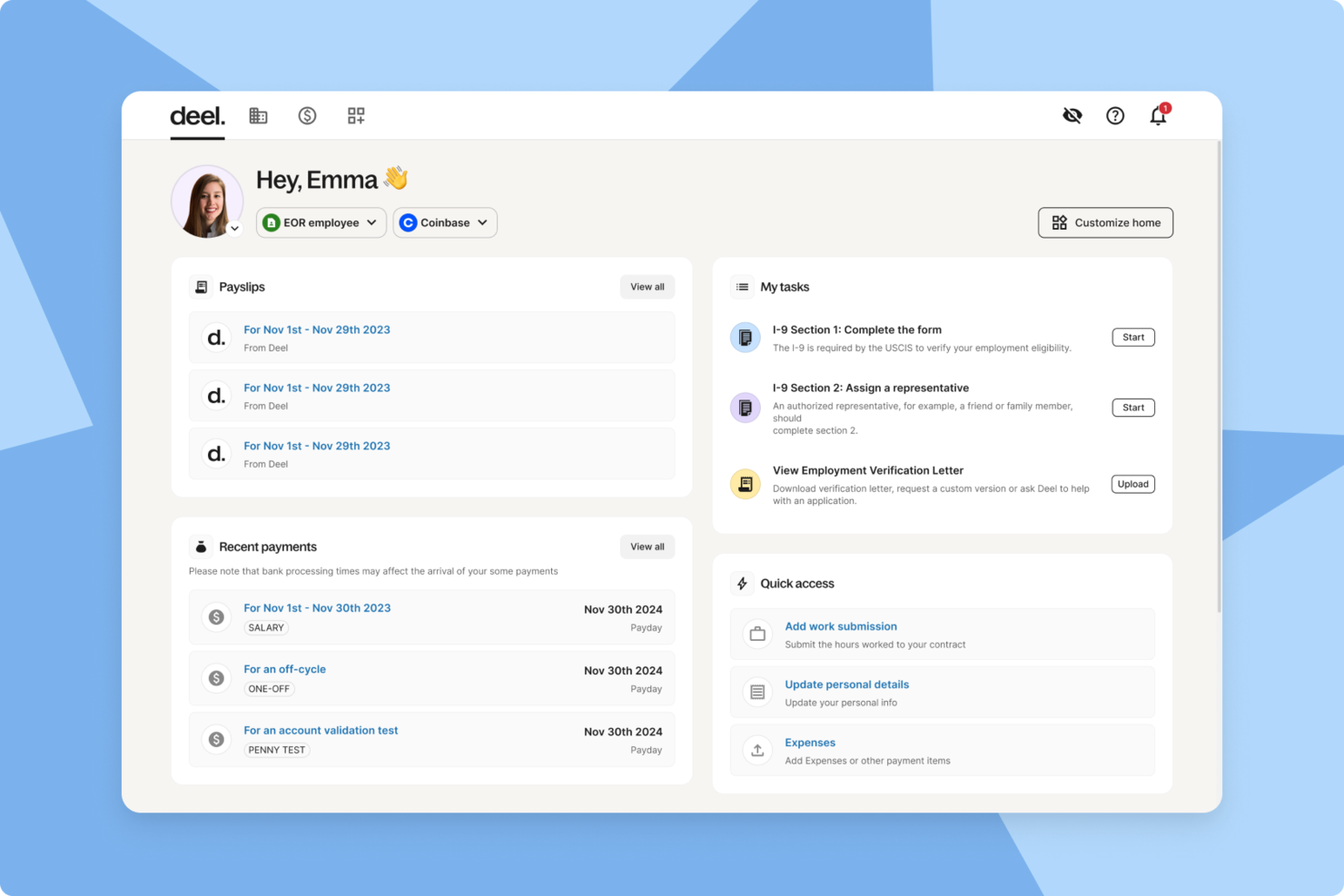
Deel is a global employer of record platform that lets you legally hire, onboard, and pay employees in Thailand—and 150+ other countries—without setting up a local entity.
Who Is Deel Hire Best For?
Deel is a strong fit for growing companies that need to hire employees in Thailand without the overhead of establishing a local legal entity.
Why I Picked Deel Hire
I picked Deel as one of the best because document generation is baked directly into the onboarding flow. When I'm hiring in Thailand, Deel automatically produces locally compliant employment contracts that align with Thai labor law, without me needing to involve a legal team. I also like that Remote Worker Verification handles background checks and identity confirmation before the contract is sent, so everything from vetting to signing happens in one place.
Deel Hire Key Features
- Thai statutory benefits enrollment: Deel configures Social Security, Provident Fund, and private healthcare through Allianz directly within the platform during onboarding.
- Compliance monitoring: Deel tracks changes to Thai labor regulations and sends alerts when your employment setup requires attention.
- Automated task assignment: During onboarding, Deel assigns tasks, collects required documents, and sets up system access for new hires automatically.
- Managed payroll tax filings: Deel calculates and files income tax withholdings and statutory contributions on behalf of your Thailand-based employees each pay cycle.
Deel Hire Integrations
Deel offers integrations with BambooHR, Xero, QuickBooks, NetSuite, Slack, Expensify, and Sage Intacct. It's available on Zapier and has an API for custom integrations.
Pros and Cons
Pros:
- Has in-house local legal experts
- Handles work permits and visa sponsorship
- Owns its Thai legal entity directly
Cons:
- Higher starting monthly management fee
- Cutoff date restrictions for payroll modifications

Best for low-cost EOR services for small, early-stage teams
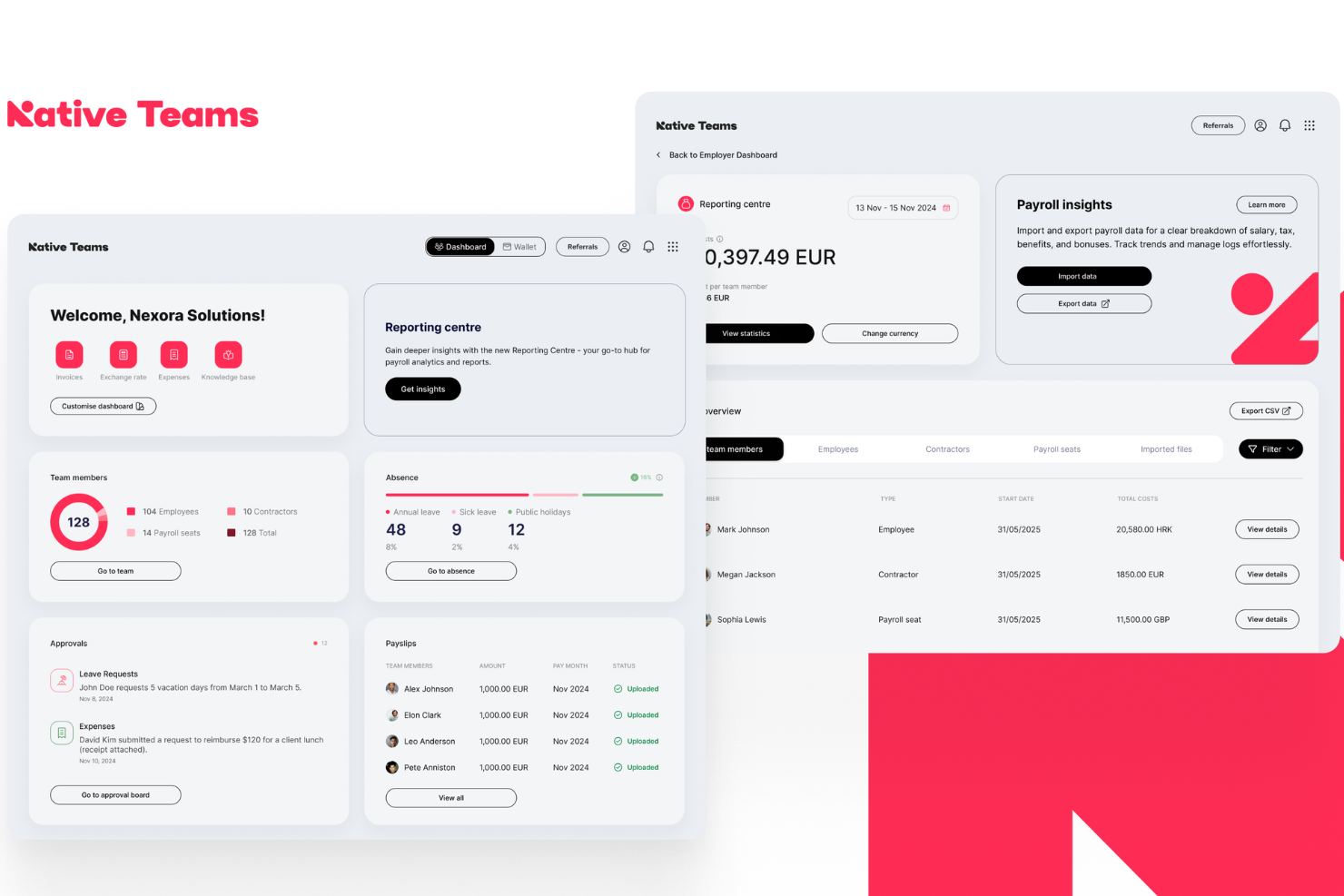
Native Teams is an employer of record platform for Thailand that enables HR teams to engage local workers through its legal entities, providing compliant employment and proper worker classification under Thai regulations. It manages payroll, benefits, and essential HR documentation within a unified system while businesses retain oversight of daily operations.
Who Is Native Teams Best For?
Global businesses and HR teams managing Thai employees and contractors across multiple countries.
Why I Picked Native Teams
I picked Native Teams as one of the best because I like how it handles local contracts and multi-country payroll from a single dashboard. My team uses its contract generator to create Thailand-compliant agreements and automate onboarding for both employees and contractors. I also rely on its payroll engine to manage payments in multiple currencies while staying compliant with Thai regulations.
Native Teams Key Features
- Employee self-service portal: Lets Thai employees view payslips, contracts, and personal details online.
- Localized benefits administration: Manages statutory and supplemental benefits for employees in Thailand.
- Automated leave management: Tracks and processes vacation and sick leave for Thai staff.
- Centralized compliance dashboard: Monitors regulatory changes and compliance status for Thai employment.
Native Teams Integrations
Native integrations are not clearly documented. An API is available for custom integrations.
Pros and Cons
Pros:
- Automated tax calculations for Thailand
- Thai labor law-compliant contract templates
- Localized payroll processing for Thai employees
Cons:
- No built-in time tracking for hourly staff
- Limited reporting customization for Thai entities

Best for ESOP and equity pay for Thai hires
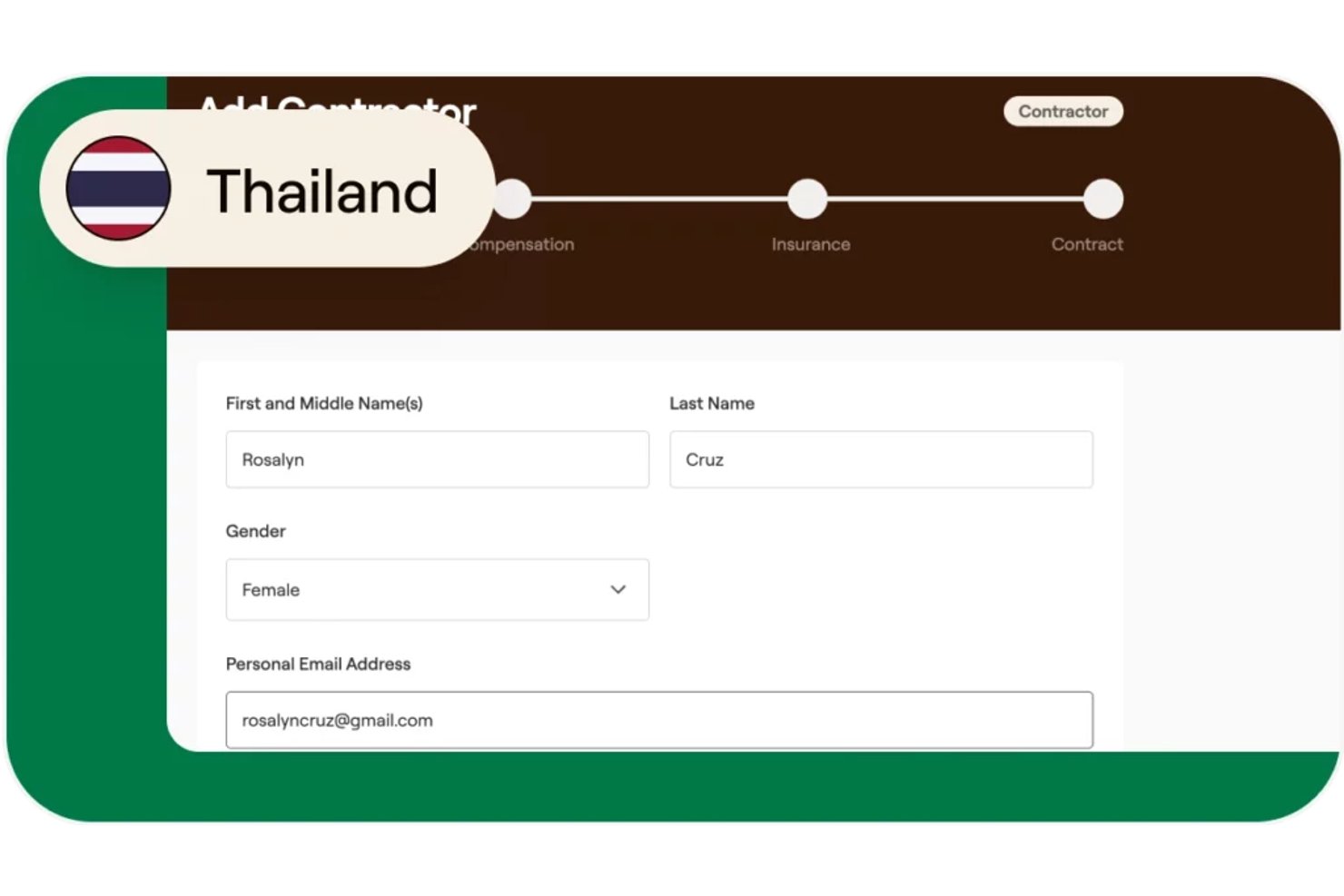
Multiplier is an employer-of-record platform that handles Thai payroll in THB, personal income tax withholding, Social Security Fund contributions, statutory benefits, work permit and visa processing, and ESOP administration for international hires.
Who Is Multiplier Best For?
Multiplier is a strong fit for tech companies and startups that want to offer equity compensation to Thai hires without setting up a local entity.
Why I Picked Multiplier
I've included Multiplier in my top picks because it's one of the few EOR platforms that handles ESOP administration natively, meaning you can grant equity to Thai hires without setting up a local entity or patching together a separate equity tool. I particularly like that this extends to tax-compliant stock-based compensation, which is genuinely rare in the EOR space. Multiplier also manages Thai work permits and BOI-linked visa applications end to end, which is a real advantage if you're relocating foreign talent into Thailand.
Multiplier Key Services
- Thai payroll processing: Runs payroll in THB across 120+ currencies with 99.95% cycle accuracy, including PIT withholding and SSF contributions.
- Provident Fund administration: Manages optional Provident Fund enrollment, contributions, and reporting for Thai employees.
- Employee self-service portal: Gives Thai hires a mobile app to access payslips, submit PTO requests, and manage personal documents.
- Contractor classification tooling: Identifies misclassification risk and onboards compliant contractors in Thailand with multi-currency payment support.
Multiplier Integrations
Multiplier integrations include BambooHR, HiBob, Personio, and Workday. It also provides an API for custom integrations.
Pros and Cons
Pros:
- Dedicated in-house legal and tax experts
- Fast work permit and BOI visa processing
- Native support for ESOP and equity pay
Cons:
- Customer support response can be inconsistent
- Invoice transparency issues reported by finance teams

Best with dedicated in-country HR support across the full employee lifecycle
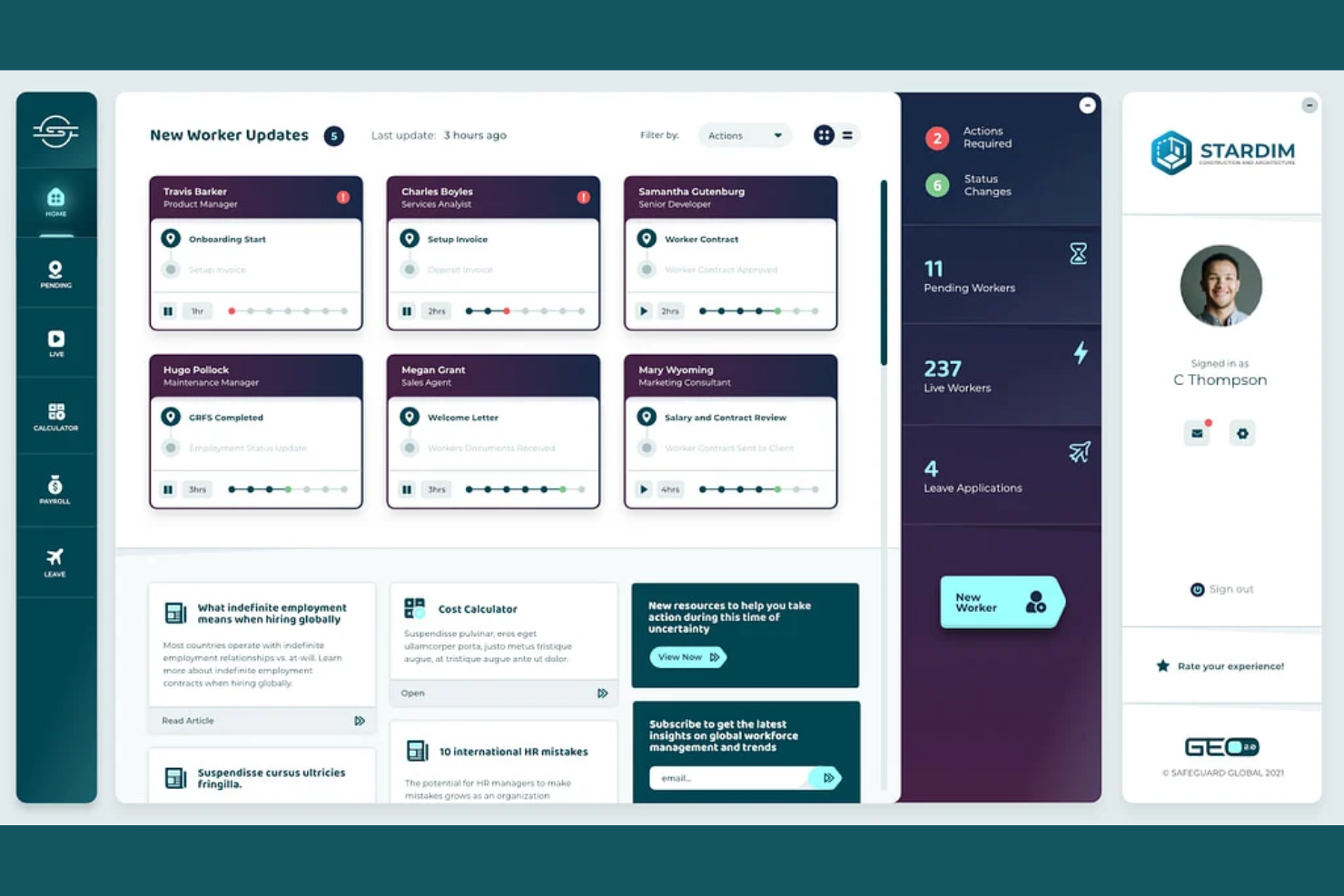
Safeguard Global provides a managed employment solution in Thailand that helps HR teams bring on local talent without needing to establish their own entity. It takes on responsibilities such as drafting compliant contracts, processing payroll, managing statutory contributions, administering benefits, and supporting the full employee lifecycle.
Who Is Safeguard Global Best For?
HR teams at multinational companies hiring employees in Thailand who need local HR and compliance expertise.
Why I Picked Safeguard Global
I picked Safeguard Global because I want direct access to local HR and compliance experts in Thailand. My team uses their platform to generate Thai-compliant employment contracts and manage payroll with in-country specialists. I like that we can rely on their local team for up-to-date guidance on Thai labor regulations and statutory benefits.
Safeguard Global Key Features
- Automated onboarding workflows: Guides new hires in Thailand through each onboarding step.
- Centralized document storage: Keeps employment records and compliance documents organized and accessible.
- Time-off management: Tracks employee leave balances and approvals for Thai staff.
- Expense reimbursement processing: Lets you submit, review, and approve employee expenses online.
Safeguard Global Integrations
Native integrations are not clearly documented. An API is available for custom integrations.
Pros and Cons
Pros:
- End-to-end employment support in one service
- Thai labor law-compliant contract templates
- Localized payroll processing for Thai employees
Cons:
- No built-in time tracking for hourly staff
- No native integrations with HRIS platforms

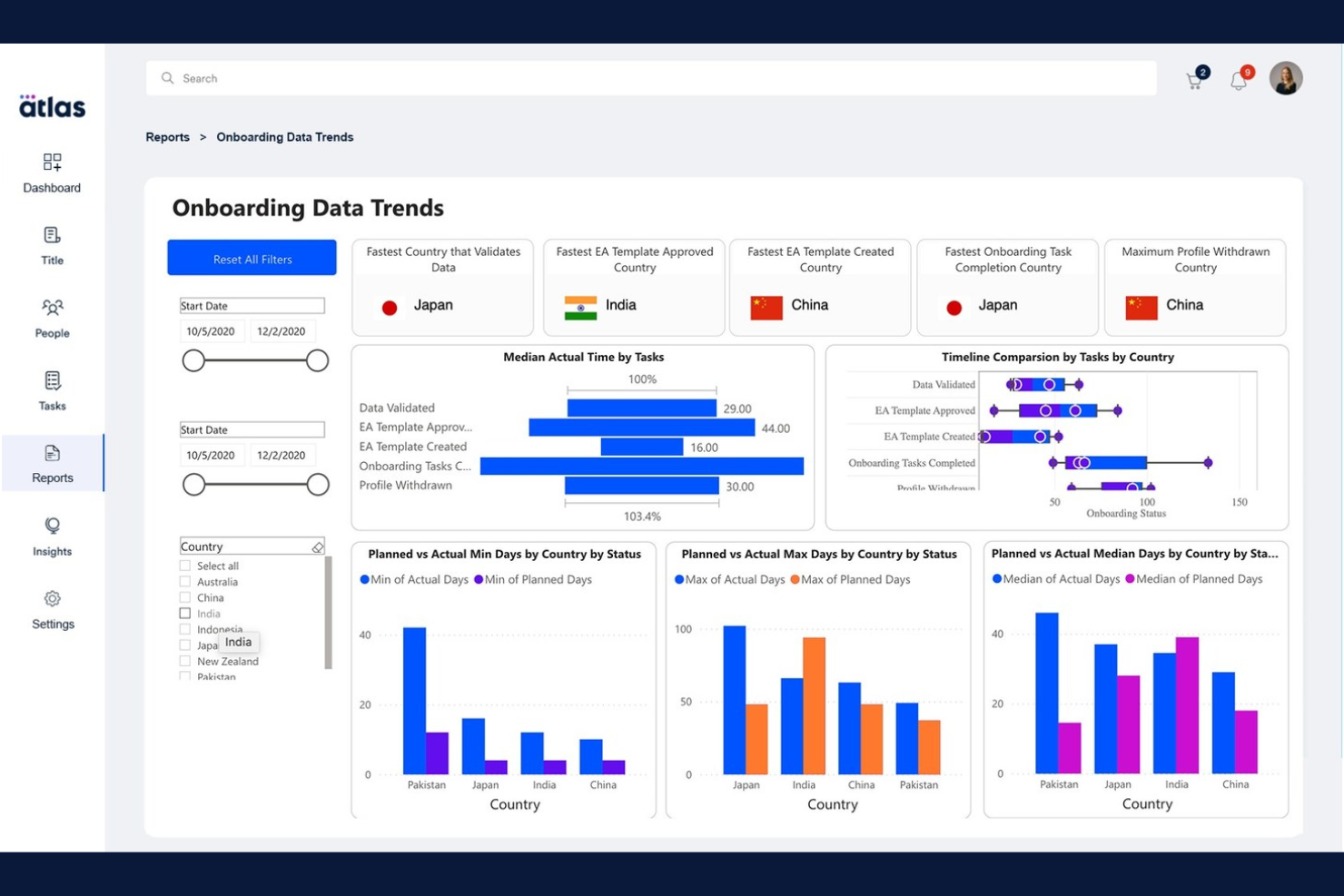
Atlas HXM is a global employment solution designed to support HR teams managing talent in Thailand through its direct entity model, enabling companies to engage local employees without intermediaries. It oversees core employment functions through its in-country teams while following Thailand's labor regulations and employment practices.
Who Is Atlas Best For?
HR leaders at multinational companies hiring employees in Thailand who need in-country expertise and global payroll management.
Why I Picked Atlas
I picked Atlas as one of the best because I need a provider with in-country expertise for Thailand and direct global payroll capabilities. I like that my team can access local HR specialists who understand Thai employment law and handle complex payroll calculations. I use Atlas to generate compliant contracts and manage statutory benefits without relying on third-party partners.
Atlas Key Features
- Automated onboarding workflows: Guides new hires in Thailand through each onboarding step.
- Document management: Stores and organizes employment contracts and compliance documents.
- Time-off tracking: Monitors employee leave balances and approvals.
- Expense management: Lets you submit, review, and approve employee expenses online.
Atlas Integrations
Native integrations are not clearly documented. An API is available for custom integrations.
Pros and Cons
Pros:
- Strong compliance support for Thai regulations
- Direct entity model ensures stronger control in Thailand
- Fast onboarding for both employees and contractors
Cons:
- Expense management lacks multi-currency support
- May require more structured processes for onboarding

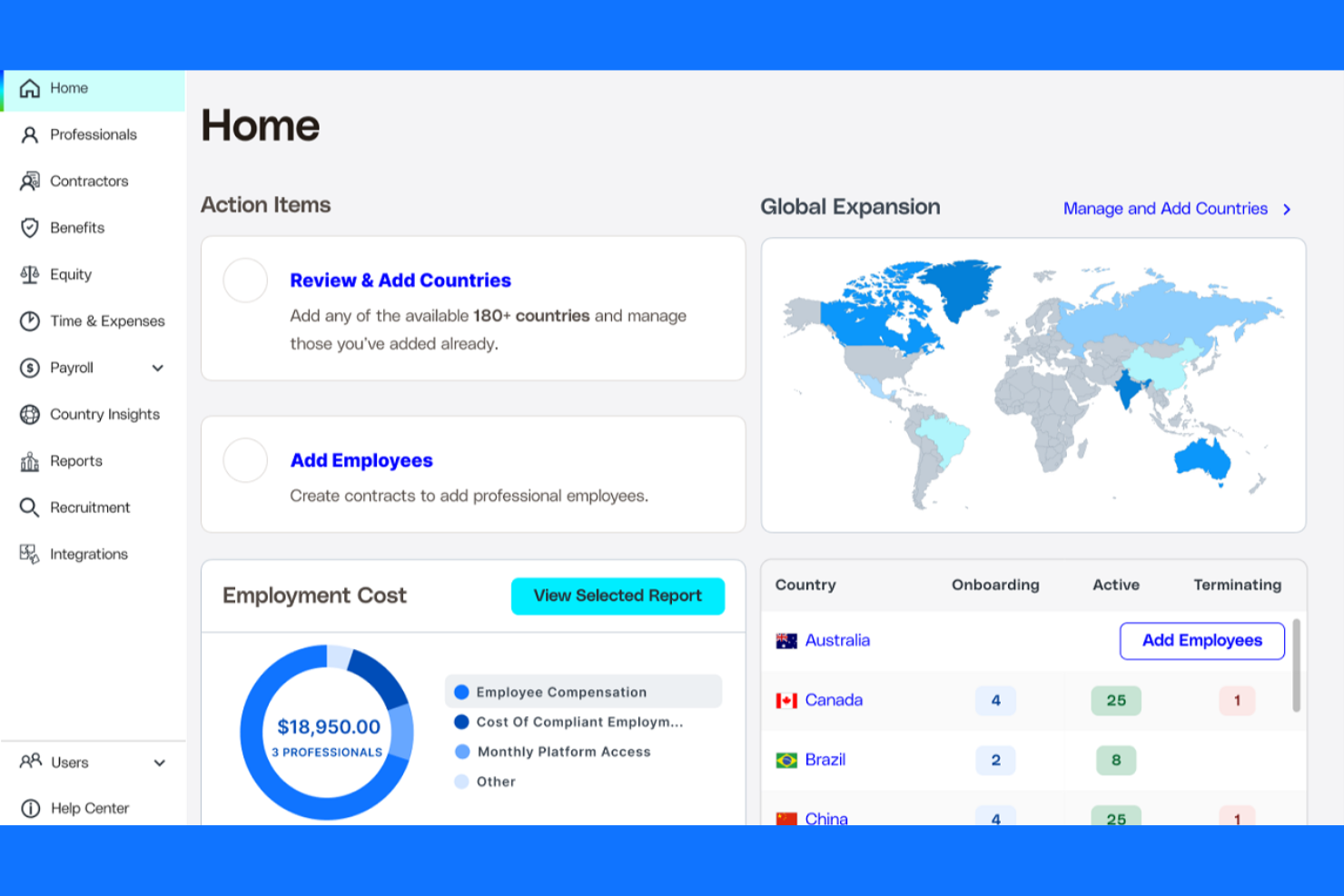
Globalization Partners is an employer of record solution for Thailand that enables HR teams to hire local talent quickly through its global entity infrastructure without managing entity setup. It supports compliant employment by handling contracts, payroll, and benefits while helping companies navigate Thailand’s labor laws and regulatory requirements with in-country expertise.
Who Is Globalization Partners Best For?
Global HR teams at multinational companies hiring and onboarding employees in Thailand.
Why I Picked Globalization Partners
I picked Globalization Partners because I like how the platform automates onboarding and payroll for Thai hires in one place. My team uses its global payroll engine to handle local tax and compliance requirements without manual calculations. I also rely on the built-in contract generation tools to create Thai-compliant employment agreements quickly.
Globalization Partners Key Features
- Employee self-service portal: Lets Thai employees access payslips, contracts, and personal details online.
- Localized benefits administration: Manages statutory and supplemental benefits for employees in Thailand.
- Automated leave management: Tracks and processes vacation and sick leave for Thai staff.
- Centralized compliance dashboard: Monitors regulatory changes and compliance status for Thai employment.
Globalization Partners Integrations
Integrations include ADP TotalSource, ADP Workforce Now, Paylocity, BambooHR, Workday, SAP SuccessFactors, HiBob, Microsoft Entra ID, Google Workspace, and more.
Pros and Cons
Pros:
- Centralized document management for compliance
- Fast onboarding for both employees and contractors
- Automated tax calculations for Thailand
Cons:
- No built-in time tracking for hourly staff
- Limited reporting customization for Thai entities

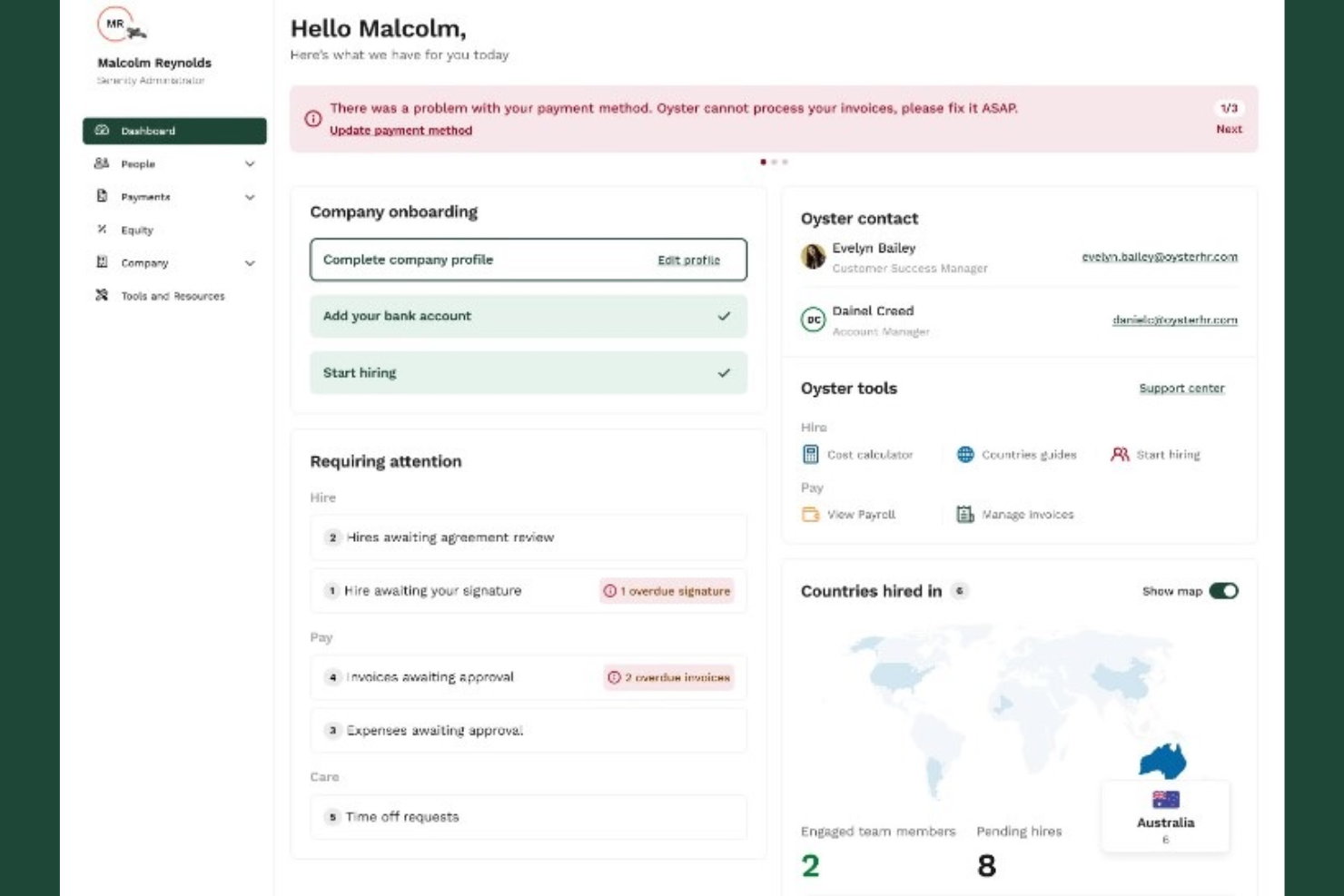
Oyster is an employer of record platform for HR teams that provides a complete employment framework for employees in Thailand. It supports companies in hiring, paying, and supporting team members while minimizing compliance risks through strong local expertise.
Who Is Oyster Best For?
HR teams at global companies hiring employees in Thailand who want automated compliance and localized support.
Why I Picked Oyster
I picked Oyster as one of the best because I need a platform that automates compliance and adapts to Thai employment regulations. I like that my team can generate compliant contracts and manage local benefits with built-in templates. I use Oyster’s localized support to resolve regulatory questions quickly and keep onboarding moving without delays.
Oyster Key Features
- Automated payroll processing: Calculates and pays salaries in Thai baht.
- Expense management: Lets you review and approve employee expenses online.
- Time-off tracking: Tracks leave balances and approvals for Thai employees.
- Centralized document storage: Stores contracts, onboarding files, and compliance documents securely.
Oyster Integrations
Oyster offers native integrations with BambooHR, HiBob, Workday, Greenhouse, and QuickBooks Online. An API is available for custom integrations.
Pros and Cons
Pros:
- Fast onboarding and market entry in Thailand
- Thai labor law-compliant contract templates
- Localized payroll processing for Thai employees
Cons:
- Limited flexibility for complex local HR needs
- Benefits may lack strong local competitiveness
Best for localized onboarding flows and automated tax handling for Thai employees
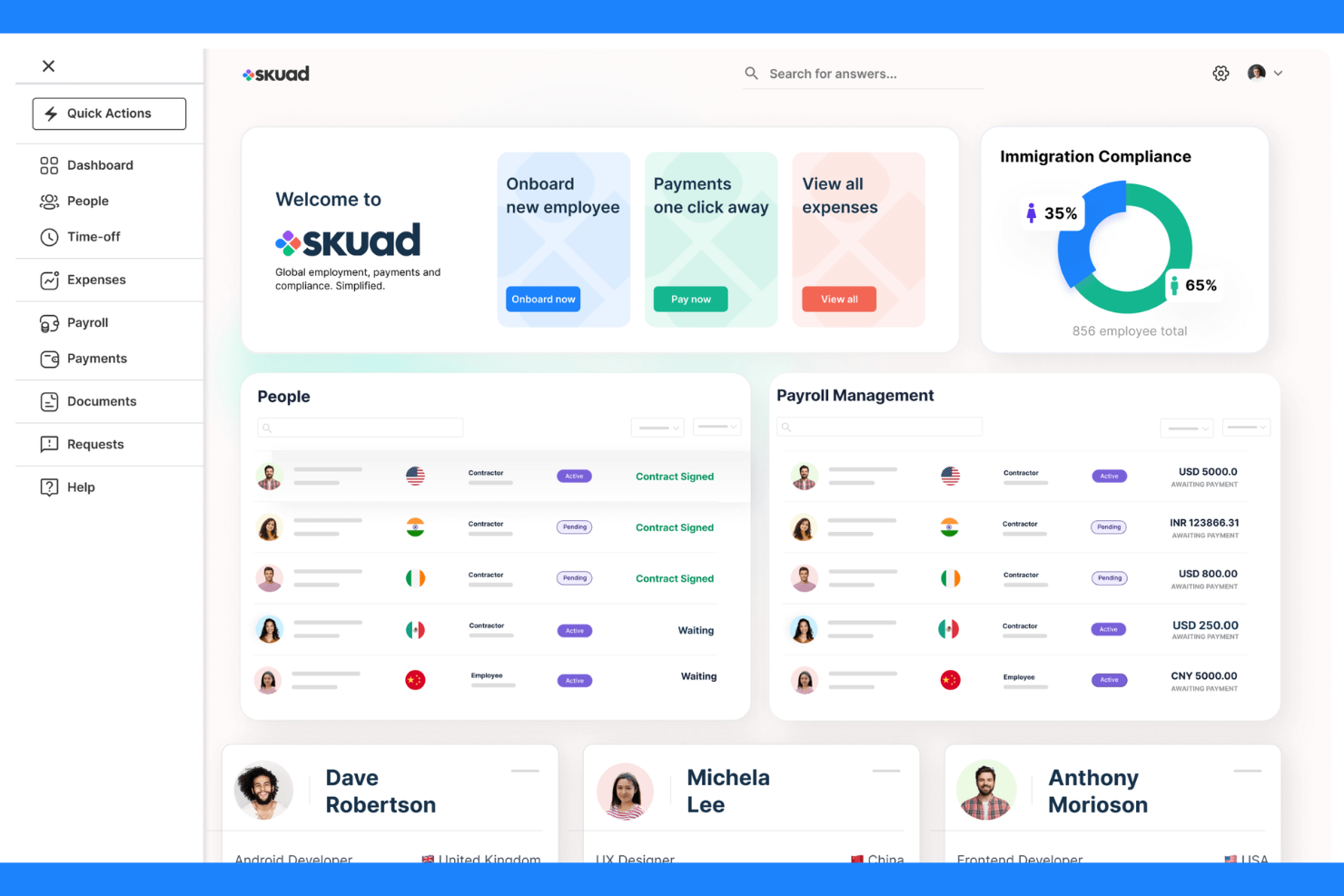
Skuad is an employer of record platform for Thailand that lets you oversee onboarding, payroll, contracts, and compliance for local employees and contractors through a unified dashboard. It simplifies hiring by handling local labor laws, tax requirements, and statutory benefits, helping you with Thailand’s employment regulations without setting up a legal entity.
Who Is Skuad Best For?
HR teams and founders hiring employees or contractors in Thailand who want localized onboarding and payroll.
Why I Picked Skuad
I picked Skuad as one of the best because I can onboard Thai employees and contractors with contracts tailored to local laws. I like that Skuad handles payroll in Thai baht and manages statutory benefits, so my team stays compliant without extra manual work. The platform’s localized onboarding flows make it easy to get new hires set up quickly.
Skuad Key Features
- Automated tax calculations: Calculates and withholds Thai taxes for each employee automatically.
- Expense management: Lets you approve and reimburse employee expenses directly through the platform.
- Document management: Stores contracts, payslips, and compliance documents in one secure location.
- Time-off tracking: Tracks employee leave balances and approvals according to Thai labor laws.
Skuad Integrations
Native integrations are not clearly documented. Skuad provides an API for custom integrations.
Pros and Cons
Pros:
- Automated tax calculations for Thailand
- Thai labor law-compliant contract templates
- Localized payroll processing for Thai employees
Cons:
- No built-in time tracking for hourly staff
- No native integrations with HRIS platforms


Pebl is an employer of record solution for Thailand that supports companies in engaging local talent through fully managed employment arrangements backed by regional expertise. It oversees employment terms, mandatory contributions, and ongoing HR administration while aligning with Thailand’s labor framework and workplace standards.
Who Is Pebl Best For?
HR leaders at multinational companies expanding teams in Thailand who need local expertise and global reach.
Why I Picked Pebl
I picked Pebl as one of the best because I need a partner with both global reach and deep local expertise in Thailand. I like that my team can rely on their in-country HR specialists for Thai labor law compliance and contract management. I use their platform to onboard employees, manage payroll, and handle statutory benefits without worrying about local regulatory changes.
Pebl Key Features
- Automated payroll processing: Calculates and disburses salaries in Thai baht.
- Expense reimbursement management: Lets you review and approve employee expenses online.
- Time-off tracking: Tracks leave balances and approvals for Thai employees.
- Centralized document storage: Stores contracts, onboarding files, and compliance documents securely.
Pebl Integrations
Native integrations are not clearly documented. An API is available for custom integrations.
Pros and Cons
Pros:
- Automated tax calculations for Thailand
- Thai labor law-compliant contract templates
- Strong local compliance support for Thai labor laws
Cons:
- Customer support response times can vary
- Benefits may not match local expectations

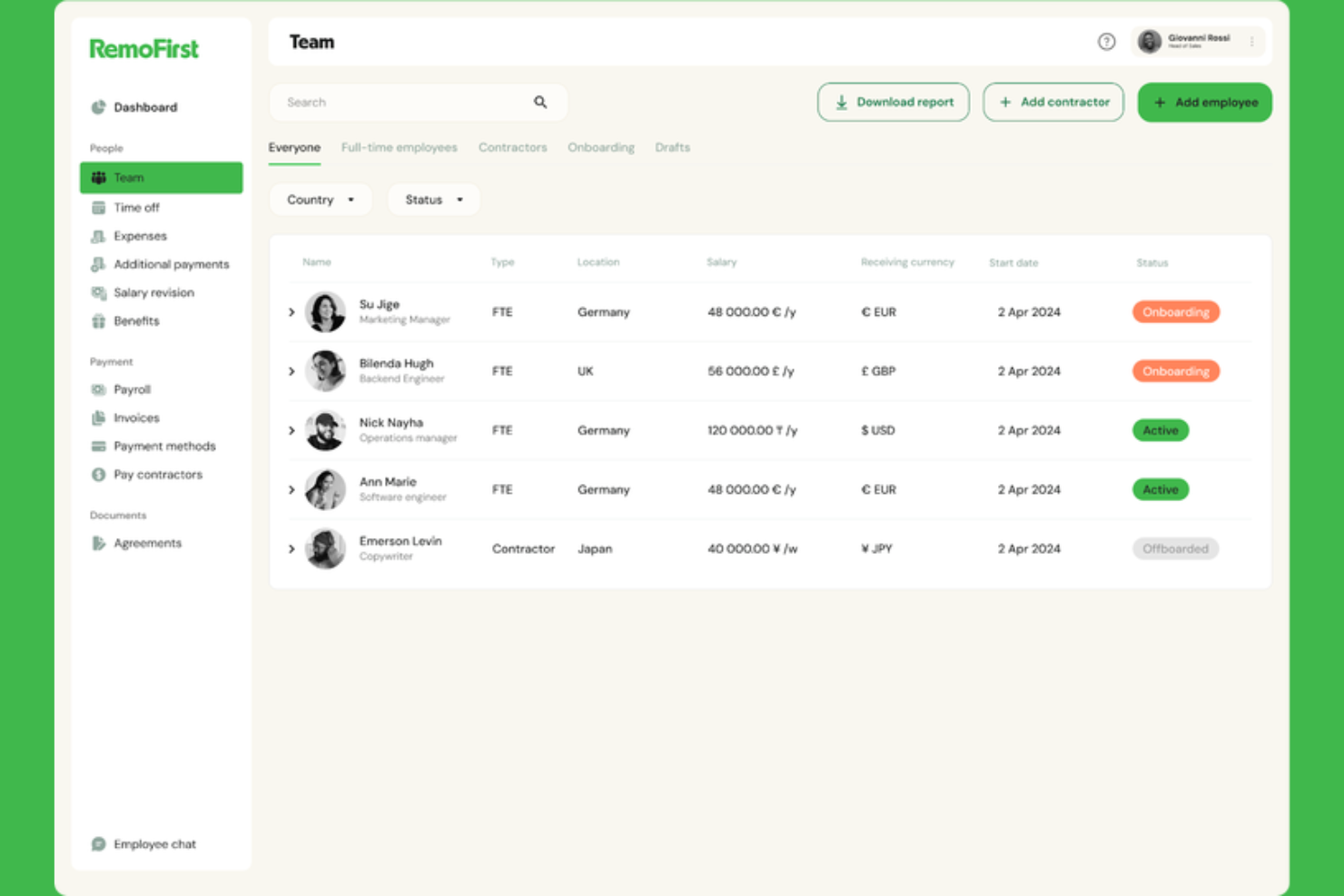
RemoFirst is an employer of record platform for Thailand that allows you to hire, onboard, and manage employees or contractors without establishing a local entity. It takes care of payroll processing, tax compliance, benefits administration, and local labor requirements, ensuring your team operates within Thailand’s regulatory framework.
Who Is RemoFirst Best For?
HR teams and founders who need to quickly onboard and pay employees or contractors in Thailand with local compliance.
Why I Picked RemoFirst
I picked RemoFirst as one of the best because I can onboard Thai employees and contractors in just a few days, with contracts that meet local legal requirements. I like that RemoFirst handles payroll in Thai baht and manages statutory benefits, so my team stays compliant without extra manual work. The platform’s onboarding dashboard lets me track every step and resolve compliance tasks quickly.
RemoFirst Key Features
- Expense management: Lets you review and approve employee expenses directly in the platform.
- Document storage: Stores contracts, payslips, and compliance documents securely for each Thai employee.
- Time-off tracking: Tracks leave balances and approvals in line with Thai labor laws.
- Automated invoicing: Generates monthly invoices for payroll and service fees automatically.
RemoFirst Integrations
Native integrations are not clearly documented. An API is available for custom integrations.
Pros and Cons
Pros:
- Centralized document management for compliance
- Fast onboarding for both employees and contractors
- Automated tax calculations for Thailand
Cons:
- No built-in time tracking for hourly staff
- No native integrations with HRIS platforms
Other Employer of Record Services in Thailand
Here are some additional employer of record services options that didn’t make it onto my shortlist, but are still worth checking out:
- RemotePeople
For managing Thai statutory registrations and recurring filings
- Remote
For contract management and structured IP assignment support
- Mauve Group
Employer of record and global HR solutions for Thailand


How I Evaluate Employer of Record Services in Thailand
I split my evaluation into baseline criteria—like whether a vendor holds a Thai legal entity and processes payroll in THB—and differentiators that set the best options apart.
Core Functionality (Table Stakes For This List)
When I'm selecting tools for my list, I rank each one on a scale from 0 (does not offer the functionality) to 5 (excels in this area) for each core functionality listed below. Then, I calculate the tool's total score into a percentage. Each tool needs to achieve a minimum total score of 55% to be considered for inclusion.
- Thai Legal Entity Presence: I check whether the provider operates its own registered entity in Thailand or relies on a third-party partner, since that affects how much control they have over your employees' experience.
- Thai Payroll & Tax Processing: Payroll needs to run in THB with proper handling of withholding tax, Social Security Fund contributions, and Provident Fund—so I evaluate how each vendor manages statutory filings.
- Employment Contract Management: I look for localized, bilingual contracts that cover Thai-specific provisions like probation terms, severance rules, and notice periods rather than generic global templates.
- Statutory Benefits Administration: Each vendor should administer mandatory benefits like social security, workers' compensation, and paid leave entitlements aligned with the Thai Labor Protection Act.
- Work Permit & Visa Support: For teams hiring foreign nationals, I evaluate whether the provider handles Non-Immigrant B visa applications and work permit renewals or simply refers you elsewhere.
- Onboarding & Offboarding Compliance: I look at how each service manages compliant hiring documentation and, just as importantly, severance calculations and termination procedures under Thai labor law.
Once I have a list of tools that meet the criteria, I consider what sets each platform apart.
Differentiating Factors (What Sets Vendors Apart)
Here's how I compare and contrast different vendors:
Standout Features
Contractor management is a big one—I evaluate whether a provider can onboard and pay Thai independent contractors alongside full-time employees, which reduces misclassification risk. A self-service employee portal with Thai-language support also matters, especially for payslip access and PTO requests. Beyond Thailand itself, I look at whether the vendor supports hiring across APAC, since many teams expanding into Thailand are building regional teams and benefit from a single provider.
Beyond Features
I evaluate whether a provider has local HR and legal specialists based in Thailand who can respond during Thai business hours—this makes a real difference when you're navigating a termination dispute or a last-minute work permit renewal. Compliance and risk coverage also weighs heavily, particularly indemnification against Labor Protection Act claims and PDPA data privacy obligations. Time-to-hire rounds out my evaluation; I check how quickly each vendor can onboard a new Thai employee from contract signing to first payroll run.
How to Choose Employer of Record Services in Thailand
It’s easy to get bogged down in long feature lists and complex pricing structures. To help you stay focused as you work through your unique software selection process, here’s a checklist of factors to keep in mind:
| Factor | What to Consider |
|---|---|
| Scalability | Will the provider support your growth if you expand your Thai workforce or add new countries? |
| Integrations | Does the platform connect with your HRIS, payroll, or accounting systems, or will manual workarounds be needed? |
| Customizability | Can you tailor workflows, document templates, or reporting to fit your Thai entity’s requirements? |
| Ease of use | Is the interface intuitive for both HR teams and Thai employees, or will you need extra training? |
| Implementation and onboarding | How long does it take to get set up and onboard your first Thai employee? Are there migration or data import tools? |
| Cost | Are all fees transparent, including setup, monthly, and offboarding costs? Watch for hidden charges. |
| Security safeguards | Does the provider meet your data privacy standards for storing and processing Thai employee data? |
| Compliance requirements | How does the provider stay current with Thai labor laws and regulations? Are compliance updates proactive or reactive? |
What Is an Employer of Record (EOR) in Thailand?
An Employer of Record is a third-party organisation that holds a registered legal entity in Thailand and uses it to employ workers on behalf of a foreign client company. The EOR appears on the employment contract, files taxes with the Thai Revenue Department, makes Social Security Fund (SSF) contributions, and issues compliant payslips—all while you direct the employee's work, set objectives, and manage performance.
How Employment of Record Services in Thailand Actually Work
The typical EOR engagement in Thailand follows a five-stage lifecycle:
- Scoping and Proposal — You share the role requirements, target compensation, and start date. The EOR provider assesses compliance obligations including work-permit needs, benefits benchmarks, and tax residency status.
- Contract Signing — Two parallel agreements are executed: a service agreement between your company and the EOR, and a Thai-law-compliant employment contract between the EOR and the employee.
- Onboarding — The EOR registers the employee with the Social Security Office (SSO), sets up payroll, enrols the employee in statutory and supplementary benefits, and, if the hire is a foreign national, initiates the work-permit and visa process.
- Ongoing Payroll and Compliance — Each month the EOR calculates gross-to-net pay, withholds personal income tax (PIT), remits employer and employee SSF contributions, files the PND 1 withholding return, and delivers a Thai-language payslip.
- Offboarding — When the engagement ends, the EOR manages notice periods, severance calculations, final-pay disbursement, SSF de-registration, and work-permit cancellation.
Legal Entity Requirements and How an EOR Removes Them
Establishing your own company in Thailand typically involves registering a Thai limited company (Co., Ltd.) with the Department of Business Development (DBD). If your business activities fall under the Foreign Business Act (FBA), which restricts majority foreign ownership in dozens of service categories, you will also need a Foreign Business Licence (FBL) or must apply for Board of Investment (BOI) promotion to enjoy foreign-ownership and tax incentives.
The registration process alone takes 30 to 60 business days, requires a minimum of three shareholders (at least one Thai national for a standard Co., Ltd.), paid-up capital requirements, and ongoing corporate-tax filings. An EOR eliminates this entire process. Because the EOR already holds a registered Thai entity, you can employ people in Thailand without incorporating, without FBA exposure, and without BOI application timelines. In fact, some EORs with Thai services advertise setup in less than 5 days.
Why Use an Employer of Record Service in Thailand?
Thailand's regulatory environment creates specific friction points that make EOR services especially valuable:
- Speed to market — An EOR can onboard a Thai national in as little as 3 to 10 business days. Setting up a Co., Ltd. from scratch takes 30 to 60+ days, and a BOI-promoted entity can take three to six months.
- Cost savings at small scale — You avoid upfront capital requirements (THB 2 million minimum registered capital is common for companies employing foreign workers), annual audit fees, and dedicated in-house legal or HR headcount.
- Foreign Business Act avoidance — Many service-sector activities are restricted under FBA Lists 2 and 3. Operating through an EOR sidesteps the need for a Foreign Business Licence.
- Risk mitigation — The EOR bears primary liability for payroll errors, late SSF filings, and labour-law non-compliance. Penalties for PIT withholding mistakes can reach 100 percent of the amount owed plus a 1.5 percent monthly surcharge.
- Flexible headcount scaling — You can hire one engineer in Bangkok today and add five more in Chiang Mai next quarter without any structural change.
Financial Modeling: EOR vs. Local Entity in Thailand
For HR teams, the EOR is a lifesaver for speed, but it has a built-in "scaling tax." Since most EORs charge a flat fee per employee, your "HR tech spend" grows linearly with your headcount.
The Tipping Point
At a fee of $600 per month, a 20-person team costs your department $144,000 USD a year just in administrative fees. To put that in perspective for a Hiring Manager: that’s the equivalent of hiring 2 or 3 additional mid-level engineers for free.
The Internalization Threshold In Thailand, the "crossover point" usually hits between 15 and 25 employees. At this scale, the annual EOR fees exceed the cost of:
- Hiring a dedicated local HR/People Manager (THB 60,000–80,000/mo).
- Retaining a local accounting firm for monthly payroll and filings.
- Paying for annual audits and legal compliance.
The Verdict: If you plan to hire more than 20 people in Thailand within a year, the EOR should be your bridge, not your permanent home. Use the EOR to secure talent today, but start the entity incorporation process in the background so you can eventually "graduate" your team to your own entity and reinvest those six-figure fees back into your talent acquisition budget.
| Side-by-Side Comparison: Thailand Market Entry (2026) | |||
|---|---|---|---|
| Criteria | EOR Model | Thai Co., Ltd. (Standard) | BOI-Promoted Entity |
| Setup Time | 3 to 10 business days | 30 to 60 business days | 3 to 6 months (inc. application) |
| Upfront Cost | Zero capital deposit; set fee | THB 2M registered capital (per work permit) | THB 1M to 10M+ (project-dependent) |
| Ongoing Admin | Low: EOR handles payroll, taxes, and Social Security | High: Requires local auditor and monthly tax filings | Very High: Requires BOI monitoring and SSC evidence |
| Foreign Ownership | N/A (EOR's local entity) | Restricted to 49% (strict nominee checks) | 100% Foreign Ownership for tech/SaaS |
| Hiring Flexibility | High; EOR manages the 4:1 Thai ratio | Rigid; 4 Thai staff per 1 foreign work permit | Scalable based on approved project scope |
| IP Ownership | Contractual assignment to client | Direct ownership by your entity | Direct ownership by your entity |
EOR vs Permanent Establishment in Thailand
One of the biggest legal and tax concerns when hiring full-time employees in Thailand is permanent establishment risk. In simple terms, permanent establishment means your company may be treated as having a taxable business presence in Thailand, even if you have not opened a local entity there.
Under the Thai Revenue Code and Thailand’s double taxation agreements, this risk can arise when a foreign company has a fixed place of business in Thailand, or when someone in Thailand regularly signs or finalizes contracts on the company’s behalf. Thailand’s Revenue Department lists its double tax agreements publicly, and local PE guidance commonly focuses on fixed business locations and contract authority.
When employee activities may trigger a PE:
- The employee signs binding sales contracts with Thai customers on your company’s behalf
- The employee works from an office in Thailand that your company rents, controls, or presents as its own
- The employee’s work is not just support work, but a core revenue-generating activity for your business in Thailand
How an EOR structures the relationship to mitigate PE exposure:
An employer of record, or EOR, can support global hiring by acting as the local employment provider. This can help companies enter new markets faster without immediately setting up a local entity. In Thailand, the EOR typically signs the local employment contract, runs payroll, manages employer contributions, supports leave entitlements such as annual leave, maternity leave, and paternity leave, and helps with local employment requirements like minimum wage and severance pay.
This structure may reduce PE exposure because:
- The employment contract is between the EOR and the employee, not your foreign company and the employee
- The EOR maintains the local employment presence in Thailand, not your company
- Your agreement with the EOR is structured as a service relationship, not a direct employment relationship
- The employee does not have the authority to sign contracts in your company’s name
That said, EOR solutions are workforce tools, not tax shields. If your Thai-based team is generating significant local revenue, negotiating contracts, signing deals, or operating like a local branch, an EOR alone may not protect you from PE classification. Thai tax authorities can look at what is actually happening in practice, not just what the contracts say.
Before assuming an EOR gives you full compliance from a tax perspective, get a PE risk assessment from Thai tax counsel.
Hiring in Thailand: Important Details
Hiring in the Land of Smiles is a strategic move, but the administrative "smile" can quickly turn into a grimace if you aren't prepared for the local labor code. Using an Employer of Record (EOR) allows you to bypass the 30 to 60-day incorporation process and move from "Offer Letter" to "Day One" in about a week.
The EOR Responsibility Split
In a standard EOR engagement, the provider handles the legal "back-office" while you maintain control over the employee's output.
| Responsibility | EOR Provider | Your Company |
| Legal Employer on Contract | Yes | No |
| Work-Permit & Visa Sponsorship | Yes | Supports Docs |
| Day-to-Day Task Management | No | Yes |
| Performance & Salary Reviews | Advises | Final Decision |
| Termination & Severance | Executes | Decision Maker |
The "Four-to-One" Ratio & Work Permits
Thailand has a unique requirement: companies must typically employ four Thai nationals for every one foreign work-permit holder.
- The EOR Advantage: Because an EOR manages a massive pool of Thai employees across multiple clients, they can "absorb" the ratio requirement for you, allowing you to hire an expat leader even if your local team is small.
- Timeline: Expect 4 to 8 weeks for work-permit processing for foreign nationals through standard tracks.
Compliance Safeguards: IP, PDPA, and Termination
- Intellectual Property: Under Section 9 of the Copyright Act, IP belongs to the employer. Your EOR contract must include a tripartite assignment to ensure IP flows from the employee $\rightarrow$ EOR $\rightarrow$ Your Company.
- Data Privacy (PDPA): The EOR acts as the Data Controller for payroll and tax data. If you use centralized HRIS tools outside Thailand, ensure your EOR agreement covers cross-border data transfer safeguards.
- Termination: Severance is mandatory and non-negotiable. For an employee with 1 to 3 years of service, the statutory payout is 90 days' wages.
Tax Overview for Employers in Thailand
Thailand operates a progressive Personal Income Tax (PIT) system. For 2026, the tax brackets remain steady, but the Long-Term Resident (LTR) Visa has emerged as a massive "tax hack" for senior talent.
Personal Income Tax (PIT) Brackets: 2026
Tax is calculated on assessable income after a standard deduction (50% of income, capped at THB 100,000) and a personal allowance (THB 60,000).
| Taxable Income (THB) | Approx. USD | Tax Rate |
| 0 – 150,000 | ~$4,100 | Exempt |
| 150,001 – 300,000 | ~$8,200 | 5% |
| 300,001 – 500,000 | ~$13,700 | 10% |
| 500,001 – 1,000,000 | ~$27,400 | 20% |
| 1,000,001 – 4,000,000 | ~$109,600 | 25% – 30% |
| Over 4,000,000 | >$109,600 | 35% |
The LTR Visa Advantage: Senior foreign talent in the "Highly Skilled Professionals" category can qualify for a flat 17% PIT rate. This can save a senior executive earning THB 4M annually upwards of THB 320,000 in taxes compared to the standard progressive rates.
Total Cost of Employment in Thailand
Budgeting for a Thai team requires moving beyond the base salary to the "Super-Gross" calculation. For 2026, employers must account for the first major Social Security hike in decades and the introduction of new mandatory fund contributions.
Statutory Contributions (Employer Share)
Thailand’s statutory load is relatively light compared to Europe or the US, but it has fixed caps you need to know.
| Contribution Component | 2026 Rate / Requirement | Monthly Cap (THB) |
| Social Security Fund (SSF) | 5% of gross salary | THB 875 (Wage base raised to THB 17,500) |
| Workmen’s Compensation (WCF) | 0.2% – 1.0% | Based on industry (0.25% for Tech) |
| Employees Welfare Fund (EWF) | 0.25% (Effective Oct 1, 2026) | Required for companies with 10+ employees* |
| Statutory Leave Accrual | 120 days Maternity / 15 days Spousal | Budget for 60 days employer-paid maternity |
*Note: Businesses with a Ministry of Labour-recognized Provident Fund (PVD) are typically exempt from the EWF.
The "Scaling Pivot" Math
For HR teams, the EOR is a lifesaver for speed, but it carries a "scaling tax." Most EORs charge a flat fee of $400 – $700 per employee per month.
The Crossover Point: The math usually favors a local entity once you reach 15 to 25 employees.
Case Study: 20-Engineer Team (SaaS)
If you hire 20 engineers at a gross salary of THB 70,000 each:
- Total Annual Payroll: ~$501,000 USD (including 2026 SSF caps, WCF, and a standard 13th-month bonus provision).
- Annual EOR Fees: $144,000 USD (at $600/head).
- The "Premium": The EOR fee represents a 28.7% premium on top of your payroll.
At this scale, the management fees exceed the cost of hiring a dedicated local HR Manager and an accounting firm, making incorporation the smarter long-term play.
Features of EOR Services in Thailand
When selecting an employer of record service, keep an eye out for the following key features:
- Local payroll processing: Calculates and disburses salaries, statutory deductions, and bonuses in compliance with Thai payroll regulations.
- Employment contract management: Generates and stores Thai labor law-compliant contracts, making it easy to onboard and update employee agreements.
- Benefits administration: Manages statutory and optional benefits, such as social security, health insurance, and paid leave for Thai employees.
- Tax compliance automation: Handles withholding, filing, and remittance of all required Thai taxes for both employees and employers.
- Employee onboarding workflows: Guides new hires through document collection, contract signing, and orientation steps tailored to Thai requirements.
- Expense management: Let employees submit expenses for approval and reimbursement, with workflows that align to Thai business practices.
- Leave and attendance tracking: Monitors vacation, sick leave, and public holidays, ensuring accurate accruals and compliance with Thai labor laws.
- Document management: Centralizes storage and retrieval of employment records, payslips, and compliance documents for audit readiness.
- Regulatory compliance monitoring: Tracks changes in Thai employment laws and updates processes to maintain ongoing compliance.
- Multi-currency support: Supports payments and reporting in both Thai baht and other currencies for international businesses operating in Thailand.
AI Features of EOR Services in Thailand
AI is still an emerging layer in employer of record platforms, and it’s not yet a standard feature across all providers—especially those focused on specific markets like Thailand. While most solutions continue to rely on structured workflows, automation, and in-country expertise to manage compliance with Thai labor laws, payroll, and HR processes, below are some of the AI features that are becoming increasingly common:
- Automated contract generation: Uses standardized templates aligned with Thailand’s Labour Protection Act, sometimes enhanced with AI, to generate compliant employment agreements and speed up onboarding.
- Compliance monitoring and alerts: Tracks evolving Thai labor regulations—such as updates to social security contributions or leave policies—and surfaces changes in near real time, often supported by AI-assisted compliance engines and local experts.
- Payroll automation with anomaly detection: Processes payroll in Thai Baht, including statutory deductions and filings, while flagging inconsistencies based on historical data patterns to reduce compliance risk.
- Workflow automation for onboarding and registration: Guides employees through onboarding steps like tax registration and Social Security enrollment, improving speed and reducing manual administrative work.
- AI-assisted compliance and HR workflows: Some enterprise platforms offer AI-driven compliance guidance or workflow automation layers that help teams interpret local regulations and reduce manual oversight.
- Document management and localization support: Organizes employment contracts, payroll records, and statutory documents, often with tagging or smart categorization to handle bilingual (Thai/English) documentation more efficiently.
- Workforce analytics and reporting: Provides dashboards for payroll costs, hiring trends, and workforce distribution in Thailand, helping companies make informed decisions—though most insights remain descriptive rather than predictive.
- Chat-based support tools: Offers automated responses to common HR and payroll questions, helping teams navigate Thailand-specific requirements (like severance rules or work permits) without constant manual intervention.
Benefits of EOR Services in Thailand
Implementing an employer of record service provides several benefits for your team and your business. Here are a few you can look forward to:
- Faster market entry: Quickly hire and onboard employees in Thailand without setting up a local entity, thanks to streamlined onboarding workflows and contract management.
- Local compliance assurance: Stay up to date with Thai labor laws and tax regulations through automated compliance monitoring and contract templates.
- Simplified payroll and benefits: Manage Thai payroll, statutory deductions, and benefits administration from a single platform, reducing manual work and errors.
- Reduced administrative burden: Offload complex HR, tax, and legal tasks to a local expert, freeing up your team to focus on core business activities.
- Centralized document management: Store and access all employment records, contracts, and compliance documents in one secure location for easy retrieval and audits.
- Cost-effective expansion: Avoid the high costs and risks of establishing a Thai legal entity by using a provider that handles employment on your behalf.
- Consistent employee experience: Deliver a smooth onboarding and support process for Thai employees, with localized workflows and support resources.
Costs & Pricing
Selecting an employer of record service requires an understanding of the various pricing models and plans available. Costs vary based on features, team size, add-ons, and more. The table below summarizes common plans, their average prices, and typical features included in employer of record services solutions:
Plan Comparison Table
| Plan Type | Average Price | Common Features |
|---|---|---|
| Free Plan | $0 | Limited access to resources, basic compliance information, and email support. |
| Personal Plan | $200-$400/employee/mo | Local payroll processing, basic contract management, and standard customer support. |
| Business Plan | $400-$600/employee/mo | Full payroll and benefits administration, compliance monitoring, onboarding workflows, and document management. |
| Enterprise Plan | $600-$900/employee/mo | Advanced compliance tools, custom integrations, dedicated account management, and tailored reporting. |
FAQs
Here are some answers to common questions about employer of record services:
How does an EOR handle IP transfer upon termination?
In Thailand, an Employer of Record (EOR) typically establishes intellectual property (IP) ownership at the start of employment to prevent disputes later on. Thai law does not automatically assign all employee-created IP to the employer, so clear contractual provisions are essential. EORs ensure that employment agreements explicitly state that any work created within the scope of employment is owned by the client company.
When the employment ends, the EOR helps formalize the transfer or confirmation of IP rights based on those contractual terms. This can involve executing assignment agreements, securing necessary signatures, or coordinating handover procedures for work products and materials. These steps help ensure the client company retains full control and usage rights over the IP after termination.
How does an employer of record help with Thai labor law compliance?
An employer of record ensures your employment contracts, payroll, and HR processes follow Thai labor laws. They stay updated on regulatory changes and handle statutory requirements, so you don’t have to manage local compliance on your own.
Can I use an employer of record to hire both Thai nationals and foreign employees?
Yes, most employer of record services in Thailand can hire both Thai nationals and eligible foreign employees. They’ll help with work permits, visas, and ensure all documentation meets local legal standards.
What is the typical onboarding time for new hires in Thailand?
Onboarding with an employer of record in Thailand usually takes one to three weeks. This includes contract preparation, document collection, and registration with local authorities, depending on the complexity of the hire.
Are employer of record services suitable for short-term projects in Thailand?
Yes, employer of record services are often used for short-term or project-based hiring in Thailand. They let you quickly onboard and offboard employees without setting up a local entity or dealing with long-term commitments.
What happens if I want to transition employees from an employer of record to my own Thai entity?
You can transition employees from an employer of record to your own entity by coordinating with the provider. They’ll help manage contract transfers, statutory notifications, and ensure a smooth handover to your internal HR team.
This content is provided for general informational purposes only and does not constitute legal, tax, or other professional advice. It may not be complete, accurate, or current, and laws and practices may change without notice and vary by jurisdiction. You should not act on this information without obtaining advice from qualified legal or tax counsel in the relevant jurisdiction regarding your specific circumstances.