

10 Best Global Payroll Services in the Philippines in 2026

Best Global Payroll Services in the Philippines Shortlist


Global payroll services in the Philippines mean using a payroll provider that manages employee pay, taxes, and compliance for teams based in the Philippines—no matter where your headquarters or finance team sits. If you’re searching for a way to pay people in the Philippines legally and on time, you’re likely juggling local rules, cross-border payments, and changing tax laws.
This list covers the top global payroll solutions so you can compare trusted providers, avoid compliance headaches, and pick a system that works for your HR goals. Here’s what you need to know to make a confident choice.
Table of Contents
- Best Global Payroll Software
- Why Trust Us
- Compare Specs
- Reviews
- Other Global Payroll
- Related Reviews
- Selection Criteria
- How to Choose
- What Are Global Payroll Services in the Philippines?
- Why Use Global Payroll Services in the Philippines?
- How Is Payroll Calculated in the Philippines?
- How Is Payroll Compliance Regulated in the Philippines?
- Outsourcing Payroll in the Philippines
- Features
- Benefits
- Trends
- Costs & Pricing
- FAQs
Why Trust Our Software Reviews
We’ve been testing and reviewing HR software systems since 2019. As HR experts ourselves, we know how critical and difficult it is to make the right decision when selecting software.
We invest in deep research to help our audience make better software purchasing decisions. We’ve tested more than 2,000 tools for different HR management use cases and written over 1,000 comprehensive software reviews. Learn how we stay transparent & our software review methodology.
Best Global Payroll Services in the Philippines Summary
This comparison chart summarizes pricing details for my top global payroll services in the Philippines selections to help you find the best one for your budget and business needs.
| Tool | Best For | Trial Info | Price | ||
|---|---|---|---|---|---|
| 1 | Best for rapid remote onboarding through payroll | Free demo available | From $599/employee/month | Website | |
| 2 | Best for scalable payroll as teams grow | Not available | Pricing upon request | Website | |
| 3 | Best for managing payroll in emerging markets | Free demo available | From $199/employee/month | Website | |
| 4 | Best for local currency payment options | Free demo available | Pricing upon request | Website | |
| 5 | Best for in-country legal and tax expertise | Free demo available | From $499/employee/month | Website | |
| 6 | Best for integrating payroll with HR and IT | Free demo available | From $499/month | Website | |
| 7 | Best for multi-country payroll automation | Free demo available | From $29/employee/month | Website | |
| 8 | Best for unified payroll and compliance | Free demo available | From $29/employee/month | Website | |
| 9 | Best for country-specific hiring cost insights | Free demo available | From $29/contractor/month | Website | |
| 10 | Best for flexible workforce payroll solutions | Free demo available | From $399/employee/month | Website |






-

Native Teams
Visit WebsiteThis is an aggregated rating for this tool including ratings from Crozdesk users and ratings from other sites.4.6 -
Remote People
Visit WebsiteThis is an aggregated rating for this tool including ratings from Crozdesk users and ratings from other sites.5 -
Worksome
Visit WebsiteThis is an aggregated rating for this tool including ratings from Crozdesk users and ratings from other sites.4.7





Best Global Payroll Services in the Philippines Reviews
Below are my detailed summaries of the best global payroll services in the Philippines that made it onto my shortlist. My reviews offer a detailed look at the features, capabilities, and pricing of each platform to help you find the best one for you.

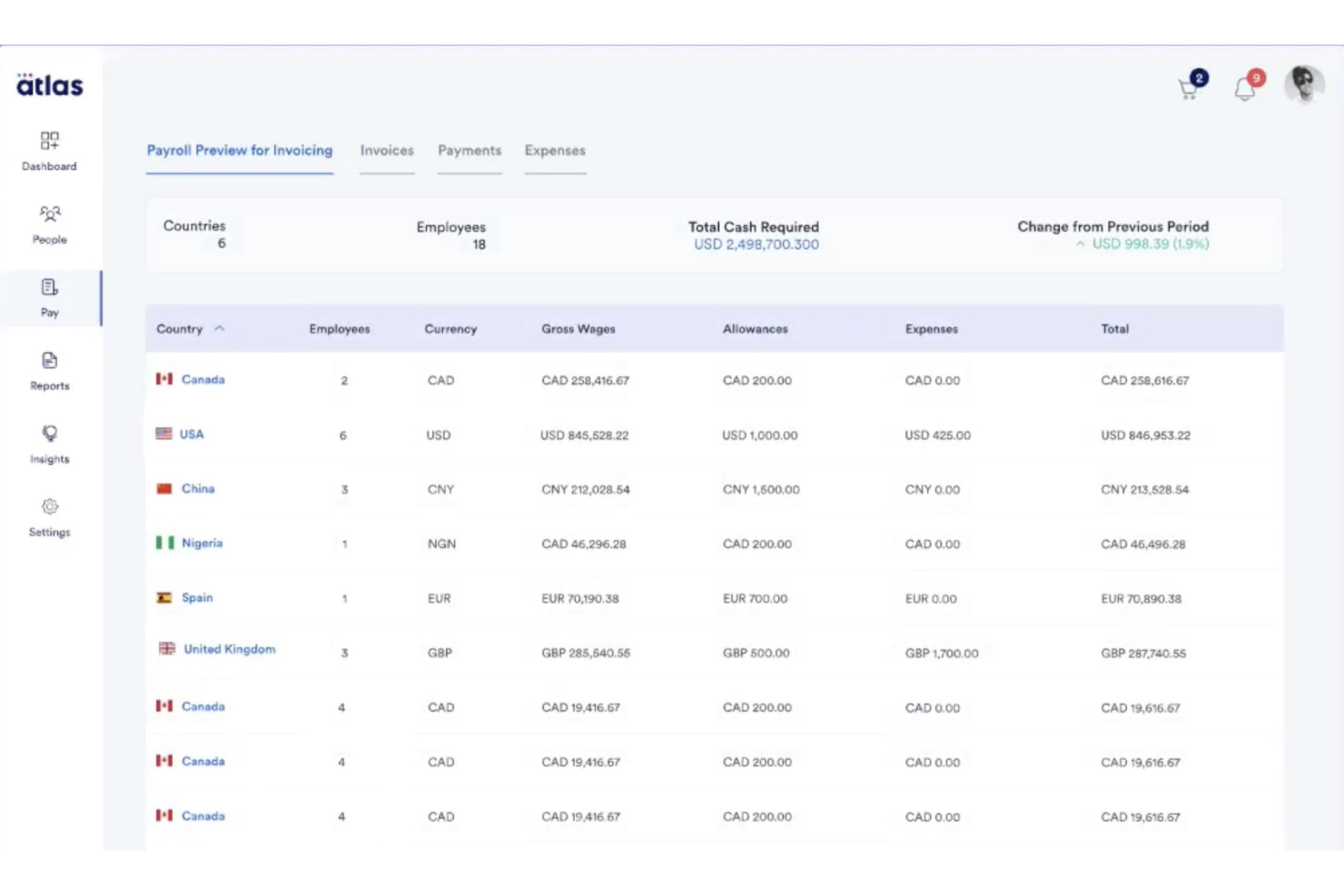
Atlas HXM is a direct employer of record platform that manages global payroll, employee onboarding, benefits administration, and contractor invoice management across 160+ countries from a single dashboard.
Who Is Atlas HXM Best For?
Atlas HXM is a strong fit for globally distributed HR teams that need to hire, onboard, and pay employees in the Philippines without setting up a local legal entity.
Why I Picked Atlas HXM
Atlas HXM earns its spot on my shortlist because new hires in the Philippines complete onboarding through a self-service portal, which cuts the administrative back-and-forth my team usually handles manually. I also like the customizable HR templates, which let me generate compliant employment contracts and offer letters for the Philippines without building them from scratch each time. The platform's downloadable country-specific HR and employment law insights also make it easy to compare the Philippines against other markets when planning regional expansion.
Atlas HXM Key Services
- One-click payroll approval: Review and approve payroll runs across all countries with a single click from the central dashboard.
- Off-cycle payroll requests: Submit and process off-cycle payroll adjustments directly in the platform without waiting for the next scheduled pay run.
- AI-powered payroll analysis: Atlas HXM's built-in AI analyzes people and payroll data to forecast upcoming headcount and business needs.
- Local legislation tracking: Monitor and prepare for upcoming changes to country-specific payroll and employment laws from within the platform.
Atlas HXM Integrations
Atlas HXM integrates with Bitybank and OpenMetadata, offering a smaller set of native integrations compared to other global payroll providers. Atlas HXM has an API available for use, allowing custom connections with your existing HR and payroll systems.
Pros and Cons
Pros:
- Onboards international hires within two weeks
- Visa sponsorship available in 100 countries
- Owns legal entities in 160+ countries
Cons:
- Occasional payroll timing and invoice errors
- Digital signatures limited to select documents

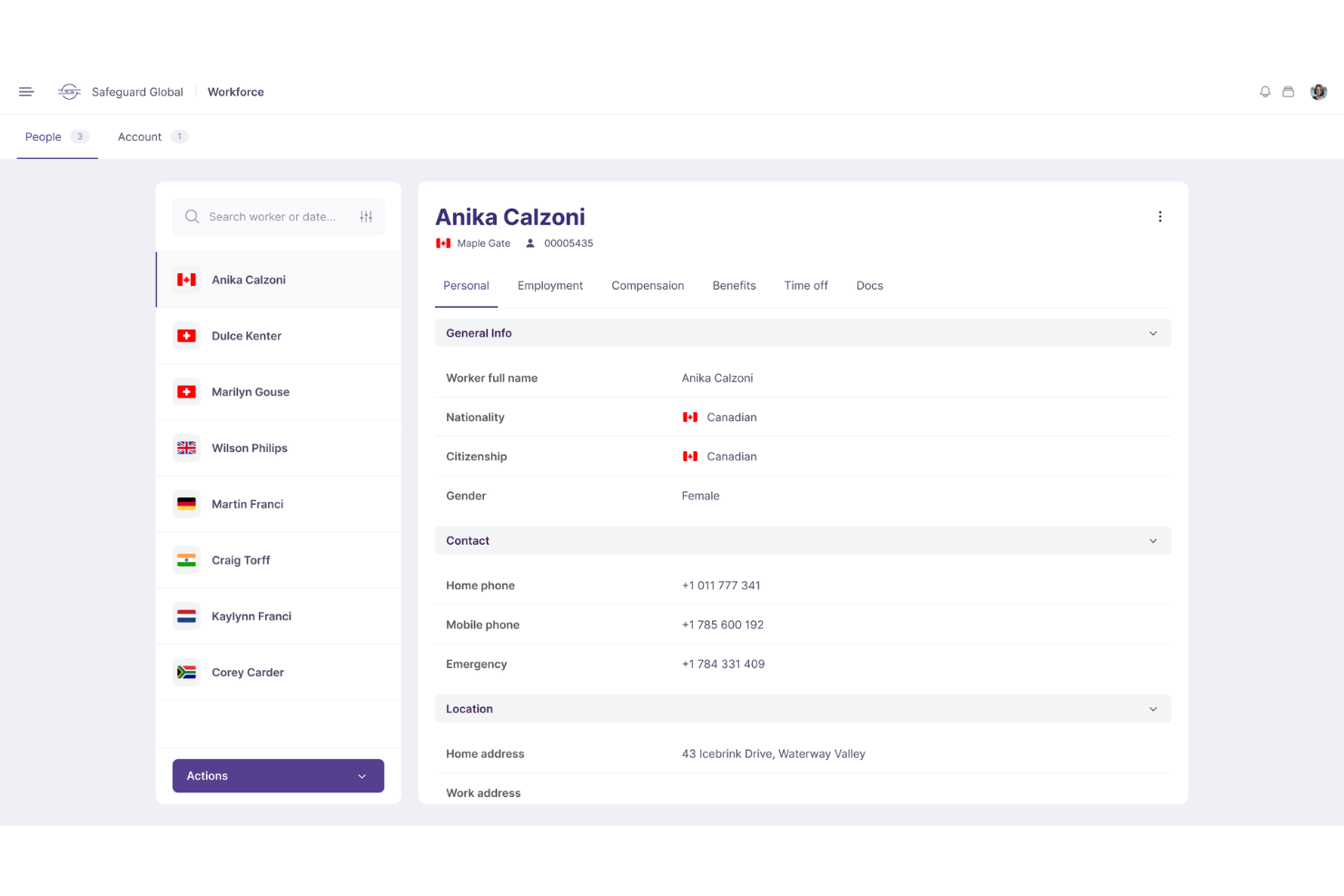
Safeguard Global is a global employment and payroll platform that supports Philippine payroll processing, EOR services, contractor management, and multi-country pay consolidation across 187 countries.
Who Is Safeguard Global Best For?
Safeguard Global is a strong fit for multinational companies expanding their Philippine headcount across multiple APAC markets that need a payroll partner that scales with them.
Why I Picked Safeguard Global
I picked Safeguard Global as one of the best because it's built to flex as your Philippine team expands. What I like most is the EOR toggle: you can hire Filipino workers through Safeguard Global's local entity on day one, then transition to running payroll on your own Philippine entity once it's cost-effective to do so. That shift typically happens around 15 to 20 FTEs, and Safeguard Global supports both models without forcing a platform switch.
Safeguard Global Key Services
- Single payroll calendar: Tracks pay dates and deadlines across all countries—including the Philippines—in one checklist view, so nothing gets missed on the 15th or 30th.
- Pre-configured country templates: Built-in Philippine payroll workflows let you go live quickly without custom builds or third-party consultants.
- Consolidated multi-country reporting: Standardized payroll outputs across every pay run give you one exportable source of truth for audits and finance.
- Worker classification tool: Built-in tool to help determine whether a Filipino worker should be classified as an employee or an independent contractor.
Safeguard Global Integrations
Safeguard Global offers native integrations with popular HR platforms like Workday, SAP SuccessFactors, and BambooHR. As the sole Workday-only global payroll partner, Safeguard Global introduced a suite of API-driven integrations through Workday's Global Payroll Connect.
Pros and Cons
Pros:
- Supports both EOR and entity payroll
- Dedicated in-country compliance and payroll experts
- Covers 170+ countries from one platform
Cons:
- Pricing requires a sales call to obtain
- Platform technology lags behind newer competitors

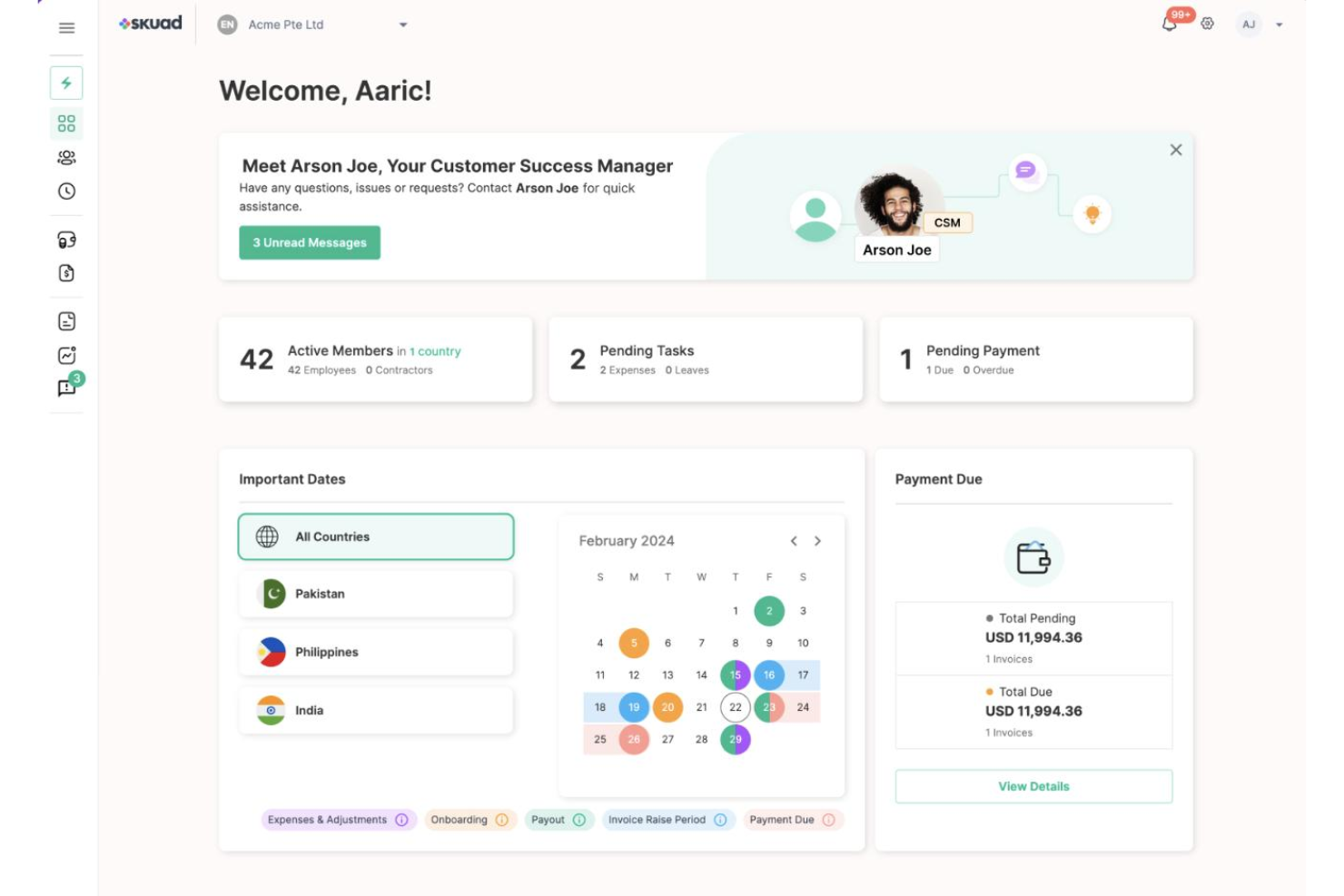
Skuad is a global employment and payroll platform that handles international hiring, contractor management, and multi-currency payroll across 160+ countries, with particular depth in emerging markets across Asia, Africa, and Latin America.
Who Is Skuad Best For?
Skuad is a strong fit for globally distributed teams hiring and paying workers across Asia-Pacific and other emerging markets.
Why I Picked Skuad
I've included Skuad in my top picks because of how well it handles payroll in markets where most platforms struggle, like the Philippines and other APAC and MEA countries. I like that it runs payroll in 70 currencies with built-in compliance across 160+ countries, so local tax obligations and statutory benefits are calculated automatically. The single bulk payment feature is especially useful, letting you pay a distributed team in their preferred currency without managing separate transfers.
Skuad Key Services
- Payslip generation: Skuad automatically generates compliant payslips for employees across 160+ countries, including the Philippines.
- Expense management: Track and process employee expense claims directly within the payroll platform.
- Bonuses and perks administration: Manage one-time payments like bonuses and allowances alongside regular payroll runs.
- Real-time reporting: Access live payroll reports across your global workforce from a single dashboard.
Skuad Integrations
Skuad offers 70+ integrations across HRIS, accounting, and time tracking categories, including BambooHR, ADP Workforce Now, Gusto, HiBob, Ceridian Dayforce, Darwinbox, FreshBooks, Harvest, and Hubstaff. API-based integrations are available on request for custom workflows.
Pros and Cons
Pros:
- Consolidates multi-country invoices into one payment
- Handles contractor-to-employee conversion in-platform
- Covers APAC and emerging markets well
Cons:
- No built-in time tracking for attendance
- Expense reimbursement timelines lag behind competitors


Multiplier is a global employer of record (EOR) and payroll platform that handles salary calculations, statutory deductions, tax filing, and contractor management across 150+ countries, including the Philippines.
Who Is Multiplier Best For?
Multiplier is a strong fit for businesses managing payroll across multiple countries through their own legal entities. It also offers EOR services for companies hiring before establishing a local entity.
Why I Picked Multiplier
I picked Multiplier as one of the best because its local currency payment options are genuinely practical for paying Philippine employees. It disburses salaries directly in Philippine Peso (PHP) across 120+ currencies, so your team in Manila gets paid in their local currency without you manually converting funds or coordinating FX rates. I also like its "one payment, every method" approach: bank transfer, direct debit, or crypto, your employees choose how they get paid, and you send a single instruction to cover it all.
Multiplier Key Services
- Smart payment preview: See exactly who's getting paid, how much, and when before each cycle closes, giving you a real-time view across your entire Philippine payroll.
- Automatic payroll adjustments: Multiplier automatically adjusts payroll calculations when time off or expenses are submitted, so your pay runs reflect accurate final figures without manual corrections.
- Consolidated payroll reporting: Pull headcount, gross-to-net, and cost center reports across countries, giving finance and HR teams a single view of global payroll spend, including Philippine operations.
- Statutory payment remittance: Multiplier calculates and remits SSS, PhilHealth, and Pag-IBIG contributions on your behalf, keeping you compliant with Philippine government-mandated contribution schedules.
Multiplier Integrations
Multiplier integrates with QuickBooks, Xero, BambooHR, HiBob, Workday, SAP SuccessFactors, Oracle, Google Workspace, Slack, and Okta.
Pros and Cons
Pros:
- Fast onboarding typically within 24–72 hours
- Pays in Philippine Peso via multi-currency payroll
- Localized contracts auto-adjust to Philippine labor law
Cons:
- Limited mobile app reporting capabilities
- Benefits enrollment lags behind onboarding timelines

Built around country-specific legal and tax data, Papaya Global is a global workforce management platform that handles payroll processing, statutory compliance, worker classification, and cross-border payments across 160+ countries.
Who Is Papaya Global Best For?
Papaya Global is a strong fit for multinational companies that need country-specific legal guidance baked into their payroll workflow, not sourced separately.
Why I Picked Papaya Global
I picked Papaya Global as one of the best because its Countrypedia is genuinely useful when running payroll in the Philippines. It gives you a detailed, regularly updated breakdown of employer and employee tax rates, statutory contributions, minimum wage rules, and termination requirements, all in one place. I also like that Papaya One, its AI knowledge base, can review contracts and answer jurisdiction-specific compliance questions without the generic hallucinations you'd get from a general AI tool.
Papaya Global Key Services
- Gross-to-net (G2N) reporting: Papaya generates a G2N report for every pay cycle, breaking down taxes, deductions, and net pay based on local Philippine regulations.
- AI-powered variance detection: Built-in anomaly flagging scans payroll data before each cycle runs, catching errors in calculations or contributions before they turn into compliance issues.
- Shadow payroll: Tracks and calculates tax obligations for employees working across multiple countries, including Philippines-based staff with cross-border assignments.
- Employee self-service portal: Employees access payslips, personal details, and compensation information directly, reducing back-and-forth with your HR team.
Papaya Global Integrations
Papaya Global offers native integrations with SAP SuccessFactors, Oracle HCM, Workday, BambooHR, HiBob, NetSuite, Personio, UKG, Sage, and Expensify, among others listed on its connectors page. An API is available for custom integrations.
Pros and Cons
Pros:
- Supports employees and contractors in one platform
- Proprietary payments network avoids third-party banks
- Countrypedia covers Philippines-specific tax and labor rules
Cons:
- Hidden transfer fees reported by some users
- Off-cycle payroll reruns can be slow


Built on a unified workforce platform, Rippling connects global payroll, HR, and IT management so you can run payroll, manage benefits, and provision devices for Philippine employees from a single system.
Who Is Rippling Best For?
Rippling is a strong fit for mid-market and scaling tech companies that manage both payroll and IT provisioning across global teams, including employees in the Philippines.
Why I Picked Rippling
I picked Rippling as one of the best because its HR and payroll share the same employee record, which is genuinely rare among global payroll tools. When a Philippine team member's compensation changes or time off is approved, payroll updates automatically, with no manual syncing between separate systems. I also like that Rippling runs its own payroll engine in key countries, which means shorter processing times compared to tools that route through local third parties.
Rippling Key Services
- Off-cycle pay runs: Run additional pay cycles outside the standard schedule, at no extra cost, for bonuses, corrections, or final pays for Philippine employees.
- Detailed payslip visibility: Employees can view a full breakdown of hours worked, expense reimbursements, benefits elections, and deductions directly in their payslip.
- Real-time payroll cost reporting: See a breakdown of salaries, taxes, benefits, and reimbursements by country before payday, with comparisons to prior pay periods.
- Automatic benefits deduction sync: When Philippine employees update benefits elections, statutory contributions and deductions update in payroll automatically.
Rippling Integrations
Rippling supports over 650 app integrations through its App Shop, including GitHub, Carta, Jira, HubSpot, Slack, Google Workspace, Salesforce, Zoom, and Microsoft 365, with accounting integrations like QuickBooks Online, Xero, NetSuite, and Sage Intacct that are especially relevant for payroll syncing.
Pros and Cons
Pros:
- Supports both employees and contractors in-country
- Payroll and HRIS share one employee record
- Handles SSS, PhilHealth, and Pag-IBIG automatically
Cons:
- Customer support slow on complex tax issues
- Off-cycle runs may incur extra fees


Deel is a global payroll and employer of record platform that lets you hire, pay, and manage employees and contractors across 150+ countries, with built-in tax filings, compliance checks, and multi-currency payment processing.
Who Is Deel Best For?
Deel is a strong fit for mid-size to enterprise companies scaling distributed teams across multiple countries that need consolidated payroll and compliance in one place.
Why I Picked Deel
Deel earns its spot as one of the best on my shortlist because of how it handles multi-country payroll automation at scale. I especially like its Payroll Connect feature, which lets my team view both Deel-run and third-party payrolls side by side in one dashboard, without having to replace every existing provider overnight. On top of that, Deel's AI flags anomalies and missing data before payroll runs, which means errors get caught before they become compliance issues across multiple countries, including the Philippines.
Deel Key Services
- Local tax filing: Deel handles in-country tax filings, including BIR compliance requirements for Philippines-based employees.
- Multi-currency payouts: Pay employees in Philippine Peso or 150+ other currencies without manual currency conversion.
- Off-cycle payroll runs: Run additional payroll cycles outside the standard schedule for bonuses, corrections, or late hires.
- Employee self-service portal: Employees can access payslips, tax documents, and payment history directly from their Deel account.
Deel Integrations
Deel offers native integrations with QuickBooks, Xero, NetSuite, Greenhouse, Workday, BambooHR, Expensify, and Slack, as well as Okta and Microsoft Entra ID. An API is also available for building custom integrations with HRIS, finance, and ERP systems.
Pros and Cons
Pros:
- 24/7 support included on all plans
- Supports 100+ currencies and local payments
- Contracts auto-update when laws change
Cons:
- The mobile app lacks full desktop functionality
- Limited withdrawal options in some regions


Remote is a global payroll platform that centralizes payroll processing, tax compliance, benefits management, and HR data for international workforces across 100+ countries, using in-house country experts and native payroll engines rather than third-party providers.
Who Is Remote Best For?
Remote is a good fit for HR and finance teams that need to manage payroll across the Philippines and other countries from a single platform. For businesses without a Philippine entity, Remote also offers employer of record (EOR) services.
Why I Picked Remote
I've included Remote in my top picks because its compliance layer is genuinely built in, not bolted on. Remote Watchtower automatically monitors payroll law changes across every country where your team operates, including the Philippines, so tax withholding rules and worker classification updates apply without manual intervention. I also like that Remote owns its payroll engines in-house and doesn't route anything through third-party vendors, which means faster resolution when something goes wrong.
Remote Key Services
- Bulk data uploads: Update payroll records for multiple employees at once without manual, one-by-one data entry.
- Localized benefits management: Select, enroll, and report on country-specific benefits like health insurance and retirement plans directly within the platform.
- Automated payments to tax authorities: Remote's native payments engine handles salary disbursements and statutory payments to local tax authorities in local currencies.
- IP Guard: A built-in tool that protects your intellectual property when hiring employees across international borders.
Remote Integrations
Remote offers native integrations with BambooHR, Greenhouse, HiBob, Personio, Workday, QuickBooks, Xero, NetSuite, Gusto, and Slack, among others.
Pros and Cons
Pros:
- Payroll organized by country with progress tracking
- Handles the Philippines 13th-month pay automatically
- Owns local entities, no third-party partners
Cons:
- Salary deposits are sometimes delayed in the Philippines
- Reporting lacks cross-country drill-down analysis


Oyster combines global payroll with employer of record services. If you already have a Philippine entity, you can use it for payroll. Otherwise, its EOR service lets you hire employees legally.
Who Is Oyster Best For?
Oyster is a good fit for HR and finance teams that want a clearer view of payroll costs before expanding into the Philippines or other countries. It's particularly useful for organizations comparing payroll expenses across multiple markets and planning international headcount.
Why I Picked Oyster
I picked Oyster because it gives payroll teams detailed visibility into country-specific payroll costs before they process their first payroll. Its employment cost calculator estimates gross salary, employer statutory contributions, and mandatory payments such as the 13th-month pay, making it easier to forecast payroll expenses in the Philippines. I also like that Oyster's country guides explain local payroll requirements, including regional minimum wage differences and statutory benefits, so you can build more accurate payroll budgets and avoid unexpected costs as your workforce grows.
Oyster Key Services
- Payroll cost calculator: Estimate total employment costs by factoring in salary, employer contributions, statutory benefits, and mandatory payments before hiring or processing payroll.
- BIR tax withholding and filing: Calculate and remit employee income tax withholding in line with Bureau of Internal Revenue (BIR) requirements.
- Contractor payments: Manage payments for Philippine-based contractors alongside employee payroll from a single platform.
- Benefits administration: Track statutory and supplemental benefits, including government-mandated contributions and employer-sponsored benefit programs.
Oyster Integrations
Oyster offers native integrations with BambooHR, Greenhouse, Workable, TeamTailor, ADP Workforce Now, Slack, Okta, QuickBooks Online, Xero, Carta, and Concur. It also connects with Zapier and provides an API for custom integrations.
Pros and Cons
Pros:
- Surfaces regional minimum wage differences automatically
- Publishes EOR rates without gating demos
- Built-in employment cost calculator per country
Cons:
- Monthly invoices can fluctuate unexpectedly
- APAC hires may be routed through third parties


For companies running payroll across borders, Pebl is a global payroll platform that handles multi-country payroll runs, contractor payments, compliance management, and cross-border disbursements from a single system.
Who Is Pebl Best For?
Pebl is a natural fit for globally distributed teams that employ both full-time staff and contractors in the Philippines under a single payroll workflow.
Why I Picked Pebl
Pebl earns its spot on my shortlist because it's one of the few global payroll platforms that pays employees and contractors without requiring a local entity in the Philippines. I like that it supports adaptable payment methods, including ACH, wire transfers, and digital wallets, so your Philippine team gets paid how they prefer. Its AI-powered routing also actively reduces failed payments across cross-border corridors.
Pebl Key Services
- Gia AI advisor: Answers real-time compliance and employment law questions specific to the Philippines and other countries.
- Worker classification tool: Assesses whether workers should be classified as employees or independent contractors under local law.
- Multi-currency payroll: Processes payroll in Philippine pesos or another preferred currency based on business and worker needs.
- Equity compensation management: Tracks stock option grants and vesting schedules for internationally distributed employees.
Pebl Integrations
Pebl offers 250+ integrations across HRIS, HCM, ATS, accounting, expense management, communication, and time tracking categories, including BambooHR, ADP Workforce Now, Workday, Greenhouse, NetSuite, QuickBooks, Sage Intacct, SAP Concur, Slack, and Expensify. An API is also available for custom integrations.
Pros and Cons
Pros:
- Handles employee and contractor compliance together
- Dedicated support rep assigned per account
- Consolidates multi-country payroll into one invoice
Cons:
- Opaque pricing requires contacting the sales team
- Onboarding is slower than fully automated competitors
Other Global Payroll Services in the Philippines
Here are some additional global payroll services in the Philippines that didn’t make it onto my shortlist, but are still worth checking out:
- G-P
For simplifying entity-free payroll setup
- RemoFirst
For contractor and employee pay flexibility
- Ramco Global Payroll
For multinational statutory compliance
- Darwinbox
For easy employee self-service access
- Oracle Fusion Cloud HCM
For configurable payroll workflows
- AYP Group
For end-to-end payroll outsourcing
- Sprout
For automated government forms processing
- PayrollHero
For facial recognition attendance payroll
- SAP SuccessFactors Employee Central Payroll
For enterprise-grade payroll analytics


How I Evaluate Global Payroll Services in the Philippines
I split my evaluation into baseline criteria every platform must meet—like automated SSS, PhilHealth, and BIR filings—and the differentiators that set one vendor apart from another.
Core Functionality (Table Stakes For This List)
When I'm selecting tools for my list, I rank each one on a scale from 0 (does not offer the functionality) to 5 (excels in this area) for each core functionality listed below. Then, I calculate the tool's total score into a percentage. Each tool needs to achieve a minimum total score of 65% to be considered for inclusion.
- Philippines payroll processing: I check whether the platform calculates and disburses salaries in PHP with localized payslip formats, allowances, overtime, and bonus components built in.
- PH statutory compliance: Each tool should automate deductions and filings for SSS, PhilHealth, Pag-IBIG, and BIR withholding tax rather than requiring manual submissions.
- 13th month pay automation: I look for engines that auto-calculate, prorate for mid-year hires or leavers, and schedule disbursement of mandatory 13th month pay.
- Multi-country payroll coverage: The platform needs to process payroll in multiple countries alongside the Philippines so you can consolidate reporting in one dashboard.
- EOR or local entity support: I evaluate whether the vendor offers its own EOR entity in the Philippines or supports payroll through a buyer's SEC-registered entity.
- Filipino contractor payments: Tools should handle contractor onboarding, compliant classification, and PHP or multi-currency payouts with proper invoicing and withholding certificates.
Once I have a list of tools that meet this criteria, I consider what sets each platform apart.
Differentiating Factors (What Sets Vendors Apart)
Here's how I compare and contrast different vendors:
Standout Features
Statutory auto-filing is a major differentiator. Some platforms submit BIR, SSS, PhilHealth, and Pag-IBIG forms directly to government portals, while others require you to download and file manually. I also evaluate whether a vendor lets you toggle between EOR and own-entity payroll—this matters when you're scaling a team past the point where EOR costs make sense. Multi-entity consolidation rounds out the picture, especially if you run APAC payroll across the Philippines and neighboring countries and need one dashboard for reporting and FX visibility.
Beyond Features
Payment rails matter more than most buyers realize. I look at whether a vendor supports PHP disbursements through major local banks and e-wallets like GCash, plus how transparent the FX markup is when you're funding payroll from another currency. In-country expertise is another factor I weigh—having Filipino payroll advisors who can guide you through a BIR audit or help compute separation pay is very different from relying on offshore-only support in a mismatched time zone. I also evaluate how well a platform handles contractor classification, especially DOLE's four-fold test and 2307 withholding certificate generation.
How to Choose Global Payroll Services in the Philippines
It’s easy to get bogged down in long feature lists and complex pricing structures. To help you stay focused as you work through your unique software selection process, here’s a checklist of factors to keep in mind:
| Factor | What to Consider |
| Scalability | Will the platform accommodate increased headcount in the Philippines or new countries as you expand? |
| Integrations | Can the system connect with your existing HRIS, accounting, and time-tracking tools without manual workarounds? |
| Customizability | Does the platform let you configure payroll cycles, reporting, or approval flows for unique Philippine compliance needs? |
| Ease of use | Will your HR and finance teams easily understand workflows, navigation, and tasks? Ask to see a demo tailored to your use case. |
| Implementation and onboarding | How long does full deployment take, including statutory registration and account setup? Will a dedicated team manage your go-live? |
| Cost | Is pricing all-inclusive, or will you face extra charges for implementation, local filings, or new headcount in the Philippines? |
| Security safeguards | Does the vendor provide data encryption, compliance with the Philippine Data Privacy Act, and clear protocols for GDPR or cross-border transfers? |
| Compliance requirements | Can the platform keep up with changes to Philippine labor, tax, and social security laws without manual intervention? Ask for local compliance case studies. |
What Are Global Payroll Services in the Philippines?
Global payroll in the Philippines refers to software and services that enable businesses to manage payroll, tax compliance, and statutory contributions for employees in the Philippines. These platforms let you pay workers in local currency, automate SSS, PhilHealth, Pag-IBIG, and BIR filings, and ensure compliance with local labor laws—all as part of a multi-country payroll solution.
Why Use Global Payroll Services in the Philippines?
Global payroll services help you pay employees in the Philippines while meeting local payroll requirements. They support payroll calculations, BIR tax withholding, SSS, PhilHealth, and Pag-IBIG contributions, mandatory benefits such as the 13th-month pay, and local reporting obligations.
Global payroll services are designed for businesses that already have a legal entity in the Philippines. I think they're the right choice if you want to manage Philippine payroll alongside payroll in other countries through a single platform while keeping local compliance requirements in one place.
How Is Payroll Calculated in the Philippines?
Payroll in the Philippines involves more than calculating an employee's salary. Each payroll cycle requires employers to calculate gross earnings, withhold income tax, deduct mandatory employee contributions, add employer-paid contributions, and account for statutory payments such as holiday premiums and the 13th-month pay.
Most employers calculate payroll in this order:
- Calculate gross earnings. Start with the employee's base salary, then add any additional earnings for the pay period, such as overtime, holiday pay, night shift differential, commissions, bonuses, or taxable allowances.
- Calculate statutory employee deductions. Deduct the employee's required contributions to the Social Security System (SSS), PhilHealth, and the Home Development Mutual Fund (Pag-IBIG) based on current contribution rates.
- Calculate income tax withholding. Apply the Bureau of Internal Revenue (BIR) withholding tax tables to determine the employee's income tax for the pay period.
- Calculate employer contributions. Determine the employer's required contributions to SSS, PhilHealth, Pag-IBIG, and any other statutory employer obligations. These increase your payroll cost but are not deducted from the employee's pay.
- Apply any additional statutory payments. Include premium pay for public holidays, rest days, overtime, or night work, and account for mandatory benefits such as the 13th-month pay, which employers typically accrue throughout the year.
- Calculate net pay. Subtract employee deductions and tax withholding from gross earnings to determine the employee's take-home pay.
- Remit taxes and contributions. Submit payroll taxes and statutory contributions to the appropriate government agencies and maintain payroll records to support reporting and compliance requirements.
Your total payroll expense will usually be higher than an employee's salary because employer contributions and mandatory benefits are paid in addition to wages.
Philippines Payroll Taxes and Deductions
Employers are responsible for withholding taxes from employee wages and remitting both employee and employer contributions to the appropriate government agencies.
The main statutory payroll deductions include:
| Contribution | Employee Contribution | Employer Contribution |
| Social Security System (SSS) | Required | Required |
| MySSS Pension Booster | Required for eligible salary credits | Required for eligible salary credits |
| PhilHealth | Shared contribution | Shared contribution |
| Pag-IBIG Fund | 2% (subject to the monthly contribution cap) | 2% (subject to the monthly contribution cap) |
| Income Tax | Withheld according to BIR tax tables | Not applicable |
The Philippines uses a progressive income tax system, which means employees with higher taxable incomes pay higher tax rates. Payroll teams use the Bureau of Internal Revenue (BIR) withholding tax tables to determine how much income tax to deduct each pay period. The table below summarizes the current annual income tax brackets.
| Annual Taxable Income | Income Tax |
| Up to PHP 250,000 | No income tax |
| PHP 250,001–400,000 | 15% of the amount over PHP 250,000 |
| PHP 400,001–800,000 | Base tax plus 20% of the amount over PHP 400,000 |
| PHP 800,001–2,000,000 | Base tax plus 25% of the amount over PHP 800,000 |
| PHP 2,000,001–8,000,000 | Base tax plus 30% of the amount over PHP 2,000,000 |
| Above PHP 8,000,000 | Base tax plus 35% of the amount over PHP 8,000,000 |
Because contribution rates and tax thresholds can change, many employers rely on global payroll services to keep calculations current throughout the year.
Philippines Leave Entitlements
The Philippines provides several statutory leave entitlements that affect payroll calculations.
- Maternity leave: Eligible employees receive 105 days of paid maternity leave, with an additional 15 days for qualified single parents. Benefits are paid through the Social Security System (SSS).
- Paternity leave: Eligible fathers are entitled to seven days of paid paternity leave, with the benefit paid by the employer.
- Sick leave: There is no statutory requirement for paid sick leave. However, many employers provide at least five days of paid sick leave as part of their benefits package.
- Probationary period: Employees may be placed on a probationary period of up to six months before becoming regular employees, provided the arrangement complies with the Labor Code.
Philippines Public Holidays
The Philippines observes 18 national public holidays, including regular holidays and special non-working days. Public holidays have their own payroll rules. Employees who work on a holiday are generally entitled to premium pay, while employees who do not work may still receive holiday pay depending on the type of holiday.
When calculating holiday pay, payroll teams should consider:
- Whether the day is a regular holiday or a special non-working day
- Whether the employee worked that day
- Whether the holiday falls on the employee's scheduled rest day
- Any overtime worked during the holiday
Applying the correct premium rates is an important part of payroll compliance in the Philippines.
Termination Terms in the Philippines
An employee's final payroll requires more than issuing their last salary payment. Employers must calculate all amounts owed and ensure statutory requirements are met before releasing final pay.
Final payroll may include:
- Outstanding wages
- Payment for eligible accrued leave
- Unpaid commissions or bonuses
- Separation pay, where required for authorized terminations
- Final tax and statutory deductions
Terminations must comply with the Philippine Labor Code, including valid grounds for dismissal and applicable due process requirements. Employers should also verify whether separation pay applies before completing the final payroll calculation.
How Is Payroll Compliance Regulated in the Philippines?
Payroll compliance in the Philippines is governed by several government agencies, each responsible for different aspects of employment and payroll. Employers must calculate wages correctly, withhold and remit taxes, make required social contributions, maintain payroll records, and meet reporting deadlines.
The Department of Labor and Employment (DOLE) enforces labor standards, including minimum wage, working hours, leave, and termination requirements. The Bureau of Internal Revenue (BIR) oversees income tax withholding and employer tax reporting. Employers must also register employees and remit contributions to the Social Security System (SSS), Philippine Health Insurance Corporation (PhilHealth), and the Home Development Mutual Fund (Pag-IBIG).
Because payroll rules, contribution rates, and reporting requirements can change, I recommend using global payroll services that update statutory calculations and support local compliance requirements. This helps you manage payroll in the Philippines alongside your payroll operations in other countries while keeping payroll records and reporting in one place.
Outsourcing Payroll in the Philippines
Outsourcing payroll in the Philippines gives you access to local payroll expertise without building an in-house payroll function. The right option depends on whether you only need payroll support in the Philippines or want to manage payroll across multiple countries.
Local Payroll Services Company
A local payroll services company focuses on payroll processing within the Philippines. These providers calculate employee pay, process statutory deductions, prepare payroll reports, and support filings with agencies such as the Bureau of Internal Revenue (BIR), Social Security System (SSS), PhilHealth, and Pag-IBIG. I think this option makes the most sense if your workforce is based entirely in the Philippines and you don't expect to expand internationally soon.
Global Payroll Services Company
A global payroll services company supports payroll in the Philippines alongside payroll in other countries through a single platform. You can manage payroll data, review payroll reports, and maintain consistent payroll processes across your international workforce while still meeting Philippine payroll requirements. I'd suggest this option if your business already has employees in multiple countries or plans to hire internationally in the future.
Features of Global Payroll Services in the Philippines
When selecting global payroll services in the Philippines, keep an eye out for the following key features:
- Philippines payroll processing: Automates salary calculations and disbursements in Philippine Pesos (PHP), including allowances, overtime, and bonuses for local employees.
- Statutory compliance automation: Handles deductions and electronic filings for SSS, PhilHealth, Pag-IBIG, and BIR, reducing manual errors and legal risk.
- 13th month pay automation: Calculates, prorates, and schedules mandatory 13th month pay in line with Philippine labor laws.
- Multi-country payroll capability: Consolidates payroll processing for teams across several countries within a single platform interface.
- EOR and local entity support: Lets you choose between employing workers through an Employer of Record or running payroll for your own Philippine entity.
- Contractor payments management: Onboards Filipino contractors, manages compliance, and facilitates local or cross-border payments in PHP.
- Employee self-service portal: Gives employees access to digital payslips, time-off balances, and personal tax documents in PHP.
- Leave and benefits management: Tracks leave requests and processes statutory and company-specific benefits, including holiday pay and de minimis benefits.
- Reporting and analytics: Generates real-time payroll, tax, and statutory reports for compliance and business decision-making.
- Data privacy and security controls: Ensures all sensitive payroll data is protected and complies with the Philippine Data Privacy Act and global standards.
Benefits of Global Payroll Services in the Philippines
Implementing the best global payroll services provides several benefits for your team and your business. Here are a few you can look forward to:
- Optimized compliance: Automated statutory deductions and filings help your business stay current with Philippine labor and tax laws.
- Accurate and timely payroll: Built-in calculation engines reduce errors and ensure salary disbursements and 13th-month pay run on schedule.
- Multi-country integration: Manage payroll across the Philippines and other countries in one platform, saving time on consolidated reporting and process oversight.
- Local and global flexibility: Choose between EOR or local entity models as your hiring needs shift, without changing systems.
- Better employee experience: Employee self-service portals and localized documentation improve transparency and access to pay details for Filipino staff.
- Reduced manual workload: Automation of most payroll tasks frees up HR and finance teams for higher-value activities.
- Improved data security: Compliance with the Philippine Data Privacy Act helps protect sensitive payroll and employee information.
Trends in Global Payroll Software in the Philippines
Payroll software in the Philippines continues to move toward cloud-based platforms that support both local compliance and international payroll. If you're comparing global payroll services, here are a few trends worth paying attention to.
- More automated statutory updates: Providers are adding automatic updates for BIR tax tables, SSS, PhilHealth, and Pag-IBIG contribution rates so payroll calculations stay aligned with current regulations.
- Global payroll in one platform: More businesses want a single system that processes payroll in the Philippines alongside payroll in other countries. This gives HR and finance teams one place to review payroll data, employee records, and payroll reports across their workforce.
- Digital government reporting: As Philippine government services continue to expand their digital capabilities, payroll platforms are adding support for electronic reporting, statutory file generation, and online submissions where available.
- Employee self-service tools: Many payroll platforms now include employee portals where staff can view payslips, tax documents, leave balances, and personal information without contacting HR for routine requests.
- Stronger payroll reporting: Employers increasingly expect payroll software to produce detailed payroll reports across countries, currencies, and entities. This is especially useful for organizations with distributed teams that need consistent payroll data for finance and workforce planning.
Costs and Pricing of Global Payroll Services in the Philippines
Selecting global payroll in the Philippines requires an understanding of the various pricing models and plans available. Costs vary based on features, team size, add-ons, and more. The table below summarizes common plans, their average prices, and typical features included in global payroll services in the Philippines solutions:
Plan Comparison Table for Global Payroll Services in the Philippines
| Plan Type | Average Price | Common Features |
| Free Plan | $0 | Basic payroll calculators, limited statutory guidance, and basic document templates. |
| Personal Plan | $10-$30/user/month | Payroll calculation for one country, limited statutory compliance, onboarding tools, and basic reporting. |
| Business Plan | $30-$75/user/month | Multi-country payroll, full statutory compliance, 13th month pay automation, leave tracking, and payslip generation. |
| Enterprise Plan | $75-$120/user/month | Consolidated global dashboard, EOR deployment, advanced analytics, dedicated support, and local banking integration. |
Global Payroll Services in the Philippines FAQs
If you’ve got questions about running payroll in the Philippines or choosing a global payroll provider, these answers cover the topics employers ask most often.
Do I Need a Legal Entity To Use Global Payroll Services in the Philippines?
Yes. Global payroll services are intended for businesses that already have a registered legal entity in the Philippines because the employer remains legally responsible for hiring, payroll, tax withholding, and statutory compliance.
If you don’t have a Philippine entity, you’ll generally need an employer of record (EOR) instead. An EOR becomes the legal employer and manages:
- Employment contracts
- Payroll processing
- Tax withholding
- SSS, PhilHealth, and Pag-IBIG contributions
- Statutory benefits and local compliance
How Often Are Employees Paid in the Philippines?
The Philippine Labor Code requires wages to be paid at least twice a month, with no more than 16 days between paydays. As a result, most employers use either a semi-monthly or biweekly payroll schedule.
When establishing a payroll calendar, employers should also account for:
- Tax withholding deadlines
- SSS, PhilHealth, and Pag-IBIG contribution due dates
- Public holidays that may affect payroll processing
- The annual 13th-month pay requirement
Many global payroll services include payroll calendars and automated reminders to help employers process payroll and submit statutory payments on time.
What Are the Minimum Wage Requirements in the Philippines?
Minimum wage in the Philippines varies by region and industry. Rather than having a single national minimum wage, rates are established by the Regional Tripartite Wages and Productivity Boards (RTWPBs), so the amount you must pay depends on where your employees work and the type of work they perform.
At the time of writing, the minimum wage includes:
- Metro Manila (National Capital Region): As of July 18, 2025, the daily minimum wage is PHP 695 for non-agricultural workers and PHP 658 for agricultural workers.
- Other regions: Minimum wages are generally lower outside Metro Manila. For example, non-agricultural workers in the Caraga region earn a minimum daily wage of approximately PHP 435.
Because regional wage rates are updated periodically, you should verify the applicable minimum wage with the Department of Labor and Employment (DOLE) or the relevant RTWPB before processing payroll.
What Are the Penalties for Late Payroll Contributions in the Philippines?
Late payroll contributions can result in penalties, interest, and surcharges. Under the Social Security Act of 2018 (RA 11199), employers that miss SSS contribution deadlines are subject to a 2% monthly penalty on unpaid amounts until they are paid in full. The Bureau of Internal Revenue (BIR) may also impose surcharges and interest for late or incorrect tax remittances.
Using global payroll services that keep statutory rates up to date and track filing deadlines can help you avoid these additional costs and stay compliant.
How Many Paid Public Holidays Are There in the Philippines?
The Philippines observes 18 national public holidays, including regular holidays and special non-working days. Payroll teams need to apply the correct holiday pay rules because employee pay varies depending on the type of holiday and whether the employee works that day.
Because holiday dates and classifications can change from year to year, employers should verify the official holiday calendar before processing payroll.
What Is the 13th-Month Pay Requirement in the Philippines?
The Philippines requires employers to provide 13th-month pay to rank-and-file employees who have worked for at least one month during the calendar year. The payment must be made no later than December 24 each year.
The benefit is calculated as one-twelfth (1/12) of the employee’s total basic salary earned during the calendar year. Basic salary generally excludes overtime pay, holiday premiums, commissions, allowances, and other non-basic compensation unless these are treated as part of the employee’s basic salary under an employment agreement or company policy.
How Do Global Payroll Services Help With Compliance in the Philippines?
Global payroll services help employers meet local payroll requirements by applying country-specific tax rules, contribution rates, and reporting requirements. In the Philippines, this typically includes:
- Calculating BIR income tax withholding
- Processing SSS, PhilHealth, and Pag-IBIG contributions
- Applying statutory payroll rules, including 13th-month pay
- Generating payroll records and compliance reports
Many providers also update their systems when payroll regulations or contribution rates change, reducing the amount of manual work required from payroll teams.
Can Global Payroll Services Pay Employees in Philippine Pesos?
Yes. Most global payroll providers support payroll payments in Philippine pesos (PHP), allowing employees to receive their salaries in the local currency.
Many platforms also support:
- Payroll processing in multiple currencies
- Consolidated payroll reporting for international teams
- Currency conversion for global finance reporting
Available payment methods and supported currencies vary by provider.
What Happens if Payroll Rules Change in the Philippines?
Payroll regulations in the Philippines change periodically, including tax brackets, statutory contribution rates, and government reporting requirements. Keeping up with these changes is the employer’s responsibility.
Many global payroll services automatically update their payroll calculations to reflect new regulations. This helps employers apply current tax rates, calculate statutory deductions correctly, and generate payroll reports that align with local requirements.
Can Contractors Be Paid Through Global Payroll Services?
Yes, but usually not through the same payroll workflow as employees. Most global payroll providers offer separate contractor management or contractor payment features, allowing you to manage both types of workers from a single platform while keeping their payments and compliance requirements separate.
Contractor payment tools typically let you:
- Pay contractors in multiple countries
- Send payments in local currencies
- Generate invoices and payment records
- Track contractor payments alongside employee payroll reporting
Because employees and independent contractors have different tax and legal requirements, most providers process them through separate workflows even when they’re managed within the same system.
This content is provided for general informational purposes only and does not constitute legal, tax, or other professional advice. It may not be complete, accurate, or current, and laws and practices may change without notice and vary by jurisdiction. You should not act on this information without obtaining advice from qualified legal or tax counsel in the relevant jurisdiction regarding your specific circumstances.