

10 Best PEO Services of 2026

Best PEO Services Shortlist


The best PEO service helps you outsource your HR functions—like payroll, compliance, and employee benefits—so you can focus on scaling your business instead of getting buried in administrative tasks.
Whether you’re frustrated with the limitations of your current provider or you’re just starting to explore what a professional employer organization can do, this guide is here to help.
A top-tier PEO can take over time-consuming HR operations, help you stay compliant with frequently changing labor laws, offer access to better benefits plans, and support your team’s growth—without the cost and complexity of building out your own HR department.
But with so many providers offering different pricing models, services, and specialties, finding the right fit can feel overwhelming.
I’ve spent years researching and reviewing HR software and services for HR professionals just like you. In this article, I’ll walk you through the best PEO services available today, why each one stands out, and how to choose the right partner to support your business goals.
Why Trust Our Software Recommendations
Our team has been testing and reviewing software since 2012. As HR experts ourselves, we know how difficult—and important—it is to choose the right software.
For this guide, we evaluated tools using hands-on testing and independent research, scoring tools using our selection criteria. We also draw on insights from industry thought leaders and practicing HR experts.
Our reviews reflect our human editorial judgment, not a sales pitch.
Expert reviewers:
PEO Services Comparison Table
This comparison table summarizes pricing, trial, and demo details for my top PEO company selections.
| Tool | Best For | Trial Info | Price | ||
|---|---|---|---|---|---|
| 1 | Best across all 50 states and beyond | Free demo available | From $599/user/month | Website | |
| 2 | Best for small US-based teams | Not available | From $599/employee/month | Website | |
| 3 | Best for unified HR, payroll, and spend management | Free demo available | Pricing upon request | Website | |
| 4 | Best for accessing benchmarked salary data | Free demo available | Pricing upon request | Website | |
| 5 | Best for U.S. businesses with up to 500 employees | Free demo available | Pricing upon request | Website | |
| 6 | Best for global workforce management | Free demo available | From $199/user/month | Website | |
| 7 | Best for globally distributed teams | Free demo available | From $459/user/month (billed annually) | Website | |
| 8 | Best for its industry reputation | Free consultation available | Pricing upon request | Website | |
| 9 | Best for global mobility support | Free demo available | From $599/user/month | Website | |
| 10 | Best for ensuring payroll compliance | Free demo available | From $29/contractor/month to $499/EOR employee/month | Website |


Reviews of the Best PEO Services
To make your search easier, I’ve handpicked and reviewed the top 10 PEO services that stand out for their services, reliability, and value. Each review breaks down what they offer, so you can quickly see which one matches your needs.
And if you’re looking for even more options, you’ll also find 16 additional providers listed below—giving you plenty of choices to explore.
Best across all 50 states and beyond
Deel is a strong fit for companies hiring across multiple states or countries who want one system to manage payroll, compliance, and worker onboarding. It’s especially useful for teams expanding into new markets without local entities, thanks to its global coverage and in-country expertise.
Why I Picked Deel
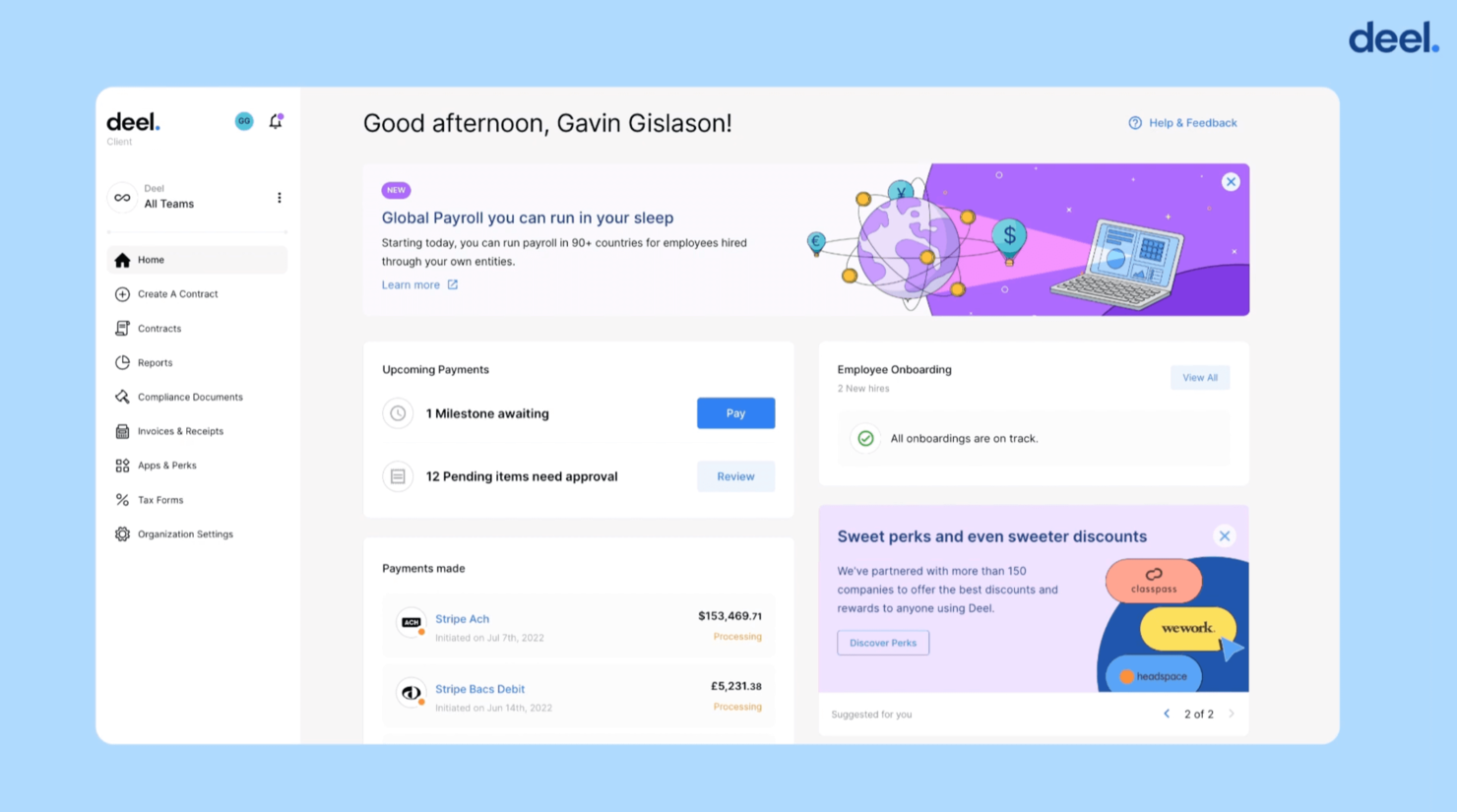
I picked Deel because it helps you hire in the U.S. and internationally without needing to set up local entities, supported by in-country legal and compliance experts. You can manage onboarding, contracts, payroll, and offboarding in one place, which reduces admin work for businesses hiring in multiple jurisdictions.
I also like that you can create localized contracts with built-in compliance checks, ensuring you meet each region’s employment requirements, and the platform includes tools such as expense tracking and international benefits that help your team manage global workers more accurately. Plus, its pricing model is straightforward, and you can estimate employee costs using their country-specific calculator tools.
Deel Key Features
Here are some standout features worth highlighting:
- Localized Contracts: Generate location-specific agreements with built-in legal and tax compliance.
- International Benefits: Provide country-appropriate health, pension, and supplemental benefits.
- Expense Tracking: Allow employees to submit expenses for approval and reimbursement directly in the platform.
- Slack Tools: Use Slack-based workflows for time-off requests and quick status updates.
Deel Integrations
Integrations include QuickBooks, Xero, Netsuite, Hibob, BambooHR, Greenhouse, Lever, Okta, Workday, and Google Workspace.
Pros and Cons
Pros:
- You can track time-off requests easily via a Slack plugin
- Offers additional employer of record (EOR) services, if needed
- Offers global payroll services across 150+ currencies
Cons:
- No free trial available
- No mobile app available
Best for small US-based teams
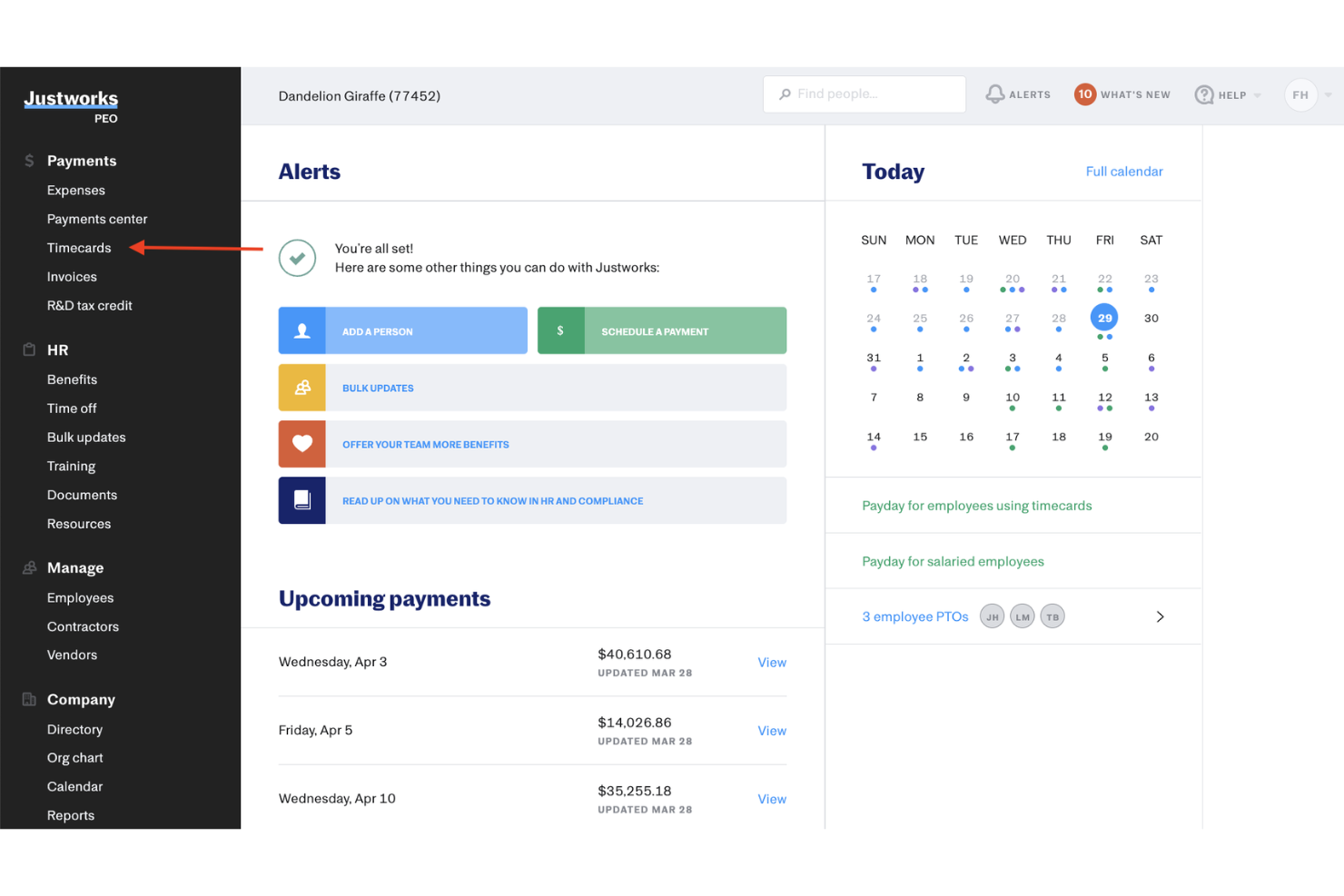
Justworks is a professional employer organization that helps small and growing businesses handle payroll, HR, compliance, and benefits from a single platform. By partnering with Justworks, you get access to tools and resources that make managing your team more manageable and efficient.
Why I picked Justworks: I chose Justworks because of its strong focus on compliance support, which is essential for any business working with a PEO. You don’t have to stress about staying on top of federal, state, and local employment laws since Justworks helps with things like workers’ compensation, unemployment insurance, and tax filings.
Another reason I picked Justworks is its payroll services. Payroll often takes up a lot of time and creates stress when errors happen. With Justworks, you can set up automated payroll that works for any type of team structure. It allows you to handle fast and flexible payments, ensures taxes are taken care of, and simplifies financial processes.
Justworks Key PEO Services:
Justworks also offers access to employee benefits that go beyond health coverage, such as 401(k) plans, mental health resources, and family-building services. It provides HR tools that let you manage your team from one place, giving you the ability to handle data-driven reporting for smarter decisions.
In addition, it offers time tracking that integrates directly with payroll, helping employees log hours easily and accurately. It even gives you resources to attract and retain talent by offering benefits packages that are often only available to larger companies, giving your small business a competitive edge.
Pros and Cons
Pros:
- Offers mental health and wellness resources
- Helps small businesses access quality benefits
- Simplifies payroll with automation and accuracy
Cons:
- Limited global or international support options
- Limited for larger enterprises

Rippling
Best for unified HR, payroll, and spend management
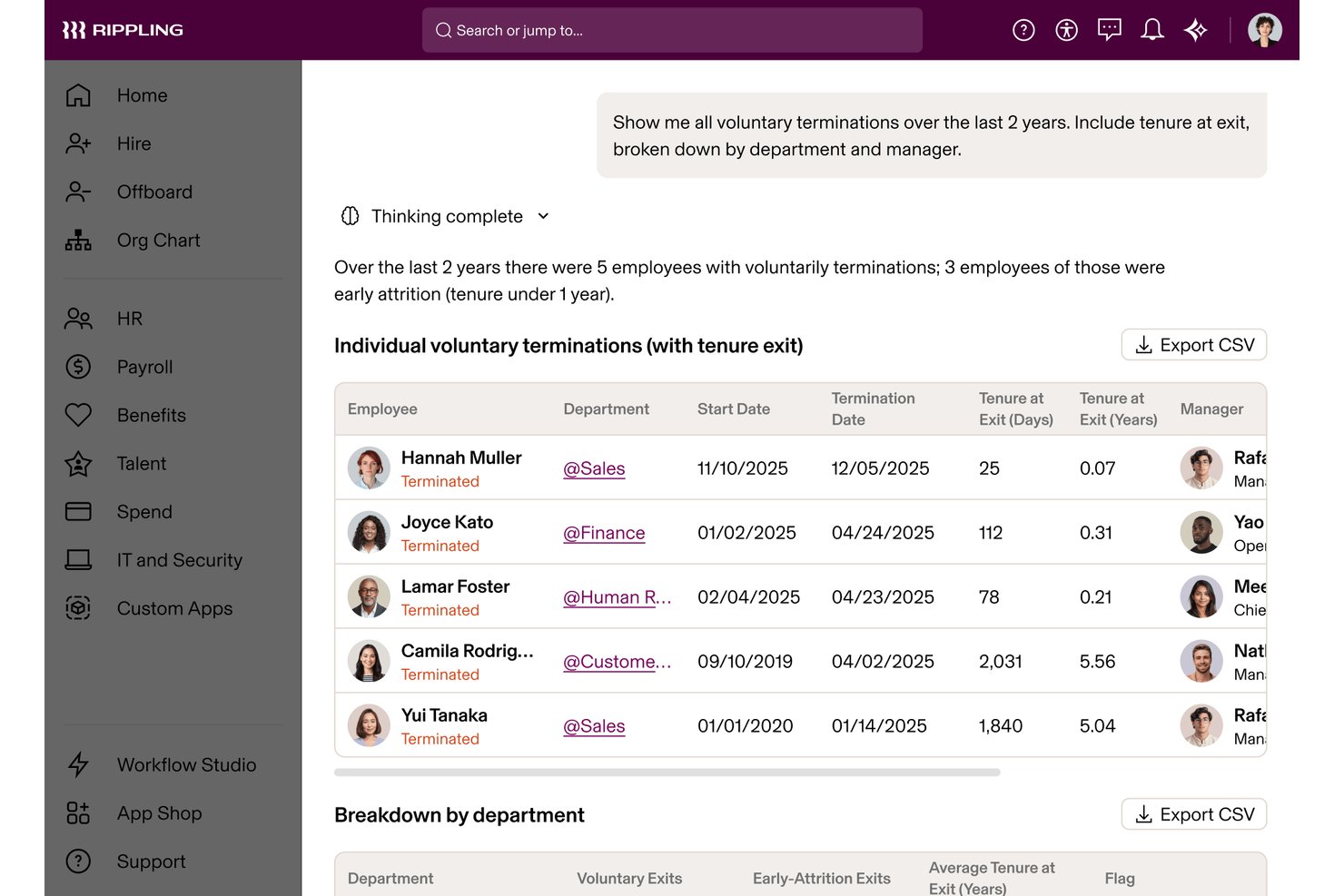
Rippling is a PEO platform that combines employer of record services, benefits administration, payroll, IT management, and spend management into a single unified system built on one employee data model.
Who Is Rippling Best For?
Rippling is a strong fit for small to mid-sized businesses that want enterprise-grade benefits and compliance support without locking themselves into a traditional PEO model long-term.
Why I Picked Rippling
Rippling earns its spot as one of the best on my shortlist because it's the only PEO built on a single employee data model that spans HR, IT, and spend. I love that when a new hire is onboarded, payroll, device provisioning, and benefits enrollment all trigger from one record, with no manual work across separate systems. What I find most useful is the PEO exit flexibility: companies can leave the PEO service and stay on the same Rippling platform, keeping their data and integrations intact.
Rippling Key Features
- Compliance automation: Handles federal, state, and local HR compliance filings and reporting automatically.
- Premium benefits administration: Manages health, dental, vision, 401(k), HSA, FSA, and commuter benefits in a single interface.
- HR advisory support: Provides access to certified HR pros for guidance on policies, employee relations, and compliance issues.
- Integrated app marketplace: Connects with over 650 third-party business tools for expanded workflow automation.
Rippling Integrations
Rippling offers a wide range of native integrations including Slack, Google Workspace, Microsoft 365, Salesforce, Zoom, Vanguard, Fidelity, QuickBooks, Xero, and Okta. An API is available for custom integrations.
Pros and Cons
Pros:
- Automates multi-state payroll tax filings
- Manages IT device provisioning with HR
- Exits PEO without losing existing data
Cons:
- Complex initial setup for smaller teams
- Customer support response times can be inconsisitent
New Product Updates from Rippling

Rippling AI Adds Plugins, Skills, and Automations
Rippling AI now supports plugins, skills, and automations so employees can connect approved third-party tools, package repeatable work into reusable AI instructions, and run recurring workflows under existing Rippling policies and permissions. For more information, visit Rippling's official site.
Best for accessing benchmarked salary data
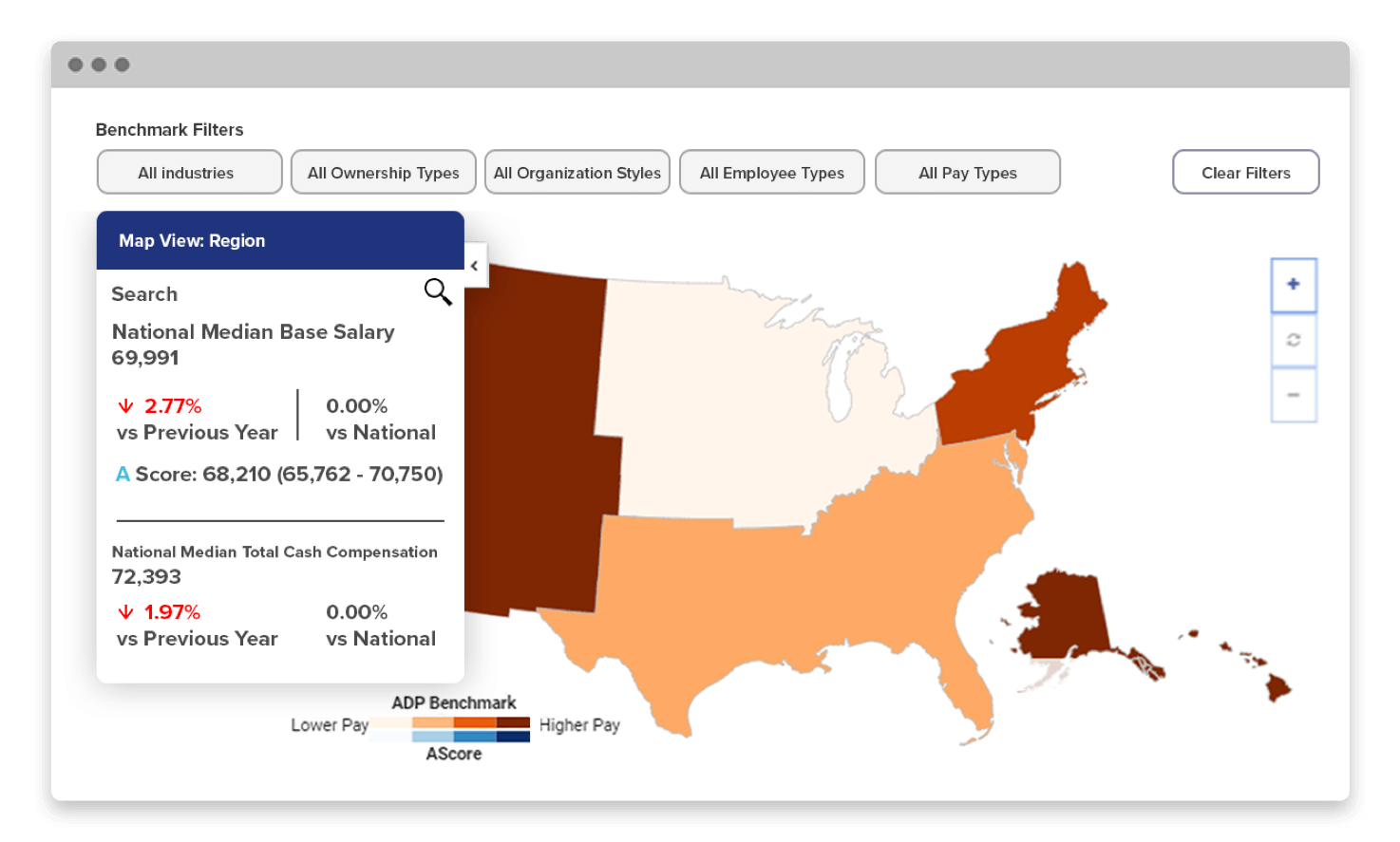
ADP TotalSource is ideal for businesses that want hands-on HR support paired with access to reliable, benchmarked salary data. It’s a strong fit for teams hiring in competitive markets because you get clear compensation insights alongside payroll, benefits and compliance services.
Why I Picked ADP TotalSource
I picked ADP TotalSource because it gives you salary benchmarking data you can use to set fair, competitive offers—especially helpful if you’re hiring across multiple markets or job families. You also get a dedicated HR business partner who helps interpret this data and guide decisions on compensation, benefits and compliance.
The service handles payroll, taxes, garnishments and multi-state processing, so you’re not piecing together separate systems, and I like that employees can manage benefits and pay information through mobile self-service tools, which cuts down the admin load on your team. If you need trustworthy compensation insights bundled with full PEO support, this is one of the strongest all-in-one options.
ADP TotalSource Key Features
Here are some standout features worth highlighting:
- Benchmarking & Compensation Insights: Access market-based salary data to inform competitive offers.
- Employee Benefits Access: Build health, vision, dental and retirement plans using ADP’s large-group buying power.
- HR Expert Support: Work directly with specialists for policy questions, employee relations and compliance.
- Mobile Self-Service: Employees handle benefits enrollment, pay statements and updates from any device.
ADP TotalSource Integrations
Integrations include QuickBooks, ADP Marketplace, JazzHR, ADP SmartCompliance, Deputy, ZipRecruiter, Slack, Microsoft Teams and time/attendance tools within the ADP ecosystem.
Pros and Cons
Pros:
- Large-group benefits plans improve total-rewards competitiveness
- Their knowledgeable staff act as your HR Business Partner for hire
- Can handle the needs of larger businesses or enterprises
Cons:
- ADP offers many services and software packages, which can be confusing
- Geared towards hiring and managing talent within the USA
TriNet
Best for U.S. businesses with up to 500 employees
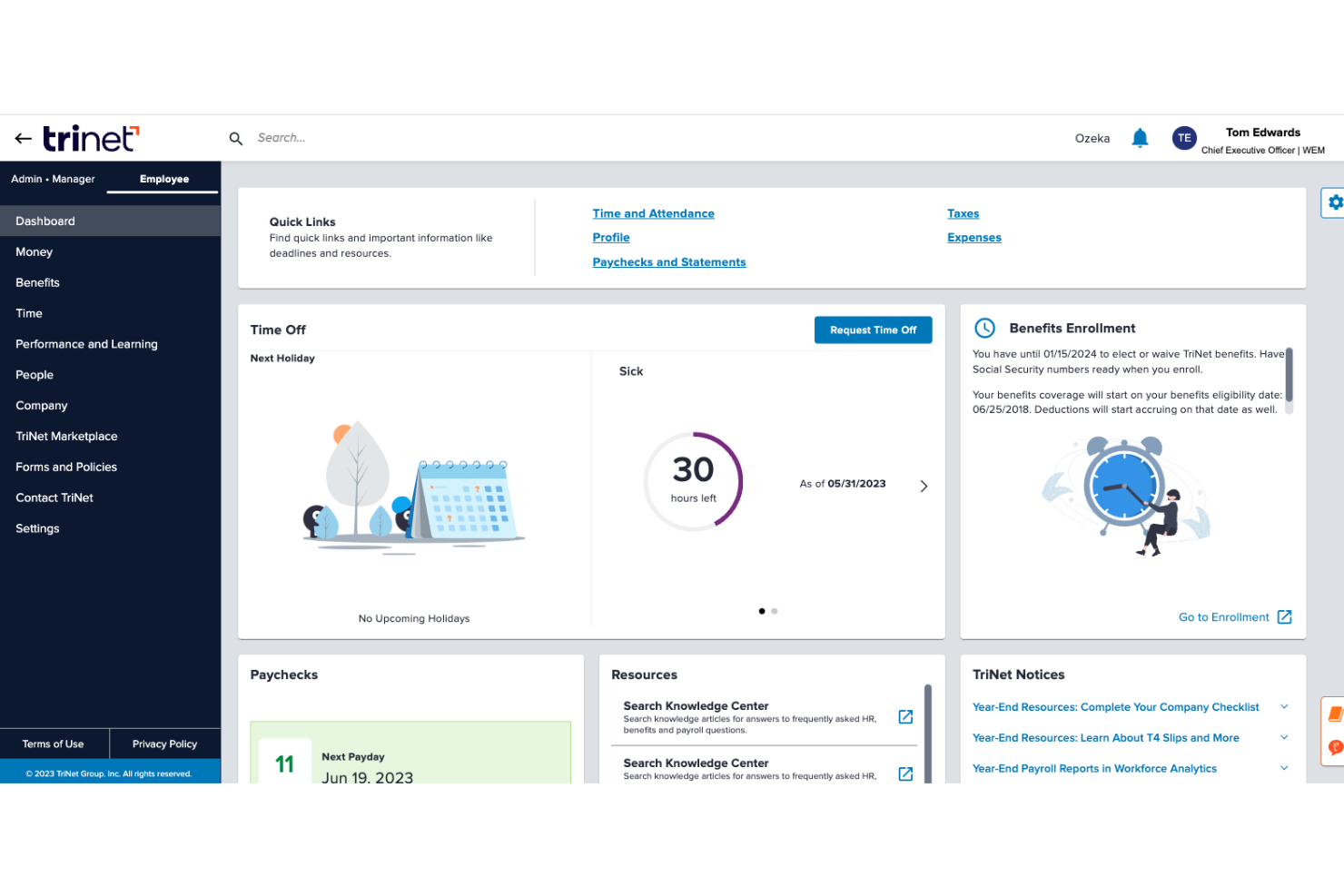
TriNet is a professional employer organization (PEO) that provides a complete HR solution for small to medium-sized businesses. Through its platform, you can offload essential HR tasks like payroll processing, benefits administration, and compliance management. This lets you focus more on your business while still giving your team reliable HR support.
Why I picked TriNet: I picked TriNet because of its ability to manage payroll and related compliance tasks through its PEO model. You can rely on it to handle payroll processing accurately, including tax filings and wage reporting, so you don’t have to juggle complex requirements. This service reduces your team’s administrative load and helps you avoid mistakes that could cause financial penalties.
Another reason TriNet stands out as a PEO is its benefits access. Even if your business is small, TriNet gives your employees access to benefit plans that are usually reserved for larger companies. You can offer medical, dental, vision, retirement, and voluntary benefits that make your workplace more competitive when it comes to attracting and keeping talent.
TriNet Key PEO Services:
Other key services include risk mitigation services that help you stay compliant with employment laws and manage potential liabilities. You also get HR expertise, where consultants support you with guidance on employee relations, policies, and organizational development.
In addition, the technology platform offers tools like applicant tracking, performance management, and reporting to help you manage your workforce efficiently. TriNet even supports contractors and global workforce needs, giving you the flexibility to manage diverse teams across different employment types and locations.
Pros and Cons
Pros:
- Supports contractors and international staff
- Access to HR consulting expertise
- Wide range of employee benefits options
Cons:
- Processing leaves or adjusting time-off balances can be slow
- Onboarding new employees sometimes involves a lot of back-and-forth

Best for global workforce management
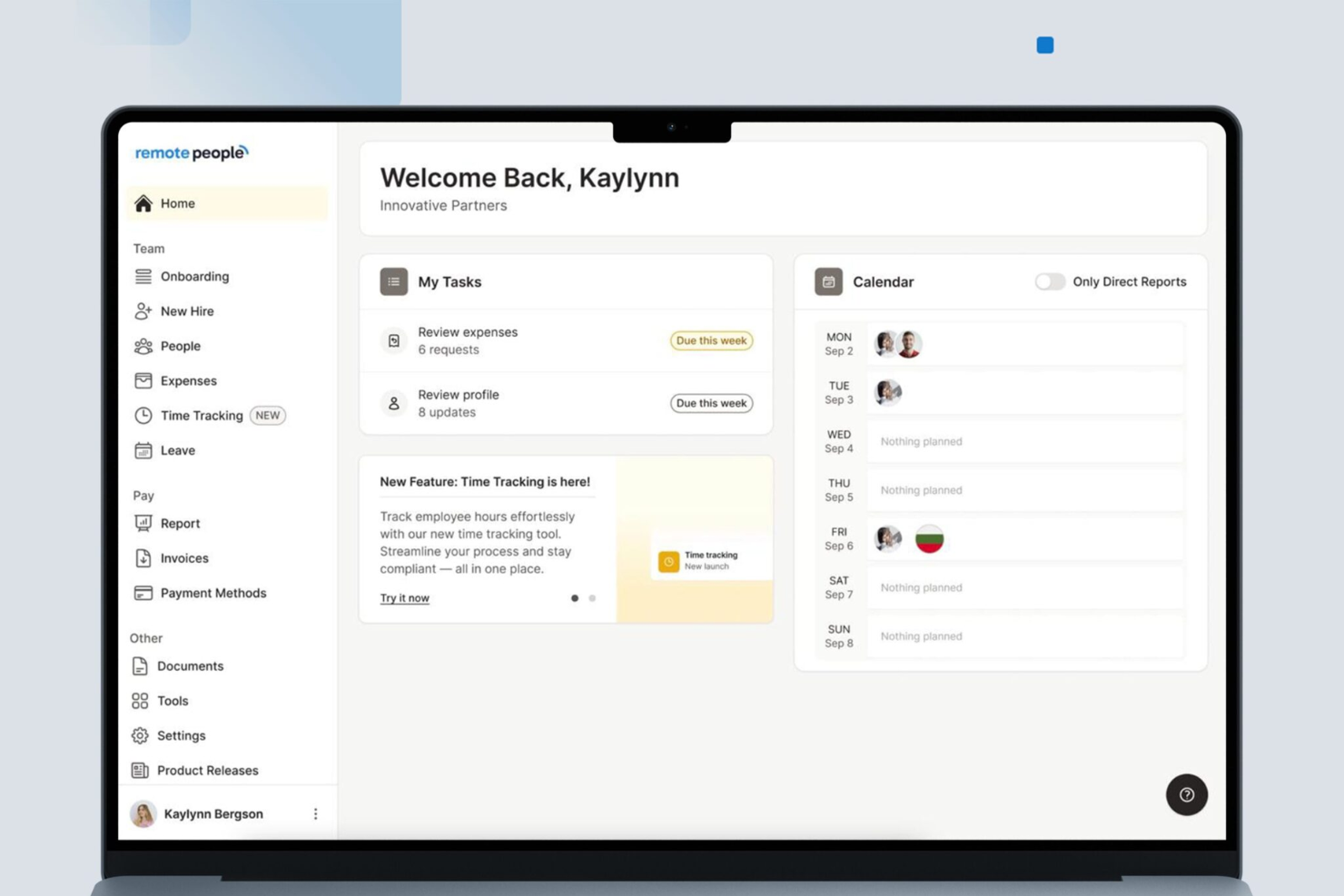
RemotePeople is built for companies looking to hire and manage talent across borders without the usual local-entity setup. If you’re a business scaling internationally or managing a distributed workforce, you’ll find its global payroll, compliance, and contractor-management services especially useful.
Why I Picked RemotePeople
I picked RemotePeople because it delivers true global hiring and payroll support in over 150 countries, which means your team can work from almost anywhere while you avoid local-entity headaches. Their co-employment model and full compliance support let you retain operational control while they handle taxes, benefits and HR admin.
You’ll benefit from a single unified platform that consolidates onboarding, contracts, and payments in different currencies, so you don’t have to cobble together spreadsheets and local vendors. Plus, their price transparency (starting around US $199 per employee per month) and dedicated onboarding manager help you scale your global team quickly without hidden fees.
RemotePeople Key Features
Here are some standout features worth highlighting:
- Global payroll and benefits: Pay employees in different countries, manage benefits and taxes in one system.
- Worldwide workforce support: Hire in 150+ countries without having to create a local legal entity.
- Dedicated onboarding & account manager: You get someone who helps you set up the system, train your team, and migrate hires with minimal disruption.
- Transparent per-employee pricing: Clear cost structure starting at a monthly rate per employee, helping you budget when growing globally.
RemotePeople Integrations
Integrations include BambooHR, Greenhouse, Slack, Workday, QuickBooks, NetSuite, Xero, Zapier
Pros and Cons
Pros:
- Dedicated onboarding manager smooths initial rollout
- Access to a vetted global talent pool
- Includes Employer of Record and PEO services
Cons:
- No listed software integrations
- Limited publicly available customer reviews
Best for globally distributed teams

Multiplier helps companies manage and pay international employees and contractors without setting up local legal entities. If your team is hiring globally—especially in multiple countries at once—this tool gives you visibility and compliance control in one platform.
Why I Picked Multiplier
I picked Multiplier because it lets your team onboard full-time staff and contractors across countries and pay them in over 120 currencies with built-in local compliance support.
You can generate employment contracts in minutes that are legally compliant for each country, helping you hire fast and correctly. You also get expense tracking, timesheet management, and benefits administration all in the same dashboard, so you don’t have to juggle multiple tools. Plus, their network of 100+ legal and tax experts means you have help navigating labour laws worldwide rather than going it alone.
Multiplier Key Features
Here are some standout features worth highlighting:
- Instant compliant contracts: Generate legally-valid employment or contractor agreements for international hires in minutes.
- Multi-currency global payroll: Run payroll across multiple countries and currencies from one invoice, reducing manual coordination.
- Unified employee & contractor support: Manage full-time employees and independent contractors through one platform, simplifying classifications and workflows.
- Real-time cost insights: See live employee cost estimates and monitor global payroll spend, so you can budget and forecast more accurately.
Multiplier Integrations
Integrations include BambooHR, Workday, Personio, HiBob and other native HR / payroll systems.
Pros and Cons
Pros:
- Lets you offer equity globally to help attract talent
- Built-in compliance and legal-tax support in 150+ countries
- Onboard global hires quickly without needing a local entity.
Cons:
- Limited number of native integrations compared to some competitors
- Maybe expensive for small teams

Best for its industry reputation
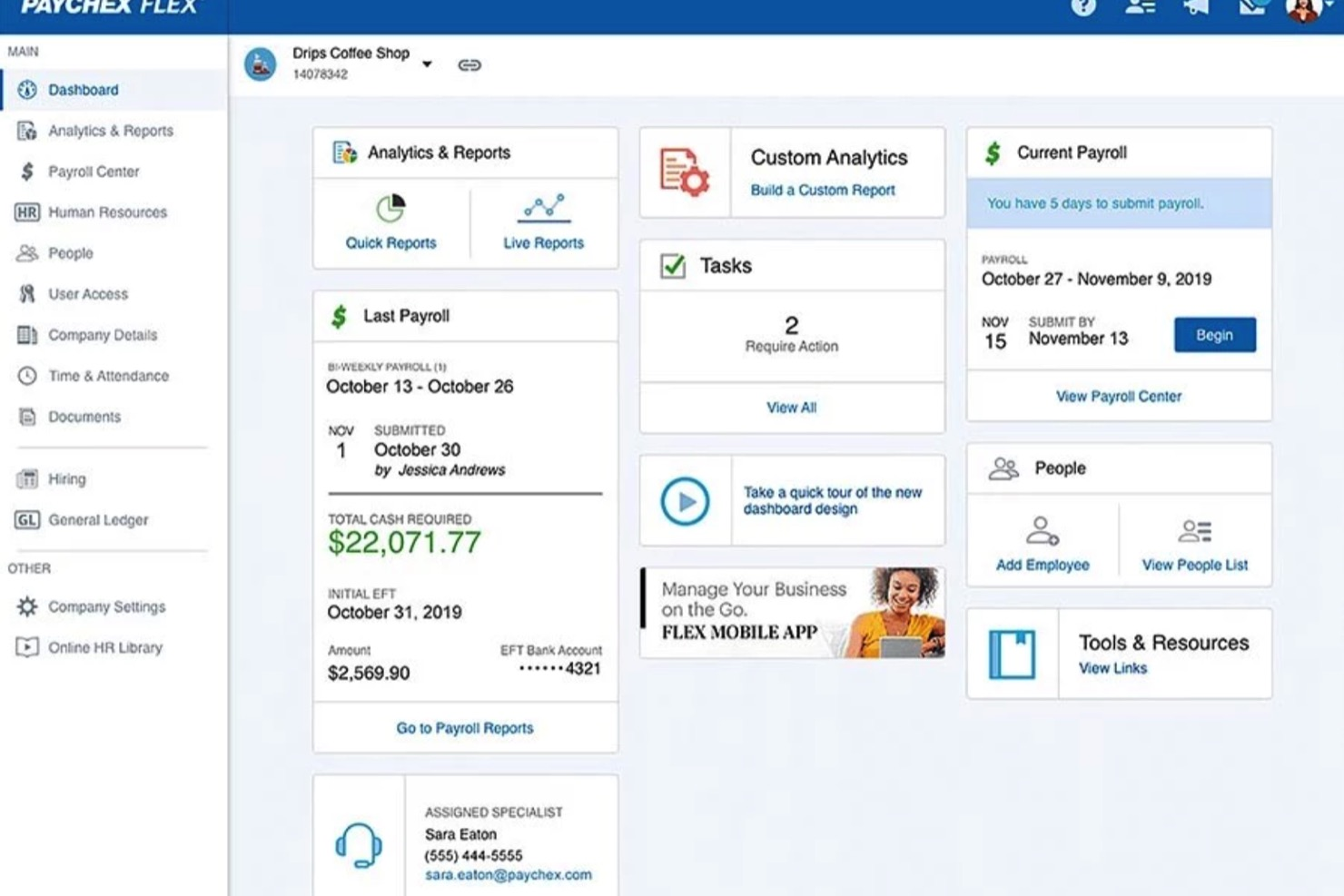
Paychex PEO is a good fit for U.S.-based companies that want hands-on HR support paired with a well-established payroll and benefits infrastructure. It’s especially useful for teams that need dependable compliance guidance and access to competitive employee benefits without managing everything internally.
Why I Picked Paychex PEO
I picked Paychex PEO because it gives your team direct access to HR specialists who handle payroll, tax compliance, benefits administration, and risk management on your behalf. You get a dedicated payroll expert who ensures deductions and filings stay accurate across local, state, and federal levels, reducing the risk of compliance errors.
I also like that employees can manage pay stubs, benefits, and retirement accounts through the Paychex Flex self-service portal, which cuts down on admin requests, and their benefits specialists help you offer perks like FSAs and premium-only plans, giving employees more flexibility in covering medical expenses. For companies needing safety guidance, Paychex provides industry-specific training support through their network of safety experts.
Paychex PEO Key Features
Here are some standout features worth highlighting:
- Time & Attendance Tools: Track hours, approve timesheets, and manage PTO directly in Paychex Flex.
- Safety Program Support: Build custom OSHA-aligned training plans with guidance from certified safety experts.
- Employee Self-Service Portal: Give staff access to pay history, tax forms, and benefit details from any device.
- Retirement Plan Management: Offer and administer 401(k) plans with employee dashboards for contribution tracking.
Paychex PEO Integrations
Integrations include QuickBooks, Sage, Xero, Microsoft Outlook, Microsoft Teams, Google Workspace, Indeed, ZipRecruiter, and Employee Navigator.
Pros and Cons
Pros:
- Multiple HR professionals to support each client
- Strong time-tracking and PTO management tools
- Wide range of competitive employee benefits
Cons:
- Potential loss of control of certain HR processes
- You need at least 5 employees to use PEO services
Best for global mobility support
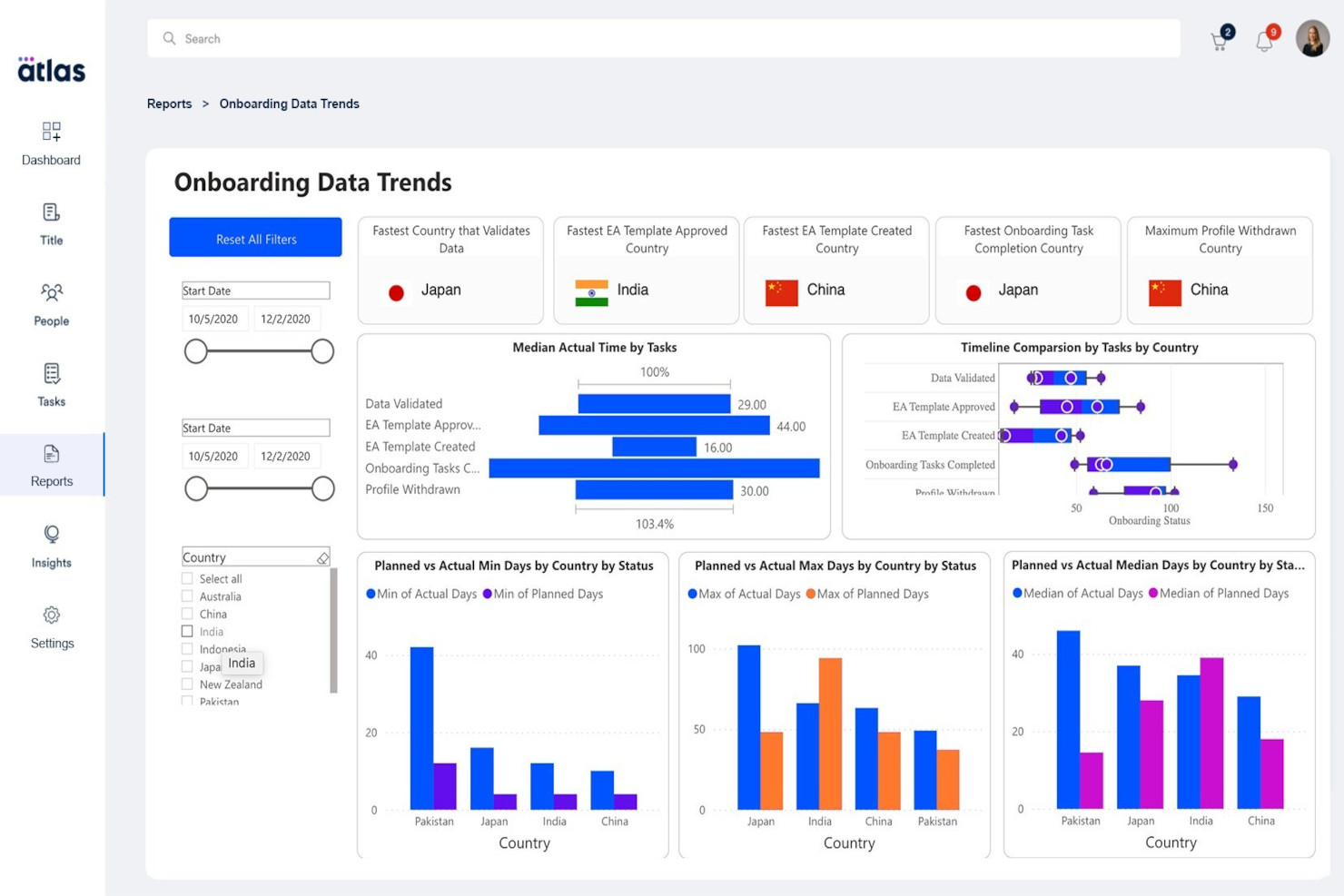
Atlas HXM provides cloud-based HR software and comprehensive PEO services, including payroll management, benefits administration, and compliance.
Why I picked Atlas HXM: They're a popular choice across numerous industries, including non-profits, financial services, oil & gas, energy, life sciences, pharmaceuticals, technology, and government, and they can tailor their service offerings to your needs, whether you're a new startup, an SME, or an enterprise organization.
Their combined HR services and software platform covers core HR processes like payroll management, benefits administration, talent management, recruiting, and onboarding. Their user-friendly interface and personalized dashboard make it easy to monitor your workforce, with all data securely stored in the cloud.
Their software enables companies to access real-time information and data analytics, enhance employee communication, and streamline transactional processes.
Atlas HXM's online portal gives employees access to essential HR information, including their pay stubs, benefits, and paid time off information. It also uses data-driven insights to help businesses identify key performers, track employee information, track performance management, and provide employees with goals and objectives. This allows companies to develop and implement effective growth and development strategies to maximize employee potential.
The platform provides businesses with tools to automate essential recruitment tasks, such as job postings, resume screening, and background checks. Its onboarding features enable businesses to provide new hires with a seamless and personalized experience, helping them feel welcome and integrated into the company culture from their first day.
Atlas HXM's Key PEO Services:
Atlas HXM specializes in payroll processing, tax management, and compliance. They handle payment processing, tax filings, workers' compensation, and risk management. Their benefits administration services cover health, dental, vision, and 401(k) plans, providing comprehensive support for employee needs.
Other unique offerings include global mobility solutions for cross-border employee transfers. Atlas HXM assists with corporate housing, office space, and vehicle leasing, simplifying relocations for international staff. These services, combined with their robust HR platform, make Atlas HXM a strong partner for businesses with global workforce needs.
Atlas HXM's Pricing:
Pricing for Atlas HXM starts at $595/employee/month for their EOR/PEO services, or $49/contractor/month if you only need their global payroll services. You can also request a free demo through their website.
Pros and Cons
Pros:
- Assistance with global immigration issues and work authorizations is very valuable
- Can help simplify cross-border mergers & acquisitions
- PEO & EOR employees can manage their own expense reimbursements through the self-service portal
Cons:
- May be too expensive for small businesses
- PEO services are administered under an EOR agreement

Omnipresent
Best for ensuring payroll compliance
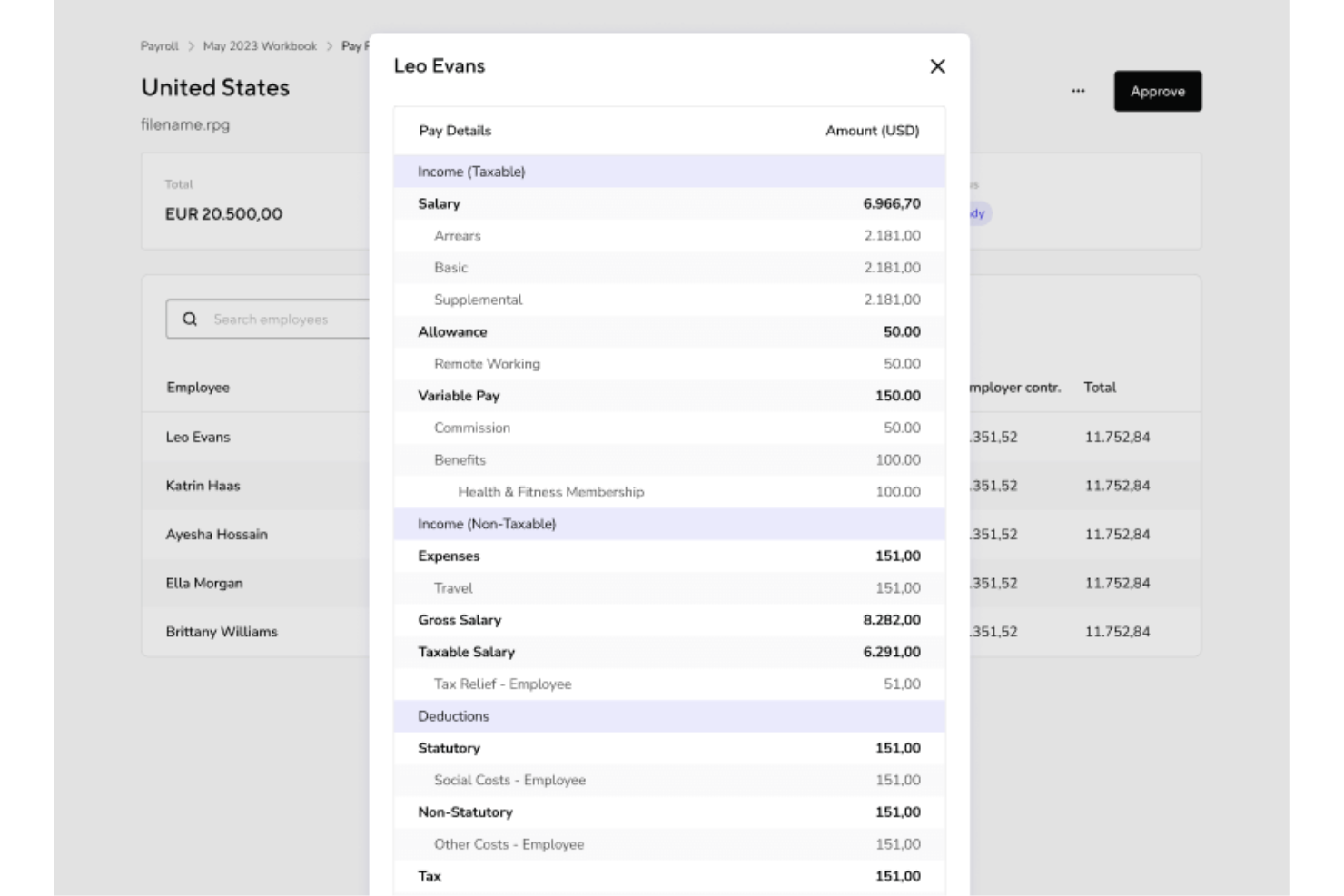
Omnipresent offers Professional Employer Organization (PEO) services designed to help businesses manage HR tasks in countries where they have established entities.
Why I picked Omnipresent: By partnering with Omnipresent as your certified PEO provider, you can avoid the need for a large in-house HR team to manage complex human resources, benefits, or legal aspects across different states or countries. This allows you to concentrate on improving employee turnover and other critical business areas.
Another benefit is Omnipresent's expertise in ensuring regulatory compliance in payroll matters. They provide compliant payroll services, including accurate calculations and necessary documentation, which helps you avoid costly fines associated with non-compliance.
Omnipresent Key PEO Services:
Services include access to better employee benefit rates, as Omnipresent leverages its pool of customers to negotiate more favorable rates and a wider range of benefits at lower costs. Additionally, their platform allows you to run payroll quickly, offering a fast and compliant solution for your global team, preventing data silos, and reducing administrative burdens.
Furthermore, Omnipresent provides real-time expert support, offering guidance on registration, payroll, taxes, labor laws, and more.
Omnipresent's Pricing:
Pricing begins from $100/employee/month.
When to Use PEO Services
A PEO (professional employer organization) lets you hand off payroll, benefits, compliance, and HR admin to a co-employer so your team can focus on actually running the business. It's not just for large companies with complex HR needs, either. If any of the scenarios below sound familiar, a PEO might be worth a closer look:
- Your HR team is buried in admin instead of strategy: You're spending hours each week on payroll processing, tax filings, and benefits questions that have nothing to do with growing the business. A PEO takes those tasks off your plate, freeing your HR team to focus on hiring, culture, and retention.
- Competing for talent with benefits you can't afford alone: Candidates are comparing your health plan to what a 500-person company is offering, and you're losing. PEOs pool employees across their client base, giving your team access to Fortune 500-level benefits at a fraction of the cost.
- Compliance is keeping you up at night: You're operating across multiple states, and keeping up with changing labor laws, tax rules, and reporting requirements feels like a full-time job. A PEO takes on shared legal liability and keeps your business compliant as regulations shift.
- You're expanding into a new state or country: Say you need to hire in Texas, California, or Canada, but you don't have HR infrastructure there yet. A PEO handles local registration, tax setup, and compliance so you can onboard new hires without the 3-6 month setup timeline.
- Managing payroll errors is eating your team's time: Mistakes in overtime calculations or tax withholding are creating corrections, complaints, and the occasional penalty. PEO payroll systems automate these calculations and catch errors before they become problems.
Other PEO Service Providers
Here are some additional PEO providers that didn’t make it into my top 10 PEO services shortlist, but are still worth considering:
- Mercans
Specialty services for global operations
- Insperity
For enterprise-grade support for growing teams
- CloudPay
For pay on-demand
- Agile HRO
For its network in Asia and Oceania
- Remunance
India-focused PEO
- HSP Group
For global payroll without local entities
- Remote
For self-service HR tools
- Papaya Global
For cross-border payroll automation
- Oyster HR
For simplifying global hiring
- Wisemonk
For compliance in India
- Worksuite
For global freelancer teams
- ANSR
For a talent network to help you source candidates
- CoAdvantage
For managing risk & regulatory compliance
- Engage PEO
For workers' compensation assistance
- Global PEO Services
PEO company for immigration and global mobility support
- Zempleo
For international recruitment services


Related HR Software Reviews
If you're looking for better HR tools in addition to PEO services, check out these other core HR offerings, that we've tested and evaluated:
- HR Software
- Payroll Software
- Recruiting Software
- Employer of Record Services
- Applicant Tracking Systems
- Workforce Management Software
How I Evaluate Professional Employer Organizations
I split my evaluation into baseline criteria every PEO must meet—like CPEO certification, multi-state payroll, and master benefits access—and differentiators that separate the best options for growing SMBs.
Core Functionality (Table Stakes for This List)
When I'm selecting tools for my list, I rank each one on a scale from 0 (does not offer the functionality) to 5 (excels in this area) for each core functionality listed below. I then calculate the tool's total score into a percentage, using 65% as a benchmark to help assess its overall fit for the list.
- Co-Employment Model: I check whether the provider operates as a true co-employer with IRS CPEO certification, ESAC accreditation, and coverage across all 50 states.
- Full-Service Payroll: Multi-state payroll with automated tax filings, garnishment handling, and self-service portals is what I evaluate for growing, distributed teams.
- Benefits Administration: I look for master-plan access to national carriers for health, dental, vision, 401(k), and ancillary benefits like FSA/HSA and commuter programs.
- HR Compliance & Risk: Each provider's compliance depth matters—EPLI coverage, workers' comp sponsorship, handbook builders, and multi-state labor law guidance all factor in.
- Onboarding & Employee Lifecycle: I evaluate whether the platform covers digital onboarding, I-9/E-Verify, PTO tracking, and offboarding workflows in a single system.
- HR Advisory & Support: Access to named, certified HR professionals for real guidance on terminations, employee relations, and policy questions sets strong PEOs apart.
Once I have a list of tools that meet the criteria, I consider what sets each platform apart.
Differentiating Factors (What Sets Vendors Apart)
Here's how I compare and contrast different vendors:
Standout Features
I evaluate whether a PEO offers global Employer of Record capabilities alongside its domestic co-employment model. A startup hiring its first engineer overseas shouldn't need a separate EOR contract—providers like Papaya Global and Rippling bundle both under one roof. I also check for open API access and prebuilt connectors to tools like QuickBooks and Greenhouse, since manual data re-entry between payroll and accounting creates real reconciliation headaches at month-end close. Benefits decision support matters too: personalized plan-comparison calculators help employees actually pick the right coverage instead of defaulting to the most expensive option.
Beyond Features
I look at whether a PEO charges per-employee-per-month or takes a percentage of payroll, since the latter quietly inflates costs as you give raises. CPEO certification and ESAC accreditation matter too—they shift federal tax liability off your books and signal financial stability. I also check exit terms, because a company that outgrows its PEO needs clean data portability and mid-year W-2 handoffs without scrambling.
In general, PEO services are a good option for smaller organizations, with no little or no in-house HR, who need better benefits or multi-state hiring. They might not be so cost effective for larger organizations with complex, custom HR needs who want tight control over all HR processes and already have an HR team and infrastructure.

How to Choose a PEO Service
Partnering with a PEO service can help you outsource your core HR functions so you can focus on more strategic HR operations. To help you figure out which PEO service best fits your needs, you need to document your specific challenges first.
As you work through your own unique selection process, keep the following points in mind:
- What problem are you trying to solve? Start by identifying the challenges you're trying to overcome, whether that's managing HR admin tasks for employees abroad, improving your benefits administration, or monitoring key markets for changes to labor laws and regulations to maintain compliance.
- Who will benefit from the service? Consider who will manage the PEO relationship (i.e., who will be your main contact person in-house?) and how working with a PEO service will improve their day-to-day work tasks.
- What is your budget? To evaluate cost, estimate how many foreign employees your chosen PEO service would serve. Since PEO providers often charge a flat monthly fee based on your employee headcount, this will help you proactively estimate your monthly costs.
- What outcomes are important? Review the capabilities you want to gain or improve, and how you will measure success. For example, you may want to reduce administrative demands on your in-house HR staff or put new HR support structures in place that are scalable to accommodate future growth. Being clear on your desired outcomes upfront will help you avoid wasting time on providers that aren't a solid fit.
- How it would work within your organization? Consider how the service provider's software ecosystem would work alongside your existing workflows and systems. Would their software framework integrate with your existing HR software, or would you face data management roadblocks?
Remember every business is different — don’t assume that a PEO service will work for your organization just because it's popular. If you're really having a difficult time figuring out the best fit for your needs, you could also enlist the help of a PEO broker to help you analyze all the options in detail.
I recommend doing thorough research on the PEO service model and culture to make sure it aligns with the needs and culture of your organization and you can work well with them. One thing to keep in mind is that, even when companies work with a PEO, they need at least one HR person on staff, or someone to liaise between the PEO and the staff.
Trends in PEO Services and Technology
PEO services are evolving fast, reshaping how businesses handle HR by embracing new tech and client demands. From AI-driven automation to blockchain-backed compliance tools, today’s PEOs are streamlining operations and enhancing service delivery.
Here’s a quick look at the top trends shaping the future of PEO software and services:
Specialized Services
- Increased Focus on SMEs and Startups: A significant trend is the emergence of services specifically designed for small to medium-sized enterprises (SMEs) and startups, providing them with scalable HR solutions that accommodate rapid growth and change.
- Industry-Specific Solutions: There's an increasing availability of industry-specific PEO services, catering to unique requirements of sectors like healthcare, technology, and retail.
- Shifting Service Demand: Services related to traditional, one-size-fits-all benefits packages are seeing a decline in demand as businesses shift towards more customizable and flexible HR solutions.
Technological Advancements
- Increased Use of AI and Machine Learning: AI and machine learning algorithms are being integrated into PEO solutions to further streamline HR processes, from payroll processing to personalized benefits packages. This integration also enables better predictive analytics and customized employee experiences.
- Automation of Compliance and Risk Management: Automation tools for compliance and risk management are becoming more sophisticated, reducing the manual workload and enhancing accuracy in monitoring changing regulations.
- Bespoke Employee Benefits Platforms: PEOs are developing more customizable benefits platforms that allow businesses to offer tailored benefits packages, meeting the diverse needs of their client's workforce.
- Blockchain for HR Operations: Some PEOs are beginning to explore using blockchain technology for secure and transparent HR operations, including payroll processing and employment verification.
These trends highlight the PEO industry’s shift toward smarter, tech-enabled, and more tailored HR solutions. As workforce needs grow more complex, the PEOs leading the way are those delivering flexible, specialized support that helps businesses adapt and scale.
What is a PEO Service?
A PEO service is a service provider that takes over your core HR responsibilities—like payroll, benefits, and compliance—through a co-employment model. Companies can outsource their human resources functions to them, while retaining control over day-to-day operations and team management.
Small to mid-sized businesses use PEOs to reduce legal risk, offer better benefits, simplify payroll and tax filings, and save time on HR tasks they don't have in-house capacity to manage.
Professional employer organizations (PEOs) handle international payroll by simplifying compliance through centralizing salary and invoicing processes across countries.

Key PEO Services
Partnering with a PEO gives businesses access to a broad range of HR, payroll, and compliance services that support efficiency, growth, and strategic focus. When selecting a PEO service, keep an eye out for the following key services:
- Payroll services: Payroll administration is one of the core functions PEOs provide. They handle payroll processing, paid time-off (PTO) management, pay stub generation, and submitting payments. They also organize and remit payroll taxes on your behalf, ensuring your employees are paid accurately and compliantly every cycle.
- Regulatory compliance: A strong PEO helps you stay compliant with employment regulations, tax rules, and labor laws across multiple states or countries. Their local expertise is especially valuable when hiring remotely or expanding into new jurisdictions, helping you mitigate risks before they become issues.
- Employee benefits: PEOs help you build competitive benefits packages that include health insurance, life insurance, retirement plans, commuter benefits, workers’ compensation, and more. Many also support FSAs and HSAs, giving employees access to high-value perks typically reserved for larger organizations.
- Recruiting and staffing: Many PEOs offer recruitment support to help you source talent locally or internationally. Once hired, they streamline onboarding through digital workflows, automated document collection, and integrated HR systems that help new employees ramp up quickly.
- Global HR services: International PEOs often provide Employer of Record (EOR) services for organizations without a legal entity abroad. This allows you to hire global talent compliantly while the PEO manages local employment, contracts, payroll, and regulatory requirements.
- Data management: Most PEOs include centralized HR software where you can manage payroll approvals, generate contracts, track employee records, and run reports. Many also offer employee self-service portals so workers can update personal information, view pay stubs, and access benefits details independently.
- Talent management: Some full-service PEOs support training, performance management, and contractor oversight. Their platforms may include built-in learning tools, feedback systems, or mobile apps for time tracking and other day-to-day tasks.
- Risk management: PEOs help identify workplace risks, establish safety protocols, reduce liability exposure, and maintain compliance with health and safety regulations. Effective risk management can also lower insurance costs and reduce the likelihood of lawsuits.
- Workers’ compensation administration: PEOs manage workers’ compensation coverage, including claims processing and insurance coordination. This ensures employees are supported during work-related injuries while keeping your business compliant and costs controlled.
- Customer support: The best PEOs offer access to HR specialists who can advise you on hiring decisions, benefits questions, compliance challenges, and unexpected issues. This expert guidance helps small and growing teams navigate complex HR scenarios confidently.
Common PEO Service AI Features
Many PEO services are incorporating AI features to improve the customer experience, for example:
- Automated compliance monitoring: AI tracks changes in local, state, and international labor laws, instantly alerting you to updates and helping ensure your HR practices remain compliant across all jurisdictions.
- Smart payroll error detection: AI scans payroll data for potential issues such as incorrect deductions, duplicate entries, misclassified employees, or unexpected variances—catching mistakes before payroll is processed.
- AI-assisted onboarding workflows: PEO platforms use AI to recommend required documents, automate contract creation, validate identity information, and streamline onboarding steps based on role, location, and employment type.
- Predictive workforce analytics: AI identifies patterns in turnover, absenteeism, performance, and labor costs. This helps businesses anticipate workforce needs, improve retention, and make more informed HR decisions.
- Chatbot-driven employee support: AI-powered chatbots answer employee questions 24/7—covering topics like benefits, payroll, PTO balances, or policy details—reducing the load on HR administrators.
- Automated talent matching: Some PEOs use AI to match job openings with ideal candidates based on skills, experience, and performance indicators, helping organizations hire faster and more effectively.
- Risk detection and safety insights: AI analyzes incident reports, workplace patterns, and historical claims data to identify potential risks and recommend proactive safety improvements.
- Benefits optimization tools: Using employee demographics and usage trends, AI recommends benefit packages that improve satisfaction while minimizing unnecessary costs for employers.
- Document automation and validation: AI populates contracts, verifies compliance requirements, and ensures all employee files are complete, accurate, and audit-ready.pliance, attract and retain top talent, and maintain a focus on their core objectives.
Benefits of Using a PEO Services
Working with a PEO Service can streamline your HR operations, reduce risk, and free up time to focus on growth. If you’re considering HR outsourcing, understanding the advantages of a PEO can help you move forward with clarity and confidence.
Here are some key benefits that show the impact a PEO partnership can make:
- Streamlined HR Administration: From payroll processing to benefits administration, PEOs take on the burden of HR operations, allowing companies to focus on core business strategies and growth, while HR professionals can concentrate on more strategic HR initiatives.
- Cost Savings on Employee Benefits: By leveraging their buying power, PEOs negotiate better rates for health insurance and other benefits, making it possible for small and medium-sized businesses to offer competitive packages that attract and retain top talent.
- Compliance and Legal Expertise: This service is invaluable as it minimizes the risk of non-compliance penalties by keeping your business up to date with local, state, and federal regulations, saving time and reducing legal risks.
- Risk Management and Safety Programs: Through developing comprehensive risk management strategies and implementing safety programs, PEOs help reduce workplace accidents, lower insurance costs, and create a healthier work environment for your employees.
- Enhanced Employee Performance Management: By providing systems for feedback, performance tracking, and development plans, PEOs can help businesses enhance employee engagement and productivity, contributing to overall business success.
Using a PEO service offers a strategic advantage by allowing businesses to allocate their resources more effectively, focusing on growth and innovation while ensuring that their HR functions are managed efficiently and professionally. This partnership both enhances operational efficiency and fosters a more engaging and compliant workplace culture.
Generally speaking, it’s advantageous to use a PEO for up to 20 employees. Above that, the buying power of the company could be close enough to that of the PEO to make the high PEO fees disadvantageous.
Costs & Pricing for PEO Services
The cost of PEO services will depend on their pricing model. PEO services typically offer flexible pricing models to accommodate the diverse needs of their clients. Some offer monthly rates based on the number of employees you have, while others have per-user pricing in addition to a flat monthly rate.
Other options include pricing as a percentage of your payroll, bundled services, or custom pricing depending on the specific services your business needs.
Here's a breakdown of the different pricing options PEO services generally offer:
- Per-Employee Fee: This is one of the most common pricing models used by PEOs. Under this model, the PEO charges a fee based on the number of employees you have. This fee can be billed monthly, quarterly, or annually. It's a straightforward model that scales with the size of your workforce, making it easier to predict costs as your business grows.
- Flat Monthly Fee: Some PEOs offer a flat monthly fee for their services. This model is less common and is typically used by small businesses with a stable number of employees. The flat fee is agreed upon in advance and covers all the PEO offerings outlined in the contract.
- Percentage of Payroll: Another pricing model is based on a percentage of the client's total payroll. This model directly ties the PEO's fees to your monthly payroll expenses. However, anticipating monthly fees is more challenging in this model if your company's payroll varies significantly from month to month.
- Bundled Services vs. A La Carte: Bundled services provide a comprehensive package of HR services for a single price, offering value for businesses that need a wide range of HR support. Alternatively, a la carte pricing allows you to select and pay for only the services you need, offering flexibility and potentially lower costs.
- Custom Pricing: For larger or more complex businesses, PEOs may offer tailored service packages with pricing that reflects the specific needs and circumstances of your business. Custom pricing is negotiated on a case-by-case basis and can provide a more precise fit for unique business requirements.
Plan Comparison Table for PEO Pricing Models
| Pricing Model | Description | Best for |
|---|---|---|
| Per-Employee Fee | Charges a fee based on the number of employees. | Businesses of any size, especially those scaling up or down. |
| Flat Monthly Fee | A predetermined monthly fee that covers all services. | Small businesses with a stable number of employees. |
| Percentage of Payroll | Fees are a percentage of the total payroll. | Businesses with variable payroll expenses. |
| Bundled Services vs. A La Carte | Offers comprehensive packages or selectable individual services. Provides flexibility and potential cost savings. | Businesses seeking specific services or comprehensive HR solutions. |
| Custom Pricing | Tailored packages and pricing for unique business needs. Negotiated on a case-by-case basis for a precise fit. | Larger or complex businesses with specific requirements. |
Understanding these different pricing models and how they align with your business objectives is crucial when selecting the right PEO partner for you. Transparency in pricing and a clear understanding of the services included are also key factors to ensure there are no unexpected costs or gaps in service.
PEO Services: Frequently Asked Questions
Here are some answers to questions we hear frequently about professional employer organizations and how they work:
Do I lose control over my employees by working with a PEO?
No, you retain all authority over your employees’ day-to-day management, hiring, and firing decisions when you partner with a PEO. The PEO becomes a co-employer and assumes primary responsibility for payroll, taxes, and compliance, but decisions about promotions, discipline, work assignments, and your company’s culture remain fully in your hands. This partnership is designed to reduce your HR admin burden, not your control.
What HR functions can a PEO handle versus what I’ll need to do myself?
A PEO typically takes care of payroll processing, benefits administration, workers’ compensation, HR compliance, and sometimes employee onboarding paperwork. You’re responsible for recruiting, supervising, and developing your staff, plus making strategic decisions. This split lets you focus on running your business while the PEO manages much of the tedious paperwork and regulatory details.
Can PEO services be customized for small businesses?
Yes, PEOs often design flexible, tailored service packages for small businesses who don’t have full HR teams. You can often select exactly which functions you need—such as payroll, benefits, or compliance—based on your company’s current stage and budget. It’s common for providers to scale services up or down as your team grows or your needs change.
If you need help finding a reliable partner, I recommend reviewing my list of the best PEO services for small businesses to save yourself all the leg work.
How does pricing work for PEO services for small businesses?
PEOs usually charge either a flat fee per employee each month or a percentage of your total payroll. Pricing may also include setup fees or additional costs for optional services like recruiting. For small businesses, providers often offer tiered packages or custom quotes based on your number of employees and the services you select. Always ask for itemized pricing so you understand what’s included and whether there are hidden fees.
Will a PEO help with compliance for multi-state employees?
Yes, many PEOs help manage compliance for teams working in multiple states, handling complex state and local tax filings, employment laws, and benefits requirements. If you have remote workers or plan on expanding into new states, ask prospective PEOs if they have expertise in those areas. The right partner can prevent costly regulatory mistakes as your business grows.
What's the difference between a PEO company and a staffing agency?
A PEO enters into a co-employment relationship with your business, handling HR tasks like payroll, benefits, compliance, workers’ comp, and HR consulting while you maintain operational control. It’s a long-term partnership designed to support your existing workforce.
A staffing agency, by contrast, doesn’t share employment responsibilities. Instead, it supplies temporary or contract workers—employing them directly but assigning them to your business. Their focus is short-term staffing needs, such as filling vacant roles, seasonal work, or project-based positions.
How do PEO companies handle data privacy and security?
PEOs prioritize protecting sensitive employee data using secure software, data encryption, and limited administrative access. They comply with legal regulations such as GDPR in Europe or HIPAA in the United States, and many obtain compliance certifications like SOC 2, which demonstrate their internal controls are regularly audited.
When evaluating providers, ask directly about their security protocols, breach response plans, and how your business data will be stored and accessed.
What are the typical contract terms with a PEO?
PEO contract terms can vary but often last 12 to 24 months, with options for shorter agreements for small firms. Read the contract closely to see how terminations work, including notice periods, penalties, and transition support if you decide to switch providers. Some PEOs allow month-to-month service with more flexible exit terms, which may be ideal if you’re just getting started.
Can I switch PEO providers easily if my needs change?
Yes, switching is possible, but you’ll need to consider contract exit clauses, transition timelines, and data migration needs. Before you sign up, confirm the cancellation policy, any fees for early termination, and what support is available during the transition. A reputable PEO should help you smoothly transfer payroll and HR records to your new provider with minimal interruption to your business.
PEO vs. EOR Services
Many employer organizations operating in the global workspace do offer both PEO and EOR services. So what’s the difference, and what does each type of service include?
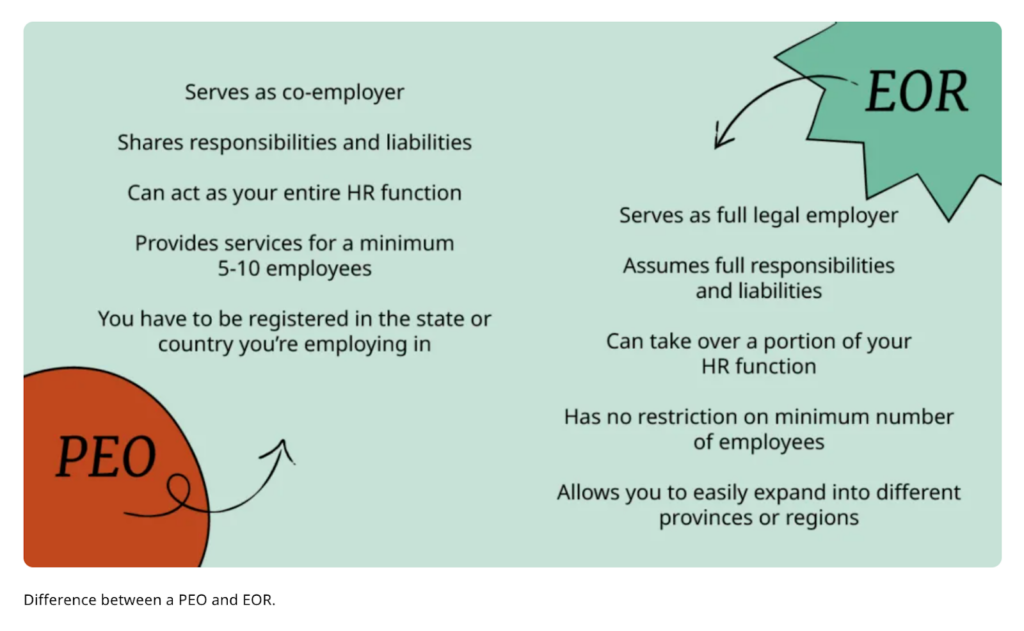
Professional employer organizations (PEOs) work on your behalf to cover common functions like payroll, tax filing, international benefits administration, and HR services. Technically, you’re only outsourcing specific functions to the PEO organization though, meaning the employees who benefit from these services are still considered your organization’s employees. In addition, you’re required to already have a legal entity set up within a foreign country in order to use PEO services within that country.
Many businesses have come to understand an employer of record (EOR) can be used to hire internationally when a business has no legal entity in the foreign country where their potential workers are located. Technically, when using an EOR provider, foreign workers are hired by the EOR and not your parent organization. Instead, the EOR becomes the full legal employer and manages all aspects of their employment while they perform work on behalf of your company.
For further guidance check out our article on the difference between a PEO and EOR.
PEO vs. HRO and ASO Services
Curious how PEO's compare to other HR services you've heard about, such as HRO (human resource outsourcing) and ASO (administrative services outsourcing) services? Allow me to explain:
As mentioned above, PEO employment services use a co-employment model, meaning they share legal responsibilities with your business.
HRO services, on the other hand, provide outsourced HR support but without the co-employment arrangement. This means your business retains full responsibility for legal compliance and employee-related liabilities. HROs typically focus on specific HR functions, such as recruitment, training, or payroll, but the scope can be more flexible, depending on your needs.
ASO services offer administrative support similar to HROs but without any legal liability sharing. They focus on handling routine tasks like payroll administration, but you won’t get the same access to employee benefits or compliance support that PEOs provide. ASO services are ideal for businesses that need help with administrative tasks but want to retain full control over their HR responsibilities.
Other HR Outsourcing Resources
To further assist you in your journey, here are some links to other global HR services you'll want to consider. If you have more questions, these links are a great place to start:
- Best Employer of Record Services
- Best Global Payroll Solutions for Distributed Teams
- Best Global HR Service Providers
- Best HR Outsourcing Services
PEOs are the Easiest Way to Achieve Global Expansion
Now that the war for top talent has gone global, PEO services are an important ally for businesses of all sizes, whether you're an SMB or an enterprise organization.
The best PEO services offer all the HR support you need to run your business. They let you focus on the things you’re good at while ensuring you stay compliant with international employment laws.
To choose the right PEO, think about the HR tasks you need to outsource and look for one that meets those needs.