
10 Best Applicant Tracking Systems (ATS) of 2026

10 Best Applicant Tracking Systems Shortlist
Here’s my shortlist of the 15 best applicant tracking systems out of the 35 ATS tools I reviewed:


The best applicant tracking systems help you attract top talent, streamline the hiring process, and stay organized and efficient from job posting to offer letter.
If you're overwhelmed by scattered resumes, disjointed communication, or slow hiring cycles, the right ATS can centralize your recruitment workflow and help your team move faster with fewer errors.
From automating candidate screening and interview scheduling, to tracking applicants across multiple roles and improving team collaboration, these systems take the guesswork and chaos out of hiring. And, if you're trying to scale your recruiting efforts without expanding your headcount, choosing the right platform becomes even more critical.
With 10+ years supporting HR teams and recruiters, I have firsthand experience evaluating dozens of ATS platforms. I created this guide to help you find a solution that fits your current hiring needs and grows with you.
You’ll find clear comparisons of key features, pricing, and differentiators—plus tips to help you narrow your shortlist with confidence.
You Can Trust Our Software Reviews
We've been testing and reviewing HR software since 2019. We've tested more than 2,000 tools for different HR use causes and written over 1,000 comprehensive software reviews.
As HR professionals ourselves, we know how critical and difficult it is to make the right decision when selecting software. We invest in deep research to help our audience make better software purchasing decisions.
Learn how we stay transparent, and take a look at our software review methodology.
Best Applicant Tracking Systems: Pricing Comparison Chart
This ATS comparison chart summarizes pricing details for my top applicant tracking systems to help you find the best software for your budget and business needs.
| Tool | Best For | Trial Info | Price | ||
|---|---|---|---|---|---|
| 1 | Best with built-in immigration support | Free demo available | From $5/employee/month | Website | |
| 2 | Best for sourcing many qualified candidates | Free demo available | Pricing upon request | Website | |
| 3 | Best for pre-built pipeline templates | Free demo available | Pricing upon request | Website | |
| 4 | Best for in-house talent acquisition teams | Free demo available | Pricing upon request | Website | |
| 5 | Best for automated offers and analytics | Free 7-day trial | From $10/user/month | Website | |
| 6 | Best for ease of use | 15-day free trial + free demo | Starting at $299/month | Website | |
| 7 | Best for BPO hiring | Free demo available | Pricing upon request | Website | |
| 8 | Best for streamlined hiring automation | Free demo available | Pricing upon request | Website | |
| 9 | Best for combined ATS and CRM | Free demo available | Pricing starts at $95/user/month | Website | |
| 10 | Best for integrating hiring with team management | 14-day free trial + free plan + free demo available | From $30/location/month (billed annually) | Website |


-

Checkr
Visit WebsiteThis is an aggregated rating for this tool including ratings from Crozdesk users and ratings from other sites.4.5 -
Kudoboard
Visit WebsiteThis is an aggregated rating for this tool including ratings from Crozdesk users and ratings from other sites.4.8 -
Native Teams
Visit WebsiteThis is an aggregated rating for this tool including ratings from Crozdesk users and ratings from other sites.4.9


Best Applicant Tracking System Reviews
Below are my detailed reviews of each applicant tracking system that made it into my top 15 list, including notes on why I picked them. Each review offers a detailed look at the key features, pros & cons, integrations, and ideal use cases for each ATS system to help you find the best option for you.

Deel HR supports global businesses and talent teams that need an applicant tracking system capable of handling international hiring, onboarding, and compliance challenges in a single platform.
Who Is Deel HR Best For?
Deel HR is a strong fit for mid-size to enterprise companies hiring across multiple countries who need to manage global recruitment and compliance in one place.
Why I Picked Deel HR
I picked Deel HR as one of the best because it's the only ATS I've come across that has immigration support built directly into the hiring flow. When my team is evaluating a candidate who needs a work visa, I can trigger a free visa eligibility assessment right from within the platform and get results within 48 hours, including a cost breakdown and required documents. From there, Deel's immigration experts handle the visa sponsorship and application process across 70+ countries, so I'm not coordinating between an external law firm and my HR tools. I also like that one-click visa renewals and automated compliance alerts keep things from falling through the cracks once a hire is in place.
Deel HR Key Features
- AI-powered candidate sourcing: Deel HR's ATS uses AI to automatically source candidates and surface relevant applicants for open roles.
- Background checks and identity verification: Run background checks and confirm candidate identity through Remote Worker Verification directly within the hiring flow.
- Localized contract generation: Automatically generate employment contracts that meet local labor laws for the country you're hiring in.
- Workforce planning with live hiring data: Forecast headcount, roles, and costs using real-time workforce and hiring data instead of static spreadsheets.
Deel HR Integrations
Integrations include FaceUp, Snowflake, DefensX, Microsoft Finance, Kintsugi, ReFresh OS, Revo.ai, Keeper, Human Interest, and Everyminute.
Pros and Cons
Pros:
- Integrates onboarding with applicant tracking workflows
- Visualizes candidate pipelines for multiple regions
- Offers automated document collection and reminders
Cons:
- Reporting features are less granular than peers
- Lacks advanced candidate sourcing tools
New Product Updates from Deel HR

Deel HR Introduces AI-Powered ATS for Hiring
Deel HR introduces an AI-powered ATS built into its platform. This update enhances hiring efficiency by automating sourcing, screening, and workflows across the recruitment process. For more information, visit Deel HR’s official site.
 .
.
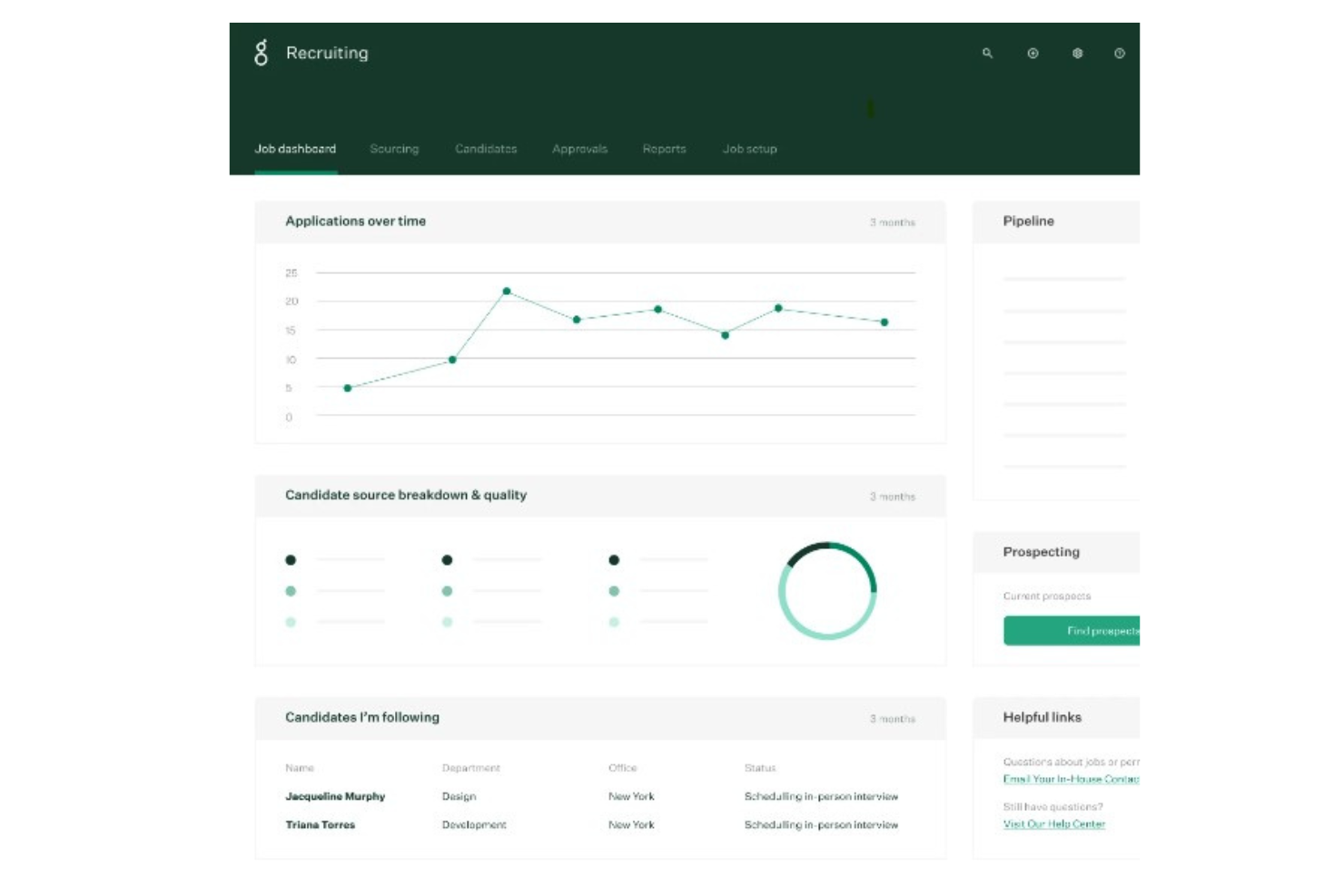
Greenhouse is an applicant tracking system built for recruiting teams at growing companies who need to manage high-volume hiring, streamline collaboration, and improve candidate quality throughout the hiring process.
Who Is Greenhouse Best For?
Greenhouse is a strong fit for mid-size to enterprise companies with dedicated recruiting teams managing structured, high-volume hiring across multiple roles or departments.
Why I Picked Greenhouse
I picked Greenhouse because it handles large sourcing volume without sacrificing candidate quality. The job listings feature lets my team post and promote open roles across 1,000+ job boards at once, including niche boards that are easy to miss when posting manually. I also like the bulk outreach campaigns, which let recruiters send automated, personalized messages to large prospect pools at scale, including text outreach powered by Grayscale. Built-in sourcing analytics track candidate quality by source, showing which channels produce hires.
Greenhouse Key Features
- Interview kits: Build structured prep kits and scorecards so interviewers assess candidates against the same defined criteria for every role.
- Candidate self-scheduling: Let candidates book their own interview slots directly, reducing back-and-forth between recruiters and hiring managers.
- Offer forecast: Uses machine learning to predict whether open roles are on track to meet target offer acceptance and start dates.
- Onboarding tools: Trigger onboarding tasks as soon as an offer is accepted, so new hires are set up before their first day.
Greenhouse Integrations
Integrations include Checkr, Criteria Corp, Findem, HireRight, BrightHire, Pave, Grayscale, AmazingHiring, Alva Labs, and Aboard.
Pros and Cons
Pros:
- Structured hiring tools help reduce interviewer bias
- Great for sourcing many candidates from diverse channels
- "Essential" (basic) plan offers good value for small businesses
Cons:
- Phone support isn’t always available for every tier
- BI tools only included in top-tier paid plan

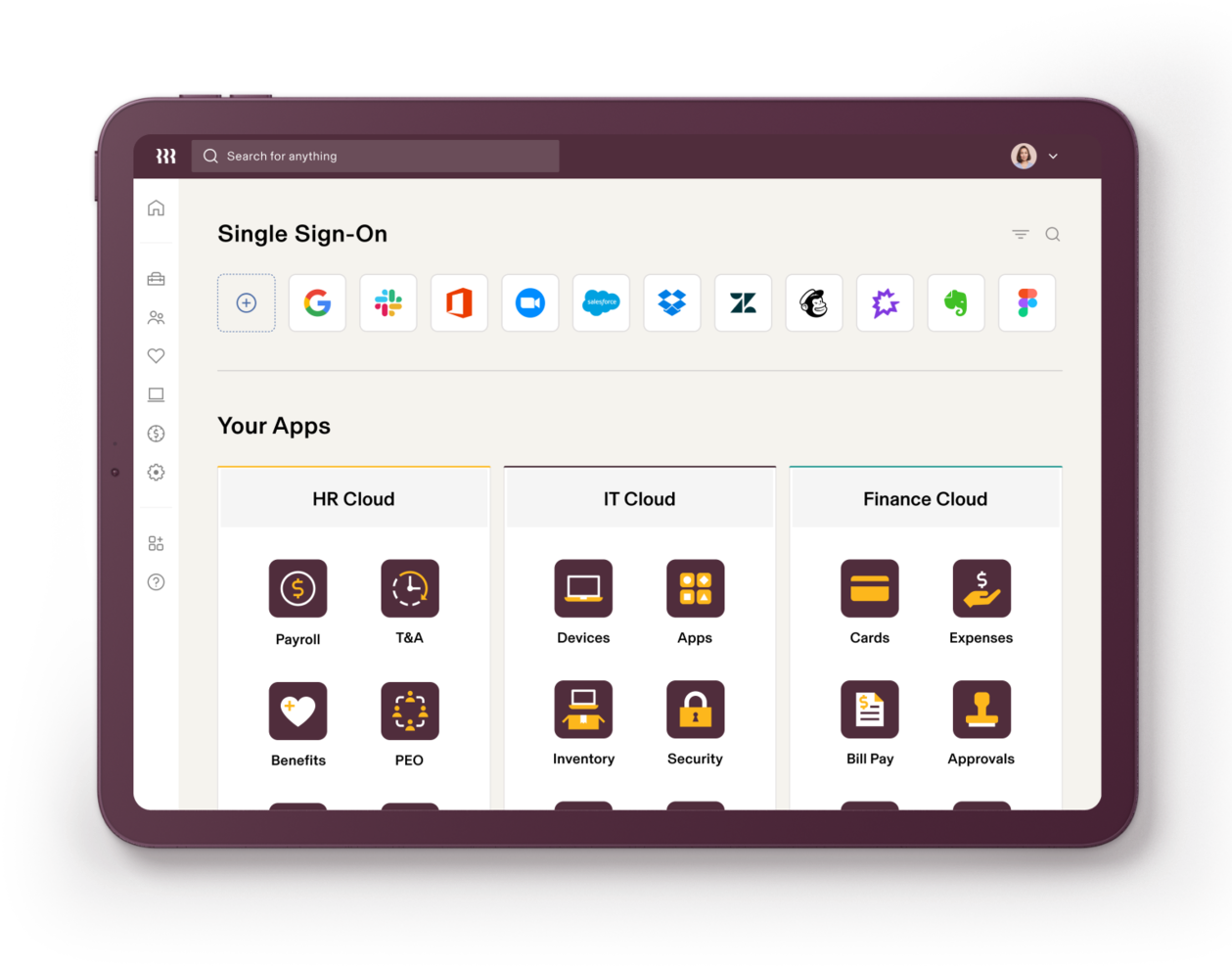
Rippling is an all-in-one HR platform that helps growing businesses and HR teams manage recruiting, automate hiring workflows, and connect applicant tracking with onboarding and employee management in one place.
Who Is Rippling Best For?
Rippling is a strong fit for mid-sized companies that want recruiting built into the same platform they use for HR, payroll, and IT management.
Why I Picked Rippling
I picked Rippling as one of the best because its pre-built pipeline templates let recruiting teams hit the ground running without building every stage from scratch. When you're opening multiple reqs at once, applying a ready-made pipeline—complete with stages, knockout questions, and automated actions—saves substantial setup time. I also like that Rippling's recruiting module connects directly to headcount planning, so when a role gets approved, the req opens instantly and recruiters can start moving candidates through the pipeline right away. It also lets my team move, email, or reject multiple candidates in bulk instead of handling each individually.
Rippling Key Features
- Job posting distribution: Publish open roles to multiple job boards simultaneously from within the Rippling platform.
- Interview scheduling: Sync interviewer calendars and send candidates self-scheduling links directly from the ATS.
- Candidate scorecards: Collect structured feedback from interviewers using standardized rating forms tied to each role.
- Automated offer letters: Generate and send offer letters with pre-filled role and compensation details once a candidate is approved.
Rippling Integrations
Integrations include Slack, Google, Zoom, Jira, Salesforce, HubSpot, Asana, Checkr, 1Password, and PayPal.
Pros and Cons
Pros:
- Unified platform / single source of truth
- One-click posting to 25,000+ job boards
- Pre-built pipeline templates save setup time
Cons:
- Lacking customization in certain areas
- Bit of a learning curve
New Product Updates from Rippling

Rippling Adds New Device Buyback Feature
Rippling has unveiled Device Buyback in its Inventory Management, allowing IT teams to retire and recycle hardware securely, with proceeds credited to future invoices. For more information, visit Rippling's official site.
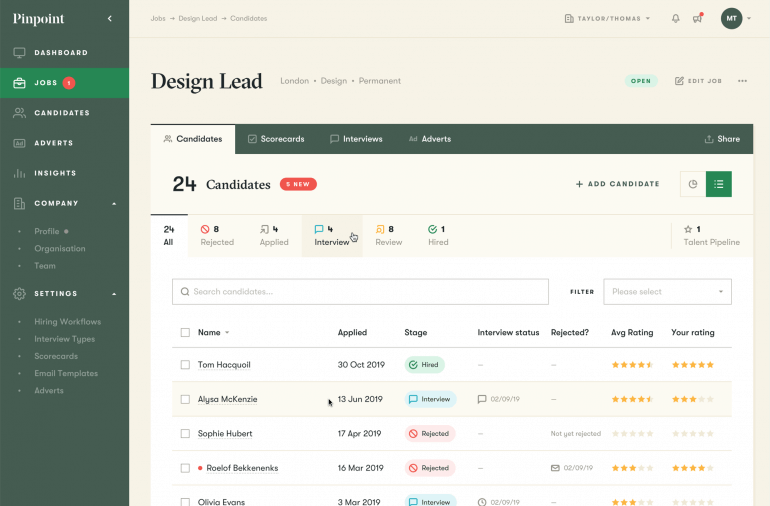
Pinpoint is an applicant tracking system built for internal recruitment teams who want to manage hiring, automate workflows, and improve candidate experience with customizable tools and collaborative features.
Who Is Pinpoint Best For?
Pinpoint is a strong fit for mid-sized companies with dedicated in-house recruiting teams who want more control over their hiring process.
Why I Picked Pinpoint
Pinpoint earns its spot on my shortlist because it's purpose-built for in-house talent acquisition teams managing multiple hiring processes at once. I particularly like the hiring workflow management feature, which lets my team run different processes side-by-side—think executive searches running alongside high-volume hourly hiring—without forcing everything into a single rigid pipeline. The AI candidate match score and blind recruitment tools also stand out to me, since they bring structured, bias-aware decision-making directly into the selection process rather than relying on separate tools.
Pinpoint Key Features
- Branded careers website: Build a custom, branded careers site that reflects your employer brand and converts visitors into applicants.
- Candidate experience surveys: Collect structured feedback from candidates at key stages and view results in a built-in report.
- Interview scheduling software: Schedule and manage interviews directly within the platform, without switching between tools.
- Employee onboarding: Manage new hire onboarding tasks and paperwork from within the same platform used for hiring.
Pinpoint Integrations
Integrations include BambooHR, ADP Workforce Now, UKG, BreatheHR, Oracle, Paycor, Sage People, LinkedIn, Microsoft Teams, and Slack.
Pros and Cons
Pros:
- Customizable workflows for any department or role type
- Unlimited users—ideal for large in-house recruiting teams
- Exceptional customer success and support
Cons:
- Reporting setup can take time to customize
- Some features only available in the Enterprise tier
New Product Updates from Pinpoint

Pinpoint Streamlines Reference Checks and Enhances Onboarding
Pinpoint now offers an integrated solution for reference checks and enhanced onboarding features to help your HR team work faster and hire smarter. For more information, visit Pinpoint's official site.


BambooHR is an HR platform with a built-in applicant tracking system for small and midsize businesses that want to simplify hiring, manage candidates in one place, and improve collaboration between recruiters and hiring managers.
Who Is BambooHR® Best For?
BambooHR is a strong fit for small to midsize businesses that need a people-first HR platform with hiring tools built in from the start.
Why I Picked BambooHR®
BambooHR is one of the best on my shortlist because it handles the offer stage of hiring well. I like that you can generate offer letters automatically using pre-built templates, then send them for e-signature without leaving the platform. My team also gets significant value from the hiring analytics, which track things like time-to-hire and source effectiveness so we can see exactly where candidates are dropping off in the pipeline.
BambooHR® Key Features
- Candidate sources report: Tracks where applicants are coming from across job boards and social channels so you can focus sourcing spend on the best-performing channels.
- Interview self-scheduling: Lets candidates pick from preset time slots you define, with automated confirmations sent to both the candidate and interviewer.
- Collaborative candidate review: Gives hiring team members custom permissions and in-system messaging to share feedback and coordinate decisions without leaving the platform.
- Automatic data transfer to employee records: Moves accepted candidate data directly into employee records at hire, removing the need for manual re-entry.
BambooHR® Integrations
Integrations include Checkr, Slack, Remote, Evolia, and an open API for custom integrations.
Pros and Cons
Pros:
- Clear analytics on candidate sources and hiring funnel
- Automated offer letters with built-in e-signature tools
- ATS is connected to onboarding tools for hired candidates
Cons:
- Some analytics features require higher pricing tier
- Reporting dashboards could use more export options
New Product Updates from BambooHR®

BambooHR Adds Cost Capping for Age-Banded Medical Plans
BambooHR introduces cost capping for age-banded medical plans. This update ensures employees are not charged for more than three dependent children under 21. For more information, visit BambooHR’s official site.
 .
.
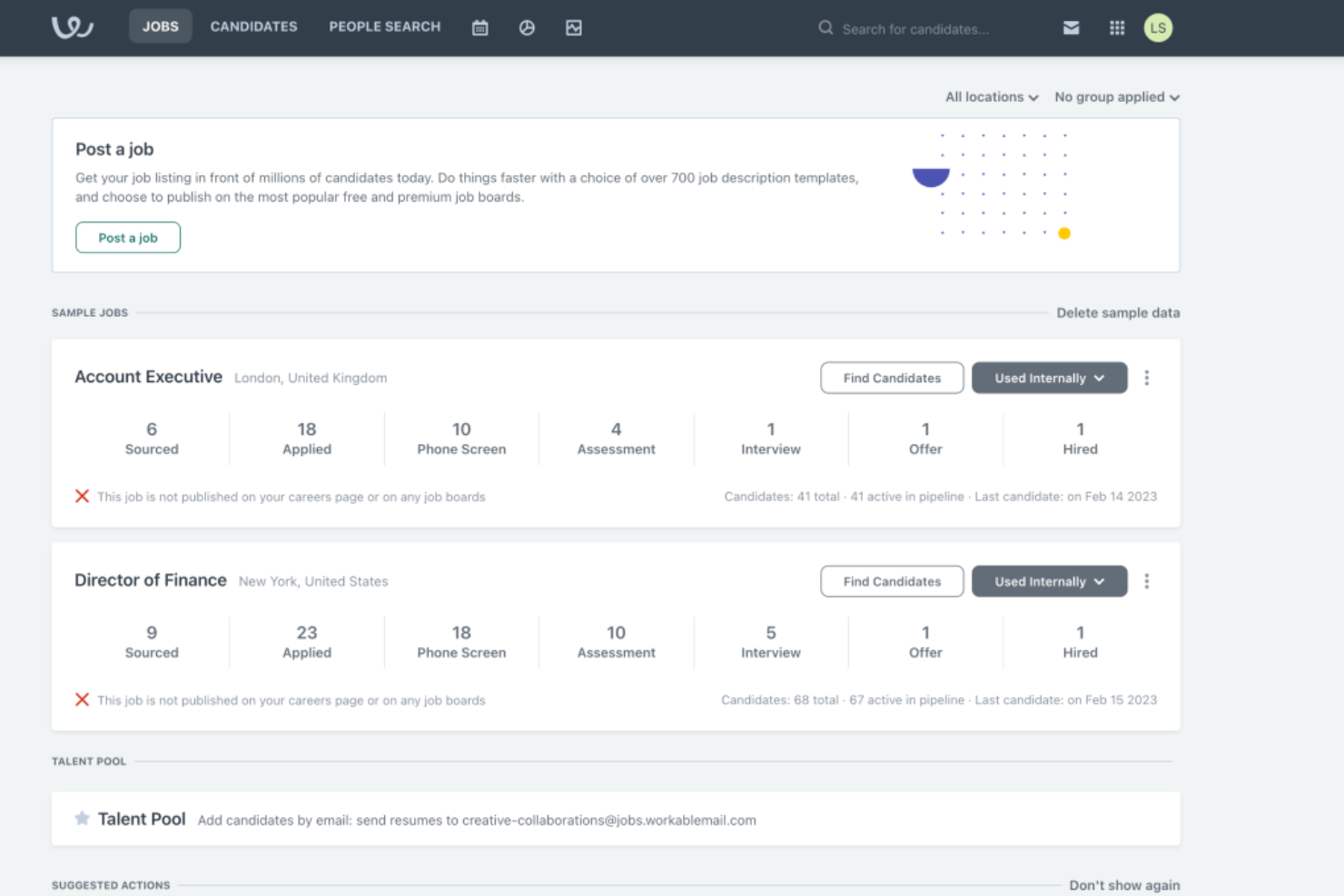
Workable is an applicant tracking system designed for HR teams and recruiters who want to simplify hiring, automate repetitive tasks, and manage candidate pipelines in one place.
Who Is Workable Best For?
Workable is a good fit for small to mid-sized businesses that need a straightforward ATS their hiring teams can be up and running within hours.
Why I Picked Workable
Workable earns its spot on my shortlist because it's genuinely one of the fastest ATS platforms to set up and start using. I've seen teams go from sign-up to posting live jobs in a matter of hours, not days. The no-code careers page builder is a good example of this—you can create a branded, mobile-friendly careers page without touching a line of code. I also like the candidate self-scheduling feature, which lets candidates book their own interview slots with automatic calendar syncing and time zone detection, cutting out the back-and-forth that slows down so many hiring processes.
Workable Key Features
- AI-powered candidate screening: Get AI-generated match scores and requirement checklists that summarize how well each applicant fits the role.
- One-way video interviews: Screen candidates at scale by sending video interview requests they complete on their own time, replacing early-stage phone screens.
- Anonymized screening: Hide candidate identifying details during resume review to support fair, bias-reduced evaluation.
- Custom hiring pipelines: Build role-specific hiring workflows with tailored stages to match how different teams recruit.
Workable Integrations
Integrations include LinkedIn, Indeed, ADP Workforce Now, Xero, Slack, Google Workspace, Microsoft 365, Zoom, DocuSign, and AssessFirst.
Pros and Cons
Pros:
- Offer-letter templates + e-signatures means fewer manual docs
- Candidates can schedule interviews themselves
- Built-in AI screening cuts time spent reviewing unqualified resumes
Cons:
- Some users report limited customisation on deep search filters
- Premium features (e.g., texting, advanced assessments) cost extra
New Product Updates from Workable
Workable Syncs Past Work Schedules to Ergani
Workable introduces past work schedule synchronization with Ergani. This update automates data syncing using actual clock-in and clock-out records to improve compliance and accuracy. For more information, visit Workable’s official site.


Journeyfront is an applicant tracking system designed for organizations that need data-driven hiring, offering predictive analytics and customizable workflows to help recruiters and HR teams identify top candidates and reduce turnover.
Who Is Journeyfront Best For?
Journeyfront is a strong fit for high-volume hiring teams, particularly in BPO environments where predicting candidate quality and reducing early attrition are top priorities.
Why I Picked Journeyfront
I picked Journeyfront as one of the best because of how deliberately it's built around the realities of BPO hiring. The class-based hiring feature is a standout for this use case—it lets you manage cohort pipelines from a single evergreen requisition, so when a new class opens, you're not rebuilding your process from scratch to hit a client launch date. I also like the language testing feature, which lets you assess candidates' language proficiency consistently across multiple geographies to meet client-specific requirements. Realistic job previews let candidates see exactly what the role involves before accepting an offer, which directly reduces early attrition—one of the biggest cost drivers in BPO operations.
Journeyfront Key Features
- Automated candidate ranking: Every candidate is scored and ranked as soon as they complete their application, so top applicants appear first.
- Structured interview guides: Give every interviewer the same questions, scoring rubrics, and instructions to reduce bias and keep hiring decisions consistent across your team.
- Source attribution tracking: Journeyfront tracks every application back to its origin channel, so you can see which job boards are delivering quality candidates and which aren't worth the budget.
- Role-specific onboarding packets: Build different form sets for different roles or client programs so each new hire receives only the paperwork relevant to their position.
Journeyfront Integrations
Integrations include Greenhouse, BambooHR, Workday, ADP, JazzHR, Jobvite, LinkedIn, Okta, and Indeed.
Pros and Cons
Pros:
- Effective onboarding processes
- Insightful analytics
- Customizable hiring processes
Cons:
- Limited feature set
- Feedback loop limitations

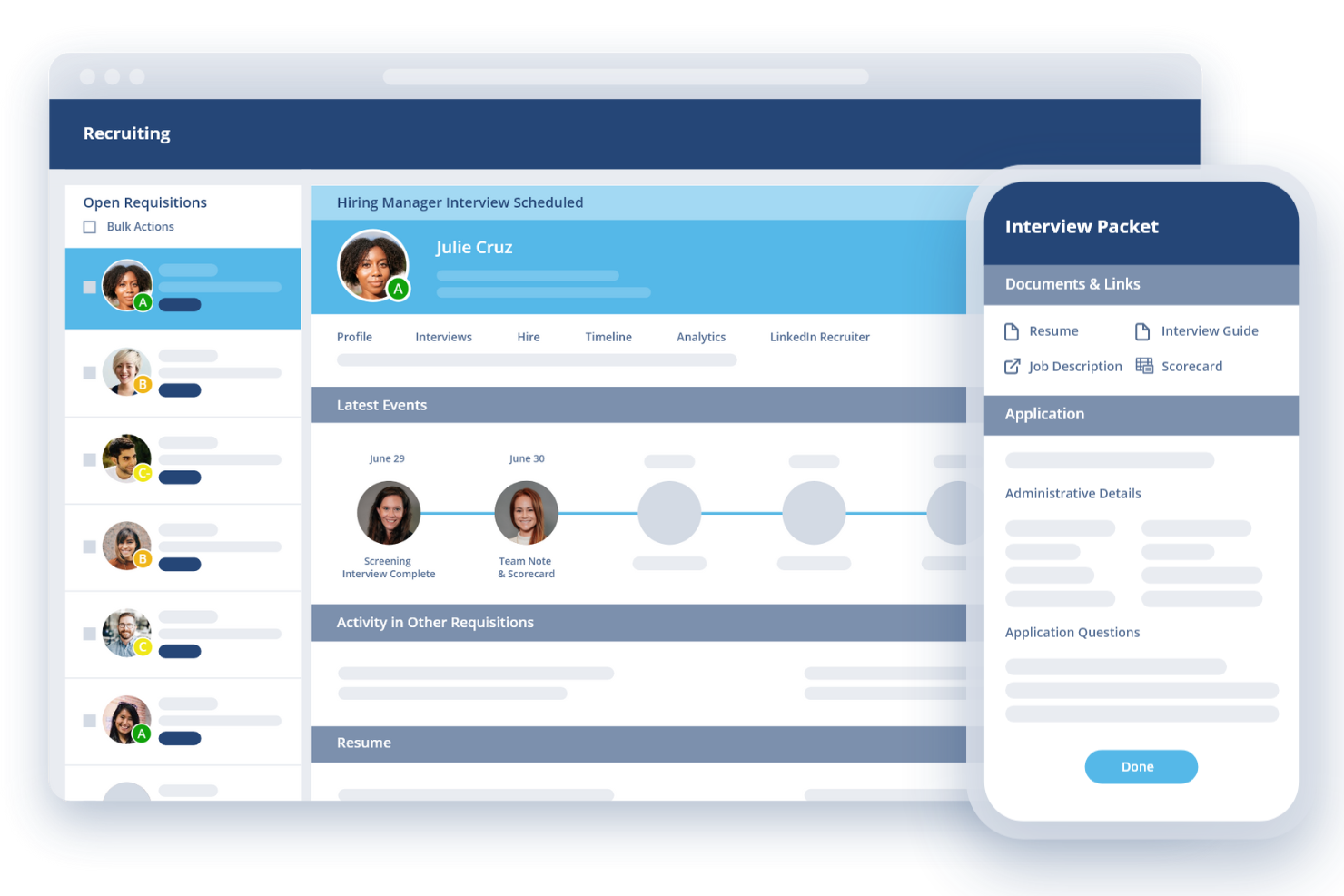
ClearCompany is an applicant tracking system built for HR teams and recruiters who want to centralize candidate sourcing, automate hiring workflows, and improve collaboration throughout the recruitment process.
Who Is ClearCompany Best For?
ClearCompany is a good fit for mid-sized to enterprise HR teams that need a structured, scalable recruiting process across multiple roles and departments.
Why I Picked ClearCompany
I picked ClearCompany as one of the best because of how well it automates the handoffs that typically slow hiring down. The hiring workflows feature tracks candidates across stages, assigns clear owners to each step, and automates approvals so nothing stalls between a recruiter and a hiring manager. I also like the built-in offer creation and e-signature tools, which cut out the back-and-forth that usually drags out the final stage of a hire. AI-assisted interviews capture key moments from conversations automatically, allowing my team to stay focused during interviews and compare candidates more consistently afterward.
ClearCompany Key Features
- Structured evaluation: Use interview guides and scorecards with consistent criteria to assess candidates fairly across every role.
- Liveboards: View real-time recruiting metrics across roles, teams, and pipeline stages as hiring activity happens.
- Two-way text messaging: Send and receive candidate messages through secure, trackable texts directly within the platform.
- Virtual recruiter: A career site chatbot gives candidates instant answers and next steps without recruiter involvement.
ClearCompany Integrations
Native integrations are not currently listed.
Pros and Cons
Pros:
- Provides real-time dashboards you can query using natural language
- Reaches candidates by mobile texting and QR-enabled applications
- Automates candidate sourcing from a large global pool
Cons:
- Some users report slower support responses and account setup complexity
- Advanced report customisation is somewhat limited

Tracker is a recruitment platform designed for staffing agencies and talent acquisition teams who want to manage candidates, clients, and job orders in one place, helping simplify hiring workflows and improve collaboration across the recruitment process.
Who Is Tracker Best For?
Tracker is a strong fit for staffing agencies and recruiting firms that need to manage both candidate pipelines and client relationships without switching between separate tools.
Why I Picked Tracker
I've included Tracker in my top picks because it's one of the few ATS platforms that builds CRM functionality directly into the same system rather than bolting it on as an afterthought. In practice, that means my team can move a qualified lead through the sales pipeline and convert it into an active job order with a single click, without ever leaving the platform. I also like the MANDACT lead qualification methodology built into the CRM, which gives recruiters a structured way to evaluate client opportunities using criteria like budget, authority, and timing. The activity management tools let my team log calls, emails, and meetings in one place, so there's a complete relationship history for every client alongside the candidate pipeline.
Tracker Key Features
- Resume parsing: Automatically extracts candidate details, employment history, skills, and qualifications from any document format to build complete candidate profiles.
- Job board posting and searching: Post to 1,000+ job boards and search multiple boards simultaneously, with de-duplicated, ranked results pulled into a single list.
- Candidate auto-matching: Automatically matches newly added candidates to open jobs based on configurable criteria, so relevant candidates surface without manual searching.
- Onboarding and compliance tools: Build custom onboarding workflows with online forms, eSignature collection, and GDPR/CCPA compliance tools directly within the platform.
Tracker Integrations
Integrations include Broadbean, LogicMelon, Indeed, Monster, Facebook, LinkedIn, Twitter, Office365, Gmail, and Textkernel.
Pros and Cons
Pros:
- Candidate database search handles “millions” of records
- Suitable for both recruiting and sales/client workflows
- Flexible workflows and customization for staffing agencies
Cons:
- No built-in payroll, but integration with QuickBooks and others
- No background check integration

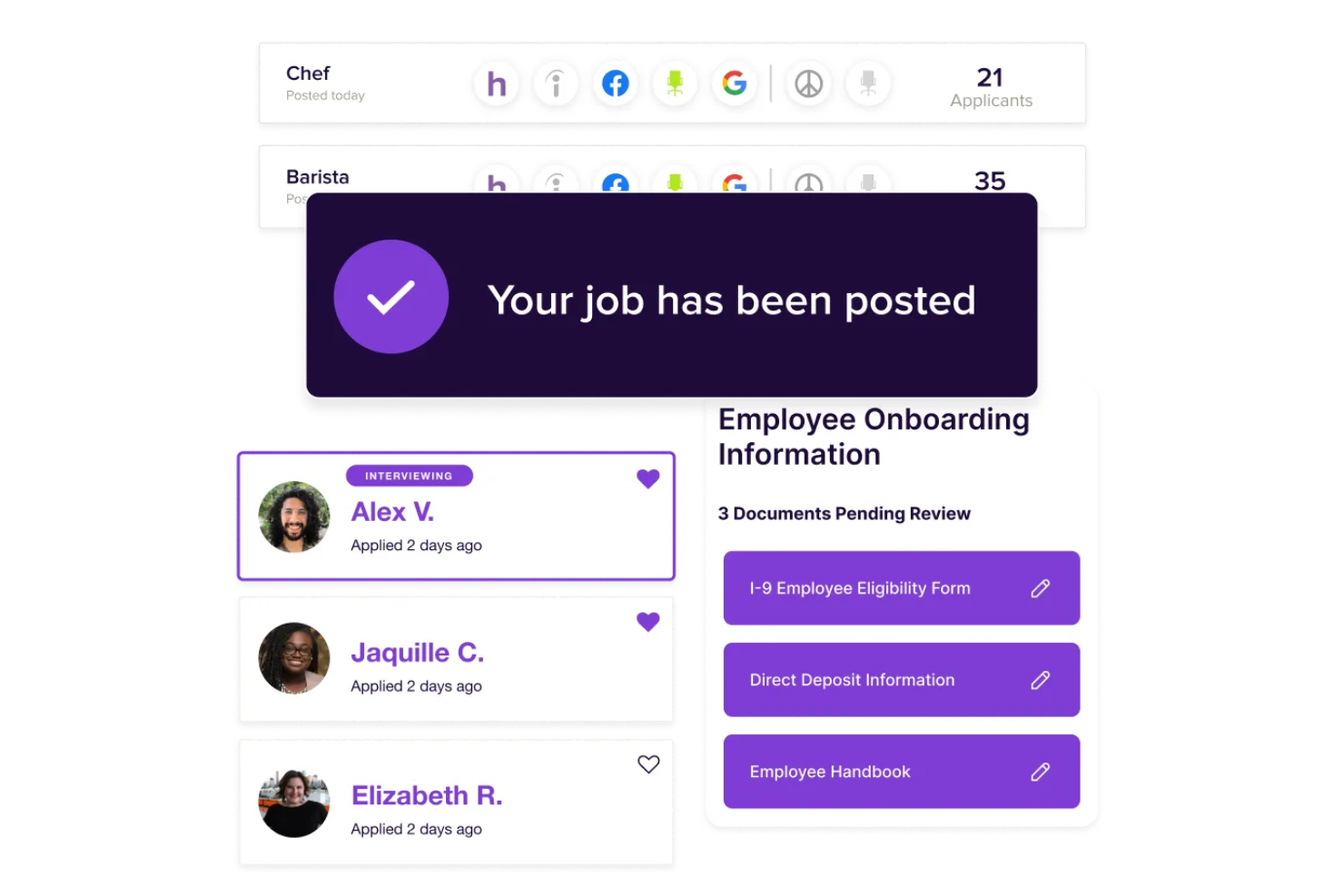
Homebase helps small businesses simplify hiring, track applicants, and manage onboarding while connecting these processes directly to team scheduling and daily operations.
Who Is Homebase Best For?
Homebase is a strong fit for small businesses in hourly-driven industries like retail, hospitality, and food service that need to hire and manage teams from one place.
Why I Picked Homebase
I picked Homebase as one of the best because of how naturally hiring flows into the rest of your team management. Once you find a candidate you want to hire, you can add them to your schedule and timesheets in a single click—there's no re-entering data or switching between tools. I also like the candidate sorting feature, which automatically ranks applicants across 20+ traits so you're not manually sifting through every application. On top of that, the self-onboarding tool lets new hires complete their W-4, I-9, and direct deposit forms before their first day, so they're ready to clock in from the start.
Homebase Key Features
- Multi-board job posting: Post open roles to Indeed, ZipRecruiter, Google, Trovit, and Glassdoor simultaneously from a single job description.
- Interview scheduling and reminders: Schedule interviews directly within Homebase and send automatic reminders to candidates to cut down on no-shows.
- Background checks: Run background checks on new hires from within the app, with status tracking and reports all in one place.
- In-app applicant messaging: Message candidates directly through Homebase without switching to email or a separate communication tool.
Homebase Integrations
Integrations include Square, Clover, Toast, Shopify, Lightspeed, QuickBooks, Gusto, ADP, Paychex, and Revel.
Pros and Cons
Pros:
- Hiring tied to scheduling
- Simple applicant tracking workflows
- Multi-board job posting support
Cons:
- Limited resume management tools
- Lacks advanced ATS analytics
New Product Updates from Homebase

Homebase Adds AI Scheduling Assistant for Faster Shift Planning
Homebase introduces Scheduling Assistant, AI-optimized shift creation, and automated conflict resolution. These updates reduce manual scheduling work while keeping teams aligned and shifts fully staffed. For more information, visit Homebase's official site.
 .
.Other Applicant Tracking Systems
Here are a few more recruitment ATS tools that didn’t make the top 15 applicant tracking systems list:
- AvaHR
For small businesses
- Zoho Recruit
For staffing agencies
- Folks HR
For automated job postings & sourcing
- Manatal
For AI recruitment and candidate sourcing
- Recruit CRM
For recruiting firms and enterprises
- Boon
For community-driven recruiting
- Gem
For unified recruitment pipeline views
- Freshteam
For growing businesses
- Recooty
For resume parsing
- Eddy
For those with little technical expertise
- Recruitee
For automated candidate reminders
- JazzHR
For customizable recruiting solutions
- PCRecruiter
For detailed recruitment analytics
- JobAdder
For built-in job posting
- Bullhorn
For integrations
- Mitratech TalentReef
For recruiting, hiring, and onboarding
- SAP SuccessFactors
For data analytics and reporting
- Avionté
For attracting quality candidates
- Unnanu Hire
For its free plan
- GoHire
For industry-specific customizations to help businesses scale
- Oracle Taleo
For large enterprises
- Transformify
For mission-driven organizations
- VidCruiter
For high-volume recruiting
- monday.com
For creating customized workflows
- Teamtailor
For advanced candidate search
- Mitratech Perform
For collaborative hiring tools
- Recruiterflow
For executive search firms
- Paycor
With an all-in-one HCM platform
- Mitratech Circa
For hiring diverse talent
- Breezy HR
ATS for diversity & inclusion recruitment


Related HR Software Reviews
If you still haven't found what you're looking for here, check out these other tools that are related to payroll software, that we've tested and evaluated.
- HR Software
- Payroll Software
- Employer of Record Services
- Workforce Management Software
- Learning Management Systems
Selection Criteria for Applicant Tracking Systems
My approach to choosing the best applicant tracking software is based on my personal experience managing hiring processes and extensive research into how these software systems address the needs, pain points, and goals of recruiters and hiring teams in real, day-to-day scenarios.
Core ATS Functionalities (25% of total score): For an applicant tracking system to land a place in my initial list, it needed to fulfill the following basic functionalities:
- Job posting tools to help you advertise positions across multiple platforms
- A customizable dashboard where you can track job applications for each open position
- Tools to streamline communication with candidates through automated emails and notifications
- Candidate screening tools, including side-by-side comparisons, skill-based comparisons, and resume screening to speed up candidate selection
- Interview scheduling tools to automate the booking process
- Collaboration tools to make it easier for internal teams to discuss hiring decisions as a group
Additional Standout Features (25% of total score): To help me hone in on the best applicant tracking software on the market, I also took note of any unique features, including:
- AI-driven analytics tools that offer deeper insights into the recruitment process
- Innovative candidate engagement tools like video interviewing or AI-driven chatbots for pre-screening
- Enhanced mobile applications or dedicated ATS apps that provide a full range of ATS functionalities for recruiters communicating with candidates on the go
Ease of Use (10% of total score): To evaluate the usability of each applicant tracking system, I considered the following:
- An intuitive user interface that minimizes the learning curve
- Clear and logical menu structures that lend quick access to essential features
- Visual recruiting pipelines, color-coding, or visual status flags that make it easy to digest information at a glance
- Drag-and-drop functionalities for ease of scheduling interviews and organizing candidate profiles
- Role-based access controls that are straightforward to configure
Customer Onboarding and Customer Support (10% of total score): To get a sense of each software provider's customer onboarding process and the level of customer support each vendor offered, I considered the following factors:
- Quick setup processes with clear guidelines for new users
- Comprehensive ATS training materials such as videos, templates, and interactive product tours
- Data migration support for transferring existing candidate information into the new system
- Availability of customer support during the onboarding phase to address any issues
- The availability of multiple support channels, including email, phone, and chat
- The existence of a self-service knowledge base or other self-help resources to speed up troubleshooting
- The overall quality, responsiveness, and helpfulness of the support team during customer onboarding and post-purchase, as inferred from customer reviews
- Regular updates regarding new features of system-wide changes
Value for Price (10% of total score): To gauge the value of each software, I considered the following factors:
- The availability of free trials or demos to test the software before purchasing
- Transparent pricing models that clearly explain which features are included at each level, without hidden fees
- Tiered pricing plans that cater to different business sizes, from small to medium-sized businesses (SMBs) up to enterprise-level organizations
- Comparable pricing to other applicant tracking system examples
Integration capability (10% of total score): Evaluating the integration capabilities of applicant tracking systems (ATS) is crucial for understanding their usability and functionality. Here are the factors I considered:
- Advanced integration capabilities with social media for a broader reach in sourcing candidates
- Seamless integration with internal HR tools such as HR Information Systems (HRIS), payroll systems, and onboarding platforms that are essential for efficient HR operations
- The system's ability to connect with external resources like recruiting platforms and job boards to enhance the recruiting reach and efficiency
- Assessing integration with advanced tools such as assessment platforms and video interviewing capabilities, which are critical for a comprehensive evaluation of applicants
- Whether the ATS system offers direct, first-party integrations or relies on third-party APIs, with a preference for systems that provide more reliable, easy, and smooth direct integration options
- A high score is given to systems that offer a wide range of robust integration options that improve overall system usability and performance
Customer Reviews (10% of total score): Evaluating customer reviews is the final element of my selection process, which helps me understand how well a product performs in the hands of real users. Here are the factors I considered:
- Whether a product has consistently high ratings across multiple review platforms, indicating a broad level of user satisfaction
- Specific praises, criticisms, or trends in customer feedback that indicate the software's strengths or areas for improvement
- Whether customer feedback specifically mentions issues with ease of use, customer support responsiveness, or lacking features
- Testimonials that highlight specific features that users found beneficial for their recruitment needs
By using this assessment framework, I was able to identify applicant tracking systems that go beyond basic requirements to offer additional value through unique features, intuitive usability, smooth onboarding, effective support, and overall value for price.
Use your ATS and sourcing tools strategically. Leverage AI to help with baseline screening, but always make room for the human touch to evaluate culture fit and adaptability.
How to Choose an Applicant Tracking System
Applicant tracking systems can help you find better candidates faster, move them through your process more efficiently, and create a better hiring experience for everyone involved.
But as you can see, there are lot of vendors to choose from. To help you figure out which applicant tracking system software is the best fit for your needs, keep the following points in mind:
| Factor | What to Consider |
|---|---|
| Hiring Challenges | - Identify current recruiting pain points - If interview scheduling is a bottleneck, prioritize ATSs with calendar integrations and scheduling tools |
| User Access & Roles | - How many users will access the system? - Is pricing based on per-user, per-job, or flat rate? - Look for role- and/or location-based permissions for recruiters, hiring managers, and collaborators - Ensure proper access controls and data security compliance |
| Integration Needs | - Does it integrate with your HRIS, onboarding tools, or background check platforms? - Can it replace multiple tools with one consolidated system? |
| Scalability | - Will the ATS support long-term hiring growth? - Does it offer flexible pricing plans? - If hiring globally, does it support multi-country compliance, language localization, and international job postings? |
| Workflow Compatibility | - Does the ATS align with your current recruiting workflows and delivery models? - Consider what’s working, what isn’t, and tailor your selection accordingly - Don’t rely solely on popularity—focus on what matches your specific needs and processes |
Trends in Applicant Tracking Systems for 2025
The race for top talent is fast-paced, and recruitment software is evolving just as quickly. Here are several key trends shaping applicant tracking systems to meet the needs of modern recruiters.
Most Important Evolving Features
AI-driven screening and skill matching
Managing large volumes of applications efficiently is a major challenge for many recruiters.
AI integration into ATS software is streamlining this process by using machine learning to quickly scan resumes and identify candidates with the best skill matches for your job requirements.
This significantly speeds up screening and adopts a skills-first approach, reducing potential hiring biases. AI also helps automate tasks like writing job descriptions and creating email templates, cutting down time-to-hire.
If this resonates with you, check out our best AI recruiting software for some cherry-picked options.
Hiring Bias Reduction Tools
As diversity, equity, and inclusion (DEI) continue to grow in importance, many ATS tools are adding features to reduce unconscious bias.
These tools can anonymize applications by removing personal details like names, gender, age, and ethnicity, allowing recruiters to focus solely on skills and qualifications, fostering a more equitable hiring process.
Mobile accessibility and optimization
With mobile usage continuing to rise, ATS systems are increasingly optimized for mobile recruiting.
According to Appcast's 2022 Recruitment Marketing Benchmark Report, 67% of job applications are now completed on mobile devices. Key mobile-friendly features include:
- Mobile-friendly job applications
- Career pages with SMS alerts or notifications for new postings
- Applications via text
- Texting candidates directly from your ATS
- Dedicated mobile ATS apps to speed up recruiting from anywhere.
Unique and Unusual Functionality
- Virtual Reality (VR) and Augmented Reality (AR) Integrations: Some ATS companies are experimenting with VR and AR for immersive job previews and interviews, offering a novel way to engage candidates and provide a realistic job preview.
- Blockchain for Candidate Verification: The use of blockchain technology for verifying candidate credentials and work history is emerging as a novel application, ensuring authenticity and transparency in the recruitment process.
What Is An Applicant Tracking System?
Applicant tracking systems are a type of HR software that helps you organize all aspects of your recruiting process, from sourcing candidates to comparing their skill sets to making them an offer.
The main aim is to help make your hiring process more efficient by reducing manual work and improving your time-to-hire.
Applicant tracking systems can also improve the quality of your hires and support better data-driven decision-making due to their advanced filtering and screening capabilities.
They're designed for both professional recruiters and in-house talent acquisition specialists.
Features of Applicant Tracking Systems
When selecting an applicant tracking system, keep an eye out for the following key features:
- Job posting management: This lets you create, schedule, and publish job openings across multiple job boards in just a few clicks. It cuts down your manual posting time and helps you reach a wider pool of candidates.
- Resume parsing: This feature automatically extracts information from resumes and organizes it into standardized profiles. You can quickly scan critical details—like skills, experience, or education—without having to dig through each document by hand.
- Candidate database: Store all applicant records in one organized, searchable hub. With this, you can easily revisit past candidates, build talent pipelines, and avoid losing track of promising applicants.
- Communication tools: Send emails, texts, or interview invites directly from the platform. These tools keep all communications streamlined and help you stay in sync with your team and applicants.
- Interview scheduling: Coordinate and book interviews without endless email chains. Candidates and interviewers can select slots based on real-time calendar availability, saving headaches and double-bookings.
- Collaboration and feedback: Team members can add notes, share ratings, and comment on candidates in one place. This encourages faster decision-making and helps you avoid miscommunication.
- Workflow automation: Standardize repetitive steps like sending acknowledgment emails or moving candidates through hiring stages. You get more time for the important stuff—like actually talking to people.
- Compliance and reporting: Keep your recruitment process above board with tools to ensure you’re meeting legal standards, like EEO tracking, and generate reports to identify possible bottlenecks or bias.
Common Applicant Tracking System AI Features
Beyond the standard applicant tracking system features listed above, many of these solutions are incorporating AI with features like:
- Automated candidate screening: AI helps narrow your applicant pool by analyzing resumes and ranking candidates based on job requirements, so you spend less time sorting and more time engaging.
- Intelligent matching: The system uses AI to match applicants with job descriptions by analyzing both skills and culture fit, surfacing candidates you might have missed.
- Predictive analytics: AI-powered insights forecast which candidates are most likely to succeed or accept an offer, letting you focus your efforts where they’ll have the most impact.
- Chatbots for candidate engagement: These AI bots answer candidate questions, schedule interviews, and provide status updates, ensuring applicants get quick responses any time of day.
- Bias reduction tools: AI can help flag biased language in job postings or provide anonymized candidate profiles, promoting a fairer hiring process.
Strong ATS tools should track metrics like offer acceptance rates, scorecard completion rates, and salary averages to provide actionable insights.
Benefits of Applicant Tracking Systems
"Once hiring gets over a certain threshold, an ATS will help you create a more efficient hiring process and provide a better candidate experience."—Mariya Hristova, People and Operations Lead.
Depending on the size of your hiring volume, you're likely dealing with a handful of positions that you’re scouting for simultaneously, all with distinct candidate skills and requirements.
On top of that, you have candidates submitting their applications around the clock, vying for your attention and time.
Without the right tools, juggling all that information can be overwhelming. Here are the key benefits of using an applicant tracking system:
- Improved recruitment efficiency: Since an ATS automates many time consuming activities, recruiters can focus more on value add activities like providing interview feedback.
- Enhanced candidate experience: By streamlining the application process and providing timely communication, an ATS helps create a positive experience for applicants and a favorable brand perception among potential new employees.
- Increased quality of hires: With advanced filtering and matching algorithms, an ATS can help identify the most suitable candidates based on the job requirements and organizational fit. This leads to a higher quality of hires, directly impacting your company's success.
- Improved scalability: An ATS allows organizations to easily scale their recruitment efforts up or down based on their current needs without compromising the quality of the hiring process. This adaptability is crucial for businesses experiencing rapid growth or seasonal fluctuations in hiring.
- Data-driven insights: By offering detailed analytics on various aspects of the recruitment process, an ATS enables organizations to make better data-driven decisions. Insights on performance metrics and hiring trends can help in refining recruitment strategies and improving future outcomes.
In short, by automating routine tasks, enhancing the candidate experience, and providing valuable insights, the best ATS platforms not only save time and resources but also empower more informed hiring decisions.
Costs & Pricing for Applicant Tracking Systems
ATS platforms typically offer a range of plans to suit different organizational sizes and hiring needs, from free versions designed for small businesses or startups to more comprehensive, feature-rich packages for large enterprises.
Understanding these options will help you select a plan that aligns with your recruitment goals, budget, and the scale of your hiring operations.
In general, applicant tracking systems tend to cost between $10 to $100 per user, per month, though some systems do operate on a flat fee model instead. Some systems do include a one-time set-up fee too.
However, most recruiting software providers are happy to offer you a free demo or free trial so you can get a first-hand feel for their ATS system before signing up.
Pricing & Plan Comparison Table for Applicant Tracking Systems
| Plan Type | Average Per User Fee | Average Flat Fee | Common Features |
|---|---|---|---|
| Free | $0 | $0 | Basic job posting, limited candidate tracking, email notifications, and simple reporting |
| Basic | $10 to $20 per user, per month | $50 - $100/month | Enhanced job posting on multiple platforms, resume parsing, basic CRM, email integration, and basic analytics |
| Professional | $50 to $100 per user, per month | $200 - $500/month | Advanced CRM features, bulk email sending, advanced analytics, integration with HR systems, and customizable workflows |
| Enterprise | Custom Pricing | Custom Pricing | Full suite of features including AI-driven analytics, dedicated support, enhanced security, and unlimited job postings |
Note that the free option typically offers a taste of the system's capabilities, making it ideal for very small businesses or those in the initial stages of scaling their operations.
As I mentioned above, when considering an ATS platform, it's important to assess not just the current size of your recruitment team but also anticipate future growth. This approach ensures that the selected plan not only meets your current needs but is also scalable to adapt to your organization's evolving requirements.
If your organization is larger and more complex, you may also need to write an ATS RFP and other documentation to confirm the features and costs required.
If your hiring needs are minimal, you may be able to start with a free or basic plan initially. However, there are many reasons why you may want to opt for a more advanced plan, including:
- Increased hiring volume: If your company experiences a surge in job openings, a more advanced plan can help you handle the higher volume of applicants through advanced features like AI resume screening.
- Advanced analytics: If you need deeper insights into your recruitment metrics, advanced plans provide robust analytics tools to track and optimize your hiring strategies.
- Employer branding: To help you stand out in a competitive job market, advanced plans often include recruitment marketing features that enhance your company's visibility and attractiveness to top talent.
- Integration capabilities: Basic plans often lack integration abilities, so you'll need to scale up to unlock this feature. Advanced plans generally offer seamless integration with other HR tools and systems, allowing for a unified workflow.
Ultimately, it's important to secure a plan that offers the features you require to satisfy your current needs and solve your challenges without exceeding your budget.
Frequently Asked Questions About Applicant Tracking Systems
Here are some answers to frequently asked questions you may have about applicant tracking software and how it works:
How do applicant tracking systems work?
Are there different types of ATS I should consider?
How do ATS platforms handle data privacy and security?
How customizable are ATS solutions for different industries?
What kind of customer support do ATS providers offer?
What's the difference between an ATS and a CRM?
How does resume scoring work in an ATS?
Do applicant tracking systems filter candidates?
Is it true that an ATS might automatically reject qualified candidates?
What integrations should I prioritize when choosing an ATS?
Can ATS systems help reduce bias in hiring?
Yes, many ATS solutions offer features to reduce bias, such as anonymized resume screening and standardized interview scorecards. While no system removes bias completely, configuring your ATS thoughtfully and including structured criteria help create a more equitable hiring process.
Are there tricks candidates can use to beat an ATS?
There are some strategies candidates can use to improve their chances of passing an ATS screening, often referred to as “beating the ATS.”
The most effective approach is tailoring their resume to match the job description by incorporating relevant keywords and phrases that reflect the required skills and qualifications.
Using a clean, standard resume format without complex designs, graphics, or columns also helps ensure the ATS can accurately parse the information.
While these tricks can optimize a resume for ATS screening, they work best when paired with genuine qualifications and experience.
Recruiters should be cautious of resumes that appear keyword-stuffed or overly generic, as they might signal candidates focusing more on passing the system than being a good fit for the role. A well-configured ATS can help identify resumes that balance both keyword relevance and substance.
Other Software Reviews
As you can see, there are a lot of options to consider when it comes to the best ATS systems to source candidates for your open positions.
And, the fact that 98.9% of Fortune 500 companies use an ATS is also a strong indication of just how important these software systems are.
However, your journey doesn't have to stop here. If you're looking for a different type of application tracking system or specialty recruiting software, please take a look at these other lists too:
- Cloud Recruitment Software for Hiring Teams
- Enterprise Recruitment Software for High Volume Hiring
- Recruitment Automating Software for Hiring
- Recruiting Database Software for Hiring Teams
- Recruitment Software for Small Businesses
- Recruiting Agency Software for Recruitment Firms
- Video Interviewing Software for Virtual Interviews
- Background Check Software
Stay in Touch
I hope this article got you one step closer to finding the best application tracking system for your business. Before you go, make sure to subscribe to our People Managing People newsletter too. You'll stay up-to-date on all our latest articles, podcasts, tool recommendations, and best practices related to talent acquisition and management.